
You are currently browsing the category archive for the ‘Photojournalism’ category.

"Karla Liliana" 2005. Women's Prison "Reclusorio Oriente", Mexico City. © Patricia Aridjis
Patricia Aridjis spent over seven years on The Black Hours Project. She documented incarcerated women in the Mexican penitentiaries of Santa Martha Acatitla, Tepepan, “Reclusorio Norte & Oriente” and Michoacan Prison in Mexico City.
It is not only the photographs that Aridjis uses to tell the women’s stories with familiarity and sensitivity. Aridjis also compiled a video archive and a correspondence archive; I urge you to listen, read and pause.
I contacted Patricia and she generously gave permission to publish works from The Black Hours. It gives me great pleasure to do so, as her motivation bear striking similarity to a core principle of Prison Photography; to present imagery that jolts viewers into reassessments about prisons and the lives and stories therein.
Aridjis has been described as one of the photojournalists most committed to social issues in Mexico. It has also been explained that this project was a point of revelation in her career; Aridjis [coming to] understand prisons as only reflections of outside society:
The female penitentiary is more than a place where society hide its errors and cleans its faults; inside there are hundreds of stories of abandonment, abuse and even love.
Exhibition Board, Nacho Lopez Hall, INAH National Photographic Library
Aridjis’ photographic philosophy is clear, “To Make Visible, the Invisible”. Mexico’s penal system exerts control over what can and can’t be seen mimicking the practices of parts of the American penal system.

© Patricia Aridjis

© Patricia Aridjis
Photographers Statement
To do this photo essay I thought about being for long hours inside some women’s prisons in Mexico City. I considered that that was the only way to capture the feelings that go around the cells and corridors of these places. Loneliness, lesbianism as a way of satisfying affective needs; self punishment and suicide attempts are like gaping wounds in the wrists that cry for help. Drugs to escape reality, maternity, solidarity. Life is limited by watching towers, guards, gates and schedules. The black hours. My commitment found its exact words when I took an inmate’s picture in her cell. She asked me to be photographed because that was to be her only way out of there.
Patricia Aridjis, Mexico 2004

© Patricia Aridjis

"Mario (Maria) and Eli" 2000. Tepepan Women's Prison, México City. © Patricia Aridjis
Where is Jail?
“What would you do if I mugged you?” Natalia asked mischievously.
“You wouldn’t.” I answered. When Juan Carlos the inmate’s five-year old son over heard us he screamed, “Don’t do it mom! Don’t! Or you’ll end up in jail!”
“Jail does not exist.” she said after a brief silence.
“Where is jail?” I asked the boy who was inside his mother’s cell. “Outside, where the policemen are” he answered, pointing out to the window.
Talking with Natalia & Juan Carlos
Womens Prison, Tepepan, Mexico City, 2002.

© Patricia Aridjis
Time
To enter you have to walk through a long tunnel which leads to an almost completely feminine world, a world with no living colors, but beige and navy blue of the uniforms.
“I have been here seven years, four months and two weeks.” Exact, endless counting. Time that passes slowly and suddenly has turned into years ‘the black hours’.
Visitors are special; they are a breath of fresh air, freedom that comes from the outside.

"Cereso", 2004. Mil Cumbres, Prison Michoacan, Mexico. © Patricia Aridjis
Children
Some children have been born inside and their eyes have not seen any other light than the one that passes though the bars, especially those that have no one to take care of them. If such is the case they remain under the custody of government institutions until the legal system says otherwise.
“Dulce, Why are you in for?”
“Drugs.”
“How many years did they give you?”
“Ten.”
“Where did they get you?”
“At the airport.”
“How much did you have on you?”
“Two kilos.”
“What is your cause?” [sic]
“My mom… Maria.”
These are the words that Dulce, a four year-old girl memorized. She was born during her mother’s conviction.

© Patricia Aridjis
Objects, People, Spaces
Objects acquire a different value once they pass through the gate. Either because they are not allowed, such as scissors, perfumes in glass bottles, mirrors, or because they are outrageously expensive, like soap, deodorant or toilet paper. A phone card is like gold; the telephone is one of the few ways to keep in touch with the outside world. Family visits are another, but it is common that their partners or even their closest relatives abandon the inmates.
Beds have to be earned. Each cell houses about 15 inmates and is no more than 9 square meters. There are people sleeping on the floor and under the beds. As they leave, the ones that have been there longer get the beds. Other way to obtain this privilege is to buy it from someone who has been there more time.

© Patricia Aridjis
Love in the Time of Jail
Silvia and Claudia met in prison, they fell in love. They have loved each other night and day … intimacy is a very public thing in prison. Silivia did her time, soon after the relationship began. She could not bear to be free without Claudia – the love of her life – and planned a simulated burglary. She asked a friend to press charges so that she could be in prison again, and together again with Claudia.

"Silvia and Claudia" 2004. Women's Prison, "Reclusorio Oriente", Mexico City. © Patricia Aridjis
Biography
In 2006, Aridjis obtained the sponsorship of Revelaa Spanish organization which supports social justice photography. In 2002, she received a Grant for the Encouragement of Cultural Projects from FONCA (National Fund for Culture and Arts). That same year she won 1st place in the Anthropological Photography Contest awarded by the National School of History and Anthropology. In 2001, she received 1st place in the 5th Biennale of photojournalism. In 1994, Aridjis obtained a Grant for Young Creators (FONCA). She has been part of over sixty group & solo exhibitions.
Aridjis has recently been praised for her project The Sickness Behind Every Flower, which examines the use and toxic side effects of pesticides in agriculture.
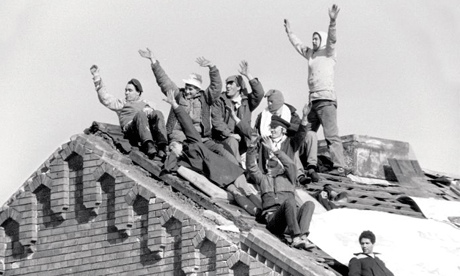
The Strangeways riots in 1990 led to breakthroughs in the prison system. Photograph: Don McPhee for the Guardian
On April 1st 1990, began Britain’s largest prison riot in history. Strangeways may not mean a lot outside of the UK, but within, Strangeways, Manchester is synonymous with the romanticised image of the Northern criminal. The photographs of prisoners on the roof are iconic. Britons watched with shock.

Photo: Ged Murray for the Observer
Prison conditions had rarely been in public debate. Our level of shock was only equivalent to our level of apathy, prior. The general public were in awe of the unprecedented institutional collapse.
Prisoners occupied the roof for 25 days in front of round-the-clock media coverage. The protest ended when the final five prisoners surrendered themselves peacefully on 25th April.
The estimated damage was pegged between £50 and 100 million. The true cost for the HM Prison Service was lord chief justice, Lord Woolf’s subsequent damning report, which cited inmate frustration and poor prison conditions as a main reasons for the riot.
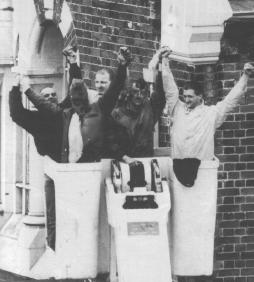
Photo: Ged Murray for the Observer
According to the Guardian – which includes a transcript of the prevailing exchange between proctor and prisoners – the stirrings of unrest began in the chapel following the 10am service. Prison officers evacuated the chapel and then (arguably) too hastily other areas of the prison. Inmates using keys taken from chapel guards released other inmates. Soon the overcrowded and understaffed facility was no longer in the control of government authority.
Strangeways roof protest photographs are iconic because their subject was so unexpected. Britain had harboured class and political confrontation much in the past. But in the miners strikes and clashes with police, football hooliganism, the general strike violence could be in some way predicted. The circumstances for those prior tensions had been played out through media narrative. UK Prisons were neglected; they were in desperate conditions and we – the public – were oblivious.
Don McPhee
Photographs of the Strangeways riot are hard to come by but I have gleaned a few from the web. In doing so I came across the work of the late Don McPhee.
I strongly urge you to watch this slideshow of his work.
McPhee had a 2005 exhibition at the Manchester Art Gallery and is a fondly remembered northern talent. He was a crucial part of the alternative editorial voice of the Guardian at that time. That distinctly Northern paper is now internationally distributed & respected.
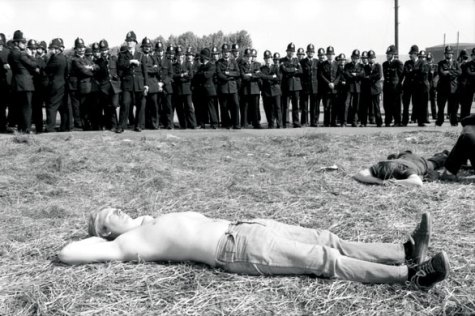
Miners sunbathing at Orgreave coking plant. Photograph: Don McPhee
_______________________________________________________
Here is the inevitable percolating legacy of Strangeways in public dialogue.
Here, Eric Allison makes a succinct argument for British prison reform.
And here is the UK Parliament debate in 2001, ten years after the January, 1991 publication of Woolf’s report reviewing the response to the report recommendations.
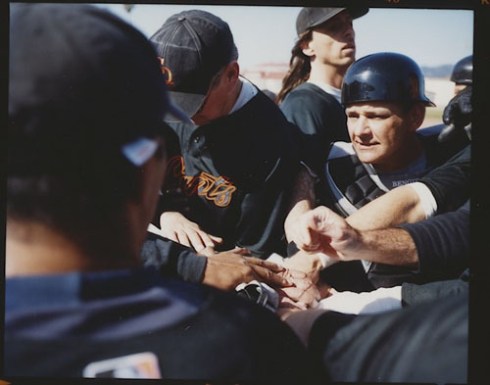
Last week, I threw up a quick post featuring Emiliano Granado’s website images of his photographs of the San Quentin Giants. Here, Granado shares previously unpublished contact sheet images, his experiences and lasting thoughts from working within one of America’s most notorious prisons.


What compelled you to travel across the US to photograph the story at San Quentin?
This was actually a magazine assignment for Mass Appeal Magazine. However, the TOTAL budget was $300, so it really turns out to be a personal project after the film, travel expenses, etc. So, the simple answer to the question is that I’m a photographer. I’m curious by nature. Part of the reason I’m a photographer is to study the world around me. I like to think of myself as a social scientist, except I don’t have any scientific method of measuring things, just a photograph as a document.
With that in mind, it would be crazy of me to NOT go to San Quentin! I’d never been in a correctional institution but I’ve always been fascinated by them. If you look through my Tivo, you’ll see shows like COPS, Locked Up, Gangland, etc. I was also a Psychology major in college and remember being blown away by Zimbardo’s prison experiment and other studies. Basically, it was an opportunity to see in real life a lot of what I’d seen on TV or read in books. And as a bonus, I was allowed to photograph.

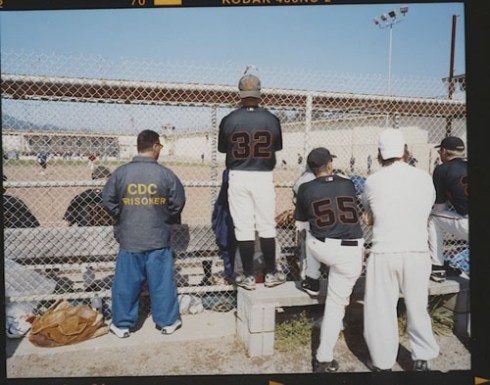
What procedures did you need to go through in order to gain access?
I was amazed at the lack of procedure. The writer for the story had been in touch with the San Quentin public relations people, but that was it. There was plenty of other media there that day. It was opening day of the season, so I guess it made for a minor local news story.
I’m pretty sure SQ prides itself in being so open and showcasing what a different approach to “reform” looks like.
It is my opinion that San Quentin is one of the best-equipped prisons in California to deal with a variety of visitors. Did you find this the case?
Definitely. Access was very easy. They barely searched my equipment! Parking was easy. I was really surprised at how easy and smooth the process was. Not to mention there were many other visitors that day (an entire baseball team, more media, local residents playing tennis with inmates, etc).
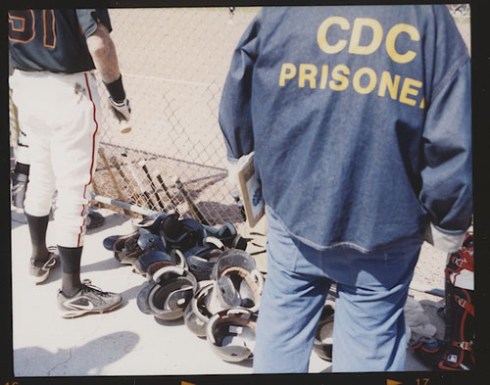

Did your preparation or process differ due to the unique location?
Definitely. I usually work with a photo assistant and that couldn’t be coordinated, so I was by myself. I packed as lightly as I could and prepared myself for a fast, chaotic shoot. Some shoots are slow and methodical, and others are pure chaos. I knew this would be the latter.
One thing I didn’t think about was my outfit. SQ inmates dress in denim, so visitors aren’t allowed to wear denim. Of course, I was wearing jeans. The officers gave me a pair of green pajama pants. I’m glad they are ready for that kind of situation.
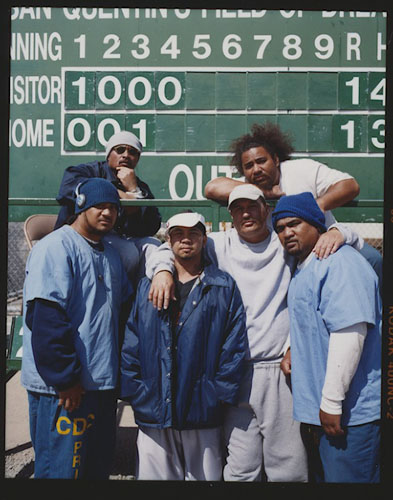
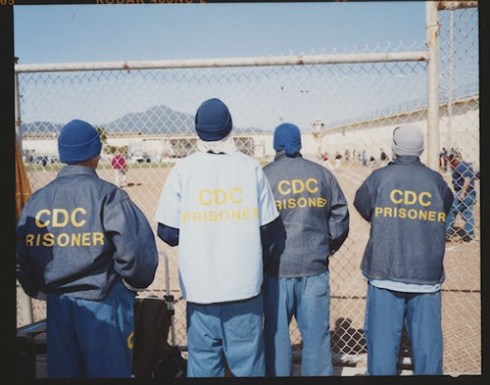
You are not a sports shooter per se. You took portraits of the players and spectators of inmate-spectators. How did you choose when to frame a shot and release the shutter?
Correct. I’m definitely not what most people would consider a sports photographer. I don’t own any of those huge, long lenses. However, I photograph lots of sporting events. I think of them as a microcosm of our society. There are lots of very interesting things happening at events like this. Fanaticism, idolatry, community, etc. Not to mention lots of alcohol and partying – see my Nascar images!
Hitting the shutter isn’t entirely a conscious decision. That decision is informed by years of looking at successful and unsuccessful images. It’s basically a gut instinct. There are times that I search for a particular image in my head, but mostly, it’s about having the camera ready and pointed in the right direction. When something interesting happens you snap.
There are photographers that come to a shoot with the shots in their head already. They produce the images – set people up, set up lighting, etc. Then there are photographers that are working with certain themes or ideas and they come to the location ready to find something that informs those ideas. I’m definitely the latter. There is a looseness and discovery process that I really enjoy when photographing like this. It’s like the scientist crunching numbers and coming to some new discovery.


A lot of photo editors say the story makes the story, not the images. Finding the story is key. Do you think there are many more stories within sites of incarceration waiting to be told?
I’m not sure I agree with that. I always say that a photograph can be made anywhere. Even if there is no story, per se. I definitely agree that a powerful image along with a powerful story is better, but a photograph can be devoid of a story, but be powerful anyway.
Every person, every place, everything has a story. So yes, there are millions of untold stories within sites of incarceration. Hopefully, I’ll be able to tell some of them.
Having had your experience at San Quentin, what other photo essays would you like to see produced that would confirm or extend your impressions of America’s prisons?
Man, there are millions of photos waiting to be made! I’m currently trying to gain access to a local NYC prison to continue my work and discover a bit more about what “Prison” means. Personally, I’d love to see long-term projects about inmates. Something like portraits as new inmates are processed, images while incarcerated, and then see what their life is like after prison. Their families, their victims, etc. And of course, if any photo editor wants to assign something like that, I’d love to shoot it!

Anything you’d like to add to help the reader as they view your San Quentin Baseball photographs?
Yes. When I walked in to the yard, I didn’t know what reaction I would get from the inmates. Everyone was super friendly and willing to be photographed. Everyone wanted to tell me their story. I’m not sure how different their reaction would have been to me if I didn’t have a camera, but I was pleasantly surprised. At first, I felt like an outsider and fearful, but after an hour or so, I felt comfortable and welcome. It was a weird experience to think the guy next to me could be a murderer (and there were, in fact, murderers on the baseball team), and not be afraid. There was this moral relativism thing going on in my head. These people were “bad,” yet they were just normal guys that had made very big mistakes. I left SQ thinking that pretty much any one of us could have ended up like them. Given a different set of circumstances or lack of access to social resources (e.g. education, money, parenting, etc) I could very easily see how my own life could have mirrored their life.
And finally, can you remember the opposition?
I don’t remember who they were playing, but I do remember that their pitcher had played in the Majors and even pitched in a World Series. I believe the article that finally ran in Death + Taxes magazine mentions the opposition.
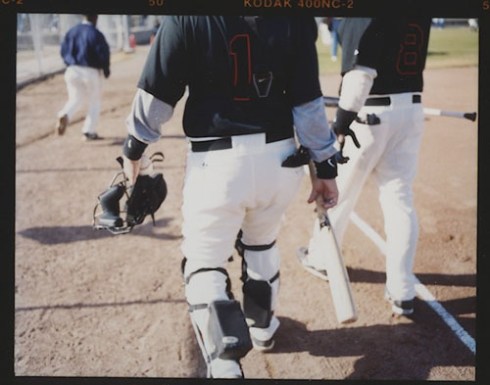
ALL IMAGES © 2009 EMILIANO GRANADO
Authors note: Huge thanks to Emiliano Granado for his thoughtful responses and honest reflections. It was a pleasure working with you E!
Housekeeping. At the end of my previous post on Emiliano’s work, I postured when San Quentin would get more sports teams for the integration of prisoners and civilians. Emiliano has answered that for me in this interview. He observed locals playing tennis and also states San Quentin also has a basketball team.
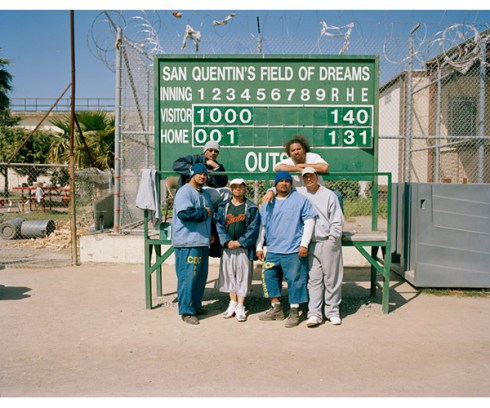
With Emiliano‘s permission I have lifted these images straight from his website. We are working together on an interview for a second post on his work (scheduled for next week). It will include previously unpublished and untouched images from his contact sheets. Please stay tuned for that. Meanwhile enjoy my personal selection of six preferred prints.

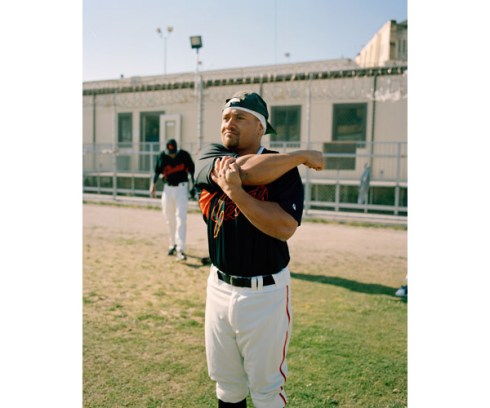


ALL IMAGES © 2009 EMILIANO GRANADO
_____________________________________________
The San Quentin Giants are well known in the San Francisco Bay Area. I have met a couple of guys in the past who’ve played inside the walls during regular season – it is not unusual.
In an ideal world, the to and fro of public in and out of prison would be without restriction, threat or security protocol. This way, society could fear inmates less and inmates would not be institutionalised to the extent they are today.
I realise this is pie-in-the-sky thinking as the minority of seriously dangerous prisoners necessarily dictate the need for stringent controls. Still it doesn’t mean that increasingly trusted and regular contact between inmate and no-inmate populations cannot be our ideal to shoot for. Smaller and purposefully designed institutions would certainly be the first step in this sea change.
The scheduled games for the San Quentin Giants baseball team are the closest approximation to genuine & normalised interaction between inmate and non-inmate populations. When will San Quentin get a basketball team? Or any other teams for that matter?
____________________________________________
Check out these sources for further information on the San Quentin Giants. Press Enterprise – Long Article and Audio, Mother Jones article – Featuring Granado’s photography, California Connected – Video, Christian Science Monitor – Long article and video, NPR Feature – Audio.
And, if you are really engrossed you can always purchase Bad Boys of Summer, a recent documentary from Loren Mendell and Tiller Russell.

Kevin Van Aelst for The New York Times
I posted about Google’s collaboration with LIFE Magazine a few months ago. I – like many folk – were excited to dig in, ferret about and generally enjoy the visual culture of decades past. It seems the novelty has worn off for some. An excellent diatribe, Photo Negative, in the New York Times last week made the point succinctly.
“When Google first announced on its blog that the Life archive was up, it seemed like another Google good deed: rescuing the name of Life magazine and the glorious 20th-century tradition of still photojournalism. But Google has failed to recognize that it can’t publish content under its imprint without also creating content of some kind: smart, reported captions; new and good-looking slide-show software; interstitial material that connects disparate photos; robust thematic and topical organization. All this stuff is content, and it requires writers, reporters, designers and curators. Instead, the company’s curatorial imperative, as usual, is merely ‘make it available’.”
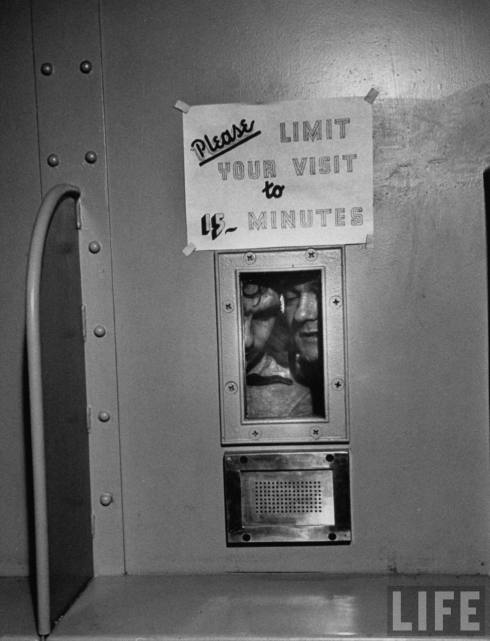
Prisoners watching baptism of repentant killer, in Harris County jail, TX, US. March 1954. Credit: John Dominis. ©2008 Google
With little in the platform or functionality to inspire users, Google could find visitors’ perusal time shrinking. Users might face unavoidable limits to their search time and patience. 15 minutes?

An interior view of the dining facility at the newly opened Baghdad Central Prison in Abu Ghraib on February 21, 2009 in Baghdad, Iraq. Wathiq Khuzaie for Getty Images Europe.
Yesterday, my good friend Debra Baida sent me through the link to the New York Times Abu Ghraib – Baghdad Bureau Blog. This came at the same moment I was preparing a post to discuss the first images to come out of the renamed, refurbished and relaunched Baghdad Central Prison.
By far the best, and possibly the only, extended photo essay of Abu Ghraib Baghdad Central Prison is by Wathiq Khuzaie of Getty Images Europe. There is also this brief video from the BBC.
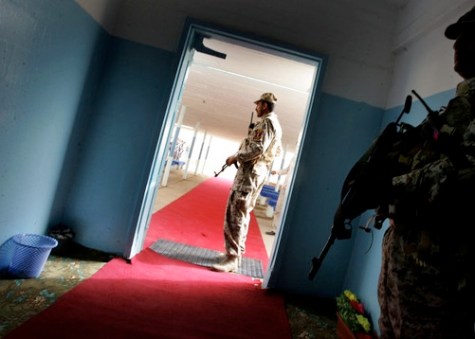
Iraqi security personnel stand guard at the newly opened Baghdad Central Prison in Abu Ghraib on February 21, 2009 in Baghdad, Iraq. The Iraqi Ministry of Justice has renovated and reopened the previously named "Abu Ghraib" prison and renamed the site to Baghdad Central Prison. Wathiq Khuzaie/Getty Images Europe
New Era, New Penology
The BBC noted, “Along with the change of name, the Iraqi justice ministry is trying to change both image and reality, billing it as a model prison, open to random inspection by the Red Cross and other humanitarian organisations.”
This transparency is a refreshing change to the policy of Abu Ghraib’s former operators. The work is not yet complete though and the upgrade is ongoing. The BBC describes, “[The prison] will eventually be the city’s main jail, holding about 12,000 inmates. Initially, only one of its four sections will be used. There are already about 300 prisoners there to test it out and, once the prison has been officially inaugurated, that figure will rise to 3,500.”
So, not only do Iraqi authorities want to repurpose the institution, they want to make it the penal institution of “The New Iraq”. This is an ambitious policy riddled with dangers; the site is loaded with memory and controversy. As the New York Times notes, “the promise of a new era can also be a time for remembrance.”
I highly recommend one goes onto read accounts from Iraqis, correspondents and photographers who lived and recorded Abu Ghraib’s recent history, particularly photographer Tyler Hicks’ account of Saddam’s prison amnesty in October 2002 that turned from celebration to human catastrophe.

Wathiq Khuzaie/Getty Images Europe

An interior view of one of the cells at the newly opened Baghdad Central Prison in Abu Ghraib on February 21, 2009 in Baghdad, Iraq. Wathiq Khuzaie/Getty Images Europe
Two things struck me about the photographic series of the new prison. Firstly, the number of flags, insignia and national colours across walls, above fences and emblazoned on uniforms. The Iraqi authorities have stamped their identity all over this project. It is the presentation necessary to supersede Abu Ghraib’s reputation.
Secondly, the pastel palette of many of the interior shots – namely the ubiquitous lilac. I want to know who has the decision-making power at Baghdad Central Prison! However, I suspect lilac paint was cheap and readily available; so it wasn’t so much a decision – more a fact created by circumstance.
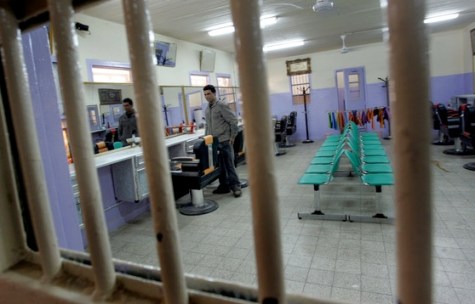
Interior view of the barbers shop at the newly opened Baghdad Central Prison in Abu Ghraib on February 21, 2009. Wathiq Khuzaie/Getty Images Europe.
Following that logic, one could presume lilac and purple fabric & thread is also at a surplus in Baghdad…

Interior view of sewing machines at the newly opened Baghdad Central Prison in Abu Ghraib on February 21, 2009. Wathiq Khuzaie/Getty Images Europe.
I don’t want to sound facetious, I was just shocked by the light purple, which according to colour theory is supposed to evoke emotional memory and nostalgia. Darker purples are supposed to represented, nobility, royalty and stability. From those evocations one is instilled with wisdom, independence, dignity and creativity.
If Baghdad Central Prison is to spur such emotional response in its inmate population it will succeed where many, many prisons have failed.
Basically, I am hopeful that the new prison can operate justly and succeed with the rehabilitation it emphasised this week. And despite all the lilac, soft-furnishings and current open media access – in reality it remains a prison with doors, locks and guards.
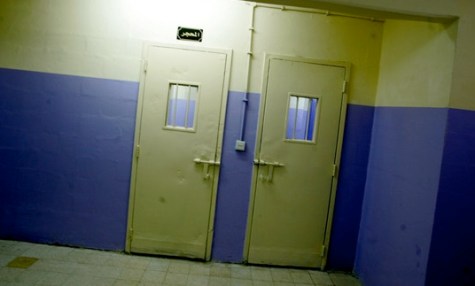
Interior view of cell doors at the newly opened Baghdad Central Prison in Abu Ghraib on February 21, 2009 in Baghdad, Iraq. The Iraqi Ministry of Justice has renovated and reopened the previously named "Abu Ghraib" prison and renamed the site to Baghdad Central Prison. According to the Iraqi Ministry of Justice about 400 prisoners were transferred to the prison which can hold up to 3000 inmates. The prison was established in 1970 and it became synonymous with abuse under the U.S. occupation. Wathiq Khuzaie/Getty Images Europe.

James Estrin for the New York Times
Jeffrey Deskovic was imprisoned for 16 years for a rape and murder he did not commit. The New York Times produced this sobering slideshow of his first year outside prison.

James Estrin for the New York Times
Two things in Deskovic’s story stood out. First of all, I was struck by the everyday practices and processes he lists as doing for the first time – cooking his own breakfast; opening and closing the window, keeping his own hours, shopping, even driving “represents power and freedom”; using the internet; using a cell phone (“I asked where the holes were to talk into”); first day at college; and swimming. “The water felt heavy” was Deskovic’s summary. It had been so long his body was not used to it.
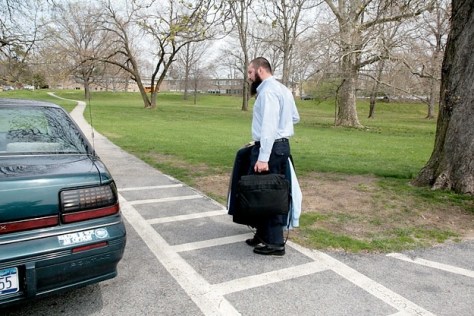
James Estrin for the New York Times
The second thing that struck me was how alone Deskovic was. He admitted to low points, thinking about taking his own life, wondering if it was a dream. Most tragic was his nagging feelings that he has somehow slipped through the cracks and that a twist of fate landed him on the outside. He is struggling and wonders whether he will be a ‘prisoner’ all his life. His institutional life has seeped into his psyche it seems.

James Estrin for the New York Times
These revelations are most shocking to me because Deskovic looks so well equipped to deal with his new life. He is an advocate for overturning wrongful convictions, he works with the press diligently, he feels “at his best” when he is making a presentation or talk. And yet, he is still waiting for the gradual process of a “normal-life”, including a trusting partner, to become him.
Jeffrey Deskovic addresses the press. James Estrin for the New York Times
Jeffrey Deskovic admitted to a small smile when he first spoke to the press following his release, because “they knew what I had always known”. I would like to think this smile has sustained and grown in the 15 months since the New York Times did the feature.
Please read the original story by the New York Times. Photography by James Estrin and Suzanne DeChillo, who has photographed incarcerated immigrants awaiting deportation at Wyatt Prison, Rhode Island.
BURN Magazine, under the fiscal umbrella of the Magnum Cultural Foundation, have announced a $10,000 grant “to support [the] continuation of the photographer’s personal project. This body of work may be of either journalistic mission or purely personal artistic imperatives”
I am encouraging people to take on the difficult task of securing prolonged and necessary time with a prison/jail/detention-centre population in order to faithfully describe the stories and systems of its particular circumstance. On top of that your product must be “work is on the highest level”.
It’s a tall order but if you have carried out portrait or documentary photography in a site of incarceration before (I know many of you), then submit an application to continue that critical and valuable work. It will have to better than my attempt.

San Pedro Prison, La Paz. July 2008.
Hmm. On the same day I encourage photographers to attempt access into sites designed to be impenetrable, the government and police in my home country have introduced “laws that allow for the arrest – and imprisonment – of anyone who takes pictures of officers ‘likely to be useful to a person committing or preparing an act of terrorism’.” (British Journal of Photography via In-Public)
BURN Magazine is a new(ish) venture by David Alan Harvey whose got a Magnum portfolio and his own internets.

 Prison Photography