
You are currently browsing the category archive for the ‘Photojournalism’ category.

The Global Post has just launched ENCARCELACION an investigative series about the correctional systems of Latin America that “have gone horribly wrong.”
We’ve seen the headlines of jailbreaks in Mexico, riots in Venezuelan prisons, and fires in Honduran jails, but often these stories seems a world away. The politics underpinning the strife in Latin American prisons is not my area of expertise but the importance of the stories is undeniable. It is interesting that the Global Post has used photography as an anchor to the front page.
After digging down into ENCARCELACION‘s trove of info, you may want to follow links to Prison Photography‘s irregular coverage of various aspects of life in Latin American prisons:
Gary Knight – Joao Pina – Jackie Dewe Matthews – Valerio Bispuri – Pedro Lobo – Vance Jacobs and Columbian prisoners – tourist photography in Bolivian prisons – prison tattoos (some from Central America) – Kate Orlinksky’s portraits of Mexican female prisoners – Fabio Cuttica at a Columbian prison beauty pageant – Patricia Aridjis in Mexico – even Cornell Capa was in Latin American prisons at one time.
– – – – –
Thanks to Theo Stroomer for the heads up.
Amy Elkins invited me to curate an online exhibit for Women in Photography, a group now under the umbrella of the Humble Arts Foundation.
My choice of twelve female photographers – Jenn Ackerman, Araminta de Clermont, Alyse Emdur, Christiane Feser, Cheryl Hanna-Truscott, Deborah Luster, Britney Anne Majure, Nathalie Mohadjer, Yana Payusova, Julia Rendleman, Marilyn Suriani, and Kristen S. Wilkins – are a eclectic mix of artists with different approaches to photography in sites of incarceration. Among their works you’ll find fine art documentary, found photography, alternative process, painted photographs, collaborative portraiture, dreamy landscape, photojournalist dispatches and social activism.
Some ladies’ work I’ve featured before on Prison Photography; some are relatively new discoveries; others I met during Prison Photography on the Road; and a few are included in the ongoing Cruel and Unusual show at Noorderlicht.
Thanks to WIPNYC co-founders Amy and Cara Phillips for providing an avenue with which to disseminate photography that counters stereotypes and informs audiences of lives behind bars. Thanks also to Megan Charland for formatting the exhibition.
From my curatorial statement
In the past 40 years, America’s prison population has more than quadrupled from under 500,000 to over 2.3 million. This program of mass incarceration is unprecedented in human history. Women have born the brunt of this disastrous growth. Within that fourfold increase, the female prison population has increased eightfold. You heard right: women are incarcerated today at eight times the number they were in the early 1970s. Are women really eight times more dangerous as they were two generations ago?
Please, browse the gallery, bios and linked portfolios.


James Evers, an inmate at the California Men’s Colony, shaves Joaquin Cruz, 60, a convicted killer with Alzheimer’s disease. Photo Credit: Todd Heisler/New York Times
NEW YORK TIMES ON-THE-MARK WITH MULTIMEDIA
On Saturday, the New York Times ran an excellent and timely multimedia piece about California prisoners with Alzheimer’s disease and other types of dementia.
Dementia Behind Bars, produced by Nancy Donaldson, is accompanied by the article Life, With Dementia by science writer Pam Belluck.
Donaldson’s 7 minute video also focuses on the prisoners who are the primary caregivers (the state cannot afford professionals). The success of the multimedia piece is due to many factors:
– Great stills from Todd Heisler, giving the story space to breathe.
– The use of black and white, knitting video and still.
– Full description of the issue at hand; since 1995, in the U.S. the number of inmates aged 55 and older has almost quadrupled, to nearly 125,000. Longer sentencing as part of mass incarceration means these inflated numbers will remain for decades.
– Meaningful quotes.
– Dialogue between “patient” and caregiver.
– Interviews with caregivers.
– An overall focus on the caregiver/patient relationships that confound stereotypes.
To hone the story, Belluck, Donaldson and Heisler made repeated visits to California Men’s Colony in San Luis Obispo, CA. “I visited the California prison twice last year … staying for about four days,” says photographer Heisler on the New York Times’ Lens blog.
The situation in California is, to a degree, desperate but unfortunately not unique. To train lifers to administer daily care is a cost effective solution to a problem the CDCr is unprepared for. Belluck explains the costs:
New York has taken the top-dollar route, establishing a separate unit for cognitively impaired inmates and using professional caregivers, at a cost of about $93,000 per bed annually, compared with $41,000 in the general prison population. Pennsylvania and other states are giving mental health workers special dementia training.
But some struggling prison systems, including those in Louisiana and California, are taking a less expensive but potentially riskier approach. They are training prisoners to handle many of the demented inmates’ daily needs.
I applaud Belluck, Donaldson and Heisler for their well-rounded piece of journalism that stays clear of sugar-coating the issue (they describe the horrific details of the mens’ original crimes).
PHOTO EDITOR MIKE DAVIS OFF-THE-MARK WITH MULTIMEDIA
Why am I making such a fuss over Heisler, Donaldson and Belluck’s work? Well partly because of Mike Davis’ latest blog post.
Mike Davis’ Does Story Telling Lose in Multimedia is a poorly-argued position on multimedia. Usually very helpful with his industry insider’s voice, Davis has not met his usual standards. Shame.
Davis’ logic is flawed. Let me quote (in bold) and question his three-point disappointment.
1. Thou shalt approach subject matter that mostly happened in the past.
Please show me something in journalism of any medium that has happened in the future. Or, if we are to yearn for the present, does Davis want only live-feeds of events on our TVs and computers?
2. Thou shalt point a video/audio producing machine at a person looking at said machine and ask them questions, as the primary story telling medium. (You may separate said audio from said video with papal dispensation.)
So we shouldn’t interview subjects? Maybe guess what they’re thinking? Do away with quotes? Or should subjects have wireless lapel mics attached when they’re not paying attention?
In good multimedia, the questions are not the content; the answers are. To incorporate them involves, yes, separating and editing audio.
3. Thou shalt make video of something in the present tense that may or may not have anything to do with that past event and then overlay that video cleverly with the interview audio to suggest a connection between the two, without being too misleading.
If there is a gross deception that occurs whereby the mix of audio and video manipulates a story, then this is not the fault of the format, but the poor skills of the creator. If Davis spots it then viewers will too.
On the idea of misleading the audience, maybe Davis is holding too much on to old rigid rules of journalism? The multimedia producers I have spoken to are very clear that while they are reporting a situation, they are doing so with a personal verve. Multimedia has more facets and more production than say a text article or photo-essay. It is layered and if used properly can tell stories VERY effectively.
Multimedia incorporates hard facts but also the producers’ own interpretations of the contexts for those facts. I would call this space between non-fiction and interpretation, storytelling. Good storytelling involves the teller; we rely on his/her skills to walk us through the story.
I can appreciate that Davis may have had a couple of painful experiences judging multimedia competitions but for him to lament the medium is too much of a generalisation and ironically, misleading itself.
As David Campbell noted, Davis offers no examples of poor multimedia. So let me offer some examples of good multimedia:
Intended Consequences by Jonathan Torgovnik/MediaStorm.
Trapped, by Jenn Ackermann.
Afrikaner Blood, by Elles van Gelder & photojournalist Ilvy Njiokiktjien
Alternatively you can trawl the archives of Interactive Narratives or MediaStorm. In the face of such an amount of excellent storytelling, Davis’ position is simply off-the-mark.
AGING PRISONERS PREVIOUSLY ON PRISON PHOTOGRAPHY
Geriatric Prisoners
Dying In Prison
“I don’t want to die in jail. Do you want tot die in jail?”

PRINTED MATTERS
For the upcoming Cruel and Unusual exhibition, Hester Keijser and I opted for a newsprint catalogue. We did this for several reasons.
Firstly, the message behind the exhibition is one that calls for political thought and hopefully political change. Shifts in attitudes come about through public education; it made sense to distribute information as far and wide as was possible. Not everyone can afford a photobook/catalogue, but 4,000 free copies of a newspaper nullifies the issue. Some might call the newspaper medium democratic, but I just call the solution common sense. 
Secondly, we had a lot of photographers to feature. 32 pages of a tabloid-sized newspaper is a sizable amount of column inches with which to fairly deal with the many issues in the photographers’ works.
And third, Hester and I wanted to bring attention to the fact that [photo]bloggers continue to shape, react to, and distort new media economies. As we say in our curatorial statement:
“Cruel and Unusual looks at the utility of freelance online publishing. As bloggers with academic backgrounds, we happily invest time and intellectual capital in our research and writing. Our blogs and those of colleagues have become resources – almost contemporary libraries – that others utilize and perhaps even capitalise upon. For a host of reasons, printed journalism is in decline. Simultaneously, bloggers refine their messages unhindered. Related, but not necessarily causal, we want to acknowledge these two trends and the disruption at hand.”
We aren’t particularly worried about not knowing what the future holds, because for now we are propelled by opportunities to create things in the present.
SOME OTHER NEWSPRINT PHOTO PUBLICATIONS
Most people are probably aware of Alec Soth’s Last Days of W. President Bush was a constant source of partisan news stories, and Op-Ed’s on Bush were divided and divisive. Given that Bush was a leader who orbited world events without necessarily controlling them and given that he was a Commander-in-Chief whose war cabinet tried to warp media to its own message, Soth’s use of a newspaper is ironic and appropriate. Jeff Ladd noted that Soth’s subjects look worn out and exhausted as if reflecting the American psyche after eight years of Bush. A newspaper will soon yellow and show aging – perhaps Soth hoped his newspaper would be short lived like the memory of Bush and the reparations required following his presidency?
Recently, Harry Hardie at HERE has collaborated on two newsprint photo publications.
CAIRO DIVIDED (32 pages) sequences the photos of Jason Larkin with an authoritative essay (in both English and Arabic) by Jack Shenker about suburbanization around Egypt’s capital. Since January 25th of 2011, Egypt has not been out the news, and yet this project is not about revolution. It is however about poverty, wealth and class stratification and as such provides a good context for the revolution in Egypt. Excellent design with eye-opening photographs. Highly recommended. More info here.
Guy Martin’s The Missing is borne of a collaboration between Panos Pictures, HERE and Martin’s alma mater The University of Falmouth. Each of its 48 pages has a large image of a missing poster photographed by Guy Martin. The posters “adorned the walls of the courthouse and justice rooms on Benghazi’s seafront.” Martin estimates that in Libya, 30,000 men are missing after the 8 month conflict. As such, the quasi-legal vernacular documents he re-photographed in-situ were the making of “communal place of memory and mourning.” The newspaper acts as a bulletin existing somewhere between the makeshift and the permanent; between memory and knowing; and – as with those pictured – in ambiguous flux with time. More info here.
Shifting gears, Portrait Salon 11 is not about political events. It is, however, a political stand against institutional exclusion. In the tradition of the 1863 French Salon des Refuses, the London-based Portrait Salon is a curated showcase of photographs that were submitted but not selected for the prestigious Taylor Wessing Photographic Portrait Prize. The use of a newspaper is a mischievous challenge to the immobility of a gallery exhibition that chose 60 works from 6,000 submissions; the newspaper can move cheaply and in large quantities beyond gallery walls. Furthermore, the accompanying Portrait Salon exhibition projected portraits in order to include more photography and not be limited by physical space. The exhibition and newspaper were organised by Miranda Gavin, Wayne Ford and others. For purchase.
I’ve highlighted these projects and in each case tried to justify why the choice of newsprint was appropriate and theoretically consistent. I believe that the Cruel and Unusual newspaper is those things too.
CRUEL AND UNUSUAL: AVAILABLE ONLINE
A non-printable, non-downloadable, non-alterable screen-preview version is available online.
Starting February 18, the newspaper is also available for free in the Noorderlicht Photogallery and for sale in the webshop.
The exhibition is split into two sections: 1, a traditional presentation of 11 photographers, and 2, a heady mayhemic wall of work-prints, background material contact sheets from Prison Photography on the Road (PPOTR).
Similarly, the newspaper is divided into two sections. A 20 page PPOTR pullout is enveloped in 12 pages of descriptions of the photographers in the main part of the exhibition.
Below are the opening page and the back page of the PPOTR pullout. The portrait on the opening page was made by Tim Matsui who documented my workshop at Sing Sing Prison.

The back page is a list of 32 of our favourite international photography blogs with QR codes linking to their websites. This was our cheeky riff on the classifieds section of newspapers!

And below are two pairings of PDF pages and Hester’s photographs of the actual printed object. The paper is really beautiful … so Hester tells me; I’ve not held one yet! I would like to thank the designer Pierre Derks who worked with Hester and I. He has expertise, patience and put in some hard graft.


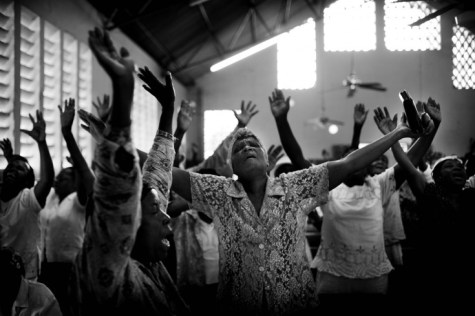
Last week, Danish photojournalist Jan Grarup was awarded the Oskar Barnack Leica Award 2011 for Haiti Aftermath.
COLOUR VS. BLACK AND WHITE
Grarup tells TIME.com: “I want to put some focus on what is going on in other places in the world. […] When you try to photograph things from perspective, you get a little more in-depth of what is happening.”
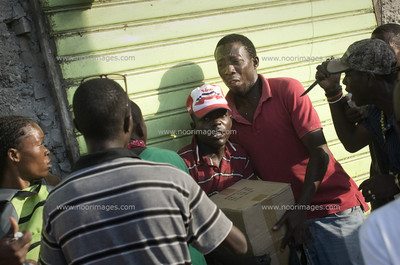
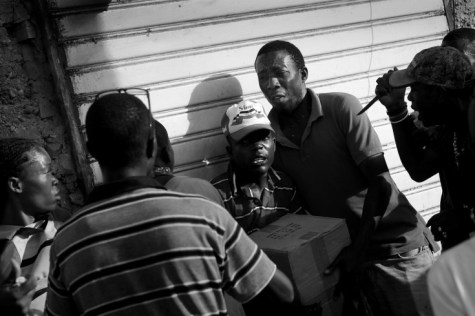
So, I guess my question is ‘Does colour not exist in the other places of the world?’ Grarup originally shot the images in colour, converting to B&W in post-production. It should be said that not all images in his Barnack entry are part of the original dispatch and so there is a (slight) chance those files were made originally in B&W. [UPDATE 06.22.11, 10:00PST. It could be that as Grarup shot in RGB, and had his screen displaying B&W. It could be that he never intended to use colour. Yet, everything’s colour still, as you look at it through the viewfinder.]
I include shots from his 136-image portfolio, dispatched to his agency NOOR briefly after his stint in Haiti, so you can compare them with the B&W images of his winning portfolio. I’m not here to argue for or against colour and/or B&W – I just want to provide a starting point for conversation.
FABIENNE CHERISMA
As part of my ongoing inquiry into the photojournalism surrounding Fabienne Cherisma’s death, Grarup offered Prison Photography a brief Q&A in March 2010.
Grarup took several photographs of Fabienne Cherisma dead on the collapsed roof-top; it’s an image, I argue, is both multi-authored and synonymous with the Haiti earthquake. Grarup did not include such an image in his Barnack entry, but did include a photograph of Fabienne’s brother and sister over her corpse after she’d been retrieved from the rooftop.
JUROR CONFLICT OF INTEREST?
And to the main issue at hand. Jan Grarup, a member of NOOR Images, was given the award by a five-person jury. One of the jurors was Stanley Greene, a member of NOOR Images.
I should say that, by my reckoning, NOOR is one of the most responsible photo agencies I’ve looked at; it’s stories impress me consistently and they have a couple of my preferred photographers on staff. This is not a distant attack, but a very specific question as to how they could possibly see this one panning out without any questions being asked.
Moreover, the Oskar Barnack Award (OBA) either shouldn’t have allowed Greene on the jury, or if he was so vital to the jury process, they should’ve insisted NOOR photographers needn’t apply. Both NOOR and OBA have exposed themselves unnecessarily to ethical questions.

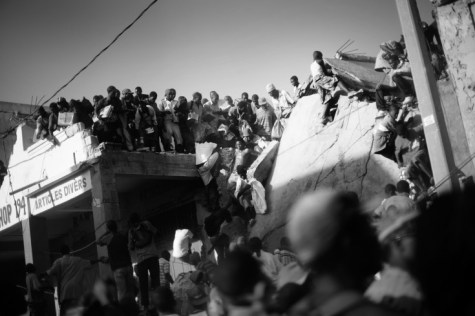

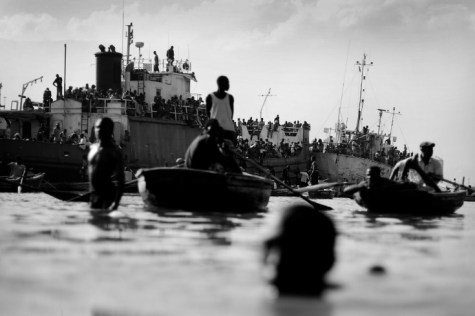
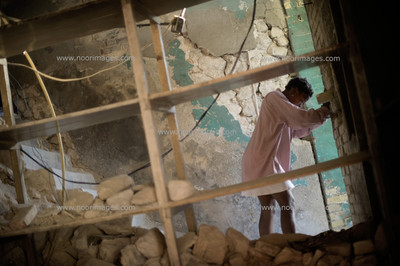

THE PURPOSE OF THIS POST?
1) These images provide anchors to which the endless colour vs. B&W debate can gain some focus.
2) Stanley Greene‘s role as a juror deserves to come under serious scrutiny. As a member of NOOR images, it’s difficult to ignore the conflict of interest.
3) I feel obliged to report on any news, updates and industry awards as they have concerned the photographers involved in my original inquiry.
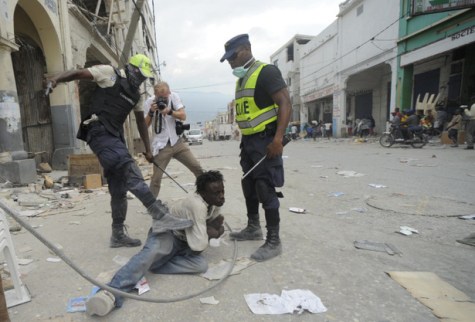
Jan Grarup photographs police beating a looter in downtown Port-au-Prince Tuesday afternoon. © Lucas Oleniuk/Toronto Star.
ALSO IN THE ‘PHOTOGRAPHING FABIENNE’ SERIES
Part One: Fabienne Cherisma (Initial inquiries, Jan Grarup, Olivier Laban Mattei)
Part Two: More on Fabienne Cherisma (Carlos Garcia Rawlins)
Part Three: Furthermore on Fabienne Cherisma (Michael Mullady)
Part Four: Yet more on Fabienne Cherisma (Linsmier, Nathan Weber)
Part Five: Interview with Edward Linsmier
Part Six: Interview with Jan Grarup
Part Seven: Interview with Paul Hansen
Part Eight: Interview with Michael Winiarski
Part Nine: Interview with Nathan Weber
Part Ten: Interview with James Oatway
Part Eleven: Interview with Nick Kozak
Part Twelve: Two Months On (Winiarski/Hansen)
Reporter Rory Carroll Clarifies Some Details
Part Fourteen: Interview with Alon Skuy
Part Fifteen: Conclusions (Matt Levitch, Felix Dlangamandla)
Part Sixteen: Fabienne Cherisma’s Corpse Features at Perpignan (Frederic Sautereau)
Part Seventeen: Brouhaha in Sweden following Award to Paul Hansen for his Image of Fabienne Cherisma (Paul Hansen, Olivier Laban Mattei, James Oatway)
Part Eighteen: A Photo of Fabienne Cherisma by Another Photographer Wins Another Award (Lucas Oleniuk)
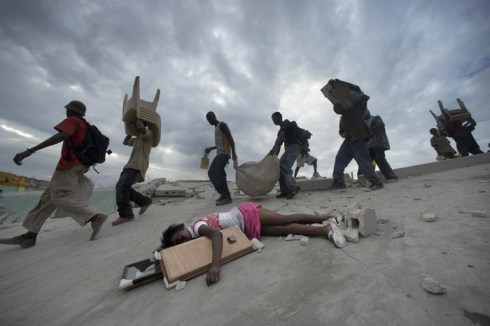
The lifeless body of fifteen-year-old Fabienne Cherisma lies on the roof of a fallen building in downtown Port-au-Prince on January 19, 2010. Photo by Lucas Oleniuk / Toronto Star
Canadian photographer Lucas Oleniuk has been awarded a National Newspaper Award in Canada for his image of Fabienne Cherisma dead on a Port-au-Prince roof-top, one week after the Haiti Earthquake.
Eight weeks ago Paul Hansen won a national award in his home country of Sweden. In March, I wrote about Hansen’s and other photographers’ awards for coverage of Fabienne’s death – Brouhaha in Sweden following Award to Paul Hansen for his Image of Fabienne Cherisma.
That’s now five photographers recognised for their images made within the space of an hour on a Tuesday afternoon.
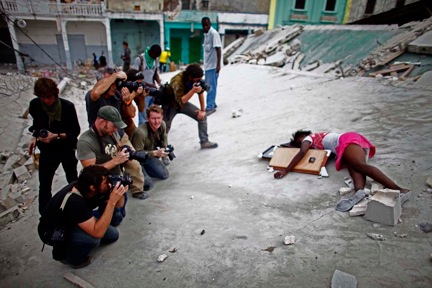
Photo: Nathan Weber
ALSO IN THE ‘PHOTOGRAPHING FABIENNE’ SERIES
Part One: Fabienne Cherisma (Initial inquiries, Jan Grarup, Olivier Laban Mattei)
Part Two: More on Fabienne Cherisma (Carlos Garcia Rawlins)
Part Three: Furthermore on Fabienne Cherisma (Michael Mullady)
Part Four: Yet more on Fabienne Cherisma (Linsmier, Nathan Weber)
Part Five: Interview with Edward Linsmier
Part Six: Interview with Jan Grarup
Part Seven: Interview with Paul Hansen
Part Eight: Interview with Michael Winiarski
Part Nine: Interview with Nathan Weber
Part Ten: Interview with James Oatway
Part Eleven: Interview with Nick Kozak
Part Twelve: Two Months On (Winiarski/Hansen)
Reporter Rory Carroll Clarifies Some Details
Part Fourteen: Interview with Alon Skuy
Part Fifteen: Conclusions (04.08.2010)
Fabienne Cherisma’s Corpse Features at Perpignan (09.07.2010)
Brouhaha in Sweden following Award to Paul Hansen for his Image of Fabienne Cherisma (03.23.2011)
Well, well, well. All sorts of commentary on the importance of photographs surrounding the assassination of Osama bin Laden and President Obama’s announcement in the East Room with reenactment of his speech for the still cameras.
From the White House Situation Room (now with added memes) and Reuters’ bloody gallery (WARNING: Graphic images of corpses) to whether we deserve or need to see bin Laden’s bullet-riddled head. Then there’s Senator Scott Brown’s faux-pas over a hoax photograph. Not to mention the reported different versions of the actual event.
For all the best articles click on the links over on Raw File Blog’s twitter feed, where I’ve been compiling them all day.
There’s still one photo – to be precise its caption – that is bothering me. And it’s this one:

White House photographer, Pete Souza, captioned the image thus: “President Barack Obama and Vice President Joe Biden, along with members of the national security team, receive an update on the mission against Osama bin Laden in the Situation Room of the White House, May 1, 2011.”
Except everywhere I’ve seen it used, the inference is that the White House team are watching a live feed of the raid on bin Laden’s compound.
They might be, but I want a SOURCE.
It seems to me this image may have been interpreted as one thing at an early stage and because it the narrative tied to the body language is so seductive, no-one has chosen to question it.
I think the reading of the image is massively altered depending on whether you think they’re watching murders in progress or whether they are, for example, waiting nervously for the screen to boot up.
Ryan Singel for Wired.com’s Epicenter blog went as far to say the White House “officials watching what one presumes is the livestream of the Navy Seal raid on Osama’s hideout in Pakistan.”
For all the hullabaloo about this image, no-one is actually sure about what is on THAT screen.
So, does anyone have a solid source saying that they are viewing a live feed of the operation?
Late last year, Aaron Huey and I met at his favourite coffee shop in Seattle (the only coffee shop in the city without WiFi, as far as I know). During our chat, his phone was buzzing; on the line was Emphas.is finalising the details of his Pine Ridge Billboard Project pitch.
PINE RIDGE RESERVATION
Ever since Huey’s powerful and viral TED talk last year, he’s been inundated with inquiries from people wanting to get involved and contribute. Huey admitted to being conflicted by his unexpected propulsion into the centre of a nebulous political energy, partly because he doesn’t have all the answers and partly because his work still doesn’t sit well with some of the Lakota community. Understandably, some Lakota don’t want images of broken homes and broken bodies to be consumed by white America. Still, Huey has the faith of the majority within the Lakota people.
With a story so large and important – and solutions so complex – Huey was unsettled with the status and future of his Pine Ridge documentary work; he had not pushed the political issue as far as it warranted. From his Emphas.is pitch:
I have been documenting the Pine Ridge Indian Reservation for the past six years. Recently I have realized how inappropriate it is for this project to end with another book or a gallery show. […] Your involvement will help raise the visibility of these images by taking them straight to the public—to the sides of buses, subway tunnels, and billboards. I want people to think about prisoner of war camps in America on their commute to work. I want the message to be so loud that it cannot be ignored.
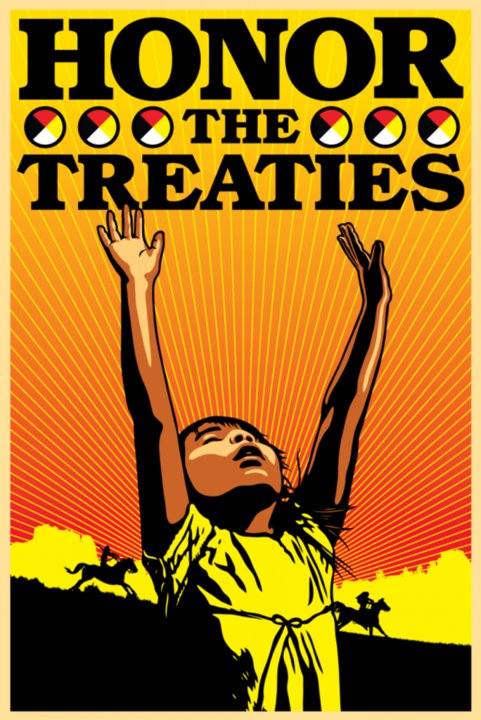
Emphas.is has given Huey, the Lakota people and us the opportunity to see and react to the work in unmissable public locations. It puts it in the face of D.C. politicians. Huey has enlisted the help of Shepard Fairey and artist and activist Ernesto Yerena who created visuals for the Alto Arizona campaign.

Source: http://www.webpages.uidaho.edu/~rfrey/329treaties_and_executive_orders.htm
PRISONER OF WAR CAMP #344
Huey’s photographs depict high unemployment, broken families, alcohol abuse and life expectancy lower than that in Afghanistan. The statistics are shocking.
But more than that, Huey’s photographs show the legacy of the lies and broken treaties of the US government stretching back over a century. If the Treaty of Fort Laramie (1868) had been observed, then the Lakota and associated Sioux tribes would own land stretching across five states.
To refer to the Pine Ridge Indian Reservation as a prisoner of war camp may seem incendiary to some, but this is how many of the Lakota see their existence. The Black Hills have been stolen and the Lakota live on the most infertile land fenced in on all sides by an encroaching dominant culture that they’ve predominantly experienced as oppressing and damaging. The solutions are not simple, but awareness and a will to action is.
Pine Ridge Indian Reservation is prisoner of war camp #344.
EMPHAS.IS
I have offered what support I can to the new crowd-funding platform Emphas.is with articles here on Prison Photography and for Wired.com. Three of the online critics I respect most (Colin, David and Joerg) have also put their weight behind it. I am chuffed to see Aaron’s proposal off the ground and I’d ask you seriously to consider funding the Pine Ridge Billboard Project.

Mock-up of a wall installation using 24x 26″ posters, proposed Pine Ridge Billboard Project
OUTLETS FOR ACTION: Throughout the campaign a website honorthetreaties.org will be formed. Aaron will build the site as a point of reference for those who want to know more about the history and the (broken) treaties of the Sioux and other tribes. There will be direct links to assist grassroots Native non-profits in places like Pine Ridge.The first partner is Owe Aku.
More on Aaron’s blog here.
Buy a 18×24 print signed by Shepard Fairey and Aaron Huey to support the project!

 Prison Photography