
You are currently browsing the category archive for the ‘Press’ category.

© 2009 Ged Murray
To append my last post about iconic photographs of rooftop inmates during the Strangeways riot of 1990 is a nod to the work of Ged Murray. Previous lamentations at the lack of Strangeways photography were premature on my part … I just had to keep digging.

© 2009 Ged Murray
These are my choice shots from a series of 20 Strangeways images on Ged Murray’s website. The image below of the two inmates in discussion is iconic (according to my brother). The silhouetted tower is instantly recognisable.

© 2009 Ged Murray

© 2009 Ged Murray
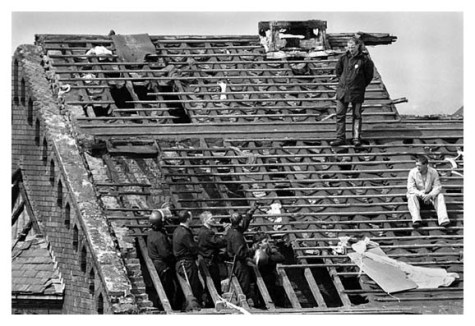
© 2009 Ged Murray

© 2009 Ged Murray

© 2009 Ged Murray
This last image of an inmate with signs took a large portion of my time. I am still thinking it over. Unerringly, I like the image. The shot bypasses the potency of icon and dilutes our consumption of events; returning our appreciation to more modest levels, focusing on the individual lives involved during a brief but pivotal moment in the history of British governmental prison policy.
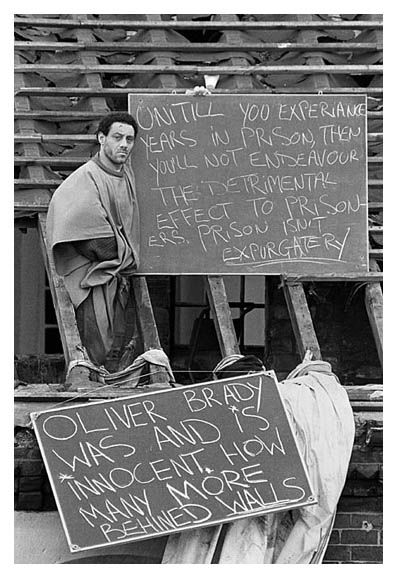
© 2009 Ged Murray
__________________________________
Thanks to Ged Murray for his permission to publish the images.
Today, March 11th 2009, marks the twentieth anniversary of the first COPS episode. Producer, John Langley, and his cohorts celebrated the when the first show of the twentieth season aired at the back end of last year. Allow me to reflect also.
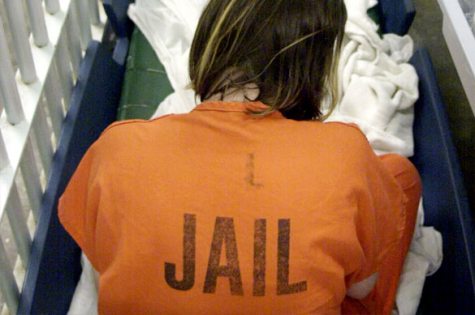
At overcrowded jails, like this one in Marion County, IN, inmates must sleep in portable containers. Credit: Inside American Jail
This is not really a day of celebration. Personally, I loathe the show. It is lazy, cheap and exploitative. In that regard, it paved the way for all the reality TV on the box today. Off my soap box.
It is worth noting that the 1988 television writers strike gave rise to COPS airing on screens. A desperate Fox Channel signed up after Langley had tried and failed pedaling the format for over six years. Lucky for him. But he was no slouch and worked the opportunity when it arose. Langley struggled early in his career. My guess is his PhD in Aesthetics took his thinking outside of the rote and predictable circles of Hollywoodthink. But TVland came round eventually and Langley has since distinguished himself as a true pioneer of America’s most-loved lowbrow art form.

Inmates in this Utah jail aren't digging an escape tunnel. They're learning to garden. Credit: Inside American Jail
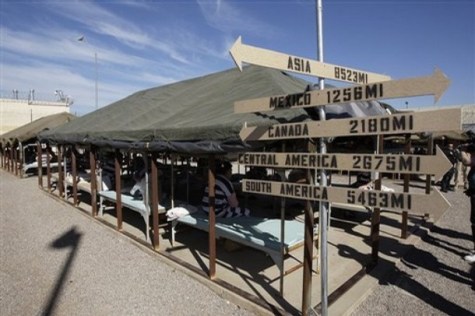
Three years ago, Langley Productions introduced a spin off show that went off the streets and into the jails. Inside American Jail has ventured into sites of incarceration across the nation including the circus-like Maricopa County Tent City. The show won high ratings when the Las Vegas County Sheriff detained O.J.Simpson.

A sign at a Maricopa County jail reads "Vacancy." The rates are good but the atmosphere is lacking. Credit: Inside American Jail
In many cases the TV cameras show the true harsh realities of institution after institution with stretched resources warehousing troubled folk with few opportunities for rehabilitation. This doesn’t stop them from hamming up the quirks of jail time as evidenced by the promotional images and campy captions (shown within this article) drawn from the show’s website.
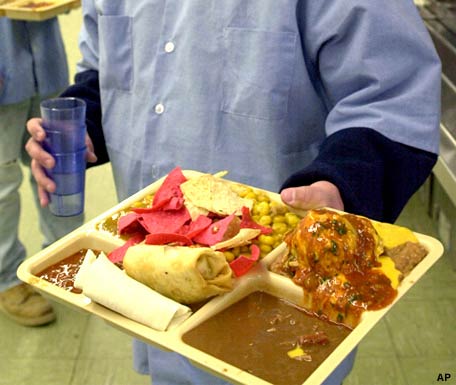
Mmm-mmm-good. An Iowa State Penitentiary inmate shows us what lunch in jail looks like. Credit: Inside American Jail
With most debates, nothing is cut and dried and an insightful article in the New York Times shows a vaguely compassionate point of view from Langley – who, let’s be honest has made his fortune of the back of America’s criminal justice exploits.
Having seen America’s prison population soar to more than 2.2 million, and with widespread prison overcrowding in California, Mr. Langley says he now believes the nation should be reconsidering which crimes should be punishable by imprisonment. “A lot of our attention is dedicated to arresting people who have drug problems,” he said, “when the real solution may be to rehabilitate them.”
And for your viewing pleasure here’s the ridiculous promo for Inside American Jail
This interview allows Langley to describe where Inside American Jail fits into the larger television ecosystem.

Inmate Jeff Curbow, 40, says he improved a watering system for the moss after others built a special hut for it at Cedar Creek Corrections Center in Littlerock, Thurston County. Credit: Ken Lambert / The Seattle Times.
Prison Photography always looks to visual sources that represent incarcerated peoples from a different perspective. Some of the best opportunities to do this is with images of prisoners employing their time in job placements, self-growth programmes and/or restorative justice & community education projects.
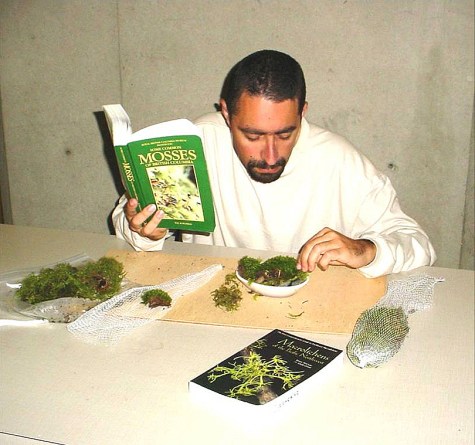
A Cedar Creek inmate and researcher in the Prison Moss Project studies mosses. Credit: Nalini Nadkarni of Evergreen State College
The Prison Moss Project, part of the Washington Department of Corrections‘ sustainability efforts uses prisoners time for the benefit of multiple causes. The project studies the growth of different mosses, cultivates the fastest growing species and sells them commercially as an alternative to mosses stripped from America’s temperate rain forests. Harvested mosses constitute a $265 million/year business. 90% of mosses come from Pacific Northwest forests. The majority of mosses are used for short lived floral-arrangement. Moss can take between 20 to 40 years to regrow even a small patch of a few square feet.
The beauty of this model based on simple scientific observation and applied methods is that it is replicable the world over. And, the business that results makes sense too.

A Cedar Creek inmate and researcher in the Moss-in-Prisons project tends the garden. Credit: Nalini Nadkarni
So, the benefits? First and foremost, the inmates at Cedar Creek, a minimum security facility in the rural southwest of Washington enjoy daily active learning. Prison staff have described the facility as one without idle time among its inmate population. Engaging the bodies and minds of frequently docile populations is the first step in combating recidivism.
Concurrently, tax-payers (economically-efficient prisons), tourists (untouched old growth forests) and global citizens (robust ecological legacies) all benefit too. Finally, all this pales in comparison to the rewards for the Pacific Northwest old growth forests, which in future will not suffer unsustainable tree-stripping and moss harvesting.

A Cedar Creek inmate and researcher in the Prison Moss Project in the purpose built greenhouses. Credit: Nalini Nadkarni
How did all this start? Two convergent forces came together. The first was a general move by the Washington Department of Corrections to improve its carbon footprint, sustainability and opportunities for its inmates. This involved composting, recycling, organic farming, beekeeping at selected facilities. This green awakening fell into step with Nalini Nadkarni‘s need for extended and immediate research into moss varietal growth patterns.
Nadkarni has been called the “Queen of the Forest Canopies”. I am not one for personality worship, but let’s just say her work is socially – as well as environmentally – responsible, she knows how to work media channels, her message is imperative and the Evergreen State College in Olympia is very lucky to have her on faculty. She co-founded the Research Ambassador Program at Evergreen, which seeks to combine academic and non-academic practitioners to widen the reach of environmental dialogue and deliver relevant forms of communication to different groups; from inner city youth, to business CEOs.
It’s all about respectful communication, and it’s all for the benefit of our environmental futures.
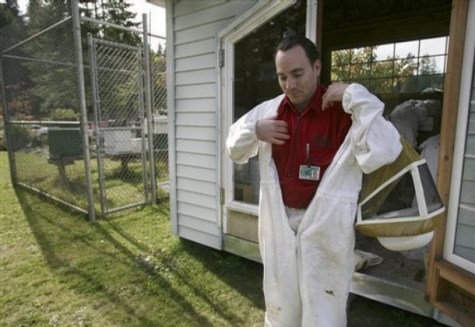
Daniel Travatte, 36, suits up to check on the Italian honey bees he cares for at the Cedar Creek Corrections Center in rural southwest, Wash. on Friday, Oct. 17, 2008. The bees are part of a program to help the prison be more environmentally green. Credit: John Froschauer/AP

Inmate, Daniel Travatte, tends the Italian honey bees he cares for at the Cedar Creek Corrections Center in rural southwest, WA. Credit: John Froschauer/AP
The media coverage of this programme has often focused on the story of a young inmate who, since release, secured a biochemistry PhD full ride scholarship at the University of Nevada, Reno. He was imprisoned after accidentally killing his friend with his sports rifle in his student apartment. Four years later, he has continued the exceptional academic track he seemed destined to follow. It is a testament to the Washington Department of Corrections and Nalini Nadkarni (his mentor during time served) that his life has been delayed rather than destroyed.
But, he surely is an atypical case and it is a case that obscures the facts about the sustainable projects in operation at Cedar Creek. Not every inmate is a PhD candidate, but every inmate is a willing recipient of education – especially environmental education which, in many cases, is totally novel. Environmental education carries an almost redemptive message in that your actions can directly benefit everyone in modest but crucial ways. Actions based upon this new learning can be very therapeutic. Responsibility for oneself and other human beings is not separate from responsibility for our shared environment.

Inmates Robert Day (left) and Brian Deboer (right) check on plants in one of the organic gardens at the Cedar Creek Corrections Center in rural southwest, Washington, on Friday. The minimum-security prison has adopted many environmental and cost saving practices. Credit: John Froschauer/AP
I have discussed sustainability efforts in California’s prison system before. In closing I’d like to repeat the sentiments of Cedar Creek superintendents who, in attempts to convince the public of the utility of this program, talk of the direct reduction in operating costs at the facility. If commentators such as myself want to espouse the rehabilitative value also then so be it. Doubters now have firm fiscal, quantitative evidence – in addition to qualitative inmate testimonies – to shape their support for sustainability programmes in prisons. WDC senior staff are adamant Cedar Creek is the correctional model to follow in the 21st century.

Inmate Robert Knowles pitches plant stalks into a compost pile Oct. 17 at the Cedar Creek Corrections Center in rural southwest Washington. The minimum-security prison has adopted many environmental and cost-saving practices. Credit: John Froschauer/AP
There are many resources out there on the Prison Moss Project and Nalini Nadkarni‘s ongoing evangelism. I personally would recommend in this order … Nalini Nadkarni’s recent TED presentation about the opportunities for academic & non-academic communities to unite for greater good; this extended video from KCTS (9 minutes); this interview with Nadkarni; a recent Mother Jones summary of her projects and two media reports (1), (2).
I don’t want to get into the habit of posting on cases of police corruption, police brutality, or correctional officer misconduct.
I don’t want to do this for three reasons:
1. It distracts me, and you the reader, from digesting content directly related to photography and its praxis.
2. Many other regional, national and international newsrooms will cover these stories – as a matter of course – more thoroughly than I.
And 3. Despite their shared “peace officer” status, cops and screws are cut from a different cloth. It would be wrong of me to carelessly blur the activities of one disciplinary group with another. Police and correctional officers share minimal operational relation to one another.
So, I don’t wish to obfuscate the reader/viewer. However, the video below leaves no confusion in anyone’s mind.
The spokesperson in the video relayed the official words of an authority under investigation, but one feels even he could barely stomach the truth here. Where some videos are subject to interpretation – and consequently endless courtroom debate – there can be no doubt here. The officer lost his head and unleashed upon this young girl. He’s a thug, just like a guy fist fighting on the street is a thug.
As some of you may know, I have recently transplanted to Seattle. Occasionally, one witnesses acts of rote police procedure in place of common sense, but by and large, the cops on the streets here (as in my former home of San Francisco) are a friendly bunch on bikes and skates.
I am saddened such a horrendous beating should take place in my new hometown … which is why I have made an exception to my rule here.
Unfortunately, this brutal lashing occurred in the same month that Seattle police chief Gil Kerlikowske was selected by Obama to be America’s next Drug Czar. Seattleites have voiced varied opinions regarding this appointment, but secretly they are all really chuffed. It is a proud moment for Seattle residents, not least, because Kerlikowske – even as a police chief – shares some majority views of the citizenry. Kerlikowske adopted a common sense approach to urban policing by making marijuana infractions the lowest priority of his force in order to redirect resources to more serious matters … matters of violence. The Stranger, Seattle’s favourite free rag offers four wildly different but well-informed opinions on Kerlikowske’s appointment.
_______________________________________
Seattle lost an age-old institution recently. The Seattle Post Intelligencer, like the Rocky Mountain News and San Francisco Chronicle has had its day. I am not sad because I believe newspapers have unending rights or high position in urban comunities because I don’t – I am excited by new media and its different forms of creation and distribution. I am upset because it was the liberal leaning paper in this two paper town. That leaves the Seattle Times, which is very mediocre. If you are intent on getting good journalism in print pick up the San Jose Mercury Times. Crap city, great newspaper!
…. was today’s New York Times’ rueful statement of fact.
Writers note: These immigrants are undocumented and unsentenced. They are not criminals. This is not prison. This situation is of acute interest to Prison Photography blog because Maricopa County Sheriff’s office is deliberately trying to blur the distinction between these two very different populations.
I recently commented on Sheriff Joe Arpaio’s scurrilous publicity stunt and parading of immigrants in Maricopa County, Arizona. Not only does Arpaio don his ensnared with the stripes of historical chain gangs, he actually puts them to work as such.
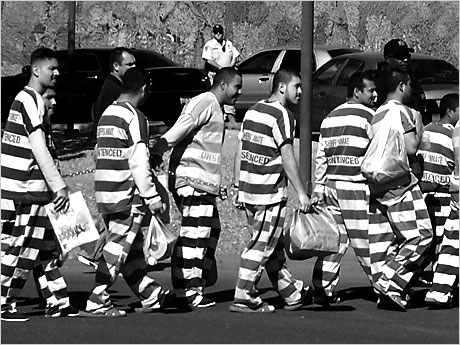
Carlos Garcia for the New York Times
Arpaio’s continued antics are firmly in the national spotlight. The New York Times has a long and varied history of comment. His mob-rule is increasingly divisive because a) we now hope for a just application of the law under an Obama administration and b) Janet Napolitano, former Governor of Arizona, and new Secretary of Homeland Security has yet to prove whether she can run the department without trampling human rights AND in so doing put pay to Arpaio’s abuses. The New York Times notes:
The burden of action is particularly high on Ms. Napolitano, who as Arizona’s governor handled Sheriff Arpaio with a gingerly caution that looked to some of his critics and victims as calculated and timid.
Ms. Napolitano, who is known as a serious and moderate voice on immigration, recently directed her agency to review its enforcement efforts, including looking at ways to expand the 287(g) program. Sheriff Arpaio is a powerful argument for doing just the opposite.
Now that she has left Arizona politics behind, Ms. Napolitano is free to prove this is not Arpaio’s America, where the mob rules and immigrants are subject to ritual humiliation. The country should expect no less.
All eyes are rightfully on this situation. It cuts right to the heart of the ideals America professes to uphold. Watch closely.
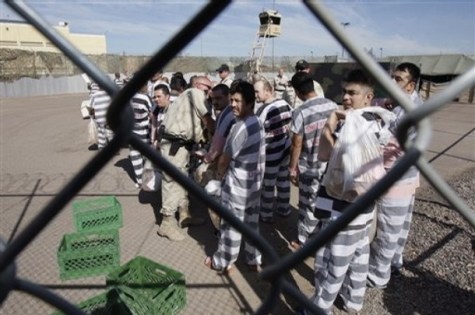
Approximately 200 convicted illegal immigrants handcuffed together arrive at their new part of the jail as they are moved into a separate area of Tent City, by orders of Maricopa County Sheriff Joe Arpaio, for incarceration until their sentences are served and they are deported to their home countries Wednesday, Feb. 4, 2009, in Phoenix. (AP Photo/Ross D. Franklin)
Hopefully, Prison Photography helps to clarify the facts behind images. In Maricopa County, Arizona yesterday the zealous Sheriff Joe Arpaio, ordered a parade of guarded, unsentenced & undocumented immigrants. Hand-cuffed and dressed in stripes, the men walked from one facility to Tent City. Hatewatch summarised the scene:
Along the way they were filmed by television news crews and guarded by at least 50 Maricopa County Sheriff’s Office (MCSO) deputies, wearing body armor and combat fatigues, armed with shotguns and automatic rifles. At least two canine units were present; a Sheriff’s Department helicopter hovered overhead.
The massive show of force was pure stagecraft for a blatant and dehumanizing publicity stunt orchestrated by Maricopa County sheriff Joe Arpaio. The MCSO gave no indication that any of the immigrant prisoners were particularly violent or presented a grave danger to the public.

Maricopa County Sheriff Joe Arpaio, left, orders approximately 200 convicted illegal immigrants handcuffed together and moved into a separate area of Tent City, inmates behind Arpaio, for incarceration until their sentences are served and they are deported to their home countries Wednesday, Feb. 4, 2009, in Phoenix. (AP Photo/Ross D. Franklin)
Arpaio, the self proclaimed “toughest sheriff in America”, has been roundly condemned by civil rights advocates, most of the regional media and clear-thinking locals for his colourful publicity stunt. Arpaio is a man hell bent on cleansing his county of undocumented immigrants and has done so by targeting Latino neighbourhoods, stopping Latinos for minor infractions (as an excuse for searching), and frequently deployed mask-wearing/gun-toting forces in petty shows of strength. Hatewatch elaborates on how all this is possible:
Arpaio is lionized by Minutemen vigilantes and other nativist extremists for his controversial “287(g)” arrangement with U.S. Immigration and Customs Enforcement, which empowers the MCSO, a local agency, to enforce federal immigration law.
Many Latinos taken into custody in recent months by MCSO 287(g) squads have been pulled over for minor traffic violations, such as a broken headlight or an improper lane change, and then arrested when they’re unable to produce proof of citizenship or a valid visa.

Feb. 4, 2009, in Phoenix. (AP Photo/Ross D. Franklin)
Arpaio is a nasty piece of work and it is unlikely he will let up. Alessandra Soler Meetze, executive director of the ACLU of Arizona, said “You’re sort of giving the message that it’s OK to treat these inmates differently. It’s OK to treat them like circus animals.” Meetze added, “He didn’t have to make a spectacle. He could’ve moved them on buses.” In the meantime, Arpaio said his office has received $1.6 million funding from the state that will go toward tackling illegal immigration.
Is dehumanisation is the issue? The point has been made on the blogs that when Iraqi forces paraded five US marines in March 2003, Rumsfeld cited it as a breach of the Geneva Convention, and yet here on American soil we have men defined as criminals, reduced to visual cliché and props in a vulgar display of power. Do these images shock? They shock me. Are they not images of racist control by the state?
Feb. 4, 2009, in Phoenix. Arpaio said housing the illegal immigrants separately would save money, although he did not explain how other than to say it's cheaper to house inmates in tents than at traditional jails. He also said the move will be more convenient for consulate officials visiting foreign inmates and for Immigration and Customs Enforcement agents charged with deporting the inmates after they have served sentences in county jails. (AP Photo/Ross D. Franklin)
Fortunately, Arpaio, try as he might, is not winning the public relations war. His brand of policing is considered by many as direct challenge to law.
Speaking of law. The Phoenix New Times noted, this pantomime just happened to fall “on the same day that his employee and political helper, Captain Joel Fox, is set to appear at a hearing to context a massive $315,000 fine for making an illegal campaign donation in the name of the mysterious “Sheriff’s Command Association,”
Which event do you think average news consumers will remember on Thursday – an administrative hearing concerning a convoluted tale of campaign finance laws, or the image of 200 Mexicans in stripes marching in chains down a public street?
Last year, Arpaio paid a visit to one of his tent jails. It gave him the opportunity for yet another photo opportunity!

Former world heavyweight boxing champion Mike Tyson listens to Sheriff Joe Arpaio (R) in the tent Tyson will stay in for 24 hours at Maricopa County Jail's tent city for prisoners in Phoenix, Arizona November 20, 2007. Tyson was sentenced on Monday to three years probation and one day in jail for drug possession and driving under the influence. Tyson is holding a copy of the book "American Gangster" according to Maricopa County Sheriff Joe Arpaio. REUTERS/Photo Courtesy of Maricopa County Sheriffs Department/Handout
I’ll leave you with this eloquent summary of Arpaio’s antics from Kevin Appleby, the Director of Migration and Refugee Policy with U.S. Conference of Catholic Bishops, “Shackling and marching fellow human beings for all to see is not in line with the values of the American people. While Guantanamo (Bay) is being closed, another one is being started in Arizona,”
For more images of this circus, see Jack Kurtz’s Blog or Ross D. Franklin’s AP Gallery. If you’d like to book a tour of the Tent City, Sheriff Arpaio’s office can make arrangements. Be sure to wear smart casual.
Thanks to Brendan at Anxiety Neurosis for sharing this through Google Reader
Chris Jordan was low on my list of priorities but this timely post by Mike Kelley at Change.org (a blog as impressive for its readers’ comments as it is for the straight forward presentation of Jordan’s work) compelled me to bump it up and champion the depressingly and unfathomable figures that arise when one simply runs the numbers.

Chris Jordan. Prison Uniforms, 2007. 10x23 feet in six vertical panels. Depicts 2.3 million folded prison uniforms, equal to the number of Americans incarcerated in 2005. The U.S. has the largest prison population of any country in the world.
In reading Change.org’s straight forward commentary on America’s broken criminal justice system, I signed up for Change.org and read a few of their older posts. In doing so I was presented with the catalyst to comment on Obama’s momentous inauguration without repeating the media-lovefest that has surrounded the 44th’s swearing in. This post will cover Jordan’s astounding artwork, Obama’s astounding tasks-at-hand and where they politically overlap.

Chris Jordan. Prison Uniforms, 2007. Partial zoom.
Chris Jordan has spent his time making larger and larger photographic constructions to communicate the scale at which American society wastes its resources, its environmental future and its grasp on logic. In his effort to catalogue the linear and thoughtless waste of the US, he has progressed from crushed automobiles, to cell phone chargers, to polystyrene cups to American prisoners.
Jordan is a bright guy, now consumed by his photography (which to be quite frank is eco-hip and brilliantly executed). He talks passionately about a sea-change in our cultural consumption. He specialises in highlighting “the behaviours that we all engage in unconsciously on a collective level … the actions we are in denial about and the ones that operate below our daily awareness … like when you’re mean to you wife because you’re mad about something else or when you drink too much at a party because you’re nervous.” Jordan is no prophet, he just sees the necessary u-turn we must all make in our habits and thoughts to move toward sustainable existence.

Chris Jordan. Prison Uniforms, 2007. 10x23 feet in six vertical panels. Detail at half actual size.
I like to think the strength of Jordan’s visual framework that deals with soda cans to the landfill as it does with prisoners to the cell blocks is deliberate. As hard as it is to acknowledge, the majority of Americans have turned their back on a seven-figure-minority as if it were worth no more thought than discarded packaging. Mass imprisonment is the result of widespread apathy, denial and unpinnable responsibility. How unconscionable is this situation? We are all responsible. Barack Obama talked very little about criminal justice and prison policy during his electioneering. This is not surprising as helping the invisible incarcerated masses is on the electorate’s mind as much as the whereabouts of their last twinkie wrapper. But, Obama also made it very clear that this was the time for personal responsibility and accountability.

Chris Jordan. Prison Uniforms, 2007. Installed at the Von Lintel Gallery, NY, June 2007.
So after a week of photography gallery after gallery, the militarised eye vs. the personal touch, Gigapan-assisted user-generated snooping, faux controversy, minor mishaps, cult worship, sentimental clap-trap, unending debate, media catfights, nerdcore details, celeb fluff and even UFO’s isn’t it time we adopt the same realism that Obama trusted in for his inaugural speech?
A wonderful article from the Wall Street Journal lays out the realism and “the audacity of hope behind bars”. (Via Change.org). Angola prisoner, Mr. Dennis served up some REALISM: “He’s got his hands full: Two wars, the economy is going in the tank and the health-care costs are skyrocketing – I’d be surprised if he has time to brush his teeth in the next four years.” While another prisoner took care of the HOPE: “If the men here can have hope, then why can’t the rest of the country?”
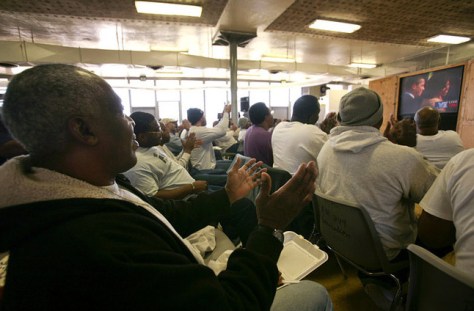
Prisoners at Louisiana State Penitentiary ("Angola") were given the day off to watch Barack Obama inaugurated as America's 44th president.
So how does this all connect? Jordan and Obama share the same call to think, with serious intent, about the things invisible to us. Both call us to consider the reality of our society and accept our shared responsibility for its faults, weaknesses and injustices. Both men challenge conventional wisdom; the logic that just because we didn’t turn the key nor bring down the gavel, we are not complicit – by our silence – in America’s mass incarceration.
What can you do? You can start by signing this petition immediately and by using web2.0 to access Obama’s administration as his team reached you during the election.
If you’d like to know more about Chris Jordan you could do worse than starting with this interview, this interview and this interview.
TYWKIWDBI is garish and off putting to anyone who judges sites on appearance alone. Fortunately for it, and us, it is also one of the best aggregators of online content. It is a one man operation to compete with Digg!

Roy Brown
I picked up this story and had to relay it. While Christian Milton, former AIG executive, got 4 years for his involvement in $500million fraud, Roy Brown was sentenced to 15 years in Louisiana for stealing $100 from a bank. Brown only took $100 dollars from thousands the cashier handed him and subsequently surrendered himself the next day, ashamed of his actions stating “My mother didn’t raise me that way.”
I don’t know how tied the judges hands were by Louisiana law, but I would resign in disgust if I was a cog in such an abusive system. Fucking disgrace.

Christian Milton
Searching for images didn’t come up with much (admittedly, it didn’t spend too long) but it occurred to me that the mugshot is the aesthetic of the poor and the street “trialshot” is the aesthetic of the rich. I understand they are captured at different moments in the judicial process, but the qualities and circumstances of the Mugshot vs Trialshot make interesting comparison.
MUGSHOT: Regimented, Artificial light, Institutional, Accompanied by booking information, Less likely recipient of bail, Controlled & private space, Everyday clothes.
TRIALSHOT: Unrestricted, Natural light, Public, Accompanied by caption and news article, Certain recipient of bail, Public space, Selected wardrobe.
These comparisons go some length to describe the influence money and status can have in the legal process and how the procedures accommodate those with money and resources to work with/within the system vs. those who are simply subject to its machinations. Just to drive the point home, when charges were first brought against Milton in February 2008, the probation office recommended a 14 to 17 year sentence. An absolute disgrace. A mockery.

Screenshot of fate. The rise and fall of individuals.

 Prison Photography