
You are currently browsing the category archive for the ‘Prison Non-Photography’ category.

MARTIN BATALLES REPRESENTING URUGUAY

LIVIA CORONA REPRESENTING MEXICO

MARCOS LOPEZ REPRESENTING ARGENTINA
Friend of Prison Photography, Emiliano Granado, likes football as much as he rocks at photography.
We pooled our knowledge to pair each country competing in South Africa with a photographer of the same nationality.
GROUP A
FRA France – JR
MEX Mexico – Livia Corona
RSA South Africa – Mikhael Subotzky
URU Uruguay – Martín Batallés
GROUP B
ARG Argentina – Marcos Lopez
GRE Greece – George Georgiou (Born in London to Greek Cypriot parent)
KOR South Korea – Ye Rin Mok
NGA Nigeria – George Osodi
GROUP C
ALG Algeria – Christian Poveda
ENG England – Stephen Gill
SVN Slovenia – Klavdij Sluban (French of Slovenian origin … I know, I know, but you try to find a Slovenia born photographer!)
USA United States – Bruce Davison
GROUP D
AUS Australia – Stephen Dupont
GER Germany – August Sander
GHA Ghana – Philip Kwame Apagya
SRB Serbia – Boogie
GROUP E
CMR Cameroon – Barthélémy Toguo
DEN Denmark – Henrik Knudsen
JPN Japan – Araki
NED Netherlands – Rineke Dijkstra
GROUP F
ITA Italy – Massimo Vitali
NZL New Zealand – Robin Morrison
PAR Paraguay – ?????
SVK Slovakia – Martin Kollar
GROUP G
BRA Brazil – Sebastiao Selgado
CIV Ivory Coast – Ananias Leki Dago
PRK North Korea – Tomas van Houtryve (it was difficult to find a North Korean photographer)
POR Portugal – Joao Pina
GROUP H
CHI Chile – Sergio Larrain
HON Honduras – Daniel Handal
ESP Spain – Alberto García Alix
SUI Switzerland – Jules Spinatsch
Emiliano has been posting images from each of the photographers and doubled up on a few nations where the talent pool is teeming. You can see them all over on his Tumblr account, A PILE OF GEMS
NOTES
* Don’t even begin arguing about who should represent the USA. It is a never-ending debate.
* I’ll be honest, finding photographers for the African nations was tricky, even for a web-search-dork like myself. But then we knew about the shortcomings of distribution and promotion within the industry, didn’t we?
* For Chile, we had to look to the past legend Larrain. I’ll be grateful if someone suggest a living practitioner.
* North Korean photographer, by name, anyone? We had to fall back on van Houtryve because he got inside the DPR.
* Rineke Dijkstra was one of approximately 4 thousand-trillion dutch photographers who are everywhere.
* Araki was the easy choice. Ill admit – I know next to nothing about Japanese photography (Marc, help?)
* I wanted a few more political photographers in there, while Emiliano goes for arty stuff. I think we found a nice balance overall.
* And, SERIOUSLY, name me a Paraguayan photographer! PLEASE.

AUGUST SANDER REPRESENTING GERMANY

JULES SPINATSCH REPRESENTING SWITZERLAND
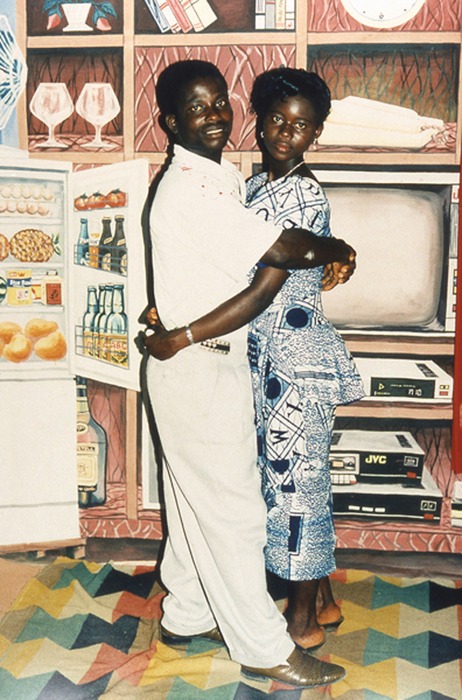
PHILIP KWAME APAGYA REPRESENTING GHANA
I was gobsmacked to learn that Utah still carries out firing squad executions, if the condemned man requests it. Ronnie Lee Gardner requested it.
“I guess it’s my Mormon heritage,” Gardner said at the time. “I like the firing squad. It’s so much easier … and there’s no mistakes.”
And another thought – If Gardner’s being killed because he killed someone else, who’s going to kill the people that kill Gardner?
From Boing Boing:
“Physicians for Human Rights (PHR) today released evidence it says indicates that the Bush administration conducted “illegal and unethical human experimentation and research” on detainees’ response to torture while in CIA custody after 9/11. The group says such illegal activity would violate the Nuremburg Code, and could open the door to prosecutions. Their report is based on publicly available documents, and explores the participation of medical professionals in the CIA’s “enhanced interrogation program.” Download the full report at phrtorturepapers.org.”
Boing Boing goes on to interview the Dr. Scott Allen, co-director of the Center For Prisoner Health and Human Rights at Brown University, and Medical Advisor to PHR.
Allen contends that the ongoing monitoring of torture techniques (waterboarding, stress positions) crossed over into note taking and experimentation on human subjects. Protocols would then demand the involvement of ethics board, consent forms, etc – the safeguards of legitimate research – but obviously, the US military and CIA never saw torture as “experimentation” in its most formal definition.
Allen: “I think it’s certainly possible that while they weren’t eagerly looking forward to setting up research they might have been backed into this by saying, let’s take notes. That citation we note of Appendix F in the CIA 2004 Inspector General’s report, the one that describes the directives to doctors, says, ‘Take these notes in a very meticulous way about how detainees respond to waterboarding so we can better inform our procedures in future.’ That’s describing the framework of a research protocol.”
The note-taking on interrogation techniques probably doesn’t surprise many, but the results of new legal avenues opened up by defining torture tactics as “experiment” and “research” may?
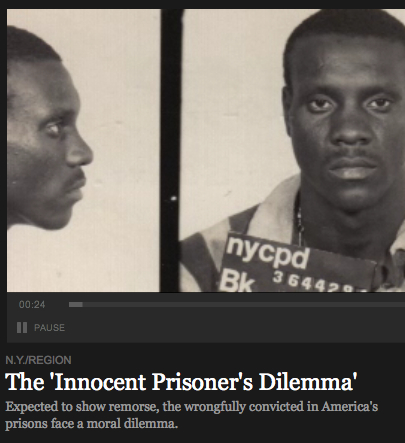
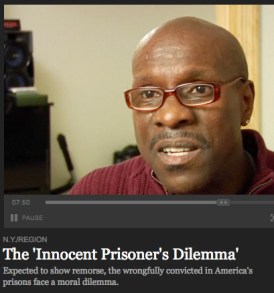
New York Times video The ‘Innocent Prisoner’s Dilemma pores over the profound moral dilemma innocent prisoners face when they present themselves to a parole board. The piece focuses on the case of Herbert Murray (above).
REMORSE IS A PREREQUISITE
Showing remorse for the crime for which they he/she was sentenced increases a prisoner’s chances of parole; the parole board wants to see contrition, wants to see the individual accept the charges, faults and responsibility the court defined many years previous.
One problem. What if the offender was wrongfully convicted? What if he or she IS innocent? The situation becomes Kafkaesque; he or she must agree to a terrible and false scenario (their agency in a crime) in order to escape a much worse scenario (further imprisonment). If an innocent man or woman acknowledges responsibility in order to curry favour, they then become the writers not only of their own history but of their own future. The individual will be forever tied to his or her parole record and the “admission” of guilt.
Herbert Murray’s story is shocking. He spent more than 29 years in prison (he was eligible for parole after 15). Murray only got out due to advanced interventions from his original lawyer and the Second Look Clinic at Brooklyn Law School.
DECISION MAKERS, KEY HOLDERS
Have you ever wondered who sits on a parole board and makes the decisions that affect tens of thousands of prisoners lives each year?
This article Convicted of Murder as Teenager and Paroled at 41 by Trymaine Lee details the job-track:
“Parole Board members, who must have a college degree and five years of experience in criminal justice, sociology, law, social work or medicine, can serve an unlimited number of six-year terms, earning $101,600 a year. By law, they must interview inmates in person and are required to consider their criminal histories, prison achievements and sense of remorse. Ultimately, though, parole decisions are subjective.”
It is great to read reporting that brings a focus to the rudimentary details of staffing and regulation, in this case that of the parole systems. There are many different arms to the criminal justice system and often they don’t compliment one another. In Murray’s case, the parole system reinforced the mistake of the judicial system.
This expository journalism reminds me of NPR’s investigative series on the bail system in January, 2010.
– – –
Thanks to Stan for the tip.
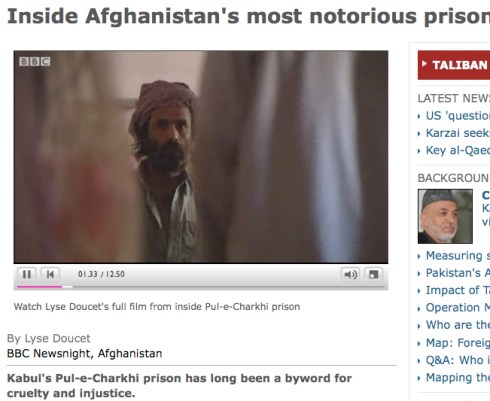
“Here” is Pul-e-Charki.
The long and contested history of this complex has eluded my ability to summarise. Lyse Doucet‘s 13 minute report for BBC Newsnight does an excellent job.
During the earthquake, it was well reported that the National Penitentiary in Port-au-Prince crumbled and all inmates escaped. I posted on it here, here and here.
But this was not the only prison in Haiti. Les Cayes Prison, 100 miles west of Port-au-Prince, was the scene of prisoner protest, guard desertion and mass killings.
Today, the New York Times released the findings of an investigation at Les Cayes.
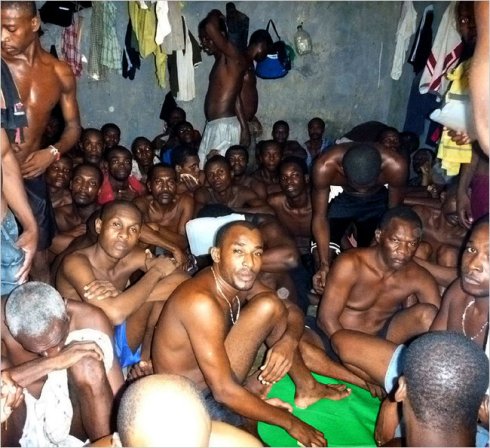
The day after the violence, the Rev. Marc Boisvert, who has run a training program at the prison for many years, was allowed in. Before the riot, conditions there were “inhumane,” he said. Afterward, with more than 400 prisoners in five or six small rectangular cells, they became “seriously inhumane.” Photo by Rev. Marc Boisvert
The New York Times reports, “After the earthquake, the warden, Inspector Sylvestre Larack, put out a “maximum alert” calling his 29 guards back to duty. But on Jan. 19, with much of Les Cayes still in a post-quake state of emergency, only five guards showed up to work inside the prison.”
Squalid conditions, described by Rev. Marc Boisvert as “subhuman”, led prisoners to hatch an escape plan. They beat an officer into surrendering his keys. All the guards fled leaving the prisoners unsupervision and doors unlocked.
Inmates could not leave the prison because UN forces had surrounded the complex.
SUPPRESSION AND VIOLENCE
In the New York Times’ investigation several inconsistencies were found. Among the allegations:
Haitian police gunned down prisoners, beat prisoners and then covered up evidence by burning blood soaked clothing, shoes etc.
Between 10 and 19 unarmed prisoners were killed when Haitian government forces entered the prison and instructed them to move away, lie down and then open fire.
Before the Haitian forces entered, prison authorities asked Senegalese and UN forces to enter the prison using munitions. The UN refused.
The warden, Inspector Sylvestre Larack (who has know been transferred to the post of warden at Port-au-Prince’s National Penitentiary) lied in the first and only internal investigation. He fabricated details of gun use by prisoners upon riot police.
RAMIFICATIONS
At the forefront of your consideration when reading this story should be the fact that, of the 800 inmates, over 300 of the inmates were pretrial detainees. They have not been found guilty of a crime. Some of them were incarcerated for something as little as loitering.
The US has requested $141 million to rebuild Haiti’s justice system. If Haiti cannot carry through its own inquiry to uncover the truth and make accountable those responsible for murder and human rights abuses then it sets a very poor precedent for trust and the culture of governance in the next few years of recovery.
– – –
I HAVE PROVIDED A MERE SUMMARY OF THE NYT INVESTIGATION. GO HERE FOR THE LENGTHY ARTICLE BY. GO HERE FOR A 12 MINUTE VIDEO OF THE INTERVIEWS AND CONCLUSIONS OF THE INVESTIGATION. GO HERE TO SEE ANGEL FRANCO’S PHOTOGRAPHY FOR THE STORY.
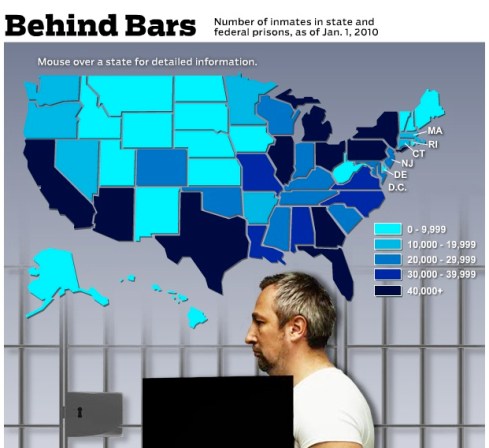
Now I know we all struggle to comprehend millions vs. billions for bail-outs, quarterly profits and deficits.
And I know we are all juggling gallons vs. barrels (US and UK measures) and official and industry estimates as the gushers spew out oil and gas in the Gulf of Mexico …
… but this next figure is simple and devastating. There are 2.3 million Americans in prison. That is more than 1 in every 100 adults. Think on that figure. Simple graphics such as this one by The Pew Center on the States make it easier.
– – –
Even among my close friends, the penny only dropped this week.
If you are in Seattle this Friday, think about dropping in at the Books To Prisoners‘ Art Auction; CREATIVE RELEASE.
Heck, if you turn up with a paperback dictionary you get in for free. I have some inside information that the quality of art is high. Loads of lithographs and a bunch of Just Seeds prison-specific prints!


 Prison Photography