
You are currently browsing the category archive for the ‘Prison Non-Photography’ category.
Magnum and Haiti intersect in a number of portfolios. Having done a lot of looking recently (here, here and here) Alex Webb‘s photography stands out.
Webb’s photography is unmistakable; he carries his busy compositions across the globe – Turkey, Santo Domingo, Mexico, Haiti …

Alex Webb. TURKEY. Istanbul. 2001. View from a barbershop near Taksim Square.

Santo Domingo. 1980. ©Alex Webb/Magnum Photos

© Alex Webb, Ponce, Puerto Rico, 1990

© Alex Webb/Magnum photos. TURKEY. Istanbul. 2004. South of Uskudar. Along the sea wall in the late afternoon.
I’ve often wondered what Webb’s thinks when he approaches groups of people and accoutrements. Indeed, I’ve wondered if (at this point) sniffing out these hectic visual environments is an unconscious practice.
On his blog today, Webb responded to a reader’s question about the framing of his images:
Saying “to run an anatomy of the scene” makes the process sound highly analytical. Nothing could be further from the truth.
My process is not about thought, not about analysis, but rather about feeling the totality of a scene and responding intuitively, emotionally, non-rationally. I have sometimes used the word “smell” in this context (and I think I am paraphrasing Cartier-Bresson) specifically because smell is sensory, not rational. The process can be a bit mysterious. When I photograph, I sense the possibility of something — something about the feel of a place, the situation, some impending moment, the light, the color, the space, the shapes — and I often hang out and wait, hoping that something will happen, something will emerge. But I’m never sure quite what this something is.
For me, the elements that go into the picture are often emotional elements: not just what is in fact “happening” in a situation (the purported “subject” of the image), but the space, the color, the light. Form isn’t just form, it can be emotion. Color isn’t just color for color’s sake, it, too, carries emotion. Sometimes a shape in the foreground becomes some kind of transformative element, sometimes an empty space strikes a special emotional note, sometimes the color changes what wasn’t an evocative scene into something very different.
[My underling]
The term composition is more appropriate to describe Webb’s photography than that of his contemporaries. He stalks opportunities to frame multilayered compositions, in that he puts himself in the best spot and then lies in wait. And his compositions, akin to music, “strike emotional notes”.
Webb states his process is not analytical, but I wouldn’t say it isn’t disciplined.
View Webb’s Magnum portfolio and a sumptuous Webb selection of images with high contrast compositions from The Edelman Gallery.
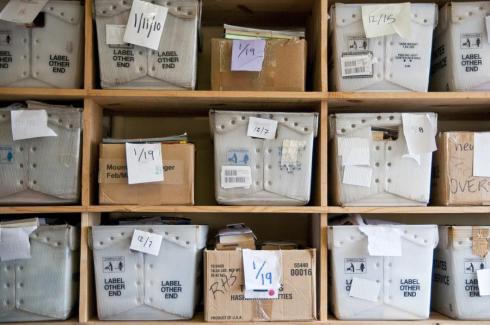
Photo by Sang Cho.
I volunteer with the Seattle organisation Books to Prisoners. It’s a pretty awesome initiative; in 2009 it mailed 12,000 packages to prisoners across the US.
Seattle is helped by satellite groups in Bellingham and Olympia in Washington, and Portland in Oregon.
Books to Prisoners has just been presented with a generous 2:1 matching grant by a local family foundation. That means if you donate $20 it is actually a $60 donation.
If there was ever a time to donate it is now!
Books to Prisoners engages volunteers from all walks of life and has lasting relationships with student volunteers from Mercer Island High School, Seattle University, Shoreline Community College and the University of Washington.
The UW Daily just published this article – quoting my buddies Andy and Kerensa – which explains a little more about the BTP community.
The tasks are simple, the impact huge.
Books to Prisoners is a very slim and simple operation; all donations go directly to operating costs (postage, wrapping paper, tape, and occasionally purchasing dictionaries). It is an all-volunteer staff, so no money goes to salaries, staffing or admin.
There are 2.3 million prisoners in the US, a quarter of the world’s prison population. Ignoring them doesn’t make a society safer, engaging their minds does. 95% of prisoners in the US will be released at some point. It is in all our interests to treat them with dignity and provide simple tools for them to aide their own rehabilitation.
Thank you

Louisiana has the highest rates of incarceration of minors of any state in the country. Louisiana has the highest incarceration rate per capita of any state in the country.
It has now become the first state to sue its own death row inmates:
via Solitary Watch.
The absurdity of this gesture is fitting for a policy that only ensures time and resources are wasted on arguing the merits for and against killing people for symbolic purposes.
Get beyond the obvious – that is that the state shouldn’t be involved in de-existing people – it seems the main conclusion to be drawn is that hundreds if not thousands of jobs rely on the self-indulged death-industry toying with the fate of death-rowers for decades.
It seems to me that victims, victims’ families and those sentenced become a secondary concern; an infrastructure of legal jousting imposes itself, acquires its own logic and fights it out because that what the cogs demand. The results are laughably tragic deadlocks and bizarre gestures such as that of suing convicted individuals who are virtually powerless anyway.
My solution would not be to limit the legal avenues of appeal following conviction, it would be to abolish the death penalty as a sentencing option.
Just as the state should not be involved in killing people, it should not be involved in the retaliatory-posturing concerning the killing of people.
_________________________________________________
Previously on Prison Photography: There is a lot of inequalities within Louisiana’s criminal [in]justice system, that I have touched upon here, here and here. There’s also chinks of light in an unforgiving system such as radio and football programs at Angola.
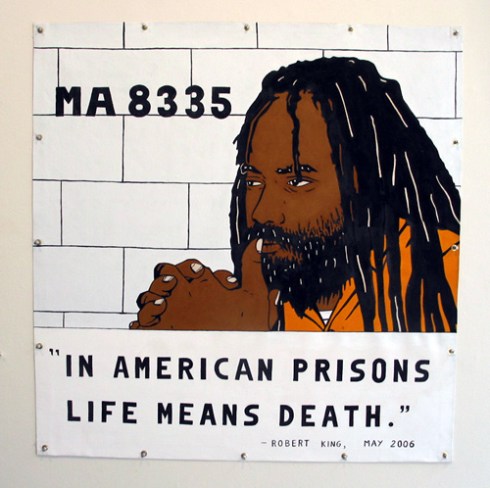
Source
I just came across one of Rigo‘s works in a book about prisons, but I can’t find it online so I wanted to share that which I could find.
I wondered if Rigo had done anything else. Turns out he has and he’s passionate about criminal justice abuses. Aside of his piece above in support of Mumia Abu Jamal*, Rigo has done works to rally support for America’s other most famous political prisoner, Leonard Peltier*.
Rigo also painted TRUTH (2002), an epic mural on Market Street in San Francisco, which I used to cycle past most days a without knowing its reason for being. It commemorates the 2001 quashed conviction of Robert H. King, one of the Angola 3, after 32 years of incarceration, 29 of which were spent in solitary confinement.

(Source)
* Yes, I know I could have chosen from thousands of links for Mumia and Peltier, but I chose their Twitter profiles with my eyes open to how bizarre it is. I have wondered if we live in a post-revolutionary world in which our radicals are reduced to blips of 140 characters, but then I figure the famous and infamous of the past have always survived on soundbites. I guess I ask that you use Mumia’s and Peltier’s Twitter feeds as one of many starting points for learning about their cases.
In November, I penned a piece for Change.org about the Texas Department of Criminal Justice’s ban on two books that advocated for prison reform.

This week, friend Matt Kelley brought to my attention that Texas is now banning John Grisham novels. Kelley describes the sophisticated approach of the TDCJ:
The system is fairly arbitrary – prison mailroom staff look for offensive images and make the decision on the spot. Prisoners can appeal to state officials, but it’s tough to argue on behalf of a book you can’t see.
C’mon! Really? Add your name to over 500 petitioners.
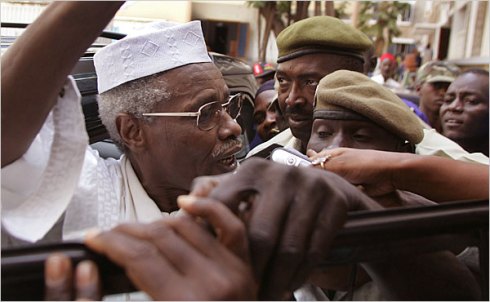
Schalk van Zuydam/Associated Press
A new study by the Human Rights Data Analysis Group (HRDAG) discloses documents prepared by Hissene Habré’s own Documentation and Security Directorate (DDS) to prove he was personally aware of the deaths of political opponents. Habré has been accused of killing and systematically torturing thousands of political opponents during his rule in Chad, from 1982 to 1990.
It has been 10 years since his indictment, yet despite strong evidence, he will not be tried until Senegal (which agreed to host the trial in 2006) receives €27.4 million from the international community to fund the trial.
The Documentation and Security Directorate (DDS) pursued opponents and operated notorious prisons during the Habré regime. The files were discovered by chance by Human Rights Watch in 2001 at the abandoned Security Directorate’s headquarters in N’Djamena, the Chadian capital.
FURTHER RESOURCES
Copies of the HRDAG report in English and French are available at: http://www.hrdag.org/about/chad.shtml
For more information on the case against Hissène Habré, please visit:
The governator wants to outsource California’s prisons to Mexico. Arnie went totally off script and blurted out an idea not even Matthew Cate, Secretary for the California Department of Corrections could, or would, back up.
Schwarzenegger suggested that outsourcing would save California $1billion/year, but couldn’t state from where he got the figure.
The idea is a non-starter for so many reasons. I know Arnie is desperate for solutions but he must at least be expected to stay within the realms of reality, no?
In a loose tangential thread, I have been impressed recently by the works of Livia Corona and Alejandro Cartagena.
Corona and Cartagena both train their lenses on suburbia, not prisons (although the psychologies of the two architectures may converge?)
On the evidence of their photographs the construction industry in Mexico is booming, even if it is ugly.

© Livia Corona. From the series, 'Two Million Homes for Mexico'

© Alejandro Cartagena. From the series, 'Fragmented Cities'
Thanks to Katie DeGraff for the tip off on Arnie’s madness
There are prisons and there are jails. The two differ.
Prisons are where sentenced offenders get sent after trial, and they are run by the state.
Jails are where offenders go before trial, and they are run by the county. All offenders, at least for a short while, will go to jail and get booked. If they can post bail they’re out until court date. If they can’t afford it, they remain until their day in court … which can sometimes be many, many months. (It should be said, some short-term sentences are served in local jails).

Across the street from the county jail in Lubbock, Texas, is a row of one-story offices housing Lubbock's bond companies. There are about a dozen bail bond companies in this city of 250,000. © Katie Hayes for NPR
THE BAIL BOND INDUSTRY
Last week, Laura Sullivan‘s sterling three-part report on the US’ broken bail system ran on NPR. Sullivan writes it LARGE: Money rules; the bond system is simple market capitalism. It favours the rich and punishes the poor.
Research shows that those who post bail serve less time post-trial. This is for many reasons, but mainly because once released, the accused can prove to the court (between arrest and trial) that they can stay straight; hold down a job; and publicly respond to their transgression in a socially-agreeable manner, in other words, attempt whatever is necessary to please the court.
However, there are half-a-million people locked-up in US jails either waiting or unable to pay bail. This is more criminal than any act these half-a-million may have committed. REMEMBER: Bail is not granted to violent or dangerous suspects, and the majority of those jailed are non-violent criminals usually for a small-victimless crimes (minor traffic infraction, petty theft).
Amounts differ to post bail differ, sometimes being as low as $50 (that’s a $10 down-payment to a bondsmen on a $500 bail).
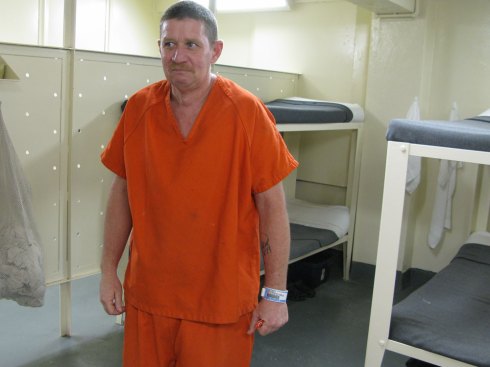
Leslie Chew, in Lubbock County Jail for theft, said his $3,500 bail was "like a million dollars to me." © Laura Sullivan for NPR
The result is that cases such as Leslie Chew’s cost the tax payer over $7,000 for 185 days of incarceration … all because he couldn’t afford the $350 down-payment for bail. His crime? Stealing $120 worth of blankets because he was suffering the cold sleeping in the back of his station wagon.
Chew is typical of many stuck in the system. But the system has alternatives. Offenders could be released on trust (a practice that used to be common) and expected to show up for court OR they could be part of pre-trial release programs using probation officers and tagging technology.
Pre-tirla release programs cost only between $2-$7/day. Compare that to $38-$115/day to house an inmate. Statistics have shown pre-trial release programs effective and offenders show up for court as regularly as those on bail.
In total the broken bail bond system costs US tax-payers $9billion/year!
WHY DOES A BROKEN SYSTEM PERSIST? WHAT ABOUT THE ALTERNATIVES?
NPR describes, ‘Ken Herzog, manager of Trammel’s Lubbock Bail Bond for over 25 years, sees an average of six people a day who need to be bonded out of jail. His bonding company currently has between 2,500 and 3,000 active accounts.’ Because they cannot secure new accounts, the bail bond industry sees pre-trial release programs as direct completion. Bail-bondsmen have organised strong lobbying groups in counties where alternative pre-trial release programs were in use.
As an example, Sullivan points to Broward County, Florida:
Bail bonding became political in Broward [and] sent shock waves through pretrial programs across the country. Here in Broward, bondsmen pushed hard for a new county ordinance that now limits the pretrial program. Now industry experts say powerful bail lobbying groups have begun using Broward as a road map of how to squash similar programs elsewhere, even though public records show the programs have saved taxpayers millions of dollars.
This gutting was all the more catastrophic because the pre-trial release program was so successful. It alleviated jail overcrowding that was deemed by a judge as unconstitutional.
Instead of building a new $70 million jail as they had proposed, county commissioners voted to expand pre-trial release, letting more inmates out on supervised release. Within a year, the jail population plunged, so much so that the sheriff closed an entire wing. It saved taxpayers $20 million a year.
And, according to court records, the defendants were still showing up for court.
“DON’T PISS ON ME AND TELL ME IT’S RAINING”
The Broward ordinance passed and, in so doing, slashed the number of defendants eligible for the pre-trial release program by hundreds.
Who, they wondered, could possibly be against a demonstrably successful program? Follow the money:
In Broward County, 135 bail bondsmen amassed and hired a lobbyist, Rob Book:
“To be perfectly arrogant about it, I’m considered if not the best, [then] one of the best in the state,” says Book. He has been lobbying for bondsmen in Florida for more than a decade.
According to campaign records, Book and the rest of Broward’s bondsmen spread almost $23,000 across the council in the year before the bill was passed. Fifteen bondsmen cut checks worth more than $5,000 to commissioner and now-county Mayor Ken Keechl just five days before the vote.
EDITORIAL: THE UNITED STATES OF CORRUPTION
Sometimes, I am carefully worded. I work with prisoners, correctional officers, DoC administrative staff and activists weekly – I must be diplomatic.
But I have no care for the bail-bond business nor the corrupt bondsmen and bought politicians of Broward County, Florida.
Their system is self-serving. It does nothing to protect NOR serve. It is overly punitive. The bondsmen are hacks and the politicians they bought are contemptible.
I hope that the backhanded decision-making in Broward is not typical, but I fear it is not isolated. Selfish, zealous systems such as those Laura Sullivan exposed are ruled by revenge, fear-emotion and profit.
The bail-bond system of America is on this evidence devoid of progressive policy. And, when a small light of common sense policy rears its head based on solid figures and a reduced bottom-line, still well-heeled and big-footed buffoons can kick it all to shit.
DISPICABLE.
THE FULL ROSTER
Part One: Bail Burden Keeps U.S. Jails Stuffed With Inmates
Part Two: Inmates Who Can’t Make Bail Face Stark Options
Part Three: Bondsman Lobby Targets Pretrial Release Programs
All brought to you by Laura Sullivan
Thanks to Jim Johnson for alerting me on this.

 Prison Photography