
You are currently browsing the category archive for the ‘Prison Non-Photography’ category.
Spot us
I filmed Dave Cohn‘s breakthrough Talking Heads jam sesh in 2005. The atmosphere was electric. It was also in our front room. I knew him when he was an intern at Wired.
I was really pleased therefore when he returned to San Francisco after grad school with a head full of ideas and pocket full of cash to launch Spot.Us

Spot.Us uses a crowd-funding model to support journalism. It is “an open source project, to pioneer ‘community funded reporting.’ Through Spot.Us the public can commission journalists to do investigations on important and perhaps overlooked stories … All content is made available to all through a Creative Commons license. It’s a marketplace where independent reporters, community members and news organizations can come together and collaborate.”
In the Spot.Us early days, I suggested a Tip to the community that it produced reporting on the impact of the economic downturn on California prisons. The speculation in the wording of my tip is now outdated – even laughable. We know that the CDCr has more than struggled – it has hit meltdown. The CDCr’s fiscal crisis can only turn inmates loose without sufficient re-entry support.
The function of ‘Tips’ seems to be simply to register interest; they are pithy when compared to the ‘Pitches‘ which are constantly promoted and on the search for supporters. Spot.Us not only empowers ordinary citizens through the $20 donations it also has established partnerships with big media – most recently the New York Times for Lindsay Hoshaw’s story on the Great Pacific Garbage Patch.
Prison Health Reporting
Prison Photography would like to encourage you all to support Bernice Yeung’s Prison Health Reporting.
Yeung explains the need for journalism, “Parolees without proper access to drug treatment, mental health and medical care could have potentially serious public health and public safety ramifications. This issue has attracted the attention of policy makers, prisons, doctors and social service providers, who are increasingly trying to connect parolees with medical care and social services upon their release.”

While my position on the broken and punitive prison system of the US is well known, I have hardly commented on the need for expanded reentry support programs.
I think public safety is a notion too easily manipulated and reduced to rhetoric when legislation is created, but it is a reality that must be objectively measured when former prisoners are released.
Yeung’s focus on the drug and mental health programs, the practitioners and clients, and their testimony is the right inquiry. Yeung’s work will crystallize the life-changing, damaging, shocking and (occasionally) redemptive effects of prisons on folk in our society. Any one of the stories she tells will be more worthy than the electioneers’ tough on crime doublespeak.
Here’s the latest from Bernice Yeung on the Spot.Us blog.
______________________________________________________
Spot.Us is a fantastic experiment and is a part of the puzzle to all of those questioning what the future of news reporting will look like. See what all the fuss is about here.
______________________________________________________
Image: The image above originally appeared in the Spot.US blog post Prisons & Public Health: Why Should You Care? It is uncredited. I am curious about the image, because I am not even convinced it is from an actual prison. I would guess that a closely-cropped black & white image including bars, an obscured face and a blinding source of outside light ticks all the right boxes for a photo illustration. Our brain is fooled by these visual cues.
In this case, the writing and the appeal are more important than the image and, if my reading is right, I understand why this image was manufactured. However, I could be completely wrong. I’d like to know the photograph’s back-story….
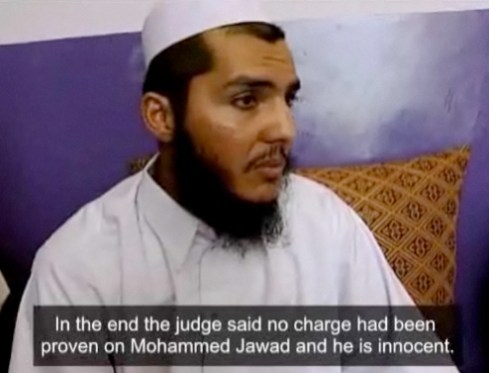
His family claim he was 12 when he was taken into US custody. The pentagon claim he was 17. Whichever the case, the treatment remained the same.
Video from the Guardian.
“These analyses [of the prison system] – coupled with what I had seen firsthand – made sense, steering me to work towards the dismantling, rather than the reform, of the prison system. Resistance Behind Bars should not be mistaken for a call for more humane or ‘gender responsive’ prisons.”
Vikki Law (Source)
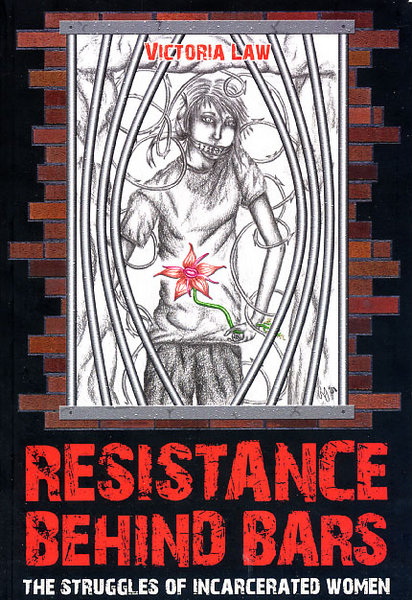
This is the second in a three part mini-series entitled Women Behind Bars, casting an eye over the work of writers and artists dealing with women’s struggle within the US prison system. The first installment featured journalist Silja Talvi’s work. Today we look at the activism of Vikki Law.
Speaking
“How many people know about the Attica prison riots?” asked Vikki Law. The majority of the audience raised hands. “How many of you have heard of the August Rebellion?” she then asked. No response. Point made.
The August Rebellion was staged in 1974 by women imprisoned at New York’s maximum-security prison at Bedford Hills. Protesting the brutal beating of a fellow prisoner, the women fought off guards, holding seven of them hostage, and took over sections of the prison.
Writing
Vikki Law wrote Resistance Behind Bars to counter the historical erasure of women’s prison resistance. The book challenges the reader to question why these instances and efforts have been ignored and why many assume that women do not organize to demand change. It fills the gap in the existing literature, which has focused mostly on the causes, conditions and effects of female imprisonment.
Law has worn many hats in the anti-prison movement. In 1996, she helped start Books Through Bars-New York City, a group that sends free books to prisoners nationwide. In 2000, she began concentrating on the needs and actions of women in prison, drawing attention to their issues by writing articles and giving public presentations. Since 2002, she has worked with women incarcerated nationwide to produce Tenacious: Art and Writings from Women in Prison and has facilitated having incarcerated women’s writings published in larger publications, such as Clamor magazine, the website “Women and Prison: A Site for Resistance” and the upcoming anthology Interrupted Lives.
Similar to Talvi’s work, her writing is uninfected with academese. Law’s focus is the self-organised activities of women prisoners such as forming peer education groups, clandestinely organizing ways for children to visit mothers in distant prisons and raising public awareness about their conditions.
Law will criticise writing that she deems unhelpful and misleading. For example she refutes author Virginia High Brislin’s work which stated “women inmates themselves have called very little attention to their situations,” and “are hardly ever involved in violent encounters with officials (i.e. riots), nor do they initiate litigation as often as do males in prison.”
Law urges us to acknowledge the existing patriarchy of society. The term feminism has become co-opted by predominantly white and privileged classes. The actions that would have previously fallen under the purview of feminism continue in pockets and without a top-down label. She states:
Once such case would be that is described below. Law takes the details from a letter written by the victim.
In the case of Barrilee Bannister, sentenced under Oregon’s mandatory sentencing law, she and seventy-eight other women were sent to a privatized, all-male prison in Arizona run by the Corrections Corporation of America (CCA). The approximately 1300 mile move completely cut the women off from family, friends and others whose outside support could have prevented their abuse. Only weeks after the women’s arrival, some were visited by a captain, who shared marijuana with them. He left it with them and then returned with other officers who announced that they were searching the cell for contraband. They promised that if the women performed a strip tease, they would not search the cell. “Two of the girls started stripping and the rest of us got pulled into it,” Bannister recalled. “From that day on, the officers would bring marijuana in, or other stuff we were not suppose[d] to have, and the prisoners would perform [strip] dances.” From there, the guards became more aggressive, raping several of the women. Bannister reported that she was not given food for four days until she agreed to perform oral sex on a guard. (Source)
Private prisons will forever provide opportunities for gross abuse of human rights, but this is obvious and a discussion for another time. Still, on this evidence, Law has a long road of resistance and a lot of public education to provide. I wish her well.
Photography
Law’s commitments don’t stop with the pen. She also wields a camera and has contributed significantly to the activist-photography community of NYC.

ABC No Rio through a 6-year-old’s Holga, 2006
In 1997, she organized a group of activist photographers to transform one of No Rio’s upstairs tenement apartments into a black-and-white photo darkroom for community use. Since then, she has remained actively involved in coordinating (and sometimes co-teaching) free photography classes for neighborhood youth. In addition, she has participated in and curated numerous exhibitions at No Rio’s gallery, many with themes addressing social and political issues such as incarceration, grassroots efforts to rebuild New Orleans, Zapatista organizing, police brutality and squatting.
Every Halloween, Law also moonlights as a portraitist for ABC No Rio‘s free haunted house for kids. As she explains, “Over 400 kids from the neighborhood show up to shriek and scream their way through the first floor and backyard. Tipping my hat to Tom Warren’s “Portrait Studio” in the 1980s, I set up a portrait area to document some of the kids and their costumes.”
Below is Prison Photography‘s favourite.

Please read Vikki’s extended resume. Check out Vikki’s Flickr photostream. For a list of resources from The Action Committee for Women in Prison click here.
This is the first of three posts celebrating the work of journalists/academics/photographers bringing to popular conscience the abuse of women in the American prison system.
I have called this triplet mini-series Women Behind Bars and it was spurred by a couple of news stories this week. In New York state, protesters outside the Governors house drew a promise from David Paterson that he’d sign legislation banning the chaining of incarcerated women who are giving birth.
Also, a class action lawsuit is gearing up in Michigan, which seeks a $100million settlement for over 900 female inmates and former-inmates who suffered harassment, groping and rape between the years of 1993 and 2009.
Women Behind Bars as a name for this mini-series was co opted from the Silja J. Talvi‘s most recent book of the same title.
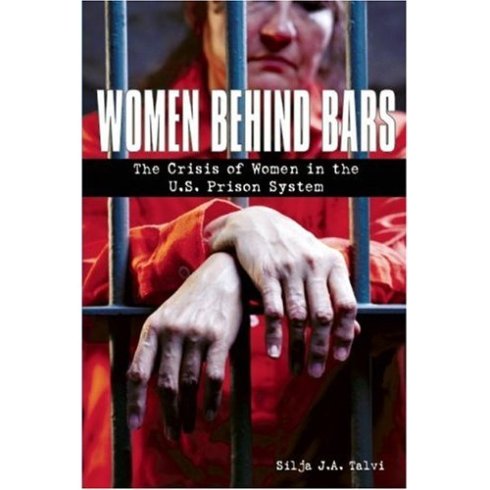
I had the pleasure of hearing Silja talk at the Seattle Public Library. Silja speaks as she writes – without jargon or polygonal argument. She keeps it simple; she is usually retelling the testimony of female prisoners she has visited and interviewed. No flourish required.
Beyond the physical and sexual harassment of female prisoners, Talvi asks us to reevaluate our understanding of psychological welfare as it is handled by the prison system. The 775% increase in the US female prison population since 1977 is – for want of a better word – criminal. It is double the rate of growth for the male prison population. Talvi is in no doubt that this increase is due for the most part to the war on drugs. Talvi also describes the constituencies entering US womens prisons.
Talvi’s work crystallises the fact that the massive incarceration of American women has not been a result of crime on the streets, but a result of criminalisation by writ of political assemblies. In the war on drugs, women are involved but surely we must analyse that involvement. Occupying residence, associating with family drug dealers are indirect misdemeanours that stand to be punished. When a society is blighted by drugs and the dealers are involved in the “war” on the street, usually it is women who hold the threads of family and community – and home – together … despite its faults and its drug use.
Talvi points to another remarkable trend,
There’s also the fact that women are less likely than men to snitch on loved ones. Prosecutors will come to them and say they will go to prison unless they give up the names of three higher-ups, but women usually either say they don’t know those people or will simply decline. Men will snitch and, unfortunately, they often get less time in prison than women who don’t.
The shocking statistics are simply an application of US culture that is too morally bankrupt & class divided to think of more imaginative forms of criminal justice than incarceration.
Prison is a violent, inhumane environment – the modern designations of built with violent offenders in mind. But what proportion of women prisoners are violent? Not nearly as many as our fear-gripped culture would presume.
The prison is a disciplinary tool that has needlessly subjugated women. It has been imposed and it has demolished poor communities.
When Talvi supports prison for violent murderers and rapists and then argues for its non-implementation for female ‘criminals’ she is entirely consistent. The prison has a place, but it is not in the persecution of non-violent females, it’s counter to the notion of justice and it flies in the face of social justice.
As This Is Not A Book Sale put it,
The book Women Behind Bars was produced as part of the Women Behind Bars Project which:
[Source]
Women Behind Bars. The Book: More and more women—mothers, grandmothers, wives, daughters, and sisters—are doing hard prison time all across the United States. Many of them are facing the prospect of years, decades, even lifetimes behind bars. Oddly, there’s been little public discussion about the dramatic increase of women in the prison system. What exactly is happening here, and why?
Bio: Silja J. A. Talvi is an award-winning journalist with credits in more than seventy-five publications nationwide, including The Nation, In These Times, and the Christian Science Monitor. She was honored as a recipient of the 2005 and 2006 PASS awards for criminal justice reporting by the National Council on Crime and Delinquency, a 2006 New American Media Award, and twelve regional SPJ awards for excellence in journalism. Talvi’s work has appeared in numerous anthologies, including Prison Nation: The Warehousing of America’s Poor, Body Outlaws, The W Effect, It’s So You, and Prison Profiteers. She lives in Seattle.
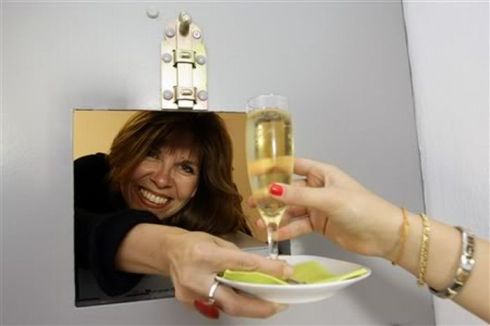
Jolted by photographs from this ludicrous Alcatraz Hotel in Kaiserslauten, Germany I recalled an article about prisons & jails converted to tourist accommodations. I guess it makes sense to convert solid and culture-worn stone fortresses into chic hotels such as at the Charles Street Jail/Liberty Hotel, Boston (it seems a shame to waste all that cool masonry) but a prison-theme is downright tacky.
I like the no-nonsense approach of Mount Gambier Jail in Australia which “markets its rooms as budget accommodations for cheapskates and backpackers”. Oxford Castle/Malmaison Hotel in the UK retained the open cell tiers of the prison, just adding some mood uplights for the new plastered ceiling.

Here’s an article on “Slumber Slammers” which points to the larger tawdry scene of architecture-as-theatre for those wantaway tourists whose appetite for the early 21st century now fails them.
Not to be outshone, the Japanese go the farthest in recreating the prison-spectacle with handcuffs, dungeon-krunk, lethally injected cocktails and salads that refer to incest?! Don’t quite understand the link for that last one …
I’d like to begin a discussion here about recuperation, but that is presuming there was ever an element of resistance or meaningful political opposition from these various sites. All we can say for certain is the current histories of these spaces are gradually erasing those of the past.

I have talked before about prison aesthetics in fashion. In the case of Haeftling, my criticism was tempered by the professed share of profits with the inmate population.
This example from Nike is less complex. These are trainers “inspired” by prison. The ‘Prison Blues‘ sneaker. How bland.
The jejune description of the shoe is trumped only by the inanity of the comments.
The quotes on the sneaker are those of Johnny Cash – an inadvertent and tellingly naive inclusion. Cash, despite his self-manipulated jail-bird image, only spent one night in lock up and (certainly today) has little to do with the reality of American prisons. I’d loved to have seen quotations from Eugene Debs, Clarence Darrow, Angela Davis or Elliot Currie used instead, but they aren’t commerce-compliant …
Ever wonder how many stories you’ve missed? Ever wonder if your world-view could be different?
Take a camera into a prison and you’re going to hear some honest tales. When people are going through a process of self-forgiveness or asking for forgiveness from others then honesty pours …
“I Knew a Man Named Simon”
The Forgiveness Project is an international charity which, among other activities, offers free digital media courses in British prisons. At the end of each course, the prisoners produce a short film on the subject of forgiveness
M.K’s story is well-delivered and uninterrupted by the questions or expectations of society. Other films from The Forgiveness Project are less gripping, but the purpose isn’t solely to entertain – it is to provide a medium through which an individual can unravel their thoughts, (often) guilt and apply forgiveness in a form that rings true.
Prisoners Offering Advise for New Prisoners
Brixton prison was in the news recently with the success of its radio station, so it should be no surprise it would also embrace film as a means to self-rehabilitation. According to the introduction, this is “the first ever film made by prisoners about life in a British prison uncensored and uncut.”
H.M.P. High Down also hosted The Forgiveness Project
Alistair Pirrie has been the lead on The Forgivness Project’s work in prisons.

The Sybil Brand Institute for women, Los Angeles. Photo Credit: LA County Arts http://www.lacountyarts.org/civicart/01_First_District/1_ela_s_sbi_ppdt_davis.htm
The fixations of Prison Photography on the infrastructural order of sites can as easily be applied outside of carceral space. The Center for Land Use Interpretation has terminus container ports, petrochemicalscapes, first responder training sites, landfill waste streams, pacific coastlines, nuclear proving grounds and even the Trans-Alaska pipeline covered by roving reconnaissance.
There is even a brief field report from the Angola Prison Museum, but I’ll have to come back to that.
I’d like to present the archive for the CLUI’s 2001 exhibit, On Locations: Places as Sets in the Landscape of Los Angeles.
Have you ever questioned the fabric of prison environments in TV or film? There were plenty prison (visiting room) scenes in The Wire, but I was too engrossed in episodes to pay the backdrop any mind. Well, this should get you thinking.
Filming in active prisons is generally not permitted for obvious reasons, and as a result, prison sets are built in soundstages, back lots, and inside other locations. A few prisons in Los Angeles are currently closed, and are regular filming locations. The Sybil Brand Institute, at the County Sheriff’s complex in City Terrace, east of downtown, was the primary Los Angeles County correctional facility for women before it closed in 1997. Though still managed by the sheriff’s department, it is now used exclusively for filming.

Credit: CLUI. Sybil Brand Institute's visiting area has appeared in several films.
Built in 1963, Sybil Brand was a minimum to maximum security facility, with a design capacity of 900, and a peak occupancy of 2,800. It once housed Susan Atkins (whose confessions to a cellmate at the prison led to the arrest of Charles Manson and family), and Susan McDougall of Whitewater scandal fame. When Sybil Brand closed, inmates were transferred to the new Twin Towers complex. The County may renovate the building and open it again as a prison, but in the meantime it offers modern looking prison rooms including cafeterias, hallways, recreation areas, visiting areas, infirmaries, and cells from solitary confinement to dormitories. As it was a women’s prison, the interior walls have a pink color, which is usually painted over for filming.
Productions film here at a rate of two or three per month. The film Blow, about cocaine dealers, recently spent five weeks shooting all over the prison. Other productions include Arrest and Trial, Gangland, X-Files, and America’s Most Wanted.
Though older and more run down, the City of Los Angeles jail in Lincoln Heights is also closed, and is used regularly as a film location, appearing in NYPD Blue, Unsolved Mysteries, and other film and television projects.

Mel Melcon / Los Angeles Times. VISITING ROOM: L.A. County Sheriff's Deputy Jack McClive peers through safety glass, while standing in the visiting room, during a tour of the Sybil Brand Institute Women's Jail in Monterey Park.

 Prison Photography