
You are currently browsing the category archive for the ‘Prison Non-Photography’ category.

–
Earlier this month, in Portland, Oregon, a coalition led by immigrants and refugees, successfully campaigned to see the city cut its ties with prison profiteer Wells Fargo. At the same time, in Los Angeles, Black students moved California State University Los Angeles (CSULA) to divest from private prisons and reinvest in services for Black students.
These victories follow on the heels of the divestment by a $25M endowment fund from the University of California and Columbia University’s decision to divest fully from prisons.
These victories demonstrate the sweeping effect that committed and targeted activism can have. Dismantling the prison industrial complex requires paradigmatic shifts, brave thinking, millions of small + incremental fixes as well as massive, infrastructural disassemblage. These divestment victories are such disassemblage, and they show that committed individuals can pressure institutions and civic authorities to enact transparency and moral judgement when it comes to invested monies, endowments and assets.
These victories feel like, if you will, a bright spot on the yard. Moments of illumination.
I’ve watched with great admiration as the divestment movement has grown in the past few years. A lion’s share of the good work has been done by Enlace, an alliance of low-wage workers, unions, and community organizations in Mexico and the U.S. Enlace’s interest began with the growth of privatized immigrant detention facilities (Under the rubric of homeland security, Federal laws have changed, and the detention of people without papers has grown exponentially.)
But of course, the capitalism and social fear that gives rise to ICE prisons, has the same roots as that which gave rise to the tumorous growth of state and federal prisons over the past four decades. Of all the factors that drive the growth of the prison industrial complex, money is the most pernicious and, perhaps, the most invisible. Enlace targets the cycle, intends to interrupt the flow of finance and influence.
–

Photo: Pete Shaw
Currently Enlace has offices in Portland, OR; New York, NY; and Los Angeles, CA. The organization has identified key targets within the cycle of exchanged goods, ideas and policy. From the Enlace website:
Private Prisons
Two publicly-traded companies dominate the private prison market in the U.S.: Corrections Corp of America (CCA) and GEO Group (GEO). CCA and GEO are notorious for abusing inmates, understaffing, and committing fraud at their for-profit prisons and detention centers. Both lobby the government for contracts and for policies that promote mass incarceration and immigration enforcement. In 2012 alone, they netted $3 billion of our taxes and spent over $1.8 million on lobbying and campaign contributions.
Million Shares Club
33 major investors own nearly all CCA and GEO stock. Each of these 33 investors owns over 1 million shares of private prison stock, so they have a huge stake in the growth and success of the prison industrial complex. With the financial and political support of the Million Shares Club, CCA and GEO are able to successfully lobby for policies that increase government demand for private prison, like “tough on crime” laws and criminalizing immigrants. We must sever the financial ties that allow shareholders to cash in on the incarceration of immigrants and people of color.
Local Institutions
Most of us are invested in private prisons–our universities, cities and faith institutions are invested with the Million Shares Club, which has no portfolio screen preventing the investment of our money in for-profit prisons. Some states, universities, cities and pension funds are even directly invested in CCA and GEO. It is unconscionable that our local institutions are using their investments–our money–to profit from and promote mass incarceration and immigration enforcement. We call on our local institutions to divest!
Politicians
Federal politicians have the power to stop private prisons. Members of the Budget and Appropriations committees have the most power to cut off funding for wasteful contracts with CCA and GEO, and for inhumane immigration enforcement policies. Unfortunately, many politicians take lobbying and campaign contributions from GEO and CCA. Others have assets in the Million Shares Club. Many politicians have both. We’re working to make private prisons a toxic liability, financially and politically.
Activism to stymie the ease with which corporations and politicians can exploit economically and socially disadvantaged communities is thrilling.
And it’s free! You can investigate private prison investments in your community and launch your own campaign. Map it here. More resources here.

–
There are many stories of prisoners’ resourcefulness and creative spirit. There’s lots of tales of redemption through art, or something akin to it. The grandly titled Prison Da Vinci is one of the better produced tellings of this type of story arc.
Filmmaker Zach Sebastian relies heavily on the subject Chris Wilson’s words and phrasing. The viewer is quickly told why a British guy was locked up in San Quentin so that we’re accelerated to the important details of how and why he made paintings made of candy.
I was surprised–but happily relieved–that Wilson was able to exist in San Quentin outside of the gang culture. He encounters philosophy for the first time and met a lot of good people, he says. And he made art.
(The Prison Da Vinci film recalls to mind the work of Donny Johnson, a man convicted of second degree murder who paints postcards with colours leached from M&Ms in his Pelican Bay State Prison solitary confinement cell for the past decade-or-more. In 2006, Johnson had a show in Mexico.)
Whilst Wilson–the artist–prevails, his existences is not far from hell. What’s missing from Prison Da Vinci is a fuller picture of the depravity Wilson experienced inside the California prison system … but that’s too big for a 4-minute short and would take us off the topic of art. We know from his book Horse Latitudes that Wilson had a torrid time of it.
Horse Latitudes first landed on my radar last year when Aaron Guy (and here) sent me a copy (Thanks, Aaron!)
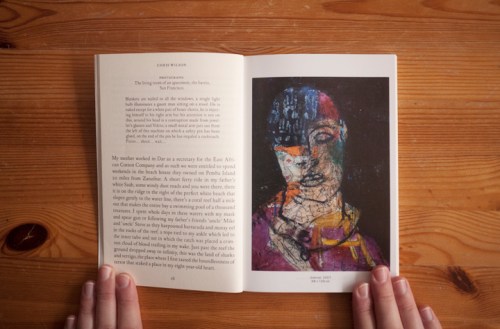
Spread from Horse Latitudes (Sorika) by Chris Wilson.
Here’s the lowdown on Horse Latitudes on Self Publish Be Happy.
What’s fascinating to me about the book is that it uses descriptions of “photographs” to anchor several scenes. Wilson describes regularly things he witnessed to put us in the picture–both when he was out on the streets living life as a junkie and later when he’s inside the nick. For example:
PHOTOGRAPH
Time Unknown
Foreground, a young man shirtless, tattooed, faces a mirror with his teeth bared, metal wires are entwined through his teeth to clamp his jaws together, in his right hand, which is raised to his mouth, he holds a red-handled pair of wire-cutters.
–
It’s dark, foreboding and inescapbaly bleak. Wilson has been called ‘The Nietzsche of Narcotics‘.
I was left to wonder how Wilson has even survived. Horse Latitudes is a short, violent and unapologetic read. Get it if you can.
The book differs massively in tone from Prison Da Vinci and that’s okay. Wilson has established himself as a successful artist and is not cagey about his tortured past. We know people change and we know identity isn’t fixed. We know people are more than their worst behaviours. Prison Da Vinci does its bit to celebrate Wilson’s post-prison and drug-free life. It’s one story of his storied life. Wilson got beyond incarceration’s grip. Art played its part. But painting with Skittles wasn’t even the half of it.

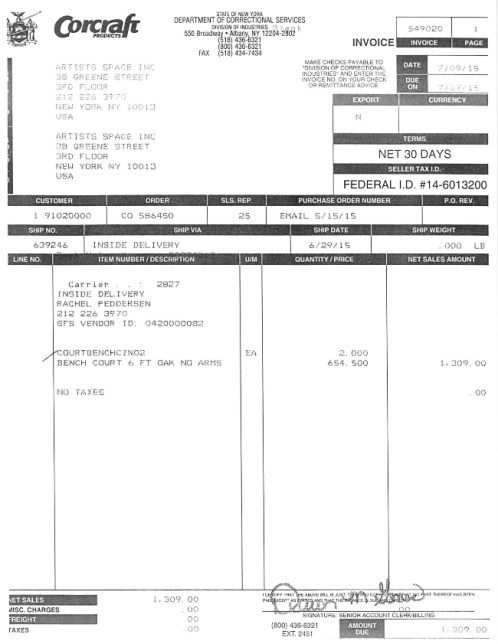
Cameron Rowland, “New York State Unified Court System” (2016), oak wood, distributed by Corcraft, 165 x 57.5 x 36 inches, rental at cost. Courtrooms throughout New York State use benches built by prisoners in Green Haven Correctional Facility. The court reproduces itself materially through the labor of those it sentences. (photo by Adam Reich, courtesy the artist and ESSEX STREET, New York)
You may have sat in the chairs, or slept on the pillows, or worn the smocks. What am I talking about? You may have used goods made by prison labour. You or your kids, depending what state you’re in, may have eaten school meals made by prisoners.
Wellington boots, uniforms, mattresses, furniture, binders, paper-goods, forms, flagpoles, hardware, utensils, even cookies … the list of goods made by prison industries is long. CALPIA (California Prison Industries Authority) in California and Corcraft in New York State are just two government agencies making high-quality goods while paying low-quality wages.
Prisoners working for CALPIA earn between 30 and 90 cents per hour (the higher end is rare) and then about 50% is taken out for taxes, charges and restitution. Supporters of these multimillion dollar agencies say it they provide valuable jobs training for prisoners. Opponents say it’s slave labor. Of course, you’re opinion will be swayed by whether you think prisons and jails are a net benefit or a net cost for society.
For prison abolitionists these state-insider agencies are second only in evil to the private prison companies. Why? Because they execute the quieter but some of the more pernicious maneuvering within capitalism. They devalue labor and devalue human beings. In California, those that defend CALPIA point out CALPIA only sells to other state bodies, but a market is a market and who the buyer is doesn’t change the work, wages or conditions for prisoners. In fact, most state-run prison industries don’t sell beyond state agencies is because they’d destroy many “free” markets simply by undercutting them on price–so great is the savings on wages. Look at those benches above; the joinery on those is out of this world. A steal at $654.50 (see below).

Artist Cameron Rowland is dismayed. And energised. The benches and the jackets and desk in the images here are from Rowland’s latest show 91020000 at Artists Space in New York. Continuing his minimalist installation approach, Rowland has put a few (of the bigger) Corcraft goods in the gallery space. The project is as much an extended and deeply researched essay as it is this gallery installation.
“Property is preserved through inheritance,” writes Rowland. “Legal and economic adaptations have maintained and reconfigured the property interests established by the economy of slavery in the United States. The 13th constitutional amendment outlawed private chattel slavery; however, its exception clause legalized slavery and involuntary servitude when administered “as a punishment for crime whereof the party shall have been duly convicted.”
To prison activists this is not new language. Even to Oprah’s List devotees this is not new. Michelle Alexander put into plain and passionate terms how the legal inequities of first, convict leasing, then Jim Crow laws and, now, expanded disenfranchisement laws in the era of mass incarceration, have maintained a “sub-class” made up disproportionately of people of colour.
Crucially, when Rowland talks of inheritance, he’s not talking about the bank accounts and assets of our parents. No, he’s talking about our shared inheritance as a nation that enjoys civic infrastructure and communities who benefit from, or not, the provision of nurturing institutions and spaces. Capitalism depends upon the movement and trade of raw materials. Roads, ports, markets, factories and comms all built upon a dependent system of inequality.
Rowland describes how convict leasing replaced a “largely ineffective” statute labor provision. And the roads in southern states got built. From there, Rowland rolls with the examples into modern day, not letting up to allow us an escape route argument of ‘This is now, That was then.’ It all connects. Read it.

Cameron Rowland, “1st Defense NFPA 1977, 2011” (2016), Nomex fire suit, distributed by CALPIA, 50 x 13 x 8 inches. Rental at cost “The Department of Corrections shall require of every able-bodied prisoner imprisoned in any state prison as many hours of faithful labor in each day and every day during his or her term of imprisonment as shall be prescribed by the rules and regulations of the Director of Corrections.” – California Penal Code § 2700. CC35933 is the customer number assigned to the nonprofit organization California College of the Arts upon registering with the CALPIA, the market name for the California Department of Corrections and Rehabilitation, Prison Industry Authority. Inmates working for CALPIA produce orange Nomex fire suits for the state’s 4300 inmate wildland firefighters. (photo by Adam Reich, courtesy the artist and ESSEX STREET, New York)
Alternatively, and also, read Ta-Nehisi Coates’ Case For Reparations. It looks at generations of African Americans robbed of earnings, assets and net-worth, with a focus on agriculture in the south and red-lining of properties in Chicago. Coates’ piece is not a tour de force only because of its impeccable research but because he puts figures on it.
Scholars have long discussed methods by which America might make reparations to those on whose labor and exclusion the country was built. In the 1970s, the Yale Law professor Boris Bittker argued in The Case for Black Reparations that a rough price tag for reparations could be determined by multiplying the number of African Americans in the population by the difference in white and black per capita income. That number—$34 billion in 1973, when Bittker wrote his book—could be added to a reparations program each year for a decade or two. Today Charles Ogletree, the Harvard Law School professor, argues for something broader: a program of job training and public works that takes racial justice as its mission but includes the poor of all races.
To celebrate freedom and democracy while forgetting America’s origins in a slavery economy is patriotism à la carte. Perhaps no statistic better illustrates the enduring legacy of our country’s shameful history of treating black people as sub-citizens, sub-Americans, and sub-humans than the wealth gap. Reparations would seek to close this chasm. But as surely as the creation of the wealth gap required the cooperation of every aspect of the society, bridging it will require the same.
Which brings us to the modern day. And to the darker corners of American commerce.
Let’s be clear, Rowland isn’t arguing about the merits, or lack thereof, of the existing judicial system and the rightness or wrongness of the control of prisoners. No, he’s more interested in the economic uses of the prisoners, of those bodies.
I’ll argue, in Rowland’s absence, that prisons in the U.S. are morally repugnant and a violence on poor Americans to a unconscionable degree. I’ll double back round and point to Rowland’s beautifully constructed text and visual arguments as one piece of evidence for the assertion.
I’m sure Rowland and I would agree that the over-arching forces of commerce (from which all hands are a few steps removed from the control panel and therefore responsibility) are the problem.
Now read Seph Rodney‘s review The Products of Forced Labor in U.S. Prisons on Hyperallergic.
This excerpt particularly:
But how do we conceal the theft? The question that has to be posed when people are systematically disappeared is: Where do we hide the bodies? “In prison” is only part of the answer. The deeper, more sinister response is also the most seemingly benign: we abstract them so they become only sources of labor and wealth. We reduce them to lines in an actuarial table, an oblique reference in a statute, a number in a log book. We dissolve people into fungible assets.
A lot of the time quiet gallery spaces don’t do a lot for me. They just seem sad. But when an artist can fill the space with poignancy … and especially when they are dealing with a grave matter that is–like in the case of prison labor–desperately sad, then I think it works.
Cameron Rowland: 91020000 continues at Artists Space (3rd Floor, 38 Greene St, Soho, Manhattan) through March 13. Get there if you can.
–

Cameron Rowland, “Attica Series Desk” (2016), steel, powder coating, laminated particleboard, distributed by Corcraft, 60 x 71.5 x 28.75 inches. Rental at cost: The Attica Series Desk is manufactured by prisoners in Attica Correctional Facility. Prisoners seized control of the D-Yard in Attica from September 9th to 13th 1971. Following the inmates’ immediate demands for amnesty, the first in their list of practical proposals was to extend the enforcement of “the New York State minimum wage law to prison industries.” Inmates working in New York State prisons are currently paid $0.10 to $1.14 an hour. Inmates in Attica produce furniture for government offices throughout the state. This component of government administration depends on inmate labor. (photo by Adam Reich, courtesy the artist and ESSEX STREET, New York)

Installation view of ‘Cameron Rowland: 91020000’ at Artists Space, New York (photo by Adam Reich)
On November 11th, five imprisoned people at Central California Women’s Facility (CCWF) endured extreme violence at the hands of prison guards. They immediately filed grievances against the officers and called for an independent investigation, but so far none of their requests have been met. They have now developed a more comprehensive set of demands listed in the letter below.
Family members alongside California Coalition for Women Prisoners, Justice Now, Family Unity Network and TGI Justice Project have prepared a petition and are asking the California Department of Corrections and Rehabilitation and the Senate Public Safety Committee for recognition of, and response to, a set of demands penned by the incarcerated women.
My letter below. You can send your own HERE.
Warden Deborah K. Johnson, Scott Kernan and Senator Loni Hancock,
I recently learned about a serious incident of physical assault and sexual harassment at CCWF.
Stacy Rojas, Sandra Rocha, Yvette Ayestas, Melissa Blanchard, Sara Lara and others were subject to degrading treatment during a November 11th incident.
I join the people in prison, their family members and advocacy groups in calling for an independent investigation into the incident and the suspension, pending investigation, of the officers specified in the administrative appeals filed.
Many women and transgender or gender non-conforming people incarcerated at your facility have long histories of sexual and domestic violence and an incident such as this can trigger trauma and PTSD. Yet the officers involved in the incident are still working in close proximity to those impacted by the assault.
I strongly support the demands of the imprisoned people:
• We demand the right to document, expose, and protect ourselves to stop abuses and violations of our human rights without retaliation or punishment.
• We demand safety from retaliation and from being coerced, threatened and blackmailed to betray our imprisoned peers.
• We demand immediate and ongoing medical attention and access to mental health support services. Additionally, we demand access to mental health support if requested, due to the extreme mental stress this assault has caused as a result of the histories of trauma that this incident triggered.
• We demand an independent investigation by the Inspector General’s office.
• We demand that any internal investigation coordinated by the CDCR and through the Investigative Services Unit (ISU) be transparent both during the process and in the sharing of results and that the investigation be conducted in collaboration with legal advocates. Additionally, when ISU is requested by people in the care and custody of CDCR, and most specifically at CCWF where staff misconduct and violence at the hands of CDCR staff was reported, those requests are immediately addressed and responsibly handled.
• We demand immediate suspension of all officers specified in the appeals filed after the incident pending independent investigation. Suspension should include those higher up the chain of command, namely the Captain and Sergeant who were involved in this incident.
• We demand an immediate end to violence and brutality at the hands of prison staff and officials. We demand an end to gender-based violence in all California prisons. We connect this violence and brutality to the state violence people experience in communities of color throughout the country and demand an end to police brutality both inside and outside of prison.
I look forward to hearing your responses.
Pete Brook, San Francisco, Calif.
Send your own letter supporting the petition HERE.
–
THE IMPORTANCE OF GIVING
Securing help, even for the most simplest things, isn’t guaranteed for lots of returning citizens. I once listened to a talk by Troy Williams, who served 18 years in the California prison system, and he ended by pointing out that the state spent (conservatively) $900,000 keeping him locked up and then one the day of release handed him $200 and waved him off at the prison gate. Anyone can see that there is a sick disproportionate allocation of funds, especially if we’re to believe any argument that prison can improve those subject to it.
Across the United States, picking up the responsibility for care during the crucial post-release days, weeks and months, are volunteer groups. 2,100 miles from San Quentin in Champaign, Illinois one such group FirstFollowers are doing amazing work. Orchestrated by all-volunteer workforce, FirstFollowers is made up of activists and the formerly incarcerated who provide support and guidance to the people getting out of prison, to their loved ones, and the community as a whole.
FirstFollowers is currently seeking $10,000 to continue its invaluable work.
DONATE MONEY AT THE FIRSTFOLLOWERS GOFUNDME PAGE
FirstFollowers are committed to peace-bulding process in the community. Crucially they involve all voices in that. Experienced voices.
“In light of the recent spate of gun violence in Champaign, formerly incarcerated people can play an important role in creating a safe environment in our communities,” says FirstFollowers which opened its doors in March of 2015.
Our program grew out of the struggle to stop a 2012 proposal by our county authorities to spend $30 million on jail construction.
“We argued that the county needed more programs and services for the community, not more incarceration,” say FirstFollowers. “Our efforts paid special attention to the fact that our county was targeting Black people for imprisonment. While only 13% of the population of our county is Black, in September 2015, 71% of the jail population and more than 60% of the parole population was African American. We realized that we needed to stop jail construction but we also needed to provide community-based alternatives. We aimed to make FirstFollowers one of those genuine alternatives.”
–
–
DONATE MONEY AT THE FIRSTFOLLOWERS GOFUNDME PAGE
There are many reasons to donate money. Here’s a few. Here’s what FirstFollowers provides–a safe stigma free environment; peer mentoring; assistance with employment searches; job readiness training; advocacy for individuals with felony convictions; family reunification; and service referrals
“We don’t seek financial assistance for salaries but for our activities, equipment, and direct support for our participants when they need IDs, birth certificates, court transcripts, even clothes for a job interview. We also want to provide short-term stipends for formerly incarcerated folks to engage in community work.
DONATE MONEY AT THE FIRSTFOLLOWERS GOFUNDME PAGE
Contribution will fund:
- Training to formerly incarcerated people and their loved ones in advocacy-we need those impacted by incarceration to speak for themselves.
- Support groups for people with issues of substance abuse, mental health and family reconnection.
- Training in research skills to our participants so that they can carry out a participatory needs assessment among the formerly incarcerated and their loved ones in our communities.
- Transportation for family members to visit loved ones, especially those who are incarcerated but are close to their release date.
DONATE MONEY AT THE FIRSTFOLLOWERS GOFUNDME PAGE
–
For more information, visit the FirstFollowers website. Or contact them via email at firstfollowerscu at gmail.com

PRISON AND SOCIAL DEATH BOOK LAUNCH IN BROOKLYN
Get yourselves down to my fave counter-culture culture-space, the Interference Archive in New York City tonight for the launch of Joshua Price’s new book Prison and Social Death.
Joshua Price will be joined by Five Mualimm-ak and Terrence Slater from the Campaign for Alternatives to Isolated Confinement (CAIC) for a discussion of current efforts to end solitary confinement and other forms of extreme isolation in state prisons and local jails in New York and nationally.
“Isolated confinement,” explains the Interference Archive. “involves confining people in a cell for 22 to 24 hours a day without meaningful human contact, programming, or therapy. This practice is ineffective, counterproductive, unsafe, and inhumane, and it causes people detained in these conditions to deteriorate psychologically, physically, and socially. Nevertheless, New York utilizes isolated confinement at rates well above the national average.
 Price, Slater and Mualimm-ak will discuss the experiences of people who have survived solitary confienment, and review recent legal settlements, legislative initiatives and activist attempts to end or curtail the use of solitary and solitary-like conditions.
BIO
Joshua Price teaches at SUNY Binghamton. He is the author of two books, Prison and Social Death (2015) and Structural Violence: Hidden Brutality in the Lives of Women (2012). He is coediting the forthcoming Decarceration and Justice Disinvestment, which examines the recent drop in the prison population in New York State.
Price has been committed to anti-racist, anti-gender-violence organizing for the last twenty-five years, especially in movements that advocate for currently and formerly incarcerated people. For his work, the Broome/Tioga County NAACP has honored him as Citizen of the Year and the New York State Assembly has cited him for “Outstanding Commitment to the Civil Rights of New Yorkers.”
DETAILS
131 8TH STREET NO. 4
BROOKLYN, NY 11215
THURSDAY, FEBRUARY 18TH
7:30PM ONWARDS
GET THE BOOK
Tomorrow evening there’s an intriguing discussion happening at the Mechanics Institute in San Francisco. On the panel for Incarceration and the Path to Reform are author and educator Baz Dreisinger. She is the Academic Director for the Prison-to-College Pipeline program, coordinated by John Jay College, NYC, that offers college courses to incarcerated men. San Francisco District Attorney George Gascón alongside Jacques Verduin of Insight-Out and GRIP, and former inmate and GRIP graduate Terrell Merritt make up the rest of the group.
Can’t wait.
It’s at Wednesday, February 17, 2016 from 6pm onwards.
Mechanics Institute, 57 Post Street, 4th Floor Meeting Room, San Francisco, CA 94104
Call staffer Pam Troy on 415-393-0116 for more info.
Tickets for the public are $15. SIGN UP HERE.
THE BLURB
“Fiscal and physical challenges to our penal systems as well as changing attitudes about prison reform are happening locally, nationally, and internationally. […] See how San Francisco is modeling a new paradigm for rehabilitation and issues of human rights for those incarcerated. With President Obama’s December 18th commutation of 95 non-violent drug offenders to the recent “vote- down” of funding the new jail in San Francisco, there is much to talk about.”
Dr. Baz Dreisinger
 Dresinger journeyed to Jamaica to visit a prison music program, to Singapore to learn about approaches to prisoner reentry, to Australia to grapple with the bottom line of private prisons, to a federal supermax in Brazil to confront the horrors of solitary confinement, and finally to the so-called model prisons of Norway. This jarring and poignant trek invites us to rethink one of America’s most devastating exports, the modern prison system. With Oscar-nominated filmmaker Peter Spirer, Dreisinger produced and wrote the documentaries Black & Blue: Legends of the Hip-Hop Cop, and Rhyme & Punishment. Her book Near Black: White to Black Passing in American Culture was published in 2008 by University of Massachusetts Press.
Jacques Verduin
 Verduin has worked in prisons for 20 years, designing and running innovative rehabilitation programs. He is a subject matter expert on mindfulness, restorative justice, emotional intelligence, and transforming violence. He directs the non-profit “Insight-Out” which helps prisoners and challenged youth create the personal and systemic change to transform violence and suffering into opportunities for learning and healing. The Guiding Rage into Power (GRIP) Program at San Quentin is a year-long transformative program that provides the tools that enable prisoners to “turn the stigma of being a violent offender into a badge of being a non-violent Peacekeeper.” A former inmate and graduate of this program will be on the panel.
Terrell Merritt

Merritt is from Gary, Indiana. After high school he enlisted in the Navy and was stationed in San Diego, CA. After leaving the Navy, he spend 20 years in prison for 2nd degree murder. During that time, he began to soul search and incorporate practices into his life that promote nonviolence. These include nonviolence communication, Zen Buddhism, and the GRIP Program; a yearlong transformational program that he became a facilitator of. On November 10th 2015, he was paroled after serving 20 years and 8 months in prison. He is currently working to reestablish himself into the community and to give back where he can.
George Gascón

Gascón is the District Attorney for the City and County of San Francisco. He has earned a national reputation as a criminal justice visionary that uses evidence based practices to lower crime and make communities safer. He is the first Latino to hold the office in San Francisco and is the nation’s first police chief to become District Attorney. Looking to find alternatives to incarceration for low-level offenders, DA Gascón created the nation’s first Alternative Sentencing Program to support prosecutors in assessing risk and determine the most appropriate course of action for each case. The goal is to protect victims and the community by addressing offenders’ risk factors in order to break the cycle of crime and reduce recidivism.
DETAILS
February 17, 2016 from 6pm onwards.
Mechanics Institute, 57 Post Street, 4th Floor Meeting Room, San Francisco, CA 94104
Call staffer Pam Troy on 415-393-0116 for more info.
Tickets for the public are $15. SIGN UP HERE.
HERE NOW: Digital Stories from the San Francisco
In December, I was a guest at San Bruno Jail, near San Francisco, for morning of screenings of HERE NOW: Digital Stories from the San Francisco Jails. The 18 film-shorts were made inside San Bruno Jail drawing on both the drama therapy expertise of the University of San Francisco’s Performing Arts and Social Justice Department and the community media skills of the Bay Area Video Coalition (BAVC).
The Resolve to Stop the Violence Project (RSVP)—a longstanding collaboration Community Works and the San Francisco Sheriff’s Department with programs inside the numerous San Francisco County Jail system–hosted the 12-week course and that inaugural screening.
Tomorrow, January 27th, a screening of HERE NOW will be held for the public. It’ll be at Noh Space which is in the Potrero Hill neighbourhood of San Francisco, specifically at 2840 Mariposa St (b/t Florida St & Alabama St), SF, CA 94110. The screening will include a panel discussion with restorative justice practitioners and members of the project.
Full details about the HERE NOW screening event.

Full details about the HERE NOW screening event.
Within the confines of one of San Bruno’s jail pods, the 20-or-so prisoners made use of every space, surface and angle to visualise their stories. The “digital stories” they developed include percussion, spoken word, movement, writing, and visual imagery. There’s some large leaps of faith to be made here. Firstly, the men must be comfortable sharing personal tales, then they must be willing to process them with a group, firstly and for a general public audience latterly.
“The men came in with strong visual concepts and artistic choices and we followed them as they were the directors for each of their stories. I approached each production as a camera operator and followed their carefully crafted shot list,” says Kristian Melom, one of the facilitators with BAVC and HERE NOW.
Furthermore, not being experts, the prisoners handed over some control of the editing and sequencing. At least those bits that they couldn’t master on their successful, short and steep learning curves!
“In the editing process, the students from each of the classes worked together and essentially learned digital film editing as they collaboratively made these pieces. It was really inspiring to see how much can happen in the edit when you have very little recording time allowed and lots of improvisation is needed,” says Melom. “We had a blast.”
Full details about the HERE NOW screening event.
MY FAVOURITES
In advance of tomorrow screening, I wanted to share a handful of notable videos.
In Motivation Through Life’s Struggles, J. Howard organizes the loneliest dinner party. One at which photographs of his loved ones substitute for the persons themselves. A lone 4×6 print on each seat.
–
You don’t even see Delon Barker’s face in Where I Grew Up, which is a clever tool because it makes his powerful story–about knowing where a hidden gun was and using it at the age of 5–all the more powerful.
“Where I grew up, I was taught to be bad and fight everyone.”
–
JDJ’s ode to his daughter simultaneously shares his joyful memories of her earliest words but also the pain of being apart. All this plays out to a video track composed of dozens of portraits of her.
–
June’s Baby Skee is the comic turn of the bunch. June recounts the first time he was charged with changing a diaper.
–
Testimony Of A Moth is Jack MacLennan’s space to reflect upon, and reenact, a moment he was the victim of gun violence. But also in that moment he reflexively protected those close to him, by literally putting his body on the line. How conflicting to find pride amidst violence. This is a reconciliation of those contradicting emotional memories.
–
I Kill Time is a bittersweet look back at, well … it’s your guess. Is this a clear metaphor for drug selling? Or is that a presumption? Either way, Vinnie was adamant from the very start that the 2 minutes would be played backward, meaning that action were acted out in reverse. Killing time? He’s playing with time. Very effective and a little disconcerting. Great soundtrack too.
–
The participants made four short interludes to sit in the middle and at each end of HERE NOW. These four shorts make use of the most expansive cinematography, song and percussion. They’re also the moment that most participants are actors in a single reel.
–

 Prison Photography