
You are currently browsing the category archive for the ‘Prison Non-Photography’ category.
G-LAW
Fight Hate With Love, a documentary film about Philadelphia-based artists and activist Michael Tabon (a.k.a. G-Law a.k.a. OG-Law) has been shortlisted for the Tim Hetherington Trust‘s inaugural Visionary Award.
The film made by Andrew Michael Ellis, director of photography at Mediastorm is about “one man’s journey to change the world and still be the guide his family needs him to be.”
The film looks inspiring, but as with any narrative arc, the protagonist faces challenges. It seems the stresses of Tabon’s art and activism upon his family is the emotive hook, Ellis is molding.
I met Tabon and his wife Gwen this time last year as he was embarking on his third self-imposed lock up in a self-built cell on the cold February streets of Philly. They did not display the tension as they do in Ellis’ trailer. Tabon was putting his un-prison cell together and Gwen was helping with supplies, PR, food & drink, and vocal support. It was clear they rely on one another to make work and to meet the silent, unending need for Tabon’s love-filled message.
Tabon’s manipulation of visual tropes is cunning and effective. He has reclaimed the cell, the orange jumpsuit and the shackles. He has jogged 10 miles a day for seven days around Philadelphia with a 40-foot banner reading FIGHT HATE WITH LOVE. He has walked with a ball-and-chain from Selma to Montgomery.
“Tabon has been caught in the revolving door of the prison system since he was sixteen years old. Incarceration became a way of life, seen as an inherited destiny for America’s young Black poor, until he had a revelation – that he could break the cycle of the womb-to-prison pipeline gripping marginalized communities across the country,” says Mediastorm.
It’s wonderful to see Tabon on the Mediastorm platform and Hetherington Trust’s radar. His unorthodox but unmissable approach to social change needs to go national.
Youtube trailer here. Follow Tabon on Twitter and on the web.


THE VISUAL CULTURE OF PRISON RESISTANCE
Liz Pelly‘s conversation with Josh MacPhee in The Media is a wonderful read. It coincided with MacPhee and his cohort’s incredible exhibition of prisoner made protest materials going all the way back to the early seventies.
MacPhee urges us to dismantle the idea that prisons are separate from outside society. Crucially, he’s not making, in the first instance, a moral point about how we’re all the same, prisoners and all. MacPhee makes an observation of the structural characteristics of the prison system.
“It’s getting harder and harder to hold up the pretense that prison is somehow distinct from the rest of society,” says MacPhee. “When there’s this many people going in and out all of the time, there’s no way that our lives out here don’t leak into there, and that their lives in there don’t leak out into the rest of society. The idea that these are completely separate realms needs to be dismantled.”
Of course, once the structural facts of the system are revealed, the moral point that we are all one-and-the-same, prisoners and all, is indisputable.
I contacted Pelly and asked if I could republish the conversation. It originally appeared as Inside/Out: On Prison Justice, Art of the Incarcerated, and Interference Archive’s New Show in Issue #44 of The Media (October 10, 2014). It is a privilege to feature Pelly and MacPhee’s interview in full here on the blog.
A LITTLE BACKGROUND
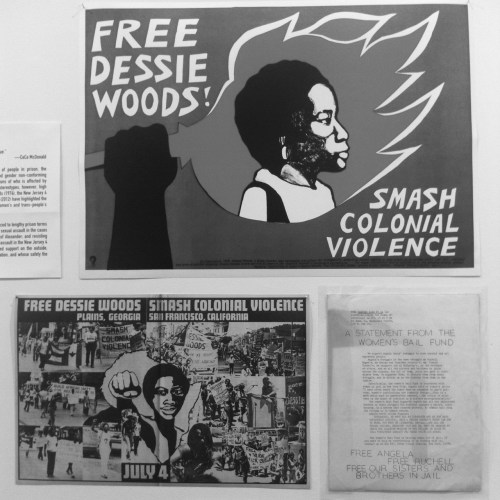
Between September 11th and November 16, 2014, Interference Archive exhibited, Self-Determination Inside/Out: Prison Movements Reshaping Society a look back at the visual and material culture of prisoner-led political movements.
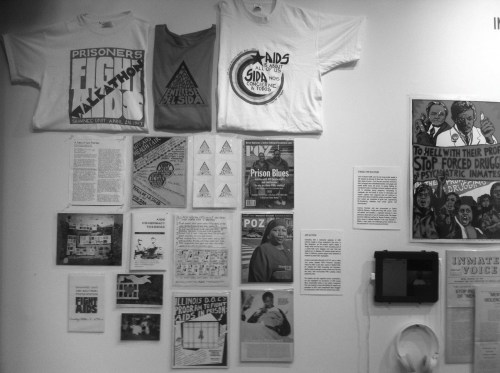
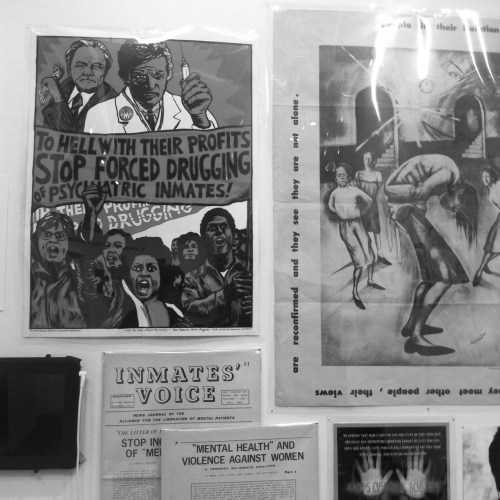
Organized by Molly Fair, Josh MacPhee, Anika Paris, Laura Whitehorn, and Ryan Wong, Self-Determination Inside/Out includes sections on the work of incarcerated AIDS educators, the experiences of women and queer prisoners, prison and control unit prisons. The exhibition features prison newsletters, pamphlets, video and audio interviews, prints, photography (!!!) and magazine covers — starting with materials created during the 1971 Attica Rebellion, a massive prisoner uprising in upstate New York, and concluding with work made by current political prisoners, the show highlights moments of self-organization within the prison industrial complex.
You can buy a booklet and a poster for the exhibition.
Interference Archive is a volunteer-run archive in Gowanus, Brooklyn, dedicated to preserving cultural ephemera related to social movements.

Inside/Out: On Prison Justice, Art of the Incarcerated, and Interference Archive’s New Show
Liz Pelly (LP): What initially inspired the creation of Interference Archive, which mostly houses ephemeral material like posters, t-shirts, and newsletters?
Josh MacPhee (JM): For the different people involved, there are different answers of course. For me, I grew up making this stuff through DIY music, cultural stuff, politics. Through the act of doing, I started collecting it. Flyers, t-shirts, buttons, the ephemera that gets produced by people who are organizing. It was a combination of wanting to understand the history of what I was doing and then at the same time, I was getting really interested in this idea of how people make art and culture in the context of trying to their lives. It’s distinct from art that’s produced purely in the realm of self expression, and the art that tends circulate within the contemporary art world.
This kind of material gets lost. It’s often not clearly authored. Institutions that deal with art don’t quite know what to do with it. Since it’s so political, places like history museums don’t know what to do with it either. It sort of falls through the cracks. But we can see during times like Occupy, or Tahrir Square in Egypt, or with the Maidan in the Ukraine, that this is the stuff of life, [created] when transformation starts to happen. When people have their arms shoulder deep into the constructions of representations of a new world, and the way they want things to be articulated.
For me, doing an archive was a way to say, “just because these moments come and go, and movements have ebbs and flows, doesn’t mean that once the peak has been reached that this material isn’t still valuable to us, to where we’ve come from and therefore where we are going.”
LP: That said, how do you think this sort of exhibit in particular shines light on the experiences of prisoners?
JM: There were five of us who organized this exhibition, and most of us have been engaged with issues around prisons in different ways, whether having been formerly incarcerated, or working with prison activism programs. As far as I know, nothing like this has ever been done before.
We live in a moment where over two million people are in prison. It’s getting harder and harder to hold up the pretense that prison is somehow distinct from the rest of society. When there’s this many people going in and out all of the time, there’s no way that our lives out here don’t leak into there, and that their lives in there don’t leak out into the rest of society. The idea that these are completely separate realms needs to be dismantled.
We thought it was important to marshal primary source material to show that people aren’t just objects of repression or study or someone else’s activism. But they have done immense amounts of organizing inside themselves. Often times that organizing takes place at the same time, or sometimes even ahead of, what people were doing on the outside. Some of the focus we have on organizing around AIDS and AIDS education in prison was really fascinating and important because it shows how people that had the least access to medical care were doing in some cases the most organizing in order to try to deal with a problem that at the time the government was not even acknowledging existed.
LP: Can you tell me more about your own experiences with prison reform activism?
JM: I first learned about how the prison system functions in the early 1990s. It just sort of blew my mind that there was a whole world of people who largely because of race and class were basically being warehoused. And that, at the time, it was completely absent from the radar of public In the 90s, the only thing discussed in relationship to prisons and criminal justice was this sort of “tough on crime” thing. There was no acknowledgment that a massive increase of the prison population going on, and that it wasn’t actually working. And that the system that decided who went in and out was so manifestly unjust, random often.
That sent me on a path of doing organizing around prison issues. I started in Ohio, and then did some work in Colorado, and then in Chicago. A lot of the organizing I did was around Control Unit Prisons, basically trying to stop solitary confinement. [Organizing around] these men and women who were spending twenty-three-and-a-half or twenty-four hours a day alone in their cells, and the psychological damage that causes and how it basically goes against international conventions of torture, yet it’s completely commonplace in this country.
LP: Over the past year, there has been lot of in the news about the racist criminal justice system. It’s an apt time for Self-Determination Inside/Out: Prison Movements Reshaping Society. But obviously there is a lot of history of racism in the criminal justice system that this brings to light. Were you inspired to put this together because of recent events, or has this exhibit been in the works longer?
JM: We worked on the exhibition for 6 months. As a space, as an institution, one of our goals is to take this material that’s perceived as marginal and present it in ways that will allow it to be in its own context, but also to actually show that it’s not marginal. Our primary audience is not people who already necessarily agree with everything that would be in this exhibition. We are conscious of, and trying to take advantage of, a moment.
The question becomes, how do we push [the discussion] farther? If we say mass incarceration is not okay, at what point is incarceration okay? If 2 million people in cages is not acceptable, is 1.9 million people in acceptable? Or 1.8? Once you start asking those questions it opens up the space to say, “this whole system is just absolutely corrupt.”
Mass incarceration accomplishes a number of things, none of which are its stated goals. It accomplishes deeply suppressing working class communities of color. That’s never been articulated as what the prison system is supposed to do. It’s just clear that that’s what it does. It clearly is completely ineffectual at actually dealing with crime.
LP: What are some underreported sides to the prison industrial complex that you hope this exhibit brings to light?
JM: The fastest growing portion of the prison population for years now has been women.
Increasingly there is a real gendered aspect of being able to look at how the criminal justice system works. Increasingly it’s used to enforce gender binaries. It’s a brutal system for queer and trans people that get sucked up into it. People are doing a lot of organizing around it now, but until recently, it was assumed if you were gender non-conforming, they have to choose where to put you, and then once they chose a men or a women’s prison, then almost immediately you’d get sent to solitary confinement. You’d do your sentence out in solitary confinement, in complete isolation, because the system is not prepared to deal with gender non-conformity. You are being punished because your very existence challenges the bureaucratic way the system works.
It’s really clear that women who refuse to be abused, who fight back against abusers, almost always get pulled into the criminal justice system. So we have things like Trayvon Martin being shot, and Zimmerman getting off. But any woman that stops an attack from an abuser is inevitably going to do time because that’s just absolutely taboo.

LP: What were the biggest challenges to getting this exhibit together?
JM: Each exhibition has unique challenges and obstacles, and then there are ones that are sort of similar across the board. For this exhibition, was just that cultural material produced by incarcerated people is hard to access. A lot of it is made in prison and then just never leaves prison.
In general, one of the challenges for all of the exhibitions, is that unless we do something that’s very focused, inevitably there’s so much stuff it’s hard to know when to say “okay we’ve got enough” or to know when to draw the lines. It’s hard to know when to accept that you’re never going to have all of the stuff that you wish you could, that you’re never going to be able to tell the whole story, that maybe even the idea that you’re going to tell some sort of master narrative is questionable in its own right.
When you’re representing things that are so deeply underrepresented, people get attached to wanting their part of the story told, because it’s been marginal or silenced for so long. It makes it really hard to make those choices, because you don’t want anyone else to continue to feel [that way].
We are collecting material from movements that are marginal. Even though they often have extremely deep impacts, rarely is that impact known or visible when they’re most active. It’s kind of like an extra kick in the face when your ideas become commonplace 10 or 20 years later and you’re still written out of the history even though you’re the ones who came up with the ideas.
LP: What do you hope, in general, visitors learn from Self-Determination: Inside/Out?
JM: On the one hand, I hope this contributes to a shift [towards] the idea that prisons are maybe not the answer to the problems that they claim to be. And that locking people in cages is not actually accomplishing what we’re being told it is.
On another level, that incarcerated people are not just objects. They’re loved ones and family members and neighbors and community members. The thing that primarily defines someone as a human being is not whether or not they’re in prison. That people that happen to find themselves in prison, many for reasons that are and then also at the same time many for doing reprehensible things, doesn’t make them not human. It doesn’t mean they don’t have the same desires, life goals, and relationships that everyone else has. And as such, the way that they conceive themselves and their world is part of, needs to be part of, any movement for social transformation.
THE PEOPLE
The Interference Archive is a collection of posters, flyers, publications, photographs, books, t-shirts, buttons, moving images, audio recordings, and other materials, made by participants of social movements throughout past decades. It is an archive “from below” — collectively run space, powered by people, and with open stacks accessible to all. The Interference Archive explores the relationship between cultural production and social movements. It provides public exhibitions, a study and social center, talks, screenings, publications, workshops, and an online presence, with an aim to preserve and honor histories and material culture that are often marginalized in mainstream institutions. It is at 131 8th Street, #4 , Brooklyn, NY 11215 (2 blocks from F/G/R trains at 4th Ave/9th Street).
Josh MacPhee is an artist, curator and activist living in Brooklyn, NY. MacPhee is one of the founder of the Just Seeds Artists’ Cooperative, which organizes, creates and distributes radical art. MacPhee is the author of Stencil Pirates: A Global Study of the Street Stencil, which is dedicated to stencil street art. He co-edited Realizing the Impossible: Art Against Authority, Reproduce and Revolt and the upcoming Paper Politics: Socially Engaged Printmaking Today. In 2001 he co-organized the Department of Space and Land Reclamation in Chicago with Emily Forman and Nato Thompson. In 2008 he co-curated the exhibition Signs of Change: Social Movement Cultures 1960’s to Now with Dara Greenwald.
Liz Pelly is a freelance writer and editor based in Brooklyn, NY. I lives and works at the all-ages collectively-run art space The Silent Barn, where she books (and sometimes plays) shows. She and her friends run the ad-free bi-weekly online newspaper The Media.
The Media is a webpaper covering alternative arts, culture, music, news, and grassroots activism. With contributors often embedded in the communities they cover, The Media aims to bridge the gap between underground presses and mainstream media. Crucially, it is AD-FREE and simply designed. “At a moment marked by short attention spans, decentralized click-bait articles, and newspapers in flux, rethinking the aesthetics of our news websites feels just as crucial as re-imagining their content,” says The Media. “We want our content to resonate on its own merit, free of frivolity and flash, and grounded by a homepage that’s striking in its radical simplicity.”

A CARTOONIST GOES TO JAIL
In June 2014, Los Angeles-based cartoonist Elana Pritchard was arrested for violating a court order. When she bailed out on July 3, she had little-to-no money and an overworked public defender. Her prospects didn’t look great.
“I knew I’d have to serve time for my violation,” Pritchard wrote for LA Weekly. “That’s when my mentor, animator-director Ralph Bakshi, advised me to *document my exploits*.”
Pritchard was jailed in the Los Angeles County jail system for two months. First, she spent 5-weeks at Century Regional Detention Facility (CRDF) in Lynwood, and closed out her remaining 3-weeks at Twin Towers Correctional Facility in downtown L.A.
ACCESS, OBSERVING & DRAWING
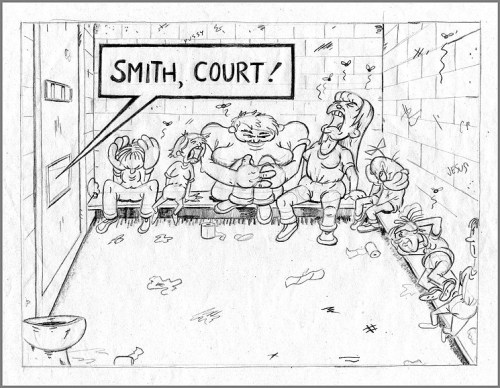
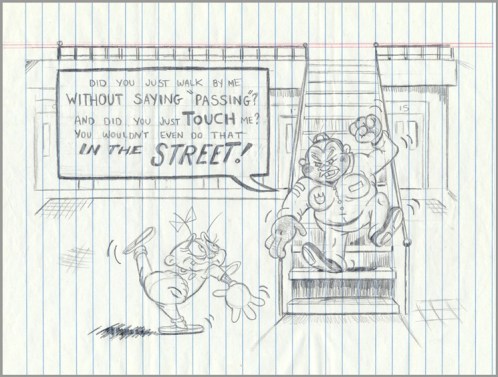
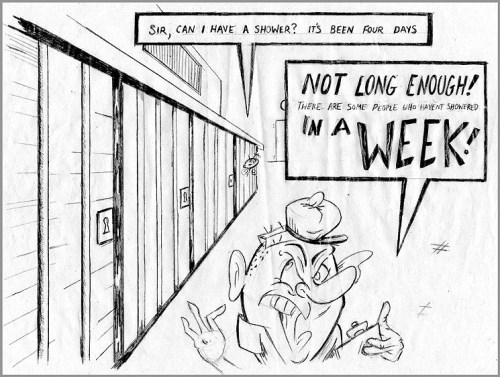
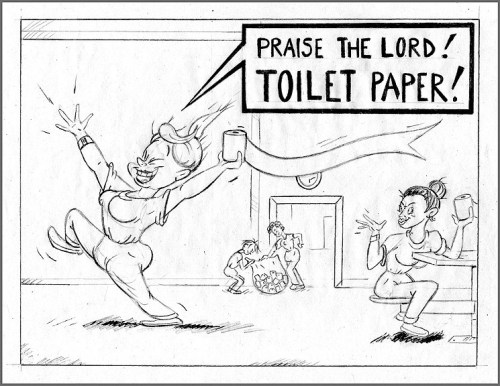
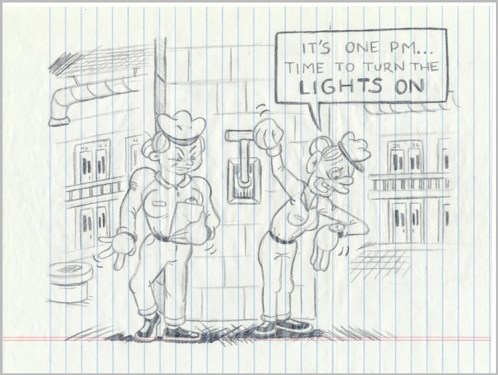
As you know, I deal with photographic imagery mostly, but I am always eager to point out creative efforts in other mediums that illuminate critical criminal justice issues more efficiently, powerfully and intelligently than photography. Pritchard’s cartoons from jail are honest, wry and direct.
“Armed with nothing more than a golf pencil and whatever paper I could get my hands on, I drew the strange world into which I’d been dropped,” says Pritchard. This was the draughtsperson’s equivalent of a two-month photojournalist embed!
They get to the root of those daily indignities that establish power-relations between guards and prisoners. Simultaneously, those power-relations ratchet up tensions for everyone in the jail.
As you look through these cartoons, I ask you to wonder is the “strange world” Pritchard reveals — of cold showers, dirty laundry, confiscated belongings, midnight cell-counts, competitions over basic sanitary products, food scarcity, sly put-downs and much more — one that we can accept, or one that we can ignore?
The unreasonable claustrophobia of the jail is made visceral in Pritchard’s drawings. I’d argue she conveys the experience of jail far better than many photographers can and have.
————
I discovered the comics at the Prison Arts Coalition blog and hastily made inquiries as to whether I could repost the cartoons and Pritchard’s commentary here. Gratefully, I was given permission.
Scroll down, here, to read Pritchard’s reaction to the cartoons’ publication in LA Weekly. I also recommend you read the original LA Weekly article in which Pritchard explains the context for each image.
————

“I Wanted To Remind Us We Were People”
I couldn’t be more pleased with the response to my cartoons from Los Angeles jail system. People from all over the world have written to me expressing their support for what I have done and their contempt for inhumane practices for incarcerated peoples everywhere.
I have been in communication with the LA County Sheriff’s department and they have told me that due to these comics they have issued a new policy that all inmates must be given showers within 24 hours of entering the jail. We are scheduled to meet to discuss further improvements. And throughout all of this it seems the original, humble message of these comics is sticking: that we were people.
Even though we had a barcode on our wrist with a number and were called “bodies” by the staff, we were still people.


Many people in jail are still on trial and haven’t even been found guilty or innocent yet. Many people made mistakes that you or I have made before in private, only they got caught. There were mothers in there that missed their children. There were kind people in there that cared about the arts and cared about each other.
I drew these comics to make us all laugh and remind us that even though there was a whole group of of people with badges and better clothes than we had telling us we didn’t matter … we DID matter and we WERE PEOPLE.
In that the comics were successful, and for that I am proud.
—————-
All images were first published in the LA Weekly, 2015.




ELANA PRITCHARD
Elana Pritchard is a cartoonist in Los Angeles. Before she landed in jail she worked as an animator on Ralph Bakshi’s film, Last Days of Coney Island.
She is currently raising money on Kickstarter to complete her animation, The Circus.
You can follow Pritchard on Twitter at @elanapritchard.
PERMISSIONS
All images were first published in the LA Weekly, 2015.


Claudia Cass with her children, Matthew, Kaylee, left, and Courtney in 2006. Credit: Alysia Santo/The Marshall Project
The lives of prison officers, as I have said before, are rarely represented by means of photography. I don’t know if that is the case for other mediums. Regardless, Alysia Santo‘s profile of Claudia Cass, a prison officer in New Hampshire, is essential reading.
“Her work in the prison had become so overwhelming that Matthew, her 11-year old son, was often alone, cooking his own dinner and seeing himself off to school,” writes Santo.
Cass, 42, is so stretched by the long hours of her job she feels unable to care adequately for her son. She made the toughest decision of her life and transferred legal custody of Matthew to her mother.
Imagine that? Having to give up legal custody of your child because you’re spending all your waking hours working in a prison? Crazy and depressing.
Santo writes:
Prison guards are often characterized, whether in news accounts or movies, as living under some constant threat of mayhem. But for Cass and her fellow officers, the recurring nightmare is not a prison riot. It is falling asleep at the wheel after a series of 16-hour shifts. Or nodding off with your sidearm exposed while escorting a sick inmate to the hospital. Or even having to tell your child that you don’t have time to be a mother.
Read 16-Hour Shifts, 300 Prisoners to Watch and 1 Lonely Son

ACTIVIST-SHAREHOLDERING
I love the term “activist-shareholder.” I envision a person wearing protest t-shirts at the AGM, or the organisation of a silent bloc that suddenly bursts into action and derails the agenda of a meeting. Activist-shareholders are moles in the system. Granted they are very visible roles, and it is soon very obvious as to why they have bought shares in a corporation whose practices they oppose, but still. yay for the little man.
Alex Friedmann, associate director of the Human Rights Defense Center and managing editor of Prison Legal News is one such activist shareholder. He made the reasonable proposal that private prisons make attempts to rehabilitate prisoners. Shock horror! And, guess what? The private prison company refused.
I just adore these tactics. If the prison industrial complex is to be dismantled it’ll take an untold amount of imagination and the combination of many tactics. Friedmann’s colleague at Prison Legal News Paul Wright was on hand this week to remind us that talking about the problem is not always doing something about the problem. Wright spoke with Alysia Santo for The Marshall Project, in a provocatively titled interview piece Sure, People Are Talking About Prison Reform, but They Aren’t Actually Doing Anything.
Go forth, let your imagination run wild.
Below, the Human Rights Defense Center press release:
Nation’s Largest Private Prison Firm Objects to Resolution to Fund Rehabilitative, Reentry Programs
Nashville, TN – Last Friday, Corrections Corporation of America (NYSE: CXW), the nation’s largest for-profit prison firm, formally objected to a shareholder resolution that would require the company to spend just 5% of its net income “on programs and services designed to reduce recidivism rates for offenders.”
The resolution was submitted by Alex Friedmann, associate director of the Human Rights Defense Center and managing editor of Prison Legal News. An activist shareholder, Friedmann owns a small amount of CCA stock; in the 1990s he served six years at a CCA-operated prison in Clifton, Tennessee prior to his release in 1999.
“As a former prisoner, I know firsthand the importance of providing rehabilitative programs and reentry services,” Friedmann stated. “I also know firsthand the incentive of private prisons to cut costs – including expenses associated with rehabilitative programs – in order to increase their profit margins.”
Citing data from the Bureau of Justice Statistics, the resolution notes that “Recidivism rates for prisoners released from correctional facilities are extremely high, with almost 77% of offenders being re-arrested within five years of release.” Further, “[t]he need to reduce recidivism rates for offenders held in [CCA’s] facilities is of particular importance, as two recent studies concluded that prisoners housed at privately-operated facilities have higher average recidivism rates.”
The shareholder resolution states that it “provides an opportunity for CCA to do more to reduce the recidivism rates of offenders released from the Company’s facilities, and thus reduce crime and victimization in our communities.”
CCA filed a formal objection with the Securities and Exchange Commission (SEC), seeking to exclude the resolution from its 2015 proxy materials distributed to shareholders. In its objection, CCA argued that the resolution relates to “ordinary business operations,” comparing it to other shareholder resolutions that have, for example, sought to require companies to “test and install showerheads that use limited amounts of water.”
In a press release issued by CCA last year, the company announced “a series of commitments” to rehabilitative programming, stating it would “play a larger role in helping reduce the nation’s high recidivism rate.” At the time, CCA CEO Damon Hininger claimed that “Reentry programs and reducing recidivism are 100 percent aligned with our business model.”
“CCA’s objection to a shareholder resolution that would require the company to spend just 5% of its net income on rehabilitative and reentry programs demonstrates the lack of the company’s sincerity when it claims to care about reducing recidivism,” stated HRDC executive director Paul Wright. “Evidently, retaining 95% of its profits isn’t enough for CCA – which isn’t surprising, because as a for-profit company CCA is only concerned about its bottom line, not what is best for members of the public, including those victimized by crime.”
“If CCA was serious about investing in rehabilitation and reentry programs for prisoners who will be released from the company’s for-profit facilities, then it would not have objected to this resolution,” Friedmann added. “But it did, so we can draw our own conclusions.”
–
The Human Rights Defense Center, founded in 1990 and based in Lake Worth, Florida, is a non-profit organization dedicated to protecting human rights in U.S. detention facilities. HRDC publishes Prison Legal News (PLN), a monthly magazine that includes reports, reviews and analysis of court rulings and news related to prisoners’ rights and criminal justice issues. PLN has around 9,000 subscribers nationwide and operates a website (www.prisonlegalnews.org) that includes a comprehensive database of prison and jail-related articles, news reports, court rulings, verdicts, settlements and related documents.
For further information:
Alex Friedmann
Associate Director
Human Rights Defense Center
(615) 495-6568
afriedmann@prisonlegalnews.org
Paul Wright
Executive Director
Human Rights Defense Center
(561) 360-2523
pwright@prisonlegalnews.org
Image source: ACLU

Photographer unknown. Group holding cages, C-Yard, Building 13, Administrative Segregation Unit, Mule Creek State Prison, August 1, 2008
The coalition activist groups Californians United for a Responsible Budget (CURB) are doing tremendous work at tracking was is said as compared to what is done by the Golden State’s politicians. Governor Jerry Brown has been particularly adept at appeasing the centrist and liberal leaning electorate without ever taking bold action to reduce California’s reliance on incarceration.
This morning, Gov. Brown announced an increase in spending on corrections at the state level. Not acceptable.
You may wonder why I focus on California so much. Well, aside of the fact it is my home state, California is often a bellwether for actions in other states. California was the first to enact Three-Strikes-And-You’re-Out Laws in the mid-nineties and it was the first to repeal them at the ballot in 2014.
California is a massive economy — bigger than most nations — and yet inequality in the Golden State has never been more stark. California tells itself it is a global leader. However, if that were true it would be spending less money on cages and more money on education, rehabilitation, and initiatives to build healthy communities.
Today’s announcement from the Governor’s office simply is not good enough. Here’s CURB’s response:
CURB PRESS RELEASE
California Governor Jerry Brown Backslides on Corrections Budget, No Substantial Reductions to the Prison Population Except Costly Expansion
Gov. Brown’s 2015-16 Budget, released this morning, defies comments earlier this week that the administration is committed to shrinking California’s over-sized prisons by increasing prison spending by 1.7%, bringing the total Corrections budget up to $12.676 billion.
“If the Governor believes that ‘we can’t pour more and more dollars down the rat hole of incarceration’ and has actively attributed the voice of the voters in this decision, then why is he increasing spending on corrections, planning for more prisoners rather than fewer and defying the demands of the Federal Court to further shrink the prison system?” asked Christina Tsao of Critical Resistance. The proposed increase of funding for corrections is partially due to 13 new reentry hubs.
California’s overwhelming passage of Prop. 47 was widely recognized as a mandate from voters to further reduce the prison population. County officials in Los Angeles have estimated an annual reduction of 2,500 in their jail population, however today’s budget predicts that in 2015-16 only 1,900 people will be released from state prison under the proposition. The budget highlights the release of people from prison as a result of the expansion of good-time credits (4,418) and elder parole (115). The budget does not outline any further plans to expand these efforts.
“Today’s budget shows the success of parole and sentencing reform measures in beginning to reduce crowding in California’s bloated prisons,” said Diana Zuñiga, Statewide Organizer for Californians United for a Responsible Budget. “Then why is Governor Brown still spending millions of dollars to open thousands of new prison beds, instead of implementing even more aggressive population reduction reforms?” asks Zuñiga. The budget anticipates that 2,376 new state prison beds will open in Feb. 2016 at 3 different locations.
“Today’s budget maintains California as #1 in poverty and #1 in prison spending. This is not an accident, “ said Vanessa Perez from Time for Change Foundation. “This morning Brown applauded the legislature on a balanced budget but we need to tear down the wall of poverty and invest more into vital programs and services that will lift the most vulnerable in our community out of poverty and stop wasting money on building new prisons walls. That is something that will be worthy of an applause”.
After years of cuts, today’s budget includes an increase in spending on K-12 and higher education. Education advocates, particularly in the UC system would like to see even further increases to prevent tuition hikes. “Higher educations in California has needed more funding for years. As we see tuition hikes happening for UC students across the state, here in San Diego they are building new prison beds at Donovan State Prison,” says Allyson Osorio a student working in External Affairs at UC San Diego. “We should support the students in California and stop wasting precious funding to increase incarceration.”
——
CURB Press Contact
Emily Harris, Statewide Coordinator, Californians United for a Responsible Budget
1322 Webster St. #210
Oakland, CA 94612
510-435-1176
emily@curbprisonspending.org
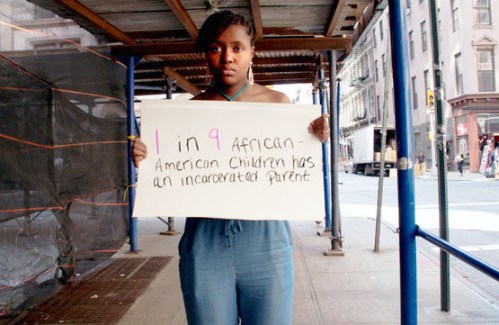
In the final two days of fundraising, Echoes Of Incarceration is a long term project that helps children of incarcerated parents to make documentary films about the effects of America’s prison industrial complex — on society, on us, on families, on communities, and mostly on children without one or both parents behind bars.
There are an estimated 2.7 million children in America with one or both parents in prison or jail. Mass incarceration has created fundamental weaknesses in society. Mass incarceration as easily impacts individuals as it does vulnerable groups (the poor, the under-educated, the discriminated against) and often we perceive the effects as lasting only years, or being contained within the experience of one identified moment, lifetime or geographical space. We neglect to recognise that mass incarceration is piling pressures on top of problems on top of expectations on top of America’s young, developing citizens.
We live in a society in which vast numbers of youth must negotiate formative years without parental support. The prison industrial complex has burdened our youth with an almost inconceivable set of problems that they did not ask for, and they do not deserve.
Echoes Of Incarceration brings much needed scrutiny to the issue of mass incarceration and crucially it does it through the lens of the innocent people who have inherited a broken, brutalising system we made. Their latest productions deal specifically with the Bill of Rights of Children with Incarcerated Parents.
Please, fund this important project.
Below is a 2009 production made by Echoes Of Incarceration


Art For Justice has a new exhibition opening in Philadelphia.
Free Library of Philadelphia, 1901 Vine Street, Philadelphia, PA 19103. (Between 19th and 20th Streets on the Benjamin Franklin Parkway)
Jan. 12 – Feb. 15, 2015

 Prison Photography