
You are currently browsing the category archive for the ‘Rehabilitative’ category.
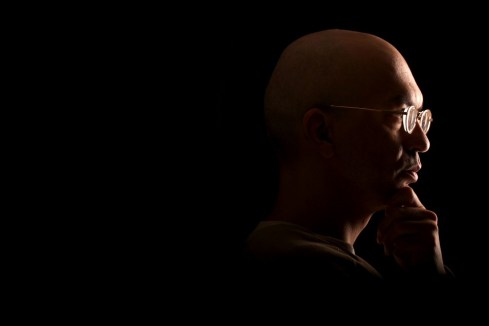
As I have mentioned here, NON-SUFFICIENT FUNDS, an exhibition of prison art by my students is ongoing in Seattle.
Prior to the show, the gallery asked that I try to make some portraits of the artists. I am not a photographer, so I was fortunate enough to secure the expertise of friend and Seattle Times photojournalist Erika Schultz.
The wall on which the portraits and their accompanying bios hung have been incredibly popular among the audience. Erika’s portraits are phenomenally unexpected. In this instance, text and image combine and challenge the damaging stereotypes of prisoners that usually hamper prison reform.
The non-existent genre of “prison photography” just expanded by one project.
PHOTOS AS EMOTIONAL CURRENCY
Not surprisingly, Erika’s portraiture has gripped the attention of the students too. For a US prisoner, sitting for a professional portrait is very, very, very rare. Photographs play a crucial part in the unorthodox family relationships that persist despite prison walls. The students are aware of this and incredibly eager for prints, which I will provide.
You should see more of this project on Erika’s blog.

… you should check out a fine exhibition of prison art.
As some of you may know, I teach an art studio class once a week at a nearby prison. Last year, I asked a local gallery if they’d be interested in partnering for a show. The time has come. Here’s the skinny:
NON-SUFFICIENT FUNDS
Fundraiser for University Beyond Bars
Opening Reception: Thursday, April 28, 5-9pm.
Vermillion Gallery, 1508, 11th Ave (between Pine & Pike), Seattle
Featuring Artists from Monroe Prison with Special works by Buddy Bunting and Paul Rucker. (show runs through May 14.) Special Video Presentation of When You Learn, You Don’t Return, by Gilda Sheppard at 7:30pm.
Non-Sufficient Funds brings together the work of twelve prison-artists from the University Beyond Bars program at Washington State Reformatory, Monroe, WA, with works by established artists Buddy Bunting and Paul Rucker.
This exhibition of more than 50 acrylic paintings, graphite drawings and one video installation address abstract, figurative, allegorical and spiritual concerns. Non-Sufficient Funds is the culmination of over a year’s worth of weekly studio sessions within the prison and the brainchild of Pete Brook, a dedicated volunteer and board member of the University Beyond Bars.
In addition to the artwork by the inmates at Monroe, Paul Rucker will be showing his video, ‘Proliferation’, which documents the growth of the US Prison system over the past 200 years in an animated mapping of the US Prison system set to original music. Also, Buddy Bunting is presenting a 13 foot color painting of the stark facade of a prison at ground level.
The title of the show, Non-Sufficient Funds, has a few meanings: First, it refers to the stretched resources of volunteer-based rehabilitation programs within prisons across America, which is what this particular exhibit is advocating for. Research indicates that inmates who maintain contact with the outside world and who engage in educational and vocational programs experience a much lower rate of recidivism.
Second, it is a commentary on the financial burden the Prison-industrial Complex places on US society. Due to harsher sentencing laws and the war on drugs, the prison population has quadrupled since 1980. Now, in times of economic crisis, serious questions are being asked about the amount of tax dollars spent on prisons.
Finally, it refers to the scenario when a prisoner receives a letter or package has insufficient postage, and no funds available in their prison account fund to cover the difference. “Non-sufficient funds” is stamped upon the return correspondence. Many of us are unaware firsthand of the rigid structure the penal system requires. Mail sent to inmates in violation of policies can lead to punishment. Prison libraries and other media are also highly censored for various reasons. Non-sufficient funds hopes to shed some light on the way art and education in institutions benefits society as a whole and we hope it encourages a dialogue and additional advocacy.
In the local press
Keegan Hamilton of Seattle Weekly penned Insider Art and also ran a photo gallery with the article.

In 2000, Mark Hogancamp was beaten by five men outside a bar in Kingston, New York. The attack was so brutal that afterward his mother Edda did not recognize him. When Hogancamp emerged from a 9-day coma, brain damage left him without language, or the ability to walk or eat without assistance. Hogancamp received state-sponsored physical and occupational therapy for twelve months, but when the aid ran dry he was on his own.
Refusing to “let those men win”, Hogancamp set about creating his own therapy, a 1/6th scale WW2 era town called Marwencol. He populated it with alter egos and played out scenes in order to make sense of life and humanity.
I’m really proud to have been able to bring his story – and his photographs as documents of that story – to a wider audience. Please read Miniature Town Brings Its Creator a New Life.
Check out the Marwencol documentary film website.
John Holbrook‘s Death Row portraits (2008) were taken in the Polunsky and Gatesville units, Texas.
The portraits serve two functions – they are the products of Holbrook’s own therapeutic journey and they are didactic props for the families of victims of murder.
“I want to teach the victims this liberating truth that I have learned,” says Holbrook. “The only way we can truly stop suffering is to love and forgive those who have caused the suffering.”

Seemingly, Death Row was propelled by Holbrook’s interpretation of Christian forgiveness and his need to psychologically heal after seeing images of violence during his work.
For 17 years, Holbrook worked as a private investigator on capital murder cases in Texas. In 1995, he was assigned to a case involving the double homicide of a teenage couple for which he spent many hours examining crime-scene evidence and graphic photographs.
Years later, Holbrook began suffering anxious episodes.
“A psychologist determined that my photographs of that time of homeless and social outcasts shown in a spiritual light, were subconscious attempts to correct the ‘bad pictures’ I saw while working the capital murder case,” says Holbrook.
“Ultimately, I learned that I could overcome PTSD by forgiving those who had caused it.”
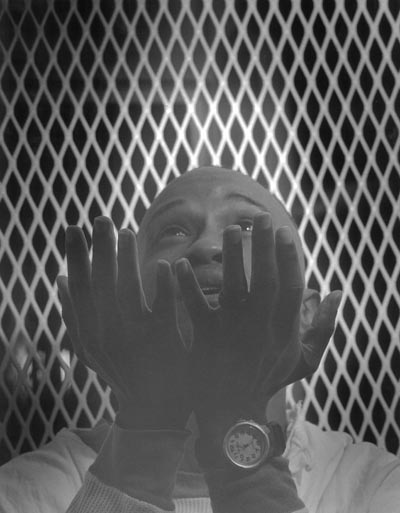
As he photographed through windows of prison visiting-room booths, Holbrook directed his subjects in spiritual gestures. The video (below) mirrors the artist’s rationale and is sympathetic to his needs. It bothers me a little that Holbrook feels he is the one to bestow forgiveness. He was a professional in his work. It was work that carried extreme emotional trauma after the fact, and I understand why Holbrook responded outwardly with conviction and a project as strong as his prior distress, but it could be argued Holbrook’s dragged prisoners into his healing process. If a university wanted to interview death-row prisoners they’d need ethics approval from a human subjects research board. I’d like to know about Holbrook’s preparations for the project.
That said, the prisoners he worked with (on the evidence of the video below) are engaged in the project and undoubtedly moved by the Holbrook’s portraits. I assume they were extremely grateful for the visits and discussion with Holbrook.
The stresses of criminal justice work lead to many responses by professionals and while Holbrook’s methods may be unorthodox, it seems he’s gone about them in good faith (pun intended). Better this outward healing than the slow degradation of family life and health that can impact police and prison personnel.
At its core, Holbrook’s work is a call to victims’ loved ones – who have significant sway in the death penalty debate – to oppose state murder.
“In order to get a death penalty, a Texas prosecutor will argue that the victim’s loved ones endorse the death of the accused. It is said that the surviving loved ones, “need closure”. Through my pictures, I argue that this disables the survivor’s ability to forgive the accused. To me, execution is a grave injustice done to the loved ones, ultimately denying survivors the ability to stop suffering.”
We mustn’t forget that Holbrook’s invocation of Christian teachings will help many Americans connect with his work. The work is anti-death penalty and Holbrook’s American audience vote.
I have not come across any project similar to this and I’d be very interested to get the views of the prisoners involved. I think only then can we begin to weigh the value of Holbrook’s works. Who knows, several of Holbrook’s subject may have already been executed?
The overt Christian imagery can be regarded as talking point, for some, maybe a noble purity, but for me it is suffocating. There are sociological causes to crime and there can be political responses. That is not to say I don’t believe in forgiveness; it is just to insist that forgiveness needn’t be monopolised by faith groups but instead incorporated into secular policy, restorative justice programs and sentencing laws that are not overly-retributive.
Forgiveness is an essential part of understanding the causes and cycles of crime. Unfortunately, too often “forgiveness” hinges upon a final apology of the condemned before we fry them anyway.
Jackie Dewe Mathews‘ series Trafficantes, is time spent with women imprisoned for drug smuggling in Brazils’ Sao Paolo Capital Penitentiary for Women. Pretty much without exception, each woman made bad choices, but those were bad choices born of tough lives, low self-esteem and sometimes addiction.

The women come from all over the globe. Dewe Mathews opens the essay with this caption: “Sao Paulo Capital Penitentiary for Women, where women from over 30 countries are held. The largest numbers come from South Africa, then South America, followed by former Portuguese colonies in Africa such as Angola, Cape Verde and Mozambique, as well as Europe, especially, Spain and Portugal and Asia, particularly Thailand and the Philippines.”
Throughout, Dewe Mathews makes efficient use of text-captioning to tell these womens circumstances. Some of the portraits are first class; by first class I mean laden with emotion and character. Other photos can be flat, but the series as a whole is a illuminating look at a hidden world.
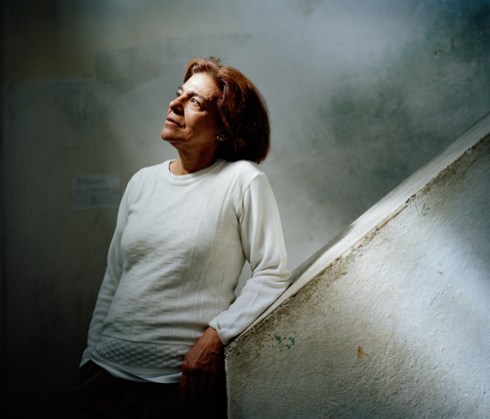
Mathews appeared on Verve today, providing the following bio:
Jackie Dewe Mathews (b.1978, England) worked in the film industry as a freelance camera assistant on feature films and commercials. Her continued interest in cinematography has informed her photography practice which she was able to develop during an MA in Photojournalism and Documentary Photography at the London College of Communication in 2007. In 2008 she was awarded the Joan Wakelin bursary for a social documentary project from the Guardian newspaper and the Royal Photographic Society. In 2009 she was selected by the Magenta Foundation for emerging photographers. In 2010 she was a runner up in the Ojodepez and Julia Margret Cameron awards.
_____________________________________________________
Thanks to Bob Gumpert for the tip.
Dewe Mathews’ work should be compared with Chan Chao‘s intimate portraiture.
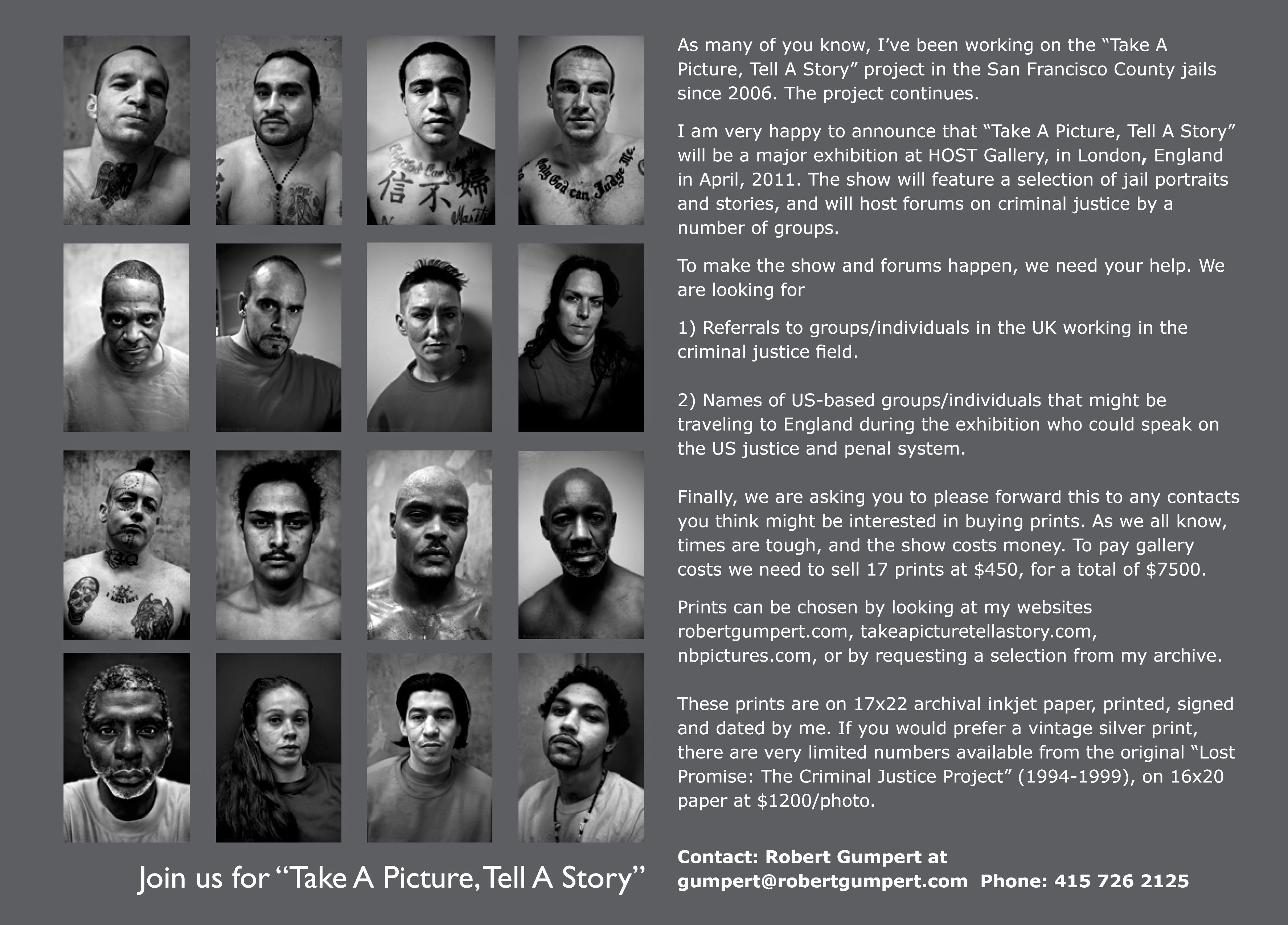
Good friend Bob Gumpert will be showing his portraiture from the San Francisco and San Bruno county jails at HOST gallery in London in April of next year.
From Bob’s email this week:
As many of you know I’ve been working since 2006 on the “Take A Picture, Tell A Story” project in the San Francisco County jails. The project continues. I go into the jails about three times a month and post to takeapicturetellastory.com as time and stories allow.
The show will host forums on criminal justice by a number of groups. To make the show and outreach happen we need your help with the following:
1) Referrals with groups/individuals in the UK working in the criminal justice field.
2) Names at US based groups/individuals that might be traveling to England during the exhibit who could speak on the US system.
3) Forwarding this note and flyer to your any of your contacts that might be able to help with contacts or might be able to help with funding by purchasing a print.
Obviously, I have a wild bias in seeing work such as Bob’s getting a wide audience.
Yet, photography from prisons/jails tests the theory that photography shows and delivers stories we otherwise would not see. Bob’s portraits and audio gives voice to the marginalised. Whatever the reasons for their incarceration, no one deserves to be made invisible. Bob’s work empowers his subjects and reveals the limitations of our criminal justice systems.
So, friends stateside and over there in Blighty, get your thinking caps on and see if you can help spread the word and find him some allies (and cash?)

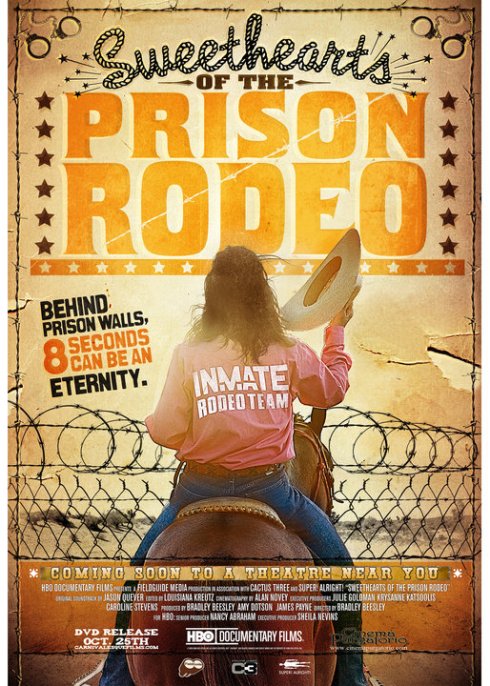
Filmmaker Bradley Beesley and his team admit beginning the project “mostly informed by the cultural lore of prison through film and music such as Cool Hand Luke, Stir Crazy, and Folsom Prison Blues.” That quickly changed. Sweethearts of the Prison Rodeo was released Friday.
I’ve talked about prison rodeos before (Damon Winter, Tim McKulka and Gary Winogrand). The Oklahoma State Penitentiary Rodeo is new to me; didn’t know it existed. It’s the largest “Behind the Walls” rodeo in the US.
From the synopsis, “In 2006, female inmates were allowed to participate in the rodeo for the first time. In a state with the highest female incarceration rate in the country, these women share common experiences such as broken homes, drug abuse and alienation from their children. Since 1940, the Oklahoma State Penitentiary has held an annual ‘Prison Rodeo’. Part Wild West show and part coliseum-esque spectacle, it’s one of the last of its kind – a relic of the American penal system […] Within this strange arena the prisoners become the heroes while the public and guards applaud.”
I was also happy to find a Q&A with three ladies from Sweethearts of the Prison Rodeo at SXSW 2009. They’d been out a year at the time. They are optimistic and they are role models.
Since last year, Sweethearts of the Prison Rodeo has shown around the world and inside prisons.
The self-respect gained by the ladies necessarily tempers my reservations toward prison rodeos. It seems like they’ve genuinely benefited from the activity, but this could have as much to do with the film-making around the activity. The entire package was a program in team building, setting and achieving goals.
The film also has a much needed outreach component:
“We’d like to use this documentary and the stories of the people connected with the film to help recognize the lives of inmates and those re-integrating into society. We’d like to create grassroots dialogue to improve awareness of issues and create opportunities. In addition, Sweethearts of the Prison Rodeo is establishing a Scholarship for inmates attending college while incarcerated.”
Bravo, bravo … I don’t want an encore though. I want the ladies to keep kicking recidivism rates into touch.

 Prison Photography