
You are currently browsing the category archive for the ‘Visual Feeds’ category.

In 2005, Alyse Emdur unearthed a photograph (above) of her visiting her older brother in prison. She recalls, even as a 5 year old, her confusion and discomfit with the tropical beach scene to her back.
To Alyse, these garishly coloured corners of the prison visiting rooms are analogous with commercial photo portrait studios, “If you weren’t familiar with prisons, you might think these were prom photos or made in community centres. They’re very ambiguous,” says Alyse.

Fascinated by the obscure and closeted mural works in prisons across the U.S., Alyse meditated upon them in her MFA grad show (she even commissioned a prison artist to paint a mural on parachute canvas). She is now bringing hundreds of authentic American prison visiting room portraits from her Prison Landscapes project together in a book to be released later this year.
Alyse contacted over 300 prisoners via prison penpal and dating websites. Just over 150 agreed to be part of the project.
In the past, I’ve argued that visiting room portraits may constitute the largest type of American vernacular photography not seen by the majority public. I’ve also noted how companies will manipulate these portraits and, at the request of the owner, photoshop out the prison environment. Photoshop “services” such as these are the post-production equivalent of the denial existent in the original works.
If these idyllic landscapes are about escape it might not just be in an emotional sense, “They are a security feature,” says Alyse. “The backdrops are there to control the type of imagery that is being exported out of the institution. To be specific, the administration doesn’t want images of the inside of the prison to circulate outside of the prison because the thinking is that those images could help an inmate escape. That’s what makes these images slippery and interesting; they also create an escape for the poser and for the [family member] who receives the photo.”
How or why does this discussion matter? Well, essentially these are images about control. Cameras are considered a security hazard by prison authorities. Prisoners have no opportunity to self-represent (bar some very exceptional prison photo workshops). After their mugshot, these visiting room portraits are the only chance America’s 2.3 million prisoners have to achieve something that approximates self-representation. These are highly mediated images and they are often a performance that belies the hardship of prison life.
Alyse and I talk about the regionalism of the backdrop murals; the dearth of research on this quirky and hidden aspect of American visual culture; and Alyse notes how the artistry of mural painting is disappearing as acrylic and enamel paint is replaced by large photo-printed screens.
LISTEN TO OUR DISCUSSION ON THE PRISON PHOTOGRAPHY PODBEAN PAGE


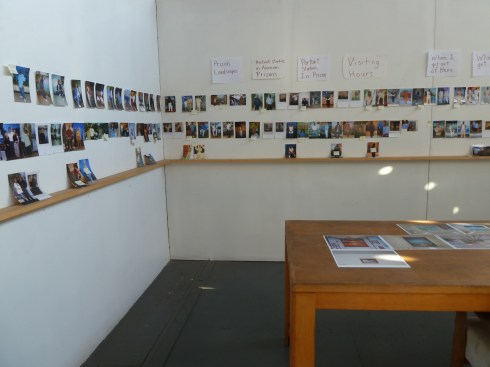

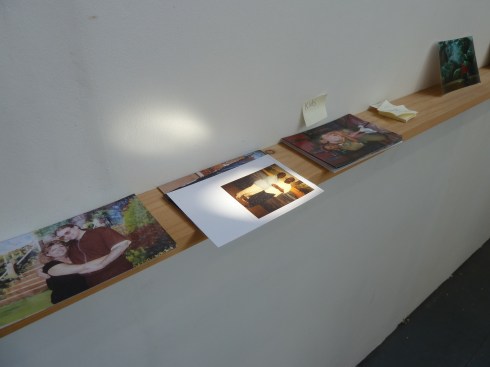
Alyse Emdur (b. NJ, USA 1983) works with photography, video, research, social engagement, and drawing. Her work has been exhibited at Printed Matter and the Lambent Foundation in New York; the University of Texas Visual Arts Center in Austin; Bezalel University in Tel Aviv, Israel; the Lab in San Francisco; La Montagne Gallery in Boston; Laura Bartlett Gallery in London, England; Spacibar in Oslo, Norway; In Situ in Paris, France, and Kunststichting Artis in Hertogenbosch, Netherlands.
In Spring 2012, a book of her project Prison Landscapes will be published by Four Corners Books (London).
Download an interview with Niels Van Tomme published in the Fall 2011 Issue of Art Papers Magazine, here (PDF)
Download an excerpt of Prison Landscapes published in Issue 37 of Cabinet Magazine, here (PDF)
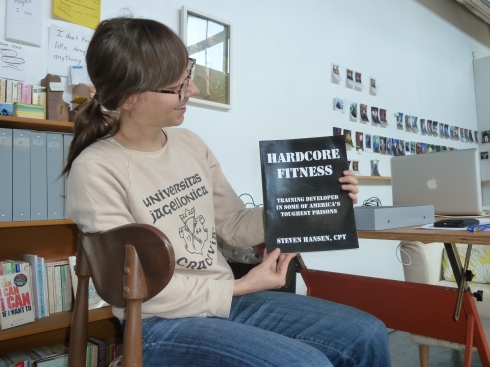
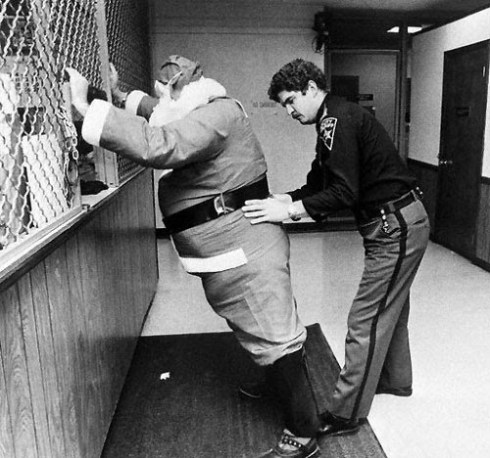














As many of you will know, a little piece of Prison Photography has been wrapped up in my monotone voice, roadtrip b-roll a bit of car-singing.
Tim Matsui (who helped film the PPOTR Kickstarter video) thought my PPOTR trip was unusual enough that he was willing to put his time and money behind a week-long commitment to follow me over the mid-point of the PPOTR trip. Read Tim’s summary of the experience.
Most importantly the voices of prisoners from Sing Sing Prison in New York State are represented in this film. The prison only allowed us to video two prisoners talking to the camera; their insightful and reasoned positions are representative of all 13 students in that workshop back in November.
I also captured audio and written response to specific photographs from all the men in the workshop. That content will be simmered into something beautiful in the new year. (On production management, I’m astonished at how quick Tim turns projects around.)
Watch the Prison Photography on the Road documentary short
Tim wanted to help clarify my mission and explain it to a wider audience. Uncomfortable being in front of the camera, I was a septic skeptic and an unwilling subject at times. But Tim knows what he’s up to and I should have just trusted him 100% instead of being so precious.
The feedback already has been very positive and encouraging; many emails and Facebook loving. My buddies at DVAFOTO, LPV Magazine, PHONAR and DEVELOP Tube have also helped spread the word.
I’m now nearly at the end of the trip. I’m in San Francisco after 12,500 miles. Four days and two interviews remain.
I’ve made 63 audio interviews so far and published ten. I have to let go of the fact that I can’t share all this material instantly and instead embrace the size of the task to edit the audio, share the images and distill the essentials to do justice to each all of the amazing work and advocacy my interviewees have done and continue to do.
So, PPOTR will bleed into 2012.
For Prison Photography, next year is going to look different and involve a handful of projects that continue still to extend the project beyond the boundaries of the typed word. Stay tuned and thanks for your continued interest.

© Paolo Patrizi, from the series Migration
This week, I wrote two pieces for Wired on Google Street View. The first was a gallery of the various projects spawned by GSV, and the second was a piece about authorship and the repetition of nine scenes in two of the most well known GSV projects (Jon Rafman’s Nine Eyes and Michael Wolf’s A Series of Unfortunate Events and FY.)
Anecdotally, the photo-thinkers out there are converging on Doug Rickard’s A New American Picture as the most robust work. A close contender though is the relatively new No Man’s Land by Mishka Henner.
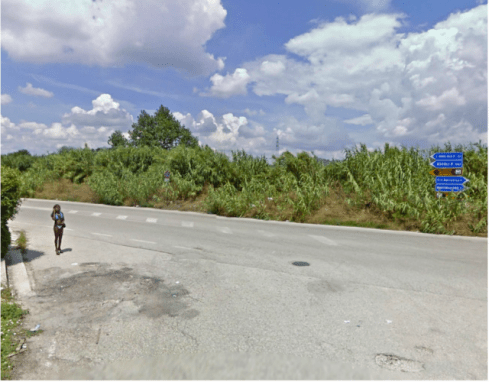
© Mishka Henner
No Man’s Land (more images here) is a disturbingly large selection of GSV screen-grabs of (presumably) prostitutes awaiting customers on the back roads of Italy. Henner says:
I came across communities using Street View to trade information on where to find sex workers. I thought that was the subject to work with. Much of my work is really about photography and this subject tapped into so many aspects of it; The fact the women’s faces are blurred by the software, that they look at the car with the same curiosity that we have when looking at them, and finally, that the liminal spaces they occupy are in the countryside or on the edge of our cities – it all has such great symbolism for our time. And that’s aside from the fact these women have occupied a central place in the history of documentary photography.
But for traditionalists, No Man’s Land is a long way from the spirit of documentary photography. Of Henner’s work and of all GSV series generally, the ever-outspoken Alan Chin says:
“Google Street Views is a navigational tool, an educational resource, and sure, it can reveal a lot about a place and a scene at a given moment in time. But if you, the artist, are really so interested, then go there and take some pictures yourself. This is about as interesting as cutting out adverts from magazines that have some connection and then presenting your edit as a work of art. Post-modern post-structuralist post-whatever denizens of of the art world and academia love this shit. Which is well and good for the university-press industry. But it has little to do with actual reporting and actual documentary work in the field.”
Well, just last week, I came across Paolo Patrizi documentary photographer that actually took himself to those byways.
For Migration, Patrizi has keenly researched where these women have come from and where, if anywhere, they may be going. From the project statement:
“The phenomenon of foreign women, who line the roadsides of Italy, has become a notorious fact of Italian life. These women work in sub-human conditions; they are sent out without any hope of regularizing their legal status and can be easily transferred into criminal networks. […] For nearly twenty years the women of Benin City, a town in the state of Edo in the south-central part of Nigeria, have been going to Italy to work in the sex trade and every year successful ones have been recruiting younger girls to follow them. […] Most migrant women, including those who end up in the sex industry, have made a clear decision to leave home and take their chances overseas. […] Working abroad is therefore often seen as the best strategy for escaping poverty. The success of many Italos, as these women are called, is evident in Edo. For many girls prostitution in Italy has become an entirely acceptable trade and the legend of their success makes the fight against sex traffickers all the more difficult.”
Patrizi is interviewed on the Dead Porcupine blog and talks about the unchanging situation, the pain experienced by the women, their reactions to him, and the destruction of woodland by authorities in attempts to literally expose the illicit encounters. It’s a must read.
The images in Migrations are inescapably bleak; therein lies their power.
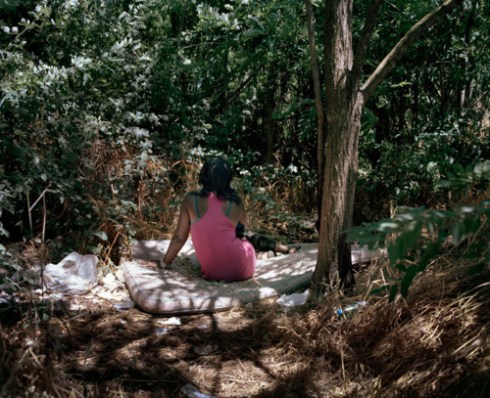
© Paolo Patrizi

© Paolo Patrizi

© Paolo Patrizi

© Paolo Patrizi
Patrizi’s Migration induces a visceral shock; images of the littered make-shift sex-camps turn the stomach. When human fluids are dumped, it is not usual that humans continue to function in and around them. These workstead pits of dirt, tarps and abuse are shrines to the shortcomings of globalisation and the social safety net.
By contrast, Henner’s work allows us to keep a safe distance. He even saves us the trouble of finding these scenes on our own computer screens; we’re detached one step beyond. We are cheap consumers.
Patrizi’s photography with its clear evidence of his boots on the ground don’t allow us to share Henner and Google’s amoral and disinterested eye.
On Henner’s virtual tour, we cruise, at 50mph. We don’t stop, we don’t get out the car and we don’t get too close. We might as well be in another country … which of course we are. Patrizi’s work walks us by hand to the edge of the soiled mattresses and piles of discarded condoms.
Patrizi’s images counter the washed out colours, the flattening effect of wide-angle lenses, and the perpendicular viewpoint of GSV. Instead, they involve texture, depth, legitimate colour, details and different focal points along different sight-lines. In other words, Patrizi’s Migration engages the senses and the basics of human experience. Patrizi’s photographs return us to the shocking fact that that these women are human and not just bit-parts in the difficult social narratives of contemporary society. Works full of threat, fear, flesh and blood.
By comparison, Henner’s screen-grabs are anaemic.
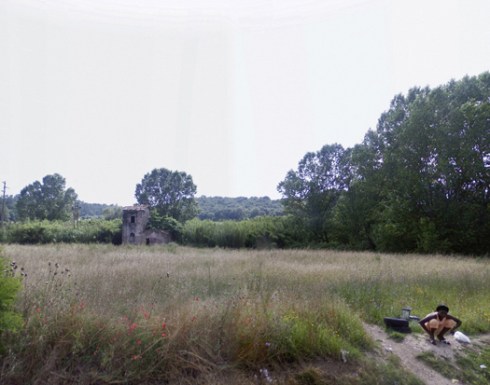
Via del Ponte Pisano, Rome, Italy. © Mishka Henner
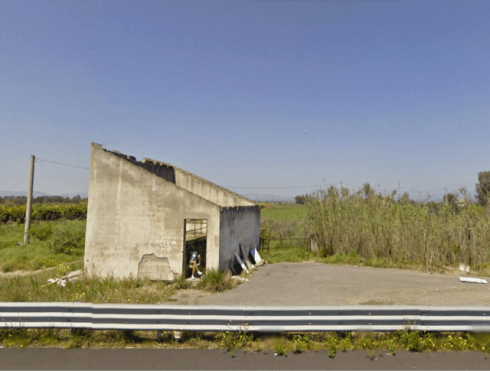
© Mishka Henner

Carretera de Ganda, Oliva, Spain. © Mishka Henner

© Mishka Henner
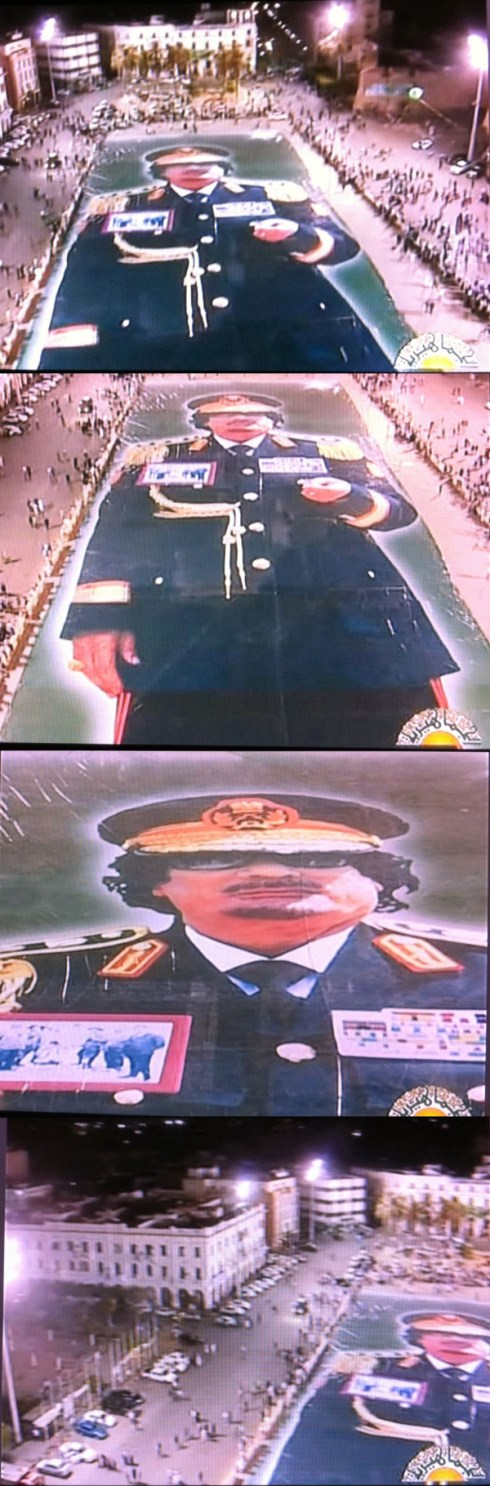
Late last night, I heard a report by a BBC World Service journalist from Tripoli. Escorted by a government liaison officer, the journo only met members of the public who were fervent Gaddafi supporters (one of Gaddafi’s information officers was captured by rebels last week and estimated 70% of people in Tripoli supported Gaddafi.)
During the report, he spoke with men piecing together a huge “photo” of Gaddafi in Green Square. I had heard nothing of this so this morning jumped on my computer to see for myself.
If it weren’t for the BBC report, I may have considered the above images an elaborate hoax – a) because I’d not heard of this month-old photo-stunt, and b) because it just seems so bonkers.
The images are screengrabs from Libyan TV made Sate Hamza ساطع, whose Twitter profile reads, “Syrian-Canadian dermatopathologist practicing in Winnipeg. Lived in the US. Enjoy comedy, world music & multimedia. Follow global news & current affairs. Vegan.” He blogs here.
Sate, whose Twitter handle is sate3 posted the screengrabs to TwitPic on 24th July with the message, “Giant photo of Gaddafi in Green Square in Tripoli unveiled yesterday (July 22, 2011), on Libyan TV. #Libya”
So, I ask for a bit of feedback. Had anyone else heard of this massive photograph? If so, can you help me with some more resources. If not, why not? How does this compare to other examples from history of nationalistic/cult of the personality shows of strength?
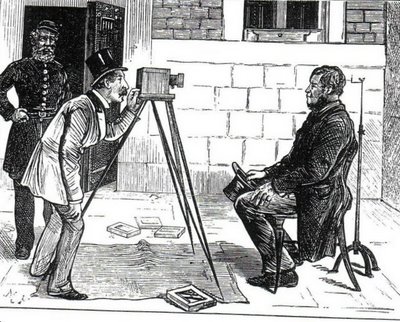
Cartoon of prison photographers from the Illustrated London News, 1873 in The Mechanical Eye in Australia (OUP, Davies & Stanbury, 1985).
Over on the high-class Threat Level blog, David Kravets has penned Mug-Shot Industry Will Dig Up Your Past, Charge You to Bury It Again a scary piece about America’s “mug shot industry racket”:
Exploiting Florida’s liberal public-records laws and Google’s search algorithms, a handful of entrepreneurs are making real money by publicly shaming people who’ve run afoul of Florida law.
Florida.arrests.org, the biggest player, now hosts more than 4 million mugs. On the other side of the equation are firms like RemoveSlander.com, RemoveArrest.com and others that sometimes charge hundreds of dollars to get a mugshot removed. On the surface, the mug-shot sites and the reputation firms are mortal enemies. But behind the scenes, they have a symbiotic relationship that wrings cash out of the people exposed.
I’ve written before about rolling galleries of the recently arrested in place of stories on online “news” sites. It is a practice particularly prevalent across southern states. These galleries are the digital version of mugshot papers like Just Busted.
Unlike these galleries that feature the latest bookings, FloridaArrests has raked the archives. But I would still criticise both for an amount of coercion; they induct, at some level, users into the visual language of law enforcement. By the act of looking we are perversely interacting with portraits threaded with menace; they are, after all, the outcome of some type of confrontation. But the visibility of these images (and thus confrontations) far outweighs the impact these contained confrontations have on the everyday life of the majority.
Kravets’ article demonstrates that beyond the dubious exchange of digital imagery for news informational purposes fear, a business model has been found to monetise the shame that goes along with being booked and photoed.
“The business model seems to be to generate embarrassment and then remove the source of the embarrassment for a fee,” said Steven Aftergood, director of the Project on Government Secrecy for the Federation of American Scientists, and one of the nation’s leading open-records advocates.
Now you are manipulated as much as prey of the mugshot industry as much as you were as a consumer!
Have you made one mistake in the Sunshine State? If so, you’re probably up there among the other 4 million mugshots. That is until you fork out $400 to a specialist firm to process a $20 take-down request. The take-down is a “URL for an automated takedown script on [a] site” that is activated by PayPal payment. FloridaArrests.org have provided the URL in advance for multiple companies.
Reads like a racket.

Sometimes it’s associated with a British band, and sometimes it associated with people who are banned.

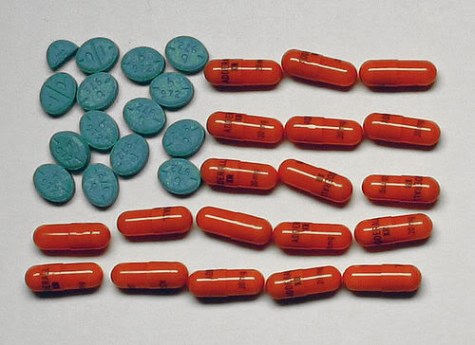
It’s about pills, madness and control. It’s about healing.

It’s about awesome fashions and it’s about bad accessories.


It’s about poor decisions by presidents.

It’s about corporate control and corporate profits.


It’s about death to ours and death to theirs.


Sometimes, it’s about imperialism.

It’s about religious freedom and freedom of religion.


It’s about fake sportspersons and real sportspersons.
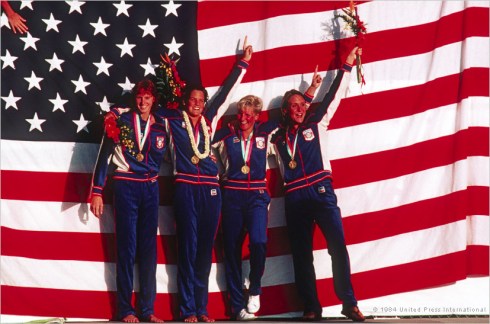

It’s about God and it’s about children.
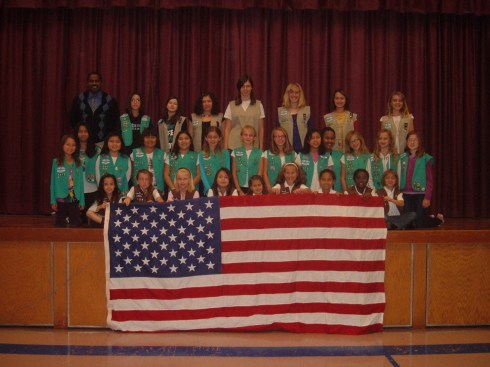
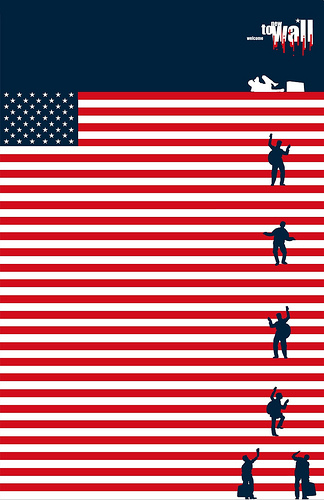
It’s about we the people, not them the people.

It’s about bigotry and it’s about a permanent underclass.


It’s about cold beer, cupcakes and weed.

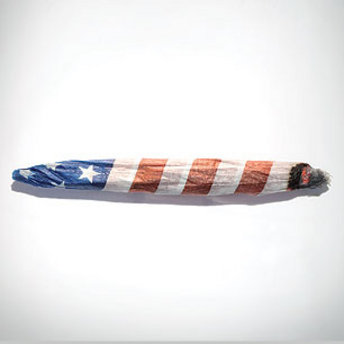
Images sources: Rolling Stones lips; Prison bars, from Teen in Jail; American flag of pills, by Talia Marisa; Heels, Fashion Munster; Spectacles, Linda Lovelock wears American flag sunglasses during the 2010 Tax Day Tea Party April 15, 2010 in Pleasanton, California. Tea Parties were held across the United States to denounce tax day. More than a thousand people attended the Tax Day Tea Party at the Alameda County Fairgrounds. (April 14, 2010 – Photo by Justin Sullivan/Getty Images North America); Bush family; Corporation flag; ISBN flag, via Adbusters; Coffin at night, Sudanese men look at the flag-draped coffin of U.S. diplomat John Granville, 33, who worked for the USAID, as it is received by U.S. officials in Khartoum, Jan. 3, 2008. (AP); US flag bomb graphic, via Daily Bleed; Imperialism flag, Christian cross, on eBay; Star-spangled burqa; Rocky Balboa shorts; Olympic winners, via Astropix (Teammates in the USA women’s 4 x 100 meter relay swim team stop in front of a giant American flag to wave to fans after winning the gold medal and setting a world record in the finals of the event during the 1984 Olympics in Los Angeles. From left are Jenna Johnson, Dara Torres, Carrie Steinseifer, and Nancy Hogshead.); Child’s drawing, via Fire Andrea Mitchell; School class photo, via Valley Community Newspaper (The Girl Scouts who meet for troop activities at Martin Luther King Jr. Elementary School had an American flag flown over the nation’s capitol on Dec. 6 to honor the school. Photo Credit: Unknown); Immigration wall graphic, by Luis Boix; “Does my fag offend you?” bumper sticker; Immigrant labour graphic, by La Mustia; Supermarket beers, via Corks and Kegs; Cupcakes, The Cupcake blog; Spliff, from Rolling Stone via The War on Drugs is a War on Me.
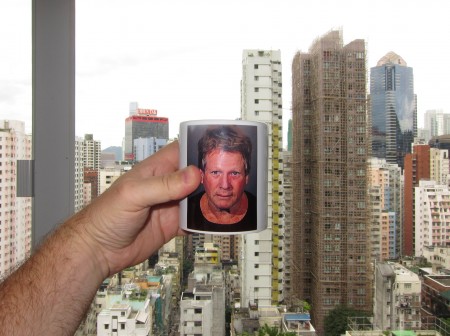
Michael Wolf’s mug. Photo by Michael Wolf for Hermann Zschiegner’s Mugshot Mugs project.
Hermann Zschiegner‘s cheeky Mugshot Mugs had me smiling. He wanted to make a comment on privacy and create and excuse to make contact with his heroes.
Zschiegner Googled and downloaded images of celebrities’ booking photos, printed them on mugs at Walmart and sent the mugs out to, as he puts it, “twenty people that have been of great influence to me in one way or another or whose work I have admired over the years. Some of the people who received a mug are friends, but most don’t know me very well – or at all. […] All I asked from the participants was to place the mug anywhere in their home and take a picture of it. The way the mug was framed in the picture dictates just how much privacy they were willing to give up.”
Zschiegner’s comparison of mugshots with paparazzi and within a framework of privacy-rights is thought-provoking:
“Federal booking photographs are automatically entered into the public domain in the United States, and can be obtained by anyone through the Freedom of Information Act. While designed as a tool to index and collect the images of potential criminals in a database, the publication and distribution of these pictures is an astonishing act of invasion of privacy. Institutionalized, but in effect not much different of paparazzi pictures shot from afar.”
Zschiegner is an active member of the Artists’ Books Cooperative (ABC) an international network created by and for artists who make print-on-demand books. Many of the recent book-projects within ABC have made overt use of public, internet and appropriated digital imagery. In a recent email, Zschiegner described ABC as “slow and spontaneous, small and excessive, serious and funny.” Okay, I’m amused so I’ll let you have it both ways.

 Prison Photography