
You are currently browsing the category archive for the ‘Visual Feeds’ category.

An interior view of the dining facility at the newly opened Baghdad Central Prison in Abu Ghraib on February 21, 2009 in Baghdad, Iraq. Wathiq Khuzaie for Getty Images Europe.
Yesterday, my good friend Debra Baida sent me through the link to the New York Times Abu Ghraib – Baghdad Bureau Blog. This came at the same moment I was preparing a post to discuss the first images to come out of the renamed, refurbished and relaunched Baghdad Central Prison.
By far the best, and possibly the only, extended photo essay of Abu Ghraib Baghdad Central Prison is by Wathiq Khuzaie of Getty Images Europe. There is also this brief video from the BBC.
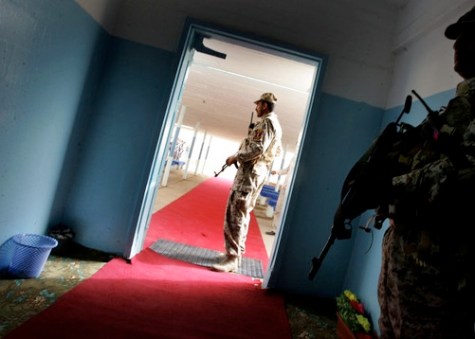
Iraqi security personnel stand guard at the newly opened Baghdad Central Prison in Abu Ghraib on February 21, 2009 in Baghdad, Iraq. The Iraqi Ministry of Justice has renovated and reopened the previously named "Abu Ghraib" prison and renamed the site to Baghdad Central Prison. Wathiq Khuzaie/Getty Images Europe
New Era, New Penology
The BBC noted, “Along with the change of name, the Iraqi justice ministry is trying to change both image and reality, billing it as a model prison, open to random inspection by the Red Cross and other humanitarian organisations.”
This transparency is a refreshing change to the policy of Abu Ghraib’s former operators. The work is not yet complete though and the upgrade is ongoing. The BBC describes, “[The prison] will eventually be the city’s main jail, holding about 12,000 inmates. Initially, only one of its four sections will be used. There are already about 300 prisoners there to test it out and, once the prison has been officially inaugurated, that figure will rise to 3,500.”
So, not only do Iraqi authorities want to repurpose the institution, they want to make it the penal institution of “The New Iraq”. This is an ambitious policy riddled with dangers; the site is loaded with memory and controversy. As the New York Times notes, “the promise of a new era can also be a time for remembrance.”
I highly recommend one goes onto read accounts from Iraqis, correspondents and photographers who lived and recorded Abu Ghraib’s recent history, particularly photographer Tyler Hicks’ account of Saddam’s prison amnesty in October 2002 that turned from celebration to human catastrophe.

Wathiq Khuzaie/Getty Images Europe

An interior view of one of the cells at the newly opened Baghdad Central Prison in Abu Ghraib on February 21, 2009 in Baghdad, Iraq. Wathiq Khuzaie/Getty Images Europe
Two things struck me about the photographic series of the new prison. Firstly, the number of flags, insignia and national colours across walls, above fences and emblazoned on uniforms. The Iraqi authorities have stamped their identity all over this project. It is the presentation necessary to supersede Abu Ghraib’s reputation.
Secondly, the pastel palette of many of the interior shots – namely the ubiquitous lilac. I want to know who has the decision-making power at Baghdad Central Prison! However, I suspect lilac paint was cheap and readily available; so it wasn’t so much a decision – more a fact created by circumstance.
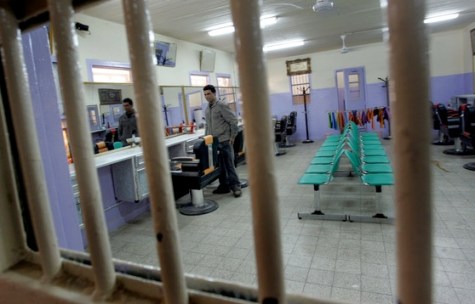
Interior view of the barbers shop at the newly opened Baghdad Central Prison in Abu Ghraib on February 21, 2009. Wathiq Khuzaie/Getty Images Europe.
Following that logic, one could presume lilac and purple fabric & thread is also at a surplus in Baghdad…

Interior view of sewing machines at the newly opened Baghdad Central Prison in Abu Ghraib on February 21, 2009. Wathiq Khuzaie/Getty Images Europe.
I don’t want to sound facetious, I was just shocked by the light purple, which according to colour theory is supposed to evoke emotional memory and nostalgia. Darker purples are supposed to represented, nobility, royalty and stability. From those evocations one is instilled with wisdom, independence, dignity and creativity.
If Baghdad Central Prison is to spur such emotional response in its inmate population it will succeed where many, many prisons have failed.
Basically, I am hopeful that the new prison can operate justly and succeed with the rehabilitation it emphasised this week. And despite all the lilac, soft-furnishings and current open media access – in reality it remains a prison with doors, locks and guards.
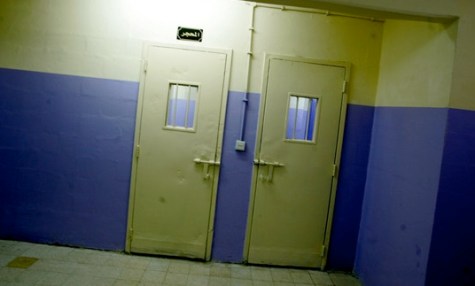
Interior view of cell doors at the newly opened Baghdad Central Prison in Abu Ghraib on February 21, 2009 in Baghdad, Iraq. The Iraqi Ministry of Justice has renovated and reopened the previously named "Abu Ghraib" prison and renamed the site to Baghdad Central Prison. According to the Iraqi Ministry of Justice about 400 prisoners were transferred to the prison which can hold up to 3000 inmates. The prison was established in 1970 and it became synonymous with abuse under the U.S. occupation. Wathiq Khuzaie/Getty Images Europe.
BURN Magazine, under the fiscal umbrella of the Magnum Cultural Foundation, have announced a $10,000 grant “to support [the] continuation of the photographer’s personal project. This body of work may be of either journalistic mission or purely personal artistic imperatives”
I am encouraging people to take on the difficult task of securing prolonged and necessary time with a prison/jail/detention-centre population in order to faithfully describe the stories and systems of its particular circumstance. On top of that your product must be “work is on the highest level”.
It’s a tall order but if you have carried out portrait or documentary photography in a site of incarceration before (I know many of you), then submit an application to continue that critical and valuable work. It will have to better than my attempt.

San Pedro Prison, La Paz. July 2008.
Hmm. On the same day I encourage photographers to attempt access into sites designed to be impenetrable, the government and police in my home country have introduced “laws that allow for the arrest – and imprisonment – of anyone who takes pictures of officers ‘likely to be useful to a person committing or preparing an act of terrorism’.” (British Journal of Photography via In-Public)
BURN Magazine is a new(ish) venture by David Alan Harvey whose got a Magnum portfolio and his own internets.

Modified captions on Colin Powell’s grainy images.
According to Joseph Pine we all crave – and will buy – authenticity these days.
According to Errol Morris we are more inclined to find authenticity in grainy low resolution images.
ERROL MORRIS: But, as we become more and more sophisticated about images — about how images are processed — haven’t we become more sophisticated about detecting fraud? Photoshop manipulations are relatively easy to detect. They fool the eye, but they don’t necessarily fool the expert.
HANY FARID: The answer is: yes and no. It depends on the image source. So, if we have the raw files[8], if we have the original footage from someone’s digital camera, you can’t fool us anymore. We have enough technology today where, given the camera, the original images that came off the camera, we can tell if you’ve manipulated them. If, however, you are talking about an image that has been cropped and reduced and compressed and posted on the web, then we might be able to do it, but there’s no guarantee. The task is decidedly harder because a lot of information has been thrown away. You’ve compressed the image; you’ve resized it. This is why all the Loch Ness monster and ghost images are always so tiny and grainy, because then you can’t see the signs of tampering. With low-res images it’s much harder to detect a fake. Definitely, when we have a high-res original image, we are much better at it.
[People often trust low-res images because they look more real. But of course they are not more real, just easier to fake. We look at picture of Nessie (the Loch Ness Monster). It’s grainy, fuzzy. It’s hard to make anything out. You never see a 10-megapixel photograph of Big Foot or the Abominable Snowman or the Loch Ness Monster. One explanation is: these monsters don’t exist. But if they did exist — so the thinking goes — they are probably unwilling to sit still for portraiture. The grainy images are proof of how elusive Nessie can be. This belief extends to documentary filmmaking, as well. If it’s badly shot, it’s more authentic. – E.M.]
Grainy image of Caribou. From the Film Board of Canada, who gave Boards of Canada a name.

Grainy image of moon surface

Grainy image of Pentagon
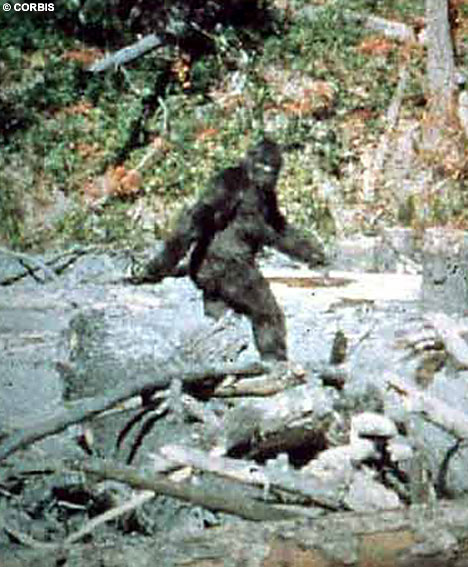
Grainy image of man in a flamboyant hirsute
Spurred by the wonderful news over at The Impossible Project that Polaroid Film is getting a second chance, I delved (via its “friends” links) into Polanoid.net. Whereupon, I found this small and particular photo-series by Lars.blumen.

Hohenschönhausen. Credit: lars.blumen
The Hohenschönhausen Memorial in Berlin is an active community/museum organization that fosters education and understanding with regards political imprisonment. The refreshingly transparent website even concedes crucial gaps in knowledge. “The history of the Berlin-Hohenschönhausen prison site has not yet been researched in sufficient detail. There is, as yet, no general overview detailing the social background of the prisoners, nor the reasons for their imprisonment, nor their length of stay. In fact, we do not even know exactly how many prisoners were kept here over the years.”
I am given the impression a precious sense of purpose & justice drives this shared project. Elsewhere on the site, their call for research is inspiring.

Hohenschönhausen. Credit: lars.blumen
The reason this set fascinated me so much was that it seemed so immediately incongruous. It is wonderful incongruity. With Polaroid one expects sanctified family portraits (60s, 70s) or blurred disco memories (80s, 90s). Polaroid of the 21st century has been largely an indulgent affair. Lars.blumen has given us a rare treat. He ‘captured’ the most infamous site of Soviet Secret Police interrogation and detention within 10 single polaroid frames.

Hohenschönhausen. Credit: lars.blumen
Lars.blumen’s project, done without fanfare nor nostalgia, uses the visual vocabulary of the past. Just to make things interesting, the prison (at he time of Polaroid) would never have been observed, nor documented, in this same manner.
The polaroids are remarkable for what they aren’t. They aren’t actual images from the era of the Stasi. And this era is that to which now all energy – as a Memorial – is focussed. The photos are a requiem for the stories and faces of the prisoners never recorded. I think this is why the Hohenschönhausen Memorial has such an emphasis on documenting oral testimony and experiences of prisoners.

Hohenschönhausen. Credit: lars.blumen
No people, no prisoners, no players in these scenes. The hardware of the site and the illusion of time passed. Understated.

Hohenschönhausen. Credit: lars.blumen
The texture reminds me of old family portraits in front of the brick of Yorkshire and Merseyside. In front of churches and on door steps.

Hohenschönhausen. Credit: lars.blumen
Outside are cameras, inside is bureaucracy. Still lured by Polaroid nostalgia, the sinister reality of the images creeps up slowly. The minimalist composition of the Frankfurt school is at use here, but Lars.blumen uses a medium that predates the movement. It’s all very disconcerting.
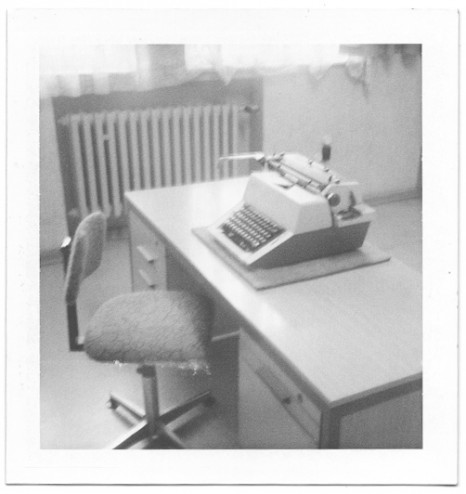
Hohenschönhausen. Credit: lars.blumen
Why do I respect these images? Because they are unique and, even to some degree, challenging. I cannot celebrate these images because of their history – they have no history. I cannot celebrate a familiar style – they are recuperations of contemporary German photography. They are idiosyncratic one-offs.

Hohenschönhausen. Credit: lars.blumen
Is it really this intentional? I wonder now if Lars.blumen just had a reel of Polaroid film to burn and that day he happened to be at the Hohenschönhausen Memorial?
If anyone cane help me with Lars.blumen’s identity I’d be grateful!
Official Blurb: The site of the main remand prison for people detained by the former East German Ministry of State Security (MfS), or ‘Stasi’, has been a Memorial since 1994 and, from 2000 on, has been an independent Foundation under public law. The Berlin state government has assigned the Foundation, without charge. The Foundation’s work is supported by an annual contribution from the Federal Government and the Berlin state government.
The Memorial’s charter specifically entrusts it with the task of researching the history of the Hohenschönhausen prison between 1945 and 1989, supplying information via exhibitions, events and publications, and encouraging a critical awareness of the methods and consequences of political persecution and suppression in the communist dictatorship. The former Stasi remand prison is also intended to provide an insight into the workings of the GDR’s political justice system.
Since the vast majority of the buildings, equipment and furniture and fittings have survived intact, the Memorial provides a very authentic picture of prison conditions in the GDR. The Memorial’s location in Germany’s capital city makes it the key site in Germany for victims of communist tyranny.
One last thing. May I recommend you spend time with the lovingly assembled staff portrait gallery at the Impossible Project.
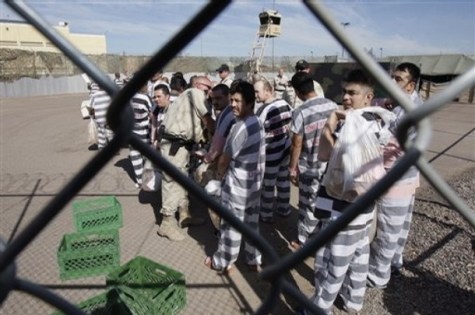
Approximately 200 convicted illegal immigrants handcuffed together arrive at their new part of the jail as they are moved into a separate area of Tent City, by orders of Maricopa County Sheriff Joe Arpaio, for incarceration until their sentences are served and they are deported to their home countries Wednesday, Feb. 4, 2009, in Phoenix. (AP Photo/Ross D. Franklin)
Hopefully, Prison Photography helps to clarify the facts behind images. In Maricopa County, Arizona yesterday the zealous Sheriff Joe Arpaio, ordered a parade of guarded, unsentenced & undocumented immigrants. Hand-cuffed and dressed in stripes, the men walked from one facility to Tent City. Hatewatch summarised the scene:
Along the way they were filmed by television news crews and guarded by at least 50 Maricopa County Sheriff’s Office (MCSO) deputies, wearing body armor and combat fatigues, armed with shotguns and automatic rifles. At least two canine units were present; a Sheriff’s Department helicopter hovered overhead.
The massive show of force was pure stagecraft for a blatant and dehumanizing publicity stunt orchestrated by Maricopa County sheriff Joe Arpaio. The MCSO gave no indication that any of the immigrant prisoners were particularly violent or presented a grave danger to the public.

Maricopa County Sheriff Joe Arpaio, left, orders approximately 200 convicted illegal immigrants handcuffed together and moved into a separate area of Tent City, inmates behind Arpaio, for incarceration until their sentences are served and they are deported to their home countries Wednesday, Feb. 4, 2009, in Phoenix. (AP Photo/Ross D. Franklin)
Arpaio, the self proclaimed “toughest sheriff in America”, has been roundly condemned by civil rights advocates, most of the regional media and clear-thinking locals for his colourful publicity stunt. Arpaio is a man hell bent on cleansing his county of undocumented immigrants and has done so by targeting Latino neighbourhoods, stopping Latinos for minor infractions (as an excuse for searching), and frequently deployed mask-wearing/gun-toting forces in petty shows of strength. Hatewatch elaborates on how all this is possible:
Arpaio is lionized by Minutemen vigilantes and other nativist extremists for his controversial “287(g)” arrangement with U.S. Immigration and Customs Enforcement, which empowers the MCSO, a local agency, to enforce federal immigration law.
Many Latinos taken into custody in recent months by MCSO 287(g) squads have been pulled over for minor traffic violations, such as a broken headlight or an improper lane change, and then arrested when they’re unable to produce proof of citizenship or a valid visa.

Feb. 4, 2009, in Phoenix. (AP Photo/Ross D. Franklin)
Arpaio is a nasty piece of work and it is unlikely he will let up. Alessandra Soler Meetze, executive director of the ACLU of Arizona, said “You’re sort of giving the message that it’s OK to treat these inmates differently. It’s OK to treat them like circus animals.” Meetze added, “He didn’t have to make a spectacle. He could’ve moved them on buses.” In the meantime, Arpaio said his office has received $1.6 million funding from the state that will go toward tackling illegal immigration.
Is dehumanisation is the issue? The point has been made on the blogs that when Iraqi forces paraded five US marines in March 2003, Rumsfeld cited it as a breach of the Geneva Convention, and yet here on American soil we have men defined as criminals, reduced to visual cliché and props in a vulgar display of power. Do these images shock? They shock me. Are they not images of racist control by the state?
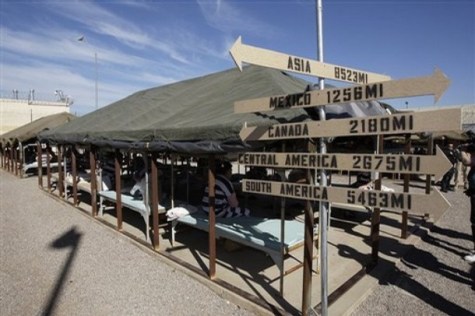
Feb. 4, 2009, in Phoenix. Arpaio said housing the illegal immigrants separately would save money, although he did not explain how other than to say it's cheaper to house inmates in tents than at traditional jails. He also said the move will be more convenient for consulate officials visiting foreign inmates and for Immigration and Customs Enforcement agents charged with deporting the inmates after they have served sentences in county jails. (AP Photo/Ross D. Franklin)
Fortunately, Arpaio, try as he might, is not winning the public relations war. His brand of policing is considered by many as direct challenge to law.
Speaking of law. The Phoenix New Times noted, this pantomime just happened to fall “on the same day that his employee and political helper, Captain Joel Fox, is set to appear at a hearing to context a massive $315,000 fine for making an illegal campaign donation in the name of the mysterious “Sheriff’s Command Association,”
Which event do you think average news consumers will remember on Thursday – an administrative hearing concerning a convoluted tale of campaign finance laws, or the image of 200 Mexicans in stripes marching in chains down a public street?
Last year, Arpaio paid a visit to one of his tent jails. It gave him the opportunity for yet another photo opportunity!

Former world heavyweight boxing champion Mike Tyson listens to Sheriff Joe Arpaio (R) in the tent Tyson will stay in for 24 hours at Maricopa County Jail's tent city for prisoners in Phoenix, Arizona November 20, 2007. Tyson was sentenced on Monday to three years probation and one day in jail for drug possession and driving under the influence. Tyson is holding a copy of the book "American Gangster" according to Maricopa County Sheriff Joe Arpaio. REUTERS/Photo Courtesy of Maricopa County Sheriffs Department/Handout
I’ll leave you with this eloquent summary of Arpaio’s antics from Kevin Appleby, the Director of Migration and Refugee Policy with U.S. Conference of Catholic Bishops, “Shackling and marching fellow human beings for all to see is not in line with the values of the American people. While Guantanamo (Bay) is being closed, another one is being started in Arizona,”
For more images of this circus, see Jack Kurtz’s Blog or Ross D. Franklin’s AP Gallery. If you’d like to book a tour of the Tent City, Sheriff Arpaio’s office can make arrangements. Be sure to wear smart casual.
Thanks to Brendan at Anxiety Neurosis for sharing this through Google Reader
Special Emergency Response Teams (SERTs) are commonplace. Less so perhaps are the “sports team” group shots seen here at the end of a good days work out.

Training Exercise, Team Portrait. Photo Credit: I.M.T.T. 2004
Personal politics dictates how one feels about these constructed scenarios. To me they just seem unfortunate sad – not because of what they are, but because of what they represent. However, we must accept that tactical training within prisons is conducted with the same professional intent as that of any police authority or force of shock and awe. With caution, I’d say these trainings are a reality of prison management, but insist that they should not be considered an inevitability.
Once you get past the unnerving brevity of the group portrait, it is the second unposed image (below) that arrests the attention. It differs from other official images from within prison walls because of its ambiguity. As an isolated image, it is not clear whether the confrontation shown is genuine or not. Without the referenced source, could this be read as an actual suppression of inmate violence? How many eyes would be keen or informed enough to tell if the prisoner and guard uniforms were those of controlled dress rehearsal?
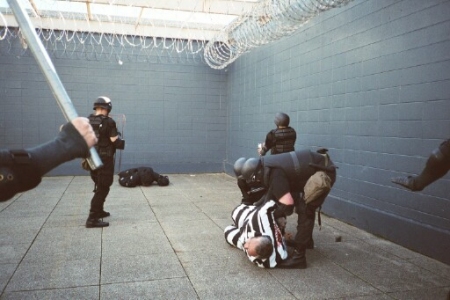
Training Exercise. Photo Credit: I.M.T.T. 2004
From building arguments of fact concerning the Abu Ghraib photographs, Errol Morris talks about the inherent traps for viewers of images, “You look at a photograph and you think you know all you need to know. That here you have a veridical piece of reality to look at. And, you need look no further. It, of in itself, is enough. You look as these infamous photographs that came out of Abu Ghraib. You look at the photographs of Gilligan, the prisoner on the box with leads, and of Gus, the prisoner on the leash, and you think you know what these are images of. ‘This is despicable, blah, blah, blah’ … You need look no further … and I believe noone looked any further, [they] presumed to know what the images were about and wrote articles accordingly.”
Morris adds to his general point, “We try to figure out the world by looking at things, and nothing we ever create is complete but you try to figure out what our relationship is to reality – to the real world.”
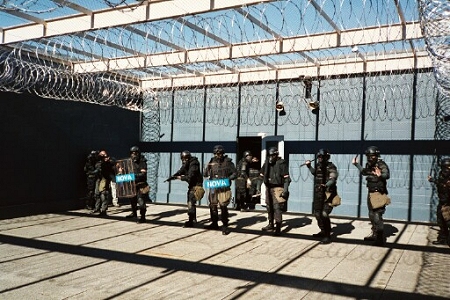
Training Exercise. Photo Credit: I.M.T.T. 2004
In a world of visual bombardment where deliberate disturbances between reality and fantasy are now commonplace have we lost interest in the strength of imagery and its testimonies? Images are mistakenly and willfully misrepresented and misinterpreted. In many ways, this is a fine game – a novel game. But does the game keep people on their toes or does it lead to apathy and disinterest? As Morris asks “What is true and what is false?” Without the proud group portrait to provide context would viewers have cared to question the seeming brutality of the second photograph?
Or am I missing the mark here? Is a lack of visual curiosity and/or sophistication really the problem here? Or, is the real problem the viewers normalisation to images of violence? Do the two issues compound one another? I would argue that many folk are too familiar with images (often involving wire, concrete walls and the ephemera of incarceration) to presume that the attacks meted out are a) unjustified or b) outside of the legal allowances of a prison authority. The issue of ‘Reality’ almost becomes redundant.
Perhaps, even, this worrisome trend of anesthetised reaction to human suffering can even be stretched through the interwoven spectacle of modern society and placed at the door of second rate video games. Prison Tycoon 4: Supermax, as featured recently on BLDGBLOG challenges the gamer to draw the most profit from prison administration; “Grow your facility to SuperMax capabilities, housing the most dangerous and diabolical criminals on earth – all for the bottom line.”

Prison Tycoon 4: Supermax. Screenshot. Source: IGN.com
I have never liked role playing video games that incorporate violence. But I am not an opponent pointing to them as the cause of delinquency among societies youth. I just don’t like them. Prison Tycoon is less gratuitous than Grand Theft Auto and the like. But I don’t know if this is any comfort. To manipulate a virtual prison population with “friendly interaction and fighting between inmates dependent upon mood and gang affiliation” and to rely on “guards [who] will subdue aggressive prisoners, medical staff to treat injuries, chaplains administer to prisoner’s spiritual needs and therapists talk to prisoners to lift their spirits” seems a bit too sinister and calculated for an evening of gaming.
And the ability to use “96 detailed prisoner model variations created to allow for a wide and varied prison population” and use a “unique ‘builder within a builder’ system to open your buildings and place their interior content wherever you like” in addition to the “over 100 different rooms and objects to place within the prison buildings, each one allowing prisoners to interact with them on various levels and each one having different effects on the prisoner’s mood.” seems like a gamer’s invitation to unleash virtual gang violence akin to those most unfortunate of prisoner abuses in real life.
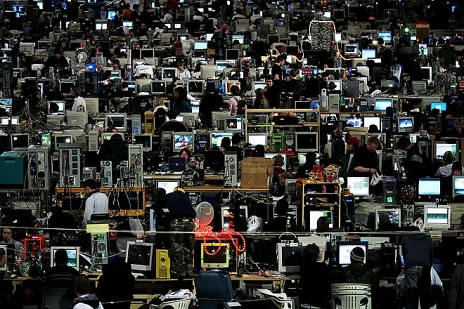
LAN Party. Source: http://www.davesdaily.com/pictures/391-lanparty.htm
Really, why does this game exist? I suppose it is just completing the loop – the gamer, as a God of Pixels, can create criminals in his other games and then manipulate them in this one.
For more information about High Risk Prisoner Transportation, Corrections Crisis Response, Cell Extraction, Escape Apprehension Training, Suicide Bomber Mitigation Tactics, Tactical Weapon and Explosive Training, Athermal Weapon Sight Usage and Finnish Sniper Training please visit the International Mobile Training Team Website. If all that seems like too much reading then just go to the IMTT promotional video and watch grown men in costume run around with guns to a butt-rock soundtrack.
Through the wall surveillance (TWS) is still a technology in it’s infancy, but strategic needs and gushing public awe will perfect this fledgling military toy. It will be driven down marketing channels and into our living rooms. Perhaps TWS, like GPS, will be assimilated into middle class families across America. However, before TWS assumes mass commodity status, I am sure it’s advantages, limitations and in-combat-uses will have been fully tested and exhausted by multiple state and federal enforcement agencies.
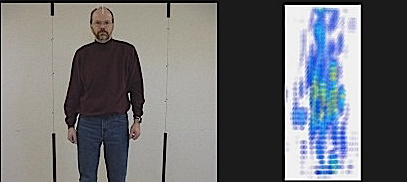
Human SAR signatures. Image: Product Information Library, Defense Research & Development Canada
These images are from Defense Research & Development Canada. This model is from the laboratory – probably a scientist. He is not an inmate or prisoner. In 2006, the National Institute for Justice (the research and development agency for the Department of Justice) sought “applications for funding research and development of sensor or surveillance technologies, or novel applications of those technologies, to address specific needs in criminal justice.”
This request included three specific interests: 1) Concealed weapon detection systems; 2) TWS technologies; and 3) “other novel sensor or surveillance technologies, applications, or support functions for specific criminal justice applications.” I guess that third was to keep the DoJ feeling lucky.
Do these images represent a future representation of a prison inmate? Could Prison SERT Teams adopt more surveillance paraphernalia into its existing observational apparatus? Given the opportunity will future media beam TWS images of hostage or seize scenarios, relying on the abstracted “Pixelated Prisoner” to impress the “otherness” – the other worldliness – of America’s incarcerated masses?

California Department of Corrections, SERT Badge
Don’t get me wrong, TWS technologies will be used more widely by agencies other than correctional agencies. One presumes city police departments would want their SWAT teams armed with TWS in hostile neighbourhoods. TWS is of most value in unfamiliar built environments. The prison is ordered and known to the extent that TWS would be needed only in crises such as riots in which prison authorities lose control of buildings or complexes.
Noteworthy of this upturn of interest in – and development of – TWS technologies, is the rabid integration of military strategy into American policing and correctional systems. Should energy and money be spent on equipment that has very limited use? Or could those resources go toward the ‘Research and Development’ of rehabilitation?

Human SAR signatures. Image: Product Information Library, Defense Research & Development Canada
I have found two developers of TWS. The first is the government’s Strategic Technology Office (STO) which is itself a branch of Defense Advanced Research Projects Agency (DARPA). The second is “your dependable ally” Camero, a private company that has developed the Xaver 400 and Xaver 800. Watch this ludicrous drama presenting the soldier-game applications of the Xaver – try not to be carried away by the macho snare drum and power chords.
My speculations about TWS use in correctional facilities may or may not prove out. I think the need for TWS is so limited in prison environments that it will not be widely adopted. That said, TWS imaging equipment could make future representations of prisoners. I cannot escape the ironic turn this possibility allows. To witness these images is to “see” through the walls – it is a technology that undermines the crude and necessary walls of prison. Appreciating such irony is to understand a power and philosophy that is only interested in making visible the invisible when it is strategically advantageous. Furthermore, this scenario should be interpreted as insidious as it is ironic. In societies of the Supermax, the prisoner is barely evident. The prisoner is not a memory even; possibly a concept. The prisoner is an abstraction, nay, an apparition – a weightless collection of pixels.
Update: Prison Photography collated a Directory of Photographic & Visual Resources for Guantanamo in May 2009.
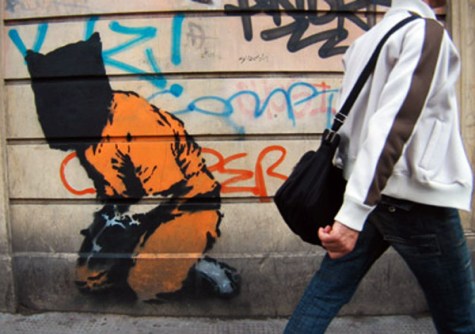
Guantanamo Prisoner, Political Graffiti. Banksy
Anyone who says the recent media tour of Guantanamo isn’t a public relations exercise by the lame duck has not had their eyes open. Global media were given a tour of camps 4, 5 and 6 at Gitmo and all the footage was screened and vetted before release.
Video: Here is the Guardian’s three minute offering. With any hope Obama will put this illegal operation out of action in 2009.
Artistic legacy of Guantanamo

Guantanamo Protesters outside the US Embassy, London
Meanwhile, we can think of the potency that the orange jump-suit has gained. It’s another icon of the Bush presidency. With regard it’s establishment and its bare-faced operations, Guantanamo was far outside of the public’s imagination. Our culture stomached the guilt and under the Bush administration it was never likely Guantanamo prison would be brought back into line with international law. Activist and non-activist art protested Guantanamo by subverting the camp’s own visual vocabulary.

UHC Collective. "This is Camp X-Ray". Art Installation, Manchester, 2003. Guards with replica guns were on duty 24 hrs and followed a regime copied from media reports.
Back on my home turf in Manchester, UHC, a notoriously bold and inventive art collective, scaled up a version of Camp X-Ray on an unused lot in Withington. It was complete with guard towers, fake guns and orders and activity that replicated the media’s reports of Guantanamo, Cuba. See other UHC Projects here, and read the BBC report here.

Road to Guantanamo (2006). A Michael Winterbottom Film, Spanish Release
And while we are not focusing entirely on photography, slightly off topic with video, I cannot recommend Road to Guantanamo highly enough. The film tells the ridiculous story of three young British-Pakistanis who were in the wrong place at the wrong time (southern Afghanistan, November 2003), and ended up in Guantanamo for 2 years. Your jaw will not leave the floor.

 Prison Photography