© Quico Garcia

In September, Ariel Rubin’s VICE article The Children of Kampiringisa was accompanied by Quico Garcia’s pictures, mostly portraits of the child prisoners.

The article describes a fetid facility, where child “offenders” (sometimes they’ve been dropped off by parents for poor behaviour) share cells with Kampala’s homeless children. The overcrowded facility breaks international law. Instead of rehabilitation, children endure malnutrition and diseases such as Malaria that – due to lack of medicines – they must “wait out.”

Upon entry into the rehabilitation prison, children are cooped in the “black house”—a barred room where they sleep on the floor, scramble for space and may to procure a filthy blanket. After 25 days they are moved to a dormitory with their own bed.

Garcia’s images for the piece do not show any of the squalid conditions. To the contrary his portraits are intimate and devoid of the trauma Rubin describes. One presumes, the Kampiringisa authorities would not allow photographs of the most desperate spaces and inmates.

VICE’s editorial decision to pair Rubin’s succinct and stark description of Kampiringisa with Garcia’s portraits leads to a dissonance between text and image and potentially misleads the reader/viewer.

Read the article here and view more of Quico Garcia‘s work from Kampiringisa here.

Until three weeks ago, Aaron Bady was a blogger with limited reach. His post Julian Assange and the Computer Conspiracy; “To destroy this invisible government” written from his Mac laptop in Berkeley (Bady’s a final year PhD student in African Literature) sent his stats skyward and altered the way journalists were thinking about Wikileaks … even if they still shied away from the type of analysis Bady eschewed.

Alex Madrigal (another remarkable writer of insight and entertainment) explains in The Unknown Blogger Who Changed WikiLeaks Coverage, The Atlantic, how Bady’s work was spread, read, answered and commended by bloggers and mainstream journalists alike.

Julian Assange and the Computer Conspiracy; “To destroy this invisible government” is as simple as it is opinion-shaping. In the spirit of Wikileaks, Bady relies on two primary sources by the same author and of the same year – Assange’s State and Terrorist Conspiracies (2006) and Conspiracy as Governance (2006) (both available in this single PDF).

Bady breaks Assange’s writing – which should feasibly be interpreted as an underpinning to Wikileaks’ philosophy – into pieces, making it digestible; making it illuminating:

[Assange] decides that the most effective way to attack this kind of organization would be to make “leaks” a fundamental part of the conspiracy’s  information environment. Which is why the point is not that particular leaks are specifically effective. Wikileaks does not leak something like the “Collateral Murder” video as a way of putting an end to that particular military tactic; that would be to target a specific leg of the hydra even as it grows two more. Instead, the idea is that increasing the porousness of the conspiracy’s information system will impede its functioning, that the conspiracy will turn against itself in self-defense, clamping down on its own information flows in ways that will then impede its own cognitive function. You destroy the conspiracy, in [Assange’s] words, by making it so paranoid of itself that it can no longer conspire:

The more secretive or unjust an organization is, the more leaks induce fear and paranoia in its leadership and planning coterie. This must result in minimization of efficient internal communications mechanisms (an increase in cognitive “secrecy tax”) and consequent system-wide cognitive decline resulting in decreased ability to hold onto power as the environment demands adaption. Hence in a world where leaking is easy, secretive or unjust systems are nonlinearly hit relative to open, just systems. Since unjust systems, by their nature induce opponents, and in many places barely have the upper hand, mass leaking leaves them exquisitely vulnerable to those who seek to replace them with more open forms of governance.

The leak, in other words, is only the catalyst for the desired counter-overreaction; Wikileaks wants to provoke the conspiracy into turning off its own brain in response to the threat. As it tries to plug its own holes and find the leakers, [Assange] reasons, its component elements will de-synchronize from and turn against each other, de-link from the central processing network, and come undone. Even if all the elements of the conspiracy still exist, in this sense, depriving themselves of a vigorous flow of information to connect them all together as a conspiracy prevents them from acting as a conspiracy.

Theorised and defined as conspiracy, Wikileaks’ challenge to – and Bady’s distillation of –  the structure of secret diplomatic communications compliments David Campbell’s analysis of a networked world. It also precedes my comment to Campbell; that the praxis of government, corporate and public relations will change drastically in the wake of Cablegate and Wikileaks. In response, Campbell agrees that this maybe inevitable.

Hopefully the implications of Wikileaks will be a transparent future for the betterment of all; the dismemberment of closed and closeted power that operates unchallenged for decades as American diplomacy has.

AARON BADY

On a personal level, Bady’s quality of writing is invigorating, and in the larger context it shows how far thoughtful (blog) writing can reach. I need to be careful here as Bady has strong criticisms of ego, journalism and the limitations of thoughtful writers to apply themselves solely to material – as does Assange – but I just want to say that Bady’s piece is not a flash in the pan.

Bady’s writing is of the highest order. I’ve heard many criticisms about Facebook, and many of them very good, but no position has maginified the acute problem of Zuckerberg’s philosophy as Bady’s The Soul of Mark Zuckerberg: What DuBois can tell us about Facebook.

Since the publication of his breakthrough piece, Bady has followed up with tenacious balance and muck-raking in equal measure. As an example, did you know US companies in Afghanistan are pimps for paedophiles? Bady:

As Boing Boing boils it down, we now know that Dyncorp, “a company, headquartered in DC with Texas offices, helped pimp out little boys as sex slaves to stoned cops in Afghanistan.” Not actualy that surprising. What we didn‘t know, though, was that Afghanistan’s Minister of Interior was told to hush things up by President Karzai and that he then requested the American assistant ambassador put pressure on journalists to keep quiet about it, because it could “endanger lives.”

Follow Aaron’s blog and on Twitter: @zunguzungu

Bryan Formhals has delivered some festive cheer for Raw File and I. Picked as one of his Top 15 Photography Websites of 2010.

We’ve still a long way to go in terms of consistent output, but Formhals is on the money about working with quality editors. Keith Axline has been a rock.

Formhals:

Raw File exploded onto my radar when they brought in Pete Brook as a writer. It’s a perfect example of how a mainstream magazine can tap into the talent of someone who knows their way around the blogosphere. The posts aren’t as frequent as I would prefer, but they’re always carefully selected and well written. You can tell Pete is working with good editors who are helping him refine his message. As much as I believe in independent blogs, there’s no getting around the fact that great editing elevates content. I’ll address this in a future post, but I think you’ll see more mainstream publications tapping into the blogosphere to find talented bloggers to run their photography blogs.”

Bryan confesses the “link-bait” title to his piece, but his selection is in fact very thoughtful and though out. Each pick is a departure point for discussion on a specific emerging, dying or morphing aspect of photo talk, sharing and criticism on the web. A melange of choices. Check it out.

In the interests of disclosure, I listed Formhals in Raw File’s Favourite Photobloggers article.

The LA Weekly has been following a story that questions the purpose and notion of “justice” in America. Zealous charges brought by the L.A. County District Attorney have destroyed Jeremy Marks’ life:

The first thing to understand is that Jeremy Marks touched no one during his “attempted lynching” of LAUSD campus police officer Erin Robles.

The second is that Marks’ weapon was the camera in his cell phone.

The third is that Officer Robles’ own actions helped turn an exceedingly minor wrongdoing — a student smoking at a bus stop — into a state prison case.

Marks, 18, has been sitting in Peter Pitchess Detention Center, a tough adult jail, since May 10. Bail was set at $155,000, which his working-class parents can’t pay.

The altercation was not pleasant and Robles and Marks (both fueled by adrenaline, I propose) are guilty of arrogance. But such involved inescapable legal proceedings? The juggernaut of procedure has pummeled common sense on this one.

Found via Discarted, who asks, “How does a situation where a campus police officer reprimands a high school kid for smoking escalate into a felony charge and a possible seven-year jail sentence for another?”

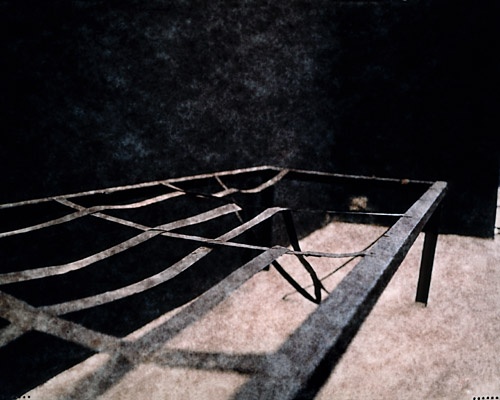
Cell for prisoners sentenced to death (by hanging), Acre/Israel, 2004. © Harri Palviranta

Harri Pälviranta‘s Prison Sheets portfolio includes work from prisons in St. Petersburg, Russia; Tartu, Estonia; Vilnius, Lithuenia; Berlin, Germany; Hämeenlinna, Finland; Jerusalem and Acre, Israel; and Gjirokastra, Albania. The series was undertaken between 1999 and 2005.

There are two common characteristics of the prisons – a) they incarcerated political prisoners and b) they were sites of torture for ideological ends.

Pälviranta’s laminated digital C-prints mounted on aluminium and photographed with 4×5 color negative film are not to my taste (although I do like the Kieferesque mood of the image above) but Pälviranta makes an important point about prison museums:

Because I don’t have an experience-based knowledge of these places, I understand these museum prisons as travel attractions, memorials or discursive constructions. […] Prisons are never passive or meaningless, even though they are empty. The violating practices these places were built on are not absent in our times. […] As architectural constructions they are combination of sacred and evil.

That is to say that prison museums are places for meditation and pathways to activism. As reflexive spaces, prison museums allow us the perspective to see the human rights abuses of today by focusing on the crimes of the past. Today, we’re fed “mitigating” (political) factors for the physical abuse of GWOT prisoners in our custody, but torture is torture. Time doesn’t change that.

——————————————————————————————

Previously on PP: Simulation and Memory: Prison Museums

Carl Court / AFP – Getty Images; Dan Kitwood / Getty Images; Peter Macdiarmid / Getty Images

These photos of WikiLeaks founder Julian Assange arriving at Westminster Magistrates Court inside a prison van with red windows reminded me of Ben Graville’s past work, which I wrote about here.

Graville’s In & Out The Old Bailey caused some controversy drawing accusations of exploitation. Do we feel Assange is being exploited here? I don’t really think so. Assange is well aware of media praxis and photographer protocols for winning that shot. By his direct eye contact, it would seem he’s putting on a show for these photographers? Or maybe it’s just the edit?

BUT WHAT ABOUT THE RED?

You could run hog wild with reading the colour here, but I won’t. I’ll just mention, witch-hunts, the Hunt for Red October, Red Letter Day, the commies, the Reds, blood on “their” hands, whoever they are, the Scarlet Pimpernel, drive by night tactics, sex by surprise, red light districts and the red ink of Top Secret papers. All collapsing on top of this portrait of a man, still widely misrepresented.

Prisoner Advocate Elaine Brown on Georgia Prison Strike: “Repression Breeds Resistance”

Elaine Brown appeared on Democracy Now! today. Amy Goodman described the strike as the biggest in American History.

Brown alleged an inmate paid $800 to a prison guard for a cell phone.

Goodman suggested the term cell-phone has realised its true meaning.

‘CELL’ PHONES

Also, for the New York Times, in Inmates in Georgia Prisons Use Contraband Phones to Coordinate Protest, Sarah Wheaton describes how ‘prison protest has entered the wireless age’ and how gang, religious and race divisions were put aside to organise the strike.

Note: The Georgia DoC say they have locked-down the prisons. Not true. The inmates locked themselves down, refusing to leave their cells.

Biggest Prison Strike in American History

Prison strikes are a rarity these days, with prison populations fragmented, disciplined, docile, estranged from society and stripped of tools for political mobilisation.

There’s a growing number of reports coming out of Georgia, where the strike is now into its fourth day. You should read the excellent Prison Law Blog for a summary of communications and developments – Georgia Prisoners Strike for Better Conditions.

As Sara points out:

“Relative to the state’s population, it has an outsize reach. In Georgia, 1 in 13 adults is either in prison, in jail, on probation, or on parole — the highest rate of correctional control in the country. (Nationwide that figure is 1 in 31.) According to the Sentencing Project, over 4% of Georgia adults and almost 10% of African-Americans cannot vote due to felony disenfranchisement laws.”

The strike is based on reasonable demands; notably, demands applicable to issues in many state prison systems:

· A LIVING WAGE FOR WORK: In violation of the 13th Amendment to the Constitution prohibiting slavery and involuntary servitude, the DOC demands prisoners work for free.

· EDUCATIONAL OPPORTUNITIES: For the great majority of prisoners, the DOC denies all opportunities for education beyond the GED, despite the benefit to both prisoners and society.

· DECENT HEALTH CARE: In violation of the 8th Amendment prohibition against cruel and unusual punishments, the DOC denies adequate medical care to prisoners, charges excessive fees for the most minimal care and is responsible for extraordinary pain and suffering.

· AN END TO CRUEL AND UNUSUAL PUNISHMENTS: In further violation of the 8th Amendment, the DOC is responsible for cruel prisoner punishments for minor infractions of rules.

· DECENT LIVING CONDITIONS: Georgia prisoners are confined in over-crowded, substandard conditions, with little heat in winter and oppressive heat in summer.

· NUTRITIONAL MEALS: Vegetables and fruit are in short supply in DOC facilities while starches and fatty foods are plentiful.

· VOCATIONAL AND SELF-IMPROVEMENT OPPORTUNITIES: The DOC has stripped its facilities of all opportunities for skills training, self-improvement and proper exercise.

· ACCESS TO FAMILIES: The DOC has disconnected thousands of prisoners from their families by imposing excessive telephone charges and innumerable barriers to visitation.

· JUST PAROLE DECISIONS: The Parole Board capriciously and regularly denies parole to the majority of prisoners despite evidence of eligibility.

Lots of lists of photobooks cropping up for different reasons.

PHONAR

To close out the remarkable efforts of Jonathan Worth’s experimental open-sourced, web-based, free Photography and Narrative (#PHONAR) course offered through Coventry University, the #PHONAR course closed with a bevvy of recommended readings.

The following photographers, writers, teachers and journalists made picks:

Alec Soth; Andy Adams; Cory Doctorow; Daniel Meadows; David Campbell; Edmund Clark; Fred Ritchin; Geoff Dyer; Gilles Peress; Grant Scott; Harry Hardie; Jeff Brouws; Joel Meyerowitz; John Edwin Mason; Jonathan Shaw; Jonathan Worth; Ken Schles; Larissa Leclair; Ludwig Haskins; Matt Johnston; Michael Hallett; Miki Johnson; Mikko Takkunen; Nathalie Belayche; Peter Dench; Pete Brook; Sean O’Hagan; Simon Roberts; Stephen Mayes; Steve Pyke; Todd Hido

As a contributor, I picked out three titles. Predictably, each dealt with photography in sites of incarceration:

Zona – Carl de Keyzer

Too Much Time – Jane Evelyn Atwood

Intimate Enemy – Robert Lyons

Chris Verene‘s Family was a later addition.

It was a privilege to be asked to guest lecture on this pioneering educational model. Thanks to Jonathan, Matt Johnston @mjohnstonmedia (Chief Engineer) and students for their encouragement and engagement.

WAYNE FORD

The #PHONAR list was spurred by Wayne Ford’s Photobooks and Narrative list.

JOHN EDWIN MASON

Following the #PHONAR list, contributor John Edwin Mason extended his selections. Mason’s Photobooks and Narrative: My (Slightly Flawed) Phonar List has an African and African American emphasis.

ALEC SOTH

Tonight, Soth put forward his Top 10+ Photobooks of 2010. As ever, Soth is thorough, thoughtful and generous in response.

JEFF LADD

Jeff at 5B4 has picked out his 15 choices for Best Books of 2010. The comments section is lively and I don’t think being to conceptual (as Jeff is accused of) is a problem, even if it were a fair allegation.

SEAN O’HAGAN

Sean at the Guardian has selected 2010’s best photography books that you should put in someones stocking.

NIALL MCDIARMID

Niall has put together his Photobooks and Magazines of the Year.

EMAIL

prisonphotography [at] gmail [dot] com

Prison Photography Archives

Post Categories