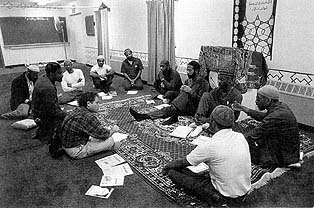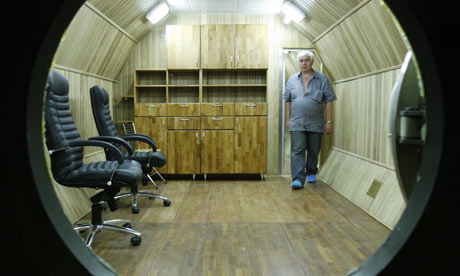
European Space Agency simulation module used to study the effects of long term confinement. Photo: Pavel Zelensky/AFP/Getty Images

In June 2010, as part of the Mars 500 research project, the European Space Agency (ESA) put six trainee astronauts into a space flight simulation. In a giant ” tin can” in a Moscow hangar with no sun, no fresh water and no alcohol for 520 days, the psychological tenacity of these six ground-bound astronauts will be under constant scrutiny. Mars 500 is the most ambitious space-simulator research to date. The ESA put away its trainees in similar conditions for 105 days in 2009.

As a spokesman for Mars 500, Dr. Christer Fuglesang, a Swedish astronaut with the human spaceflight directorate of the European Space Agency (ESA) emphasised the usefulness of the study:

“This isn’t a joke. It will give a lot of useful information, not just about Mars but also for Earth […] People are isolated in many places in the world. We have scientists in the south pole for a long time, or in submarines. Then there are all those in jail.”

Fuglesang is right. Solitary confinement is never a joke.
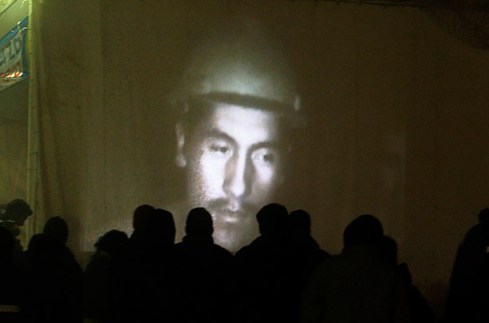
Well-wishers, family and friends watch a video of the miners projected onto a screen erected near the collapsed gold and copper mine near Copiapó, Chile. Photo: Ivan Alvarado / Reuters.

When the Chilean miners were trapped for 69 days experts from NASA were called in as experts on the psychological strains of long term confinement. A call to the management of any one of America’s hundreds Intense Management Units (IMUs) could have been as useful (except for the fact that prisoners are hardly cared for or monitored in the way necessary to improve their psychological state.) On any given day in the United States, 20,000 men, women and children are held in solitary confinement.

I have used this quote before, but it bears repeating:

First, after months or years of complete isolation, many prisoners “begin to lose the ability to initiate behavior of any kind—to organize their own lives around activity and purpose. Chronic apathy, lethargy, depression, and despair often result. . . . In extreme cases, prisoners may literally stop behaving” (Haney). [They] become essentially catatonic.

Source: Hellhole, The New Yorker, March 30, 2009, by Atul Gawande.

UNFATHOMABLE SCALE

Everyday in American prisons wallow the equivalent of 600 Chilean mining disasters … except prisoners can remain penned in for longer than 69 days.

“The [psychological and cognitive effects of long term isolation] is not something that’s easy to study,” says Craig Haney, psychology professor at the University of California at Santa Cruz, “and not something that prison systems are eager to have people look at.” Haney leads academic research on solitary confinement and notes that US prisons didn’t always resort to its current widespread use:

We have an overwhelmingly crowded prison system in which the mandate to rehabilitate and provide activities for prisoners was suspended at the same time as the prison system became overcrowded. Not surprisingly, prison systems faced with this influx of prisoners, and lacking the rewards they once had to manage and control prisoner behavior, turned to the use of punishment. And one big punishment is the threat of long-term solitary confinement. They’ve used it without a lot of forethought to its consequences. That policy needs to be rethought. (Source)

FIRST HAND TESTIMONY

Academics, studies and statistics may hook, inspire and lead some to direct action, but for others the voices of those who’ve suffered in solitary confinement may inform more effectively.

In a prison system that has lost its moral compass, in a system that uses solitary confinement cells as the new asylums, in a country which had made torture its own, it is the voices of the confined to which we should pay most attention.

I would like to recommend an excellent writer, who also happens to be a prisoner. Arthur Longworth was awarded First Place in memoir in the PEN American Center 2010 Prison Writing Contest. Longworth writes about the violence of the Walla Walla Intense Management Unit (IMU) in Washington State. Longworth’s second memoir piece is entitled The Hole.

You can buy The Prison Diary of Arthur Longworth #299180 ($7) by following the directions posted at Changing Lives, Changing Minds.

… that is unfathomable but funny.

To me, the narrator sounds like a cross between Ron Burgundy and Elliott Erwitt.

Best line? “Central to Pohaku’s work is love. Specifically, drunken ineffectual love between old buddies.”

Hat tip to Steve.

Daniel Ellsberg, left, at a news conference in 1973 in Los Angeles. In 1971, Mr. Ellsberg passed to a reporter for The New York Times a copy of a secret report casting doubt on the war in Vietnam. Associated Press

Based upon Cablegate commentary and mutterings thus far, it is reasonable to describe an opponents’ “Hierarchy of Targets”.

At the top of the pyramid is Julian Assange, second is the suspect (possibly Bradley Manning?), then come the collective of highly-skilled professionals working for Wikileaks, next are the supporters of Wikileaks (journalists, liberals, conspiracy nuts, libertarians, hackivists, net-neutrality fans, free-speech advocates, Bush-haters, China-haters, Gaddafi haters … lots of haters, you get the point). And finally – as I said, based upon commentary – toward the bottom of the pile would be Wikileaks’ major media partners, The New York Times, The Guardian, Der Spiegel and Le Monde.*

The leading newspapers of these four major powers should be and are beyond reproach. The absence of criticism toward these newspapers is telling.

Given the impossibility of controlling this outflux of data, the US Government is relying on tactics of distraction – and retribution – to elevate Assange and then take him down.

The US Government is probably well aware of the information yet to be leaked. Remember, while the cables number 251,287, of which 15,652 are “Top Secret”, only 1,344 have been published thus far.

NEWSPAPERS THEN, THE INTERNET NOW

The Nixon Whitehouse tried to smear the reputation of Daniel Ellsberg, the man who leaked the Pentagon Papers. Nixon’s painting him as a loose-nut, breaking into his psychotherapists surgery and stealing private health files to later sling shit. The thing is, before Nixon got to that he was trying to take down the media too. First he got an injunction on The New York Times. Next Ellsberg went to The Washington Post so they were next to be silenced. Through remarkable networks Ellsberg got copies of the Pentagon Papers out to 17 papers and the deluge was impossible to control.

For the Pentagon Papers leak, Ellsberg photocopied 7,000 papers himself, then photocopied those again. He delivered boxes of files by hand. 1971 was a pre-computer age; it’s easy to forget.

It is also easy to forget that Nixon administration shut down the New York Times’ publication of the Pentagon Papers for four whole days. Ellsberg’s leak brought about The New York Times vs. The United States of America, and ever since the separation between government and free press has been constitutional protected (if not always used to advantage by partisan “news” networks.)

Because of that court case – as much as the unlimited distribution possibilities of the internet – Assange and Wikileaks didn’t have to worry about any government closing down the four newspapers it had chosen as allies and partners.

As newspapers had gone before, so internet server companies followed; Assange predicted both the pressure from the government and the capitulation from Amazon and other server companies.

AREN’T WIKILEAKS AND NEWS ONE AND THE SAME?

Given that Wikileaks is only releasing individual cables after a partner has researched, redacted and discussed editorial ethics and responsibility, and given that in that light there is no difference in substance of Wikileaks’ publishing and that of its partners, why is Wikileaks singled out?

Assange claims to be a journalist. Given his blatant care (partnering with thousands of professional journalists) thus far in protecting the safety and identity of people mentioned in the cables, it seems like a fair claim.

I agree with the point of view that the Afghan or Iraq War Logs were not the equivalent to the Pentagon Papers; they told us only what we knew. We knew war was violent, we knew nasty alliances existed, we knew civilians were slaughtered, we knew no-one was in control as they claimed, we knew Iraqi’s carried out sectarian killings on one another and we could guess the allied forces turned a blind eye. Alternatively, in the way that the U.S. Embassy Cables are challenging a super power with legitimate accusations of Imperialism against it, the Embassy Cables leak could be an equivalent.

Interestingly, Ellsberg is in no doubt. If he was leaking the Pentagon Papers today, he’d be using the internet.

*Somewhere in the hierarchy of targets, there’s an argument to include Wikileaks’ methods and technologies (encryption, mirror sites, Wikileaks’ documents-cache poised for release should things not go Assange’s way). However, to keep it neat, I prefer the hierarchy of targets be made of people, not tactics.

There’s so much to be read and said about the unraveling stories and analysis of the Wikileaked Embassy Cables. The coverage by the Guardian, the New York Times’ Lede Blog and Kevin Poulsen and friends at Wired.com have been my main sources.

I cannot recommend highly enough David Campbell’s analysis – Wikileaks: From the personal to the Political.

Here’s some important snippets:

Wikileaks does publish the cables with the redactions made by media partners. (The Guardian explains how it does this here). So at the time of writing, Wikileaks has released only 1,203 of the 251,287 cables contained in the leak. This makes the coverage of the cables a prime example of networked journalism from which all partners, including the public, win.

In 2009, Wikileaks and Julian Assange won the prestigious Amnesty International New Media Award for exposing hundreds of alleged murders by the Kenyan police, an act which led to a United Nations investigation.

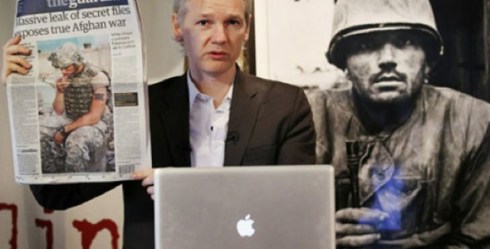
Assange is holding up a copy of The Guardian displaying a front-page story on the earlier release of the Afghan war logs. He is standing with his laptop. In the background is Don McCullin’s famous 1968 photograph of a shell-shocked marine from Hue in Vietnam. Signifying, first, the relationship between Wikileaks and its media partners, second, the role of the Internet, and third, the historical memory of the Vietnam War that hangs over current American military operations…

And just two more things from me.

1. If Julian Assange and his employees were Chinese they’d be lauded in the US as heroic dissidents and champions of free speech.

2. When was the last time rape was the headline story across the globe for a 48 hour period? Rarely? Never? Ever? Unfortunately, in this instance, I think the topic of rape will merely serve as a prop in the distraction techniques of mass media as existing powers attempt to divert the issue – from the global cultural sea change upon us – to the witch-hunt of America’s newest most-wanted. Dialogue about women’s rights, societal violence, machismo and misogyny is vitally important, but again it is diluted, set aside. The discussions that are occurring are, for the most part, not the right ones.

An inmate waves a Chilean flag from his cell at the San Miguel prison following a fire on Wednesday. Claudio Santana / AFP – Getty Images

Earlier today, the MSNBC photoblog ran a four image gallery on the fire at San Miguel Prison, Santiago.

Reporter, Jonathan Woods wrote: “Fire engulfed a prison in the Chilean capital early on Wednesday, killing 81 inmates and critically injuring 14 others, prison officials said, in the worst-ever accident in the country’s jail system. Officials said the fire was triggered during an early-morning fight between inmates.”

The arm of a flag-waving inmate from within the bowels of a charred prison is somewhat confusing for me – is he celebrating life in the face of tragedy? Is it an act of solidarity? If so, with whom – families on the outside, the people, the government (who presumably locked him away)?

The image of the flag amidst wreckage also recalls the visual cues as delivered during the 69 day rescue of the 33 Chilean miners, following the Copiao mining disaster.

The Chileans taught the U.S. a thing or to in flag-waving patriotism during the remarkable story.* The Chilean flag was in the hands of prayerful onlookers, on balloons released by children and on the t-shirts of miners as they emerged from underground in a Chilean themed extraction pod.

The uniting force of symbols – often flags – is powerful and should only be criticised when the means and ends are pernicious.

In the case of the Chilean miners rescue, a near tragedy that ended not only in no deaths but in celebration of life no criticism applies. Just joy. The montage ‘Chile, the Miners, and Respect for Life‘ packages red, blue and white footage against an uplifting music score, which is something I gather Brad Pitt is to perfect. Seriously.

This still gets me no closer to knowing the intent of the flag-waving Chilean prisoner.

Apparently, many nations involved in the rescue effort, counseling and diplomatic duty sent their flags along with their engineering experts. An isolated news report ‘Chilean miners solidarity flag resurfaces‘ explains that the Polish national flag signed by all 33 miners was retrieved from the mine today (belongings are still being extracted).

The flag had been passed to the miners when they were trapped underground in October by Polish missionary, Father Adam Bartyzoł.

* Stephen Colbert, America’s keenest flag-waver, loves the Chilean flag, “It’s just like the American flag, but chunkier!”

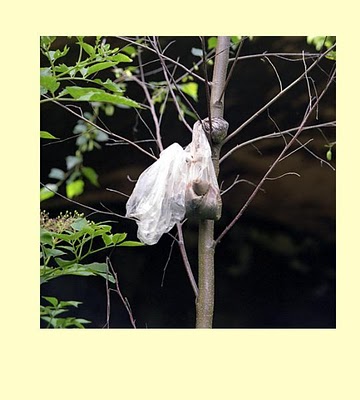
“Go to beauty spot to commune with nature, into the lovely park land and then when your dog shits, place it in a plastic bag and hang it from a tree like some f#*king hellish totem.”

– Mark Page

© John Darwell

Is photography better off dead than being a steaming pile of … ?

Photographer John Darwell has created a modern typology of a particular problem. Get yourself over to Manchester Photography for the full story.

HOW TO PAY A COMPLIMENT?

I have heard a lot of mutterings recently about how the photoblogosphere is in danger of becoming an orgy of self-on-proxy-self marketing; a web of palful happy-endings. Cliques for clicks.

It is against that septic skeptic view of the photoblogosphere, that Mark Page‘s Manchester Photography stands out. Let’s be honest, he’s in a bit of an outpost in Manchester (the one in the UK, not the one in New Hampshire) and I think that’s why his posts catch the eye. He’s on top of stuff no one else has got their eyes on.

A LOVE-IN, A POST-IT NOTE FOR MARK

Been really enjoying your posts recently. You’ve been on a roll. You’re still a cocky Jeremy Hunt, but I wouldn’t have it any other way. If Manchester Photography lost its colorful prose, it’d be the worst type of blog-lobotomy. A ‘blogotomy’?

Keep up the stellar work. I’ll see you, Leeming and anyone else who invites themselves for a lager-shandy down the Nag’s Head in 2011.

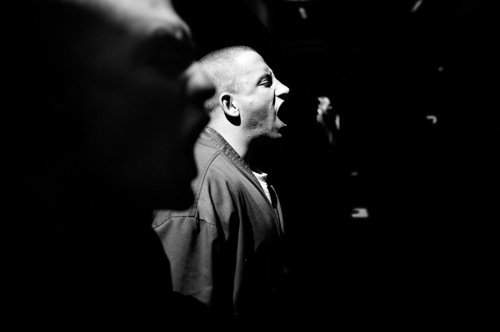
Recruit Gill and other recruits shout as they count down from 10 after being ordered to "clear the head", which means to exit the lavatory area. When the count reaches zero, everyone is expected to have put away their toiletries and be standing in line.

A couple of weeks ago, before Theo Stroomer headed off to Bolivia, we sat down for a beer.

After studying photojournalism at the University of Colorado, Stroomer went to work as a photographer for a newspaper in Vail, Colorado. He documented the Colorado Correctional Alternative Program (CCAP) in Summer 2008 as a personal project.

The CCAP, a boot camp style program, was the only program of its kind in Colorado and one of very few across the States. The three-month camp, which opened in 1991, offered physical & mental challenges, a GED program and substance-abuse treatment. About 90% of the offenders had drug or alcohol abuse problems

In March 2010, as part of Colorado State budget cuts, the boot camp was closed down. “There’s no political consequence in making a decision like that,” says Stroomer. The photographer observed change and believed it was a worthy program. Upon hearing news of the closure, Stroomer wrote, “I held a high opinion of the program, its staff, and its role in the lives of inmate participants after observing it over a three-month period in 2008. I am sorry to see it go.”

Staff use a technique called "corralling" to discipline Recruit Cardenas on Zero Day, the first day of the three-month program. Zero Day is the most intense day for new recruits. They are subjected to extreme physical and emotional stress, including supervised physical contact from staff members.

Recruits are rushed off the bus on Zero Day. To break new recruits mentally and physically, staff bark orders constantly, move them on and off the bus repeatedly, and batter them with physical exercises.

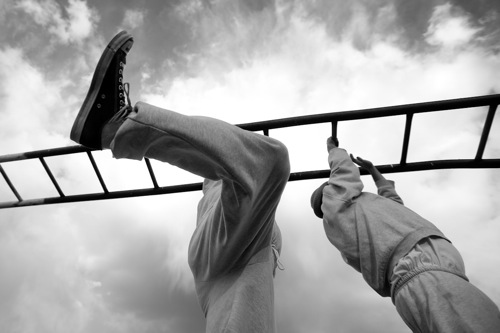
Recruits on the obstacle course during the CCAP program's daily physical training.

Admittedly, the boot camp program was more costly than simply warehousing prisoners. And costs were rising; from $78/day to $109/day per inmate in 2009 alone. Also unhelpful were the gradually increasing year-on-year recidivism rates among CCAP graduates. The Denver Post, in a rather damning summary, reports:

51% of the 155 inmates released from prison through boot camp in fiscal year 2007 have already returned to prison. The 51% recidivism rate of these nonviolent offenders was only 2% points better than the record of inmates convicted of crimes such as robbery and murder.

Another huge problem for CCAP – which only took non-violent first-time offenders – was the statewide rising proportion of inmates classified as “high security” compared to when CCAP opened in the early nineties. Indeed, it is telling that as the CCAP boot camp was being shuttered as another new maximum security prison was under construction in Canon City.

It should always be noted that the most inventive and progressive programs are more expensive than those which simply lock people up without rehabilitation efforts.

Ari Zavaras, Colorado Department of Corrections executive director, rolled out the stats to support the decision. I suspect negatively-spun statistics surface about any particular service whenever a state department is about to bin it. The closure of CCAP boot camp is forecast to save $1million in operating costs per year and relocate 33 full-time staff.

Recruit Greene log-rolls in "the pit", a gravel area that is used for group discipline and physical trials that are rites of passage in the program.

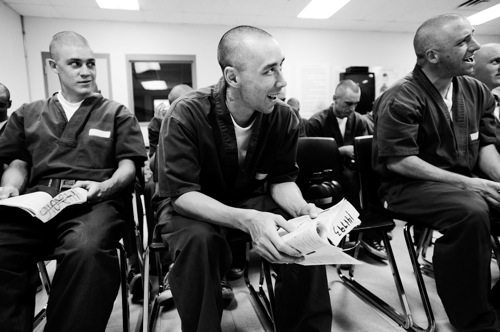
Recruits Shock, center, Davis-Gonzales, left, and Gill, right, smile during Prison Fellowship, a nationwide Christian prison ministry program that meets once a week during CCAP.

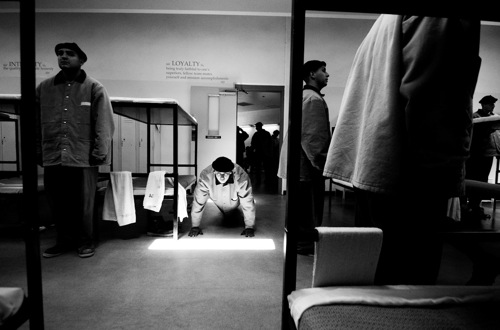
The squad bay, where recruits keep their toiletries and clothing in addition to sleeping at night. With good behavior from the entire platoon, recruits can earn amenities such as pillows.

BOOK

The Pain the Pride (Waterside Press, 2000) by Brian P. Block is an exclusive fly-on-the wall account of life inside the Colorado Correctional Alternative Program. It is available on Google Books.

STATS

The Denver Post reports on the unexpected, welcome and only half-explained trend of decreasing prison populations in Colorado (2009: 23,186 – 2010: 22,127).

Why the surprise? Shouldn’t one expect a drop in prison population if the state ceases to pursue (due to budgetary constraint) harsh, punitive legislation of boom years? After the postponement of insane policy, we should be looking how to reverse the damage and plummet the figures further. In 1981, Colorado had fewer than 3,000 prisoners. That’s the baseline to focus on.

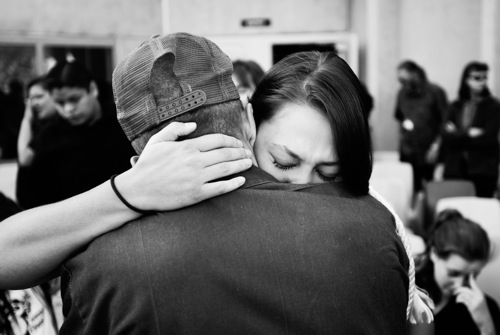
Graduate Davis-Gonzales hugs his girlfriend, Povi Chidester, during a graduation ceremony at the conclusion of the three-month program. Inmates who complete the program attend the ceremony and are allowed one hour with family and friends. Their sentences are then sent to a judge for reconsideration. "I came here from a huge house with a bunch of coke, a bunch of money, a bunch of guns ... and now I have none of that. And I feel like more of a person now than I did then," said Davis-Gonzales.

Verily, never will Allah change the condition of a people until they change it themselves with their own soul.

– Qur’an 13:11 or 8:53

Abdel Ameen, Halfway House. Richmond, Virginia. © Bryan Shih

Bryan Shih has produced an essay on prison reentry services for Muslims.

Shih says:

“Transitioning out of prison back into society is difficult for anyone, but the scarcity of Islamic centered re-entry resources often adds to the obstacles confronting prison converts to Islam. […] A lot of the people I photograph are from groups and communities that are on the margins, and that does something to their psychology.”

From a quick squint at Shih’s portfolio, Prison Converts to Islam, it is obvious he has traveled widely and photographed in San Quentin Prison, California as well as in Richmond, Virginia (above). Possibly in other states too.

I have very rarely spoken about Islam in US prisons, mainly because it is not a subject I know a lot about. But that is changing.

Recently, in discussion with New York based documentary photographer Jolie Stahl (about an altogether different project of hers from the mid-80s), Stahl took the opportunity to tell me about her photographs for the book Black Pilgrimage to Islam.

Stahl is married to the author, Robert Dannin, former editorial director of Magnum Photos, and professor of history at Suffolk University, Boston Massachusetts.

The book deals with all aspects of the Islamic experience in America and necessarily covers the increase in Islamic worship within US prisons among predominantly African American populations. Figures used for Dannin’s book indicate an increase in the numbers of self-identified Muslims in New York prison facilities between 1989 and 1992 (1989 in parentheses): Sullivan Prison, 84 (112); Green Haven Prison, 348 (286); Auburn Prison, 310 (234); Attica Prison, 388 (327); Wende Prison, 125 (74); and Eastern Prison, 175 (135).

Fortunately for us, chapter seven of Dannin’s book which is devoted to prison Islam is available online, as part of the digitised version of Making Muslim Space (Barbara Daly Metcalf (ed.), 1996, UC Press).

Dannin suggests that the body-focused discipline of Islam provides fortitude despite the stark, oppressive prison environment:

“If one tries to extend the Foucauldian idea of the prison as a simulacrum of the medieval monastery, there is a realization that something has changed, because this architecture conducive to introspection and Christian rebirth has increasingly become a place of mosques and communal prayers. The predictable monastic effect has been achieved, but somewhere its content has been subverted. […] Islam’s popularity in the prison system rests in part on the way in which qur’anically prescribed activities structure an alternative social space that enables the prisoner to reside, as it were, in another place within the same confining walls.

This same logic explains the rampant success of prison yoga initiatives. [1], [2], [3]

Door to Masjid Sankore at Green Haven Correctional Facility, N.Y. © Jolie Stahl.

New York State was the progenitor for much of today’s prison-based Islamic worship. Dannin writes:

“Following the Attica riot, DOCS designated Green Haven, the scene of similarly explosive tensions, a “program facility,” where emphasis was placed on learning and rehabilitation as opposed to punishment. College courses, vocational training, substance-abuse programs, work release, and family-reunion visits resulted directly from a negotiation of inmate demands and the actions of newly appointed liberal administrators. Muslims were situated at the center of these activities …”

The community and equanimity fostered by Islam echoed the social justice priorities of the Black Panther movement. Swiftly, the Masjid Sankore at Green Haven “achieved its reputation as the most important center for Islamic da‘wa in America”. Dannin traces the understandable transition of locked down minorities from political revolutionaries to religious observers.

The Majlis ash-Shura, or high council, of Masjid Sankore at Green Haven Correctional Facility, N.Y., with author Bob Dannin (center left), 1988. © Jolie Stahl

Friday prayers at Masjid Sankore, Green Haven Correctional Facility, N.Y. © Jolie Stahl.

Shu’aib Adbur Raheem, a former imam of Masjid Sankore, and his wife during a family reunion visit at Wende Correctional Facility, N.Y. © Jolie Stahl.

EMAIL

prisonphotography [at] gmail [dot] com

Prison Photography Archives

Post Categories