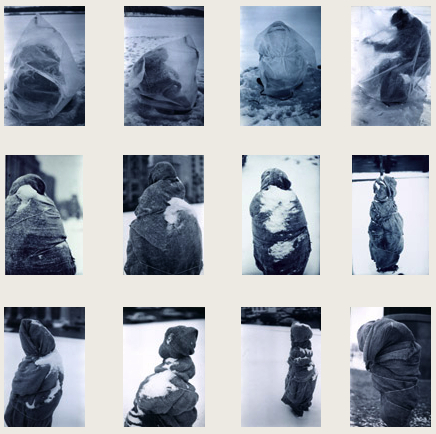
Olga Chernysheva‘s series Anabiosis looks at the “nearly indistinguishable shapes of a solitary Muscovite fisherman and plants wrapped up and protected from the freezing cold near Red Square.”

The word Anabiosis means ‘a state of suspended animation.’

Really like them.

In my spare time I enjoy sorting my socks in color sequence, imagining the sound of volcanoes and simulating flight with the aid of Google Earth.

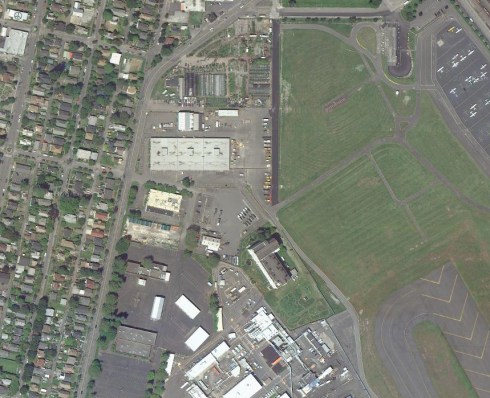
On a recent “flight” out of Boeing Field, here in Seattle, I noticed a plucky peace protest right under the nose of one of Americas largest military contractors.

Behind Lockheed Martin, Boeing is the second biggest defence contractor in the nation.

Keep you eye on the top left as I zoom in …

… closer …

… closer ….

… hooray! Whoever you are, you peace-luvvin’, rooftop decoratin’ hippiester, I salute you.

MAKE ART, NOT BOMBS

I’m not the first to ask the question which is why it is so easy for me to answer.

Known commonly as “the Parked Domain Girl” or “the Expired Domain Girl“, her’s is the beaming face that pops up when the URL punched into your browser includes a typo. Two years ago, You Suck at Websites explained:

Demand Media is the company responsible for pimping out this girl on empty websites set up to generate money from accidental visits. The Demand Media business model is this — scoop up generic or keyword-rich domain names and sell advertising space despite the lack of any iota of useful content. It’s not exactly spamming, but it’s just one notch above mass emailing Viagra ads.

In the comment threads, readers quickly found the original iStock image ‘Attractive Student‘, the photographer, a whole portfolio of images of her and one in which she’s really happy.

Also in the comments, the original photographer, Dustin Steller chimed in:

I am the photographer who took the photo you all are talking about. I shot the series in the Kansas City area, so it is definitely not a real college campus. Here is the link to see some more from the series – http://www.istockphoto.com/dsteller/ As a side note, it is my little sister.

Steller took the photo at Unity Village in Kansas (Flickr image of tower, Google street view)

WHOSE IS THAT FACE

Is it even her own at this point? Is it recognisable by a significant number of folk? Maybe only in America? Is this image ubiquitous (enough)? You Suck at Websites reckon she’s been viewed “more times than a Paris Hilton sex tape.” Of course, Ms Hilton is not the measure by which we gauge web-notoriety.

I’d argue the face/image is ours more than hers at this point. An unintended visual pseudonym for glitches in web-browsing.

AN ARTIST RESPONDS TO THE FACE

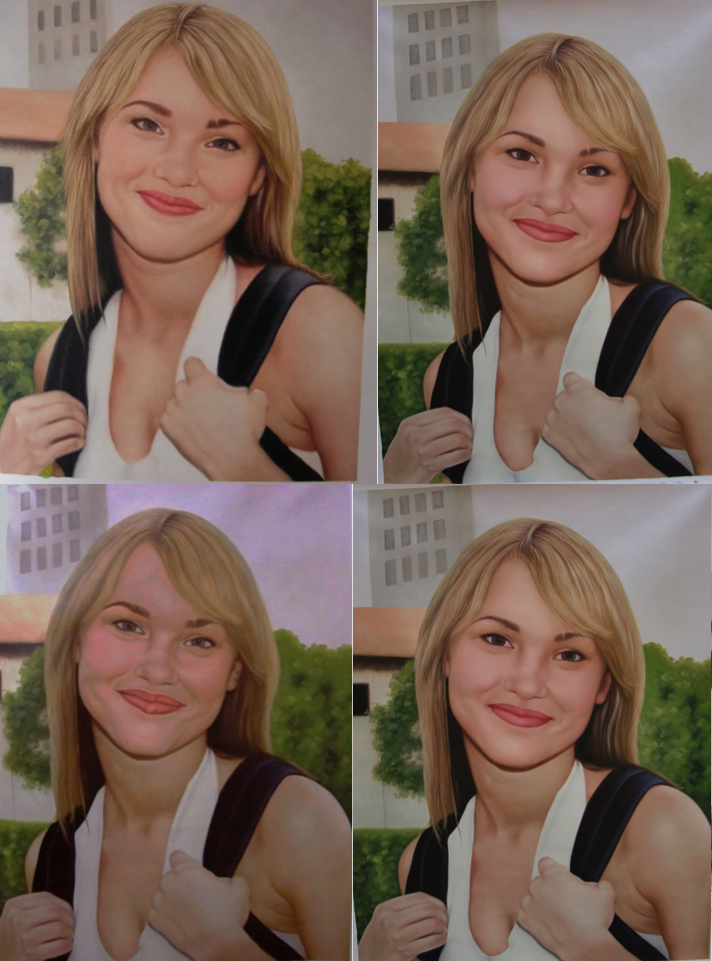
The website Urlesque points us in the direction of Parker Ito; an artist who grappled with the empty infamy of this image. For his project The Most Infamous Girl in the History of the Internet, Ito asked orderartwork.com, a Chinese company which makes oil paintings on-demand, to create a series of paintings based on the Steller/iStock/Demand Media image.

The results are spectacularly banal:

Gene McHugh at Post Internet has written about Ito’s project:

“[The Most Infamous Girl in the History of the Internet] might be considered in relation to Warhol’s Marilyn series of silkscreened paintings. Both Marilyn Monroe and “the parked domain girl” are icons of emptiness–Monroe was (in her media representation) a blank slate for sexual desire, the parked domain girl is (in her media representation) a symbol of sites without content.”

McHugh goes on to point out that Warhol was interested in “the way that ‘real life’ stars like Monroe developed a life of their own in the sphere of reproducible images. Whereas “the parked domain girl” takes on – indeed establishes – a meaning and a “reality” that didn’t exist prior to Ito’s art.

McHugh concludes that the image of “the Parked Domain Girl” is culturally-distributed enough to be defined as icon.

“Ito’s work is thus meaningful not for depicting the automated painting of a “real” icon, but for depicting the outsourced hand-painting of a “fake” icon and, in so doing, bringing Warhol’s joke full circle.”

Ito also adopted the format of Demand Media’s web-pages for his own website homepage:

Also worth checking out

The Everywhere Girl – http://www.theeverywheregirl.com/ – … the face that launched a thousand ads!

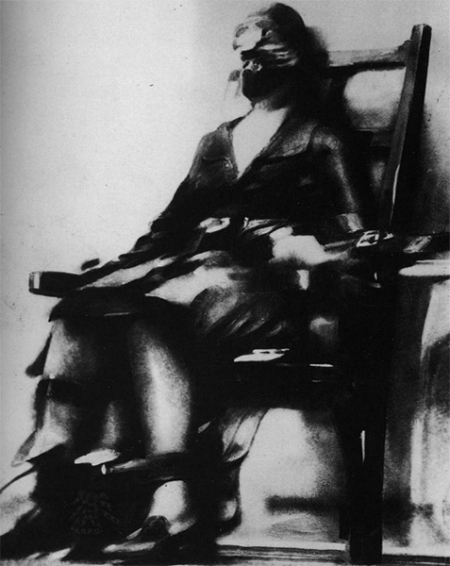
From the consistent, informative and often disturbing Iconic Photos:

“Photographers are not permitted into executions in the United States. For the notorious Ruth Snyder case, the New York Daily News was desperate to get pictures; so they hired a Chicago Tribune photographer Tom Howard – virtually unknown to the prison warders or journalists in the New York area. On that fateful day  (12 January 1928), Howard, posing as a writer, arrived early in Sing Sing Prison and took up a vantage position. A miniature camera was strapped to his left ankle, the shutter release button was concealed within his jacket. As Snyder’s body shook from the jolt, Howard hoisted his pant leg and secretly snapped with a one-use camera.”

[My bolding]

‘Seance’. A photograph of a group gathered at a seance, taken by William Hope (1863-1933) in about 1920. The information accompanying the spirit album states that the table is levitating. In reality, the image of a ghostly arm has been superimposed over the table using a double exposure. From the Collection of the National Media Museum, UK.

Great set of Spirit Photographs on the Flickr for the National Media Museum.

‘Man with a female spirit.’ Collection of National Media Museum

Kirk Crippens contacted me a few months back to tell me about his work at San Quentin. He’s working on a documentary on the SQ Insight Garden Project.

He’s also working on Hidden Population, a personal project of unorthodox portraiture.

I suspect for Crippens, the ‘back of the head approach’ is a novel workaround of DoC legal restrictions on identifiable depictions of men in its custody. As applied to a US prison population, Crippens’ work is original and rather beguiling; how many of his subjects are aware of the camera’s glare? Does the notion of victimhood surface here? How often does the bowed head recur? It is very difficult to imply penitence in prison portraiture without relying on cliche. The doo-rags, beanie-hats, neck hair, peeping tattoos and ubiquitous blue cotton mean these images fluctuate between personal and abstract.

For such a simple idea, Crippens could go a long way with it. It is still a work in progress so I just want to bring your attention to it right now. Hopefully, I’ll get Kirk on PP soon to discuss it at length.

BACKS OF HEADS

To compose images of the back of the subjects’ heads is the same approach adopted by Eric de Vries for ‘Invisible Scars’ – portraits of the Khmer Rouge labour camps, Cambodia. In terms of political context, the two sets of subjects are constellations apart , but I thought the shared technique was worth noting.

CRIPPENS

In 2010, Kirk Crippens achieved significant success with Foreclosure, USA. He had three solo exhibitions of his and nine group shows throughout 2010. Crippens was named in Photolucida’s Critical Mass Top 50 for 2010. Foreclosure, USA also won the Blue Earth Prize For Best Project Photography at the PhotoAlliance 2010 Our World Portfolio Review. Crippens was recently nominated for the 2011 – 2013 Eureka Fellowship Program, a project of the Fleishhacker Foundation.

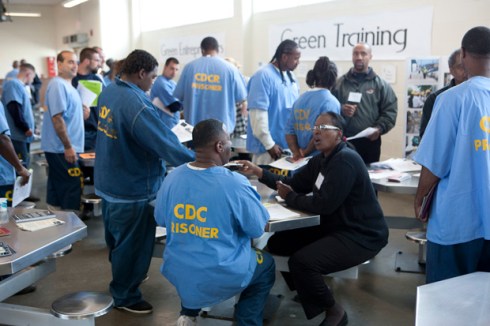
Green jobs fair at San Quentin State Prison. Courtesy of Kirk Crippens.

KALW Informant, a great quality news-site on criminal justice in the San Francisco Bay Area is asking the tough questions – The state could release 40,000 inmates soon. Where will they work? (Rina Palta, November 19, 2010) Palta has answers for readers too. The green economy.

I talked about the common sense behind green jobs for paroled and released prisoners in December 2008. Van Jones (yup, the guy hounded out of the Obama administration by the right-wing media crying Commie) posited before the nation’s economy tanked that social justice and environmental justice had common solutions. He was and remains right.

Palta highlights the mutual benefit for the tens of thousands of released prisoners and the State of California in a progressive, state-sponsored jobs programs and the expansion of the renewable energy industry. San Quentin Prison held a ‘Green Jobs Fair’ in August 2010.

Unfortunately, getting support for govt. stimulus is, these days, difficult politically; taxpayers may balk at the idea of putting taxpayer dollars toward work for felons.

However, unexpected or unpalatable for some CA residents, it would be wise to support former prisoners. It’ll save communities and save future DoC costs. California may be about to release 40,000 inmates based on a 2009 federal judicial ruling (the State of California has taken the case to the Supreme Court for appeal). That’s a lot of working age men with gaps in their skills and working histories. Train them.

Photographer and journalist, Ghaith Abdul-Ahad, reporting from an embedded position with the Taliban published a three part series of articles in the Guardian recently. They’re accompanied by a gallery of 11 images.
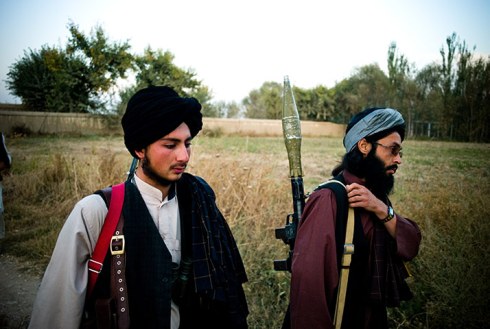
The fighters walk through a landscape of fields, criss-crossed with irrigation canals Photograph: Ghaith Abdul Ahad for the Guardian

The fighters walk through a landscape of fields, criss-crossed with irrigation canals Photograph: Ghaith Abdul Ahad for the Guardian

David Campbell talks about how valuable (if visually ordinary) Abdul-Ahad’s images are. Valuable because of where they are, alongside the Taliban; it is rare to see Western journalism this close.

Abdul-Ahad’s first part, The Taliban troop with an east London cab driver in its ranks, reveals the seasonal fighting Afghan nationals take on, in some cases they come from Britain for a Summer of Jihad. One fighter will return to his job as a London Cab driver. As remarkable as it must be rare.

In the second part, Five days inside a Taliban jail, Abdul-Ahad tells of the suspicion that fell upon he and a colleague following a battle with American forces. Their belongings were confiscated and they were blindfolded & trucked to another area. They were then marched for 9 hours up a mountain.

Shortly before daybreak we reached a barn on top of a mountain. This was where we would be incarcerated for the following days.

The word prison usually implies a thick-walled building with gates, padlocks and guards. But in the Taliban concept of a jail, the gate doesn’t exist. The jailer was the gate, the prison cell, the executioner and sometimes, if you were lucky, your friend.

The prisoners and the guards lived in the same room, divided by an invisible line. Both groups slept on flimsy mattresses covered with an almost black layer of shining grime.

For the first night we were blindfolded with chequered Afghan scarves that reeked of grease and which served as our towels and prayer mats. After that night, we were only blindfolded when we were led into the adjacent barn to wash and relieve ourselves. The floor of this barn was covered with droppings of goats and humans.

Apart from the jailer, I counted seven guards in all, from frail teenagers to big, tough fighters. They lived in conditions that were not much better than the prisoners. They were not allowed to leave or carry mobile phones and had to spend the night in the cell with the prisoners, often with their feet tied to those of their prisoners. They were fed the same meagre food.

After their credentials had been verified by Taliban leadership in Quetta, they were released.

As we were about to leave, Lal Muhamad produced a thick bundle of dollar bills and tried to give us a hundred each. “This for your trouble,” he said. We refused, and began the long journey back to Kabul.

Finally, in part three, Talking to the Taliban about life after occupation, Abdul-Ahad speaks to a Taliban commander, an administrator and an ambassador.

According to the commander, the Taliban want to be less ideological, less oppressive.

The ambassador refers to the war’s origins and what the US can and should be protecting, “The Americans have one right only, and that is their right to be assured that Afghanistan will not be used against them and that is something the Taliban should give.”

EMBEDDING WITH THE TALIBAN

Journalists Najibullah Quraishi and Paul Refsdal have embedded with the Taliban before.

Onesided embedding with allied troops can be a problem.

EMAIL

prisonphotography [at] gmail [dot] com

Prison Photography Archives

Post Categories

RSS PETE BROOK’S TUMBLR ‘PHOTOGRAPHY PRISON’

  • An error has occurred; the feed is probably down. Try again later.