PRESS TV reports:

In response to a question by Press TV on Monday over the whistleblower website’s “leaks,” President Mahmoud Ahmadinejad said “let me first correct you. The material was not leaked, but rather released in an organized way.”

“The US administration released them and based on them they pass judgment …. [The documents] have no legal value and will not have the political effect they seek,” the Iranian chief executive added at the press briefing in Tehran.

Ahmadinejad stressed that the Wikileaks “game” is “not worth commenting upon and that no one would waste their time reviewing them.”

Here, Ahmadinejad proves how little reality interests him. As with every outside threat, he attributes it to a malevolent US. Why scream conspiracy? Especially when the leaked material is being corroborated by diplomats across multiple nations? It’s a ludicrous notion. I wonder what Assange thinks of Ahmadinejad’s accusation?!

[via Lede blog, NYT]

An artist’s use of photography to stick it to the man

Asim Rafiqui brings to our attention the response of Hasan Elahi, a Bangaldeshi-born American citizen, to government suspicion and the FBI’s unwillingness to remove him from the “watch-list”.

Since 2002, Elahi has monitored his own movements on his website Trackingtranscience.net

Rafiqui:

Elahi posts his day, every single mundane aspect of it. A globe-trotting Professor of media, he posts all his activities, complete with GPS coordinates and the date/time stamps at the site, effectively monitoring his daily life. His meals, toilet breaks, airport waits and almost all the mundane acts that define 99% of what constitutes modern life. His server logs reveal that the Pentagon, and even the Executive Office of The President have clicked in while the FBI continue to monitor his activities through this site itself. Our tax payer’s money at work.

Pictured below, Elahi’s toilet breaks.

Two years ago, Elahi appeared on the Colbert Report and explained that if 300 million Americans did this, the FBI would have to employ millions of agents just to keep up with the data flood. Subversive, funny and the best type of protest … except he’s left with no privacy.

HASAN ELAHI

Hasan M. Elahi is an interdisciplinary media artist with an emphasis on technology and media and their social implications. His research interests include issues of surveillance, sousveillance, simulated time, transport systems, and borders and frontiers. Elahi is currently an Associate Professor at the University of Maryland. He previously taught at San Jose State University; Rutgers; the University of South Florida in Tampa, Florida; West Virginia University; Wanganui School of Design, in Wanganui, New Zealand; and also in Houston, Texas.

Elahi’s own site – http://elahi.umd.edu/

The Visible Man: An FBI Target Puts His Whole Life Online, Wired.com, by Clive Thompson, 05.22.07.

– – – – – – –

Found via Andrew Jackson’s Writtenbylight blog

Source: http://www.time.com/time/world/article/0,8599,1903971,00.html

Last week, Ahmed Khalfan Ghailani, 36, the first suspect transferred from Guantanamo military prison to stand a civilian trial was found guilty of only 1 of the 285 charges brought against him – a charge relating to involvement in the 1998 bombing of the American Embassy in Nairobi, Kenya.

PBS reports:

Prosecutors branded Ghailani a cold-blooded terrorist, but the defense portrayed him as a clueless errand boy, exploited by senior al-Qaida operatives and framed by evidence from contaminated crime scenes. Ghailani was convicted of one count of conspiracy to destroy U.S. property. He faces a minimum of 20 years and a maximum of life in prison at sentencing on Jan. 25.

Only one charge was successfully prosecuted because civil courts don’t look kindly upon the involvement of torture in extracting testimony for evidence.

From the New York Times:

Many observers attributed any weakness in the prosecution’s case to the fact that the Judge Lewis A. Kaplan of United States District Court in Manhattan, who presided over the trial, refused to allow prosecutors to introduce testimony from an important witness, who was discovered after interrogators used coercive techniques on Mr. Ghailani.

If this trial is a precedent for other trials of Gitmo detainees to follow, prosecutions are going to have a tough time of it.

The extent of torture used by American powers across the globe is picked apart in the ACLU’s ‘Torture Report’.

Experts have dissected govt. documents (released under the Freedom of Information Act) to piece together the practice of enhanced interrogation techniques; practices that have ultimately derailed the prosecution cases against hundreds of GWOT detainees.

(Found via)

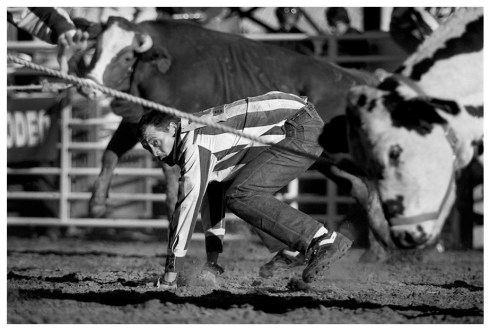
Damon Winter emailed me this week to let me know he’s been tinkering with his website. Since we spoke last [here and here] about his ‘Angola Prison Rodeo’ series, he’s revisited and re-edited.

http://www.damonwinter.com/ > STORIES2 > 5 > ANGOLA PRISON RODEO

The image above is new and one of Damon’s preferred images.

Also since then, Winter covered Haiti. It was his first work in a disaster area. This week, Winter’s Afghanistan i-Phone images hit the front page of the New York Times – Between Firefights, Jokes, Sweat and Tedium (James Dao, November 21, 2010)

On those i-Phone Hipstamatic App shots … three things.
1) David Guttenfelder did the same thing earlier this year with a Polaroid App.
2) The simple i-Phone angle is not a story. Judging by the cursory Lens Blog entry, I think James Estrin and Winter might have known this.
3) I’ll pass on the i-Phone photos. Mainly because these have got a stupid amount of attention; attention that should be going to Winter’s videography and incredible number of stories in his short time in Afghanistan.

Damon, I still love your portraits and I still dig your work!

ELSEWHERES

I’d also like to recommend my interview with Winter (for Too Much Chocolate) about his career trajectory.

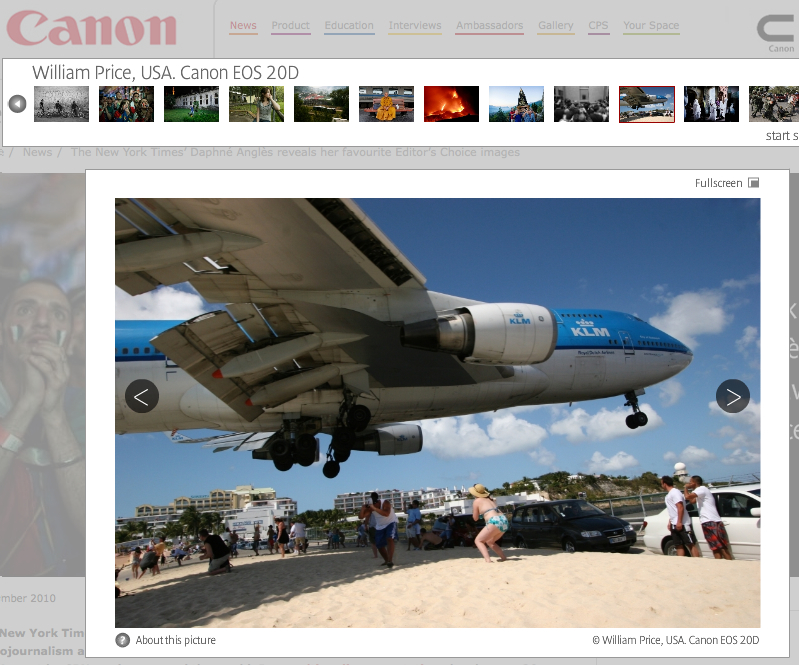
This week, the DVAFOTO boys pointed me in the direction of New York Times‘ Daphné Anglès video and “editor‘s choice” for the Canon Professional Network.

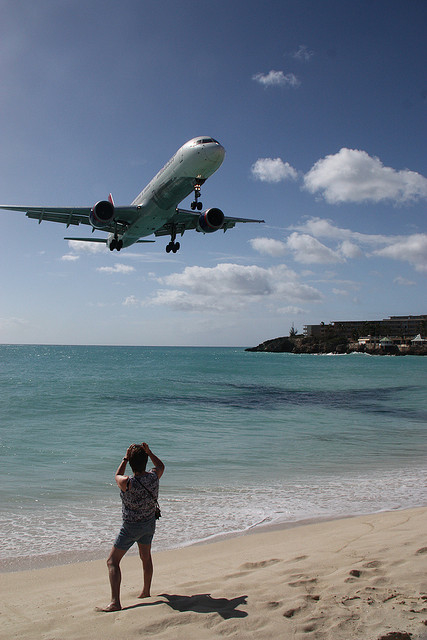
Anglès picked out ten photographs she thought worthy. One of them was this by William Price.

It’s not photoshopped. It’s at a beach on the Caribbean island of St Maarten.

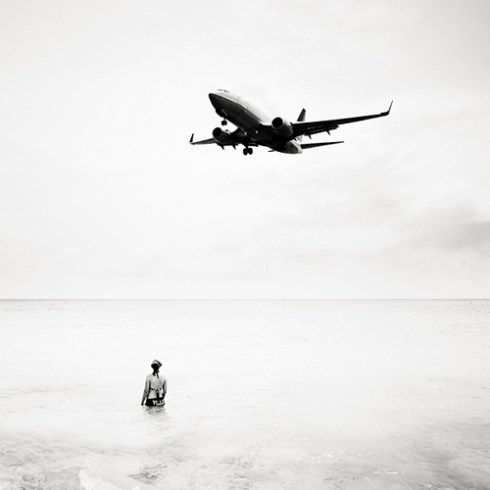
Also this week, Stephen Bulger tells me Josef Hoflehner is showing his series Jetliner at the Galerie Nikolaus Ruzicska in Austria.

Hoflehner’s photos are also from St Maarten.

Jet Airliner #11, Continental Airlines Boeing 737-800, Arriving from Newark, NJ. © Josef Hoflehner

I recall in the past seeing other photographers take on this same subject. If pros are taking the time to be out there, I presume plenty of amateurs (and many tourists) must be too?

Ahem. Flickrrrr? Result.

Image by Flickr user, Ike

A beach under an air-path is becoming iconic. It’s stunning, loud and easy to photograph. It encapsulates the compression of technology and leisure and it’s all about the madness and technological advancement in the age of speed. Now images of St Maarten are everywhere. Not a meme yet though (usually videos not images make it as memes).

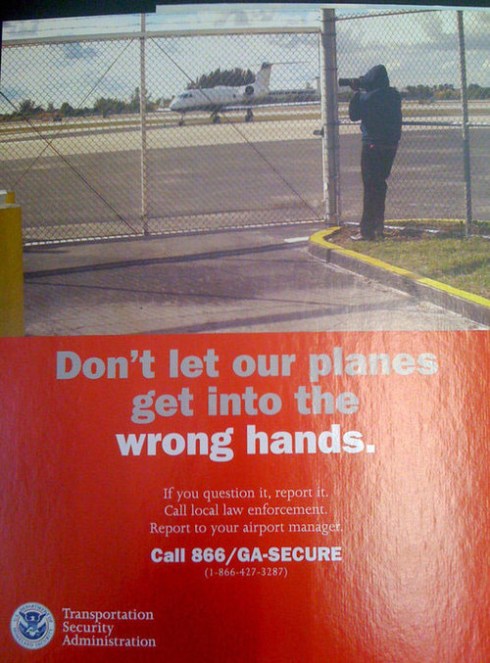
So, I wonder what That TSA Poster from a few months back was all about?

I was going to write a little something about That interview with Antoine d’Agata in Vice, but Darren’s got it covered:

“What is most troubling about D’Agata’s work is not specifically its content, but the rather trite assumption that life as a drug-addicted prostitute (in some conveniently distant place) contains more “truth” than that of, say, a suburban housewife or a plumber […] It remains a tiresome (if quite familiar) misapprehension that extremes of living can bring us closer to the most fundamental aspects of what it is to be human – as though there were no other kinds of truth.”

“The “reality” that he frames as an existential crisis is in fact an economic one, so his rhetoric is more like a transparent pretext for the way he has chosen to aestheticise what he photographs – a denial of his implied privilege. [d’Agata’s work] is beautiful and often daring, just not in the ways that he would have us believe.”

Well said Darren.

Put another way, and I heard this a few years back, “Oh d’Agata, he’s the Magnum photog who fucks and sucks his way around the world, yeah?”

© Kenneth Libbrecht. SnowCrystals.com

As heavy as the snow is falling here in Seattle, I dump these stories that I’ve noticed recently. All worth reading/seeing.

1) – The 2010 Lennart Nilsson Award (Recognizing Extraordinary Image Makers in Science) has gone to CalTach Physicist Kenneth Libbrecht. (Found via Jim)

2) – Rob Hornstra visited Abkhazia’s only prison.

3) – Moscow’s Butyrka remand prison is to install sunbeds for inmates.

4) – MIT has developed a camera that uses echos of light to see around corners. No doubt an attractive tool for SWAT teams, riot police and extraction teams in hostage situations and maybe prisons. I say this having written about ‘Through the Wall Surveillance’ before.

5) – French photographer, Olivier Laban-Mattei won the 2010 Grand Prix Paris Match for his coverage of Haiti. He was one of the many photographers who documented the death of Fabienne Cherisma. (Found via The Travel Photographer)

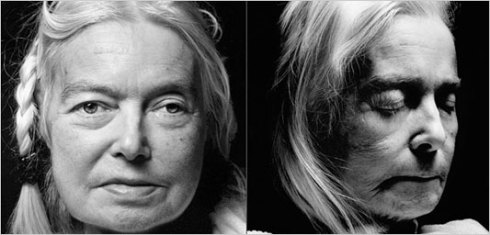
Edelgard Clavey, 67. First portrait: December 5 2003 / Second portrait: January 4 2004. © Walter Schels

6) – Walter Schels‘ photo project “Life Before Death”, includes 24 sets of before-and-after portraits ranging from a 17-month-old baby to a man of 83. Now on show at the Wellcome Collection, London. (More in this interview at LensCulture)

7) – More excellent opinion from John Edwin Mason, this time about the differences between the photo-op at Kenny Kunene’s lavish 40th birthday party and the responsible photography of Oupa Nkosi documenting the wealth and work of Black South Africans.

“No surprise, then, that Kunene has become the poster boy for shamelessly conspicuous consumption in county where, as the Guardian points out, 1.6% of the… population earns a quarter of all personal income.  Only 41% have a job and just 58% have attended secondary school; 9% don’t have access to water, 23% don’t have toilets and 24% don’t have electricity.  Average life expectancy is 52, the lowest since 1970. Zwelinzima Vavi, the South Africa’s most important labor leader, pointed to Kunene’s party when warning of elites who “scavenge on the carcass of our people” like hyenas.”

8 ) – Simon Sticker‘s 100 + 1 tips for the iconic Africa picture is the latest rant about stereotypes in conversation/photography on Africa.

National Photographers Association of Canada (NPAC) blog

9) – During the summer, I recommended the NPAC blog. Often working photographers will take over the posts for five posts in a week. Between the 8th and 12th November, Jen Osborne took the helm.

© Jen Osborne. Bounce is a very popular music movement originating in New Orleans, USA.  It came from the streets and is a mix between Rap, Jazz, and Electronic music.  It is popular amongst young adults due to its hard, fast and sexual nature, which inspires eccentric fashion trends.  It also appeals to the gay community because Bounce music now contains various gay entertainers.

Jen’s five days of blogging:

Day 1 – The Importance of Learning – Working on the fly with ‘Bounce’ dancers in New Orleans.
Day 2 – Bad associations can sabotage good work! – On access to Talavera Bruce prison, Rio de Janiero. Sketchy fixers, smuggled prison cellphones and released female prisoners.
Day 3 – Thinking Locally – Drug addiction, mental illness and homelessness in her home city Vancouver.
Day 4 – Vicarious Trauma – Vicarious trauma, a newly defined term applies to “wide range of people working with clients or subjects suffering from traumatic experiences; doctors, journalists, social workers, lawyers …”
Day 5 – Doing It Because You Want To – “It is important to have your own projects to work on – projects that make you as the photographer gratified. I think it is important to do meaningful work because it will always be there for you, even when the jobs aren’t.”

Great stuff.

10) – Ed Ou, reflecting on the Joop Swart Masterclass makes all young photojournalists smile with his stirring optimism:

“It is exciting to spend time with photographers from around the world and never mention the “death” of our industry. While there may be smaller budgets and fewer outlets, there will always be room for good photography. The only way to brave the bad times is to just keep shooting.”

© Ed Ou. Nurse Larissa Soboleva holds two-year-old Adil Zhilyaer in an orphanage in Serney, Kazakhstan. Adil was born blind and afflicted Infantile Cerebral Paralysis (ICP) and hydrocephalia as a result of his mother’s exposure to radiation during years of Soviet weapons testing during the Cold War. He was abandoned by his parents and is now cared for in an orphanage.


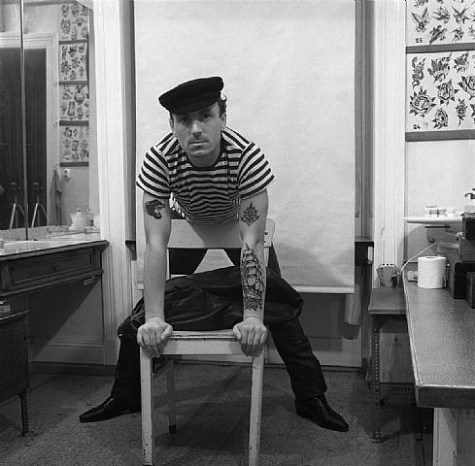
Unexpectedly, my posts on prison tattoo photography have been very popular – [1], [2], [3], and [4]. Continuing the theme, I’d like to feature the work of Herbert Hoffman.

From an early age, Herbert Hoffmann (1919-2010, b. Pommern, Germany) was drawn to people with tattoos. He was educated in Berlin. During the Third Reich, tattooed people were seen as criminals and consequently, the tattoo culture diminished. In 1940, Hoffman signed up for basic military service with the German army. From 1945-49, Hoffmann was held prisoner of war by the Russians. When he returned to Germany he worked as a travelling salesman, and encountered many persons who were tattooed despite the old Nazi ban. While working Hoffmann always took along his camera and photographed the people he met. In 1961, Hoffmann opened his own tattoo studio in Hamburg, Germany.

FIRST TATTOOS, THEN PHOTOGRAPHS

Hoffman distinguishes himself from photographers who look in at the tattoo culture from the outside. He defined the culture and then adopted the lion’s share of documenting it. Hoffman’s DIY method is like that of graffiti artists who return with a camera to make images of the surfaces which they have earlier decorated. (Notably, Hoffman’s tattooing preceded the rise of graffiti and its recognition as art/culture in the 1970s/80s.)

Aged 91, Hoffman passed away on June 30th of this year. Despite the indisputable novelty of his photographs, and his central position to German tattoo culture, Hoffman only received mainstream recognition very late in life. No surprise really; Hoffman was working with the maligned, ‘lowly vernacular’ medium of photography, to record the re-emerging tattoo subculture.

TEN HAAF EXHIBIT

Hoffman’s images are on show at Ten Haaf Projects in Amsterdam until December 18th. Ten Haaf Projects, Laurierstraat 248, 1016 PT Amsterdam, The Netherlands. Tel: 020-4285885 www.tenhaafprojects.com. And how good is this? At the Ten Haaf opening in October artist Henk Schiffmacher tattooed Hoffman’s designs on exhibition goers.

EXHIBITS / BOOKS

Hoffman’s books are here and a picture gallery of Hoffman’s life here.

Selected Solo Exhibitions: 2010 ‘Living Pictures’ Ten Haaf Projects Amsterdam; 2010 ‘St Pauli’s Souvenirs’ Galerie Lehmann Berlin. Publications: 2008 ‘Skinscapes, Die Kunst der Körperoberfläche’, text Herald Kimpel, Hrsg: H . Kimpel, Marburger Kunstverein Marburg; 2006 ‘Signs and Surfaces’ by Andreas Fux, Herbert Hoffmann, Ali Kepenek Hrsg Künstlerhaus Bethanien Berlin; ‘Mensch! Photographien aus Dresdner Sammlungen’, Hrsg: Wolfgang Hesse und Katja Schumann; ‘Kupferstichkabinett’, Staatliche Kunstsammlungen Dresden.

ALL IMAGES © HERBERT HOFFMAN

EMAIL

prisonphotography [at] gmail [dot] com

Prison Photography Archives

Post Categories