Left: According to photographer D.K. Langford, this is the Texas vehicle inspection sticker designed from his photograph. Right: This photograph is exhibit A in Langford’s suit vs. the Department of Public Safety and the Texas Department of Criminal Justice. (Source)

At last. I’ve been waiting for one of these legal disputes to have a prison angle! From the My San Antonio News:

“A photographer is suing the state over roughly 4.5 million vehicle inspection stickers that appear to incorporate, without his authorization, an image of a saddle-toting cowboy he created in 1984. Plaintiff David K. Langford wants the court to block the Department of Public Safety from further use or issuance of the stickers, the design of which he says is based on his copyrighted photo, Days End 2.”

“The stickers were produced by state prison inmates under a Texas Department of Criminal Justice (TDCJ) contract with the DPS. […] The suit says Langford’s photo was illegally appropriated by an inmate who scanned it from a copy of Texas Parks and Wildlife Magazine in 1998.” [My bolding.]

Langford, the photographer, seems quite tenacious here. He argues simply that the State of Texas should be more careful about how it sources its images.

I want to avoid the lazy joke about a prisoner “stealing”. It’s just a shame that when prisoners working for the Texas Correctional Industries which is, for some, a form of modern slave labor (I withhold comment), the products of their work are at the centre of a substantial lawsuit.

This story was brought to my attention by Bob, who says, “I guess Texas is always full of unintended ironies.”

The TDCJ refused to comment, and of course there’s no response from the prisoner. I would want to hear from the prison-artist who originally ripped Langford’s image. He ended up producing a nice piece of graphic design!

With 4.5 million stickers in circulation, the prisoner has quite the visible profile. There’s more of a story here. Texas journalists! Get on it.
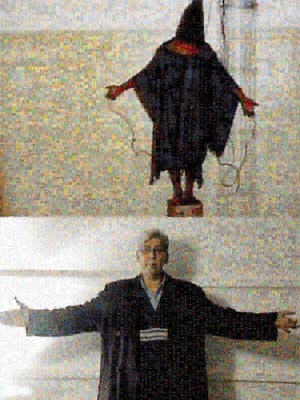
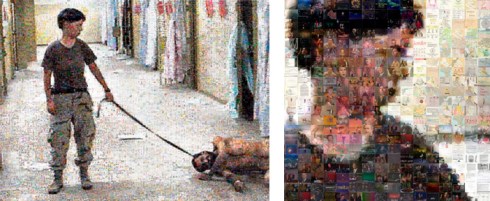
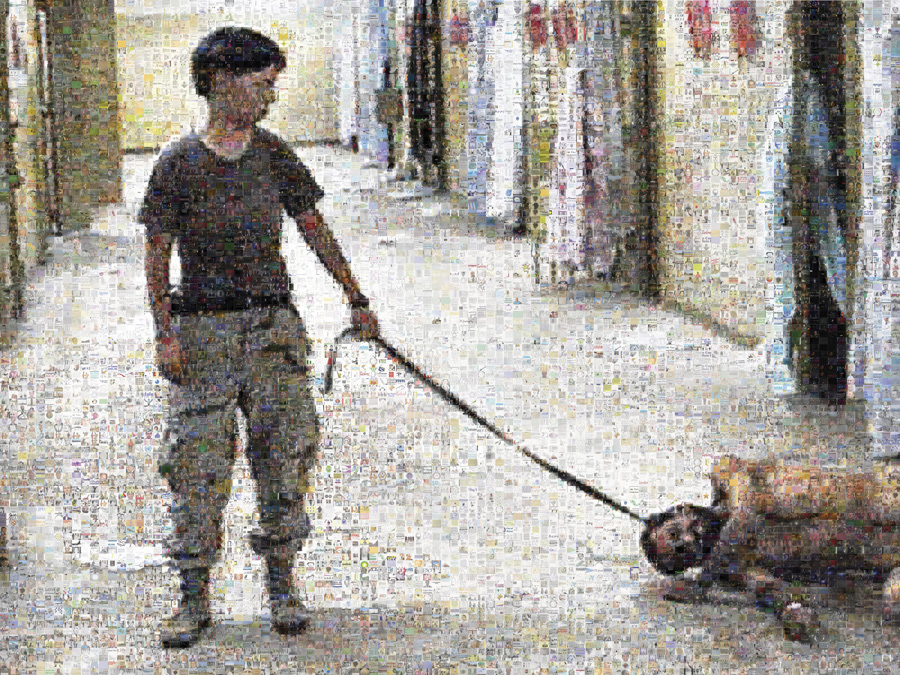
Joan Fontcuberta describes his work as “anti-authoritarian.” He is a self-taught artist and former journalist who has adopted the tricks and issues of media manipulation/propaganda into his work.

Fontcuberta’s Googlegrams are “large, colorful photo-mosaics that construct a metaphor for the internet-era’s liaisons between mass media and our collective consciousness. Using Google to blindly cull images from the internet by controlling only the search engine criteria, Fontcuberta then assembles them by another computer program into a larger photomosaic image of Fontcuberta’s choosing.” (Source)

Fontcuberta’s an iconoclast, a philosopher and doesn’t trust the image. He encourages people to distrust, but ultimately recognises that people must believe: “people need information.” (Which may relate to the necessary reinsertion into – and commitment to – the image Joerg’s calling for.)

It’s all about healthy skepticism and filtering. He’s the furthest thing from a pessimist; he teaches photographic history and adores the medium. But he is not a sap.

Fontcuberta’s work deliberately fictionalises and questions. Jim Casper’s well-metred audio interview and VICE‘s interview flesh out his approach and motives.

What I admire about Fontcuberta is that having abandoned the urge to fight against the crimes of photoshop, advertising and image politics, he plays them at their own game. His ideas are uninhibited; it doesn’t matter if the lost Japanese soldiers of WWII in the Philippines jungle that he went in search of exist or not. Fontcuberta puts the exploration of an idea before the pressure to produce an end product. “The look of my work is not important,” he says.

Fontcuberta is playful and really jolly. I’d love to see him take on a cryptozoology expedition!

BIO

Joan Fontcuberta was born in 1955 in Barcelona, where he continues to live and work. He has exhibited extensively at museums and galleries in the U.S., Europe, and Japan, and has been associated with Zabriskie Gallery since 1981. His work is in numerous institutions, including the New York Museum of Modern Art, the San Francisco Museum of Modern Art, and the Art Institute of Chicago. He contributes regularly to scholarly journals and has published many books, including Fauna, Sputnik and Miracles and Co.

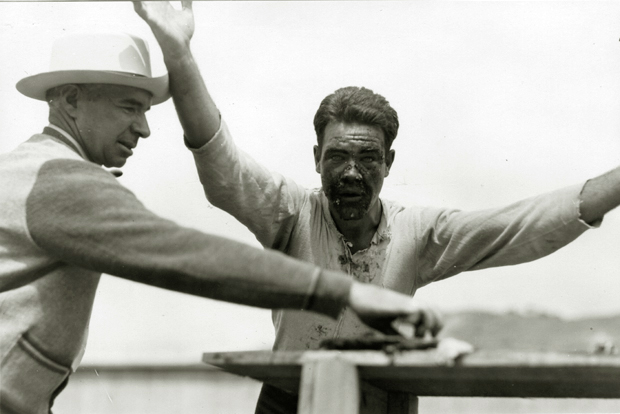
Tumbling competition, San Quentin Little Olympics Field Meet, 1930. Courtesy Anne T. Kent California Room Collection, Marin County Free Library

Earlier this morning I pointed out the riches of the Anne T. Kent California Room Collection, in the Marin County Free Library Archives. The San Quentin Little Olympics Field Meet 1930 Album deserves it own post.

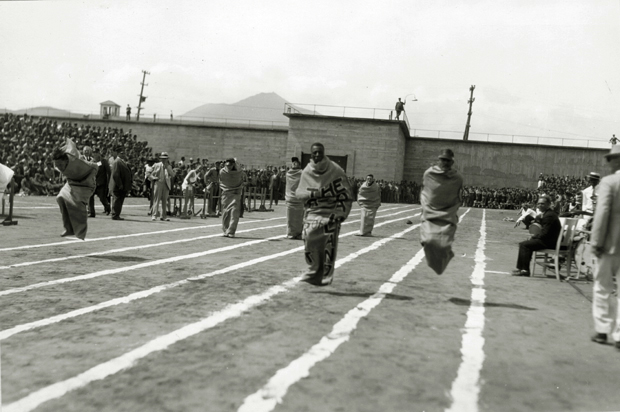
Any sack race that has contestants cocooned up to their necks is a serious affair (image 2). Any tumble would hurt.

The tug-of-war (image 3) is fought on a remarkably complex purpose-built platform. It unfortunately looks like a rack.

I have no idea what narrative the parade (image 4) carries, but African American inmates donning hessian sacks painted to mimic “primitive” costume and carrying a whiter-than-whiter mustachioed swan-king is particularly discomforting.

Pole vault without a 60 inch crash-mat beneath the bar?

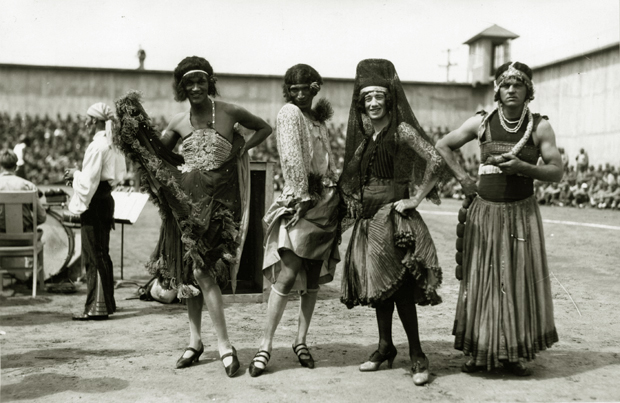
Lots to be said about cross-dressing and gender-bending in prisons, but not to be superimposed upon these 80 year old photographs. Two fascinating images.

And we just had Halloween. Who knew pie-eating contests (last image) produced zombies?

Sack race, San Quentin Little Olympics Field Meet, 1930. Anne T. Kent California Room Collection, Marin County Free Library.

Tug-of-war competition with officials looking on, San Quentin Little Olympics Field Meet, 1930. Courtesy Anne T. Kent California Room Collection, Marin County Free Library

Prisoners in costume parading at the San Quentin Little Olympics Field Meet, 1930. Courtesy Anne T. Kent California Room Collection, Marin County Free Library

Prisoners in costume parading at the San Quentin Little Olympics Field Meet, 1930. Courtesy Anne T. Kent California Room Collection, Marin County Free Library.

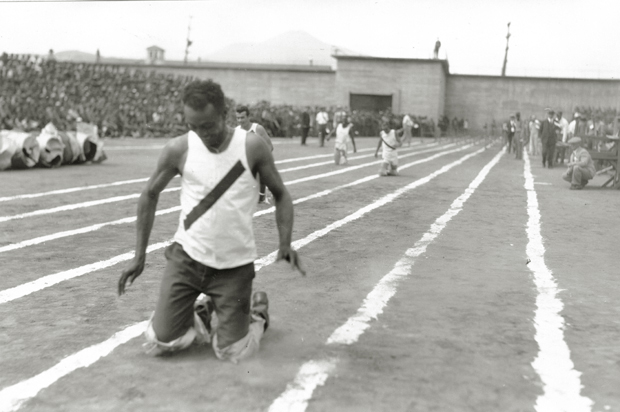
"Fifty-yard crawl" race, San Quentin Little Olympics Field Meet, 1930. Courtesy Anne T. Kent California Room Collection, Marin County Free Library.

High-jump competition, San Quentin Little Olympics Field Meet, 1930. Courtesy Anne T. Kent California Room Collection, Marin County Free Library.

Pole vault competition, San Quentin Little Olympics Field Meet, 1930. Courtesy Anne T. Kent California Room Collection, Marin County Free Library.

Long-jump competition, San Quentin Little Olympics Field Meet, 1930. Courtesy Anne T. Kent California Room Collection, Marin County Free Library.

Clown performance featuring a duck, San Quentin Little Olympics Field Meet, 1930. Courtesy Anne T. Kent California Room Collection, Marin County Free Library.

Stage entertainment with four male dancers in female dress, San Quentin Little Olympics Field Meet, 1930. Courtesy Anne T. Kent California Room Collection, Marin County Free Library.

Courtesy Anne T. Kent California Room Collection, Marin County Free Library.

Pie-eating contest showing three participants, San Quentin Little Olympics Field Meet, 1930. Courtesy Anne T. Kent California Room Collection, Marin County Free Library.

Pie-eating contest (close-up of one participant), San Quentin Little Olympics Field Meet, 1930. Courtesy Anne T. Kent California Room Collection, Marin County Free Library

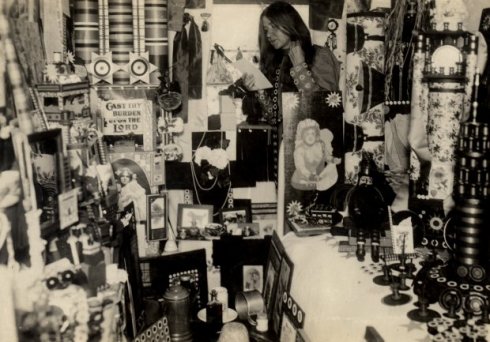
The caption to this photo reads, ‘A woman prisoner at San Quentin in her room. The decorations are all made from fancy paper and spoons.’ Courtesy Anne T. Kent California Room, Marin County Free Library.

This image from the San Quentin Photography Album from the Marin County Free Library really struck me. Dedicated decoration. The San Quentin Photography Album was compiled by Richard M. Smith & Genevieve Smith.

The Anne T. Kent California Reading Room, Marin County Free Library Archives are great. Don’t miss:

Views of the 1906 Earthquake and Fire in San Francisco by W.J. Street.

Golden Gate Bridge Photo Album (Construction images).

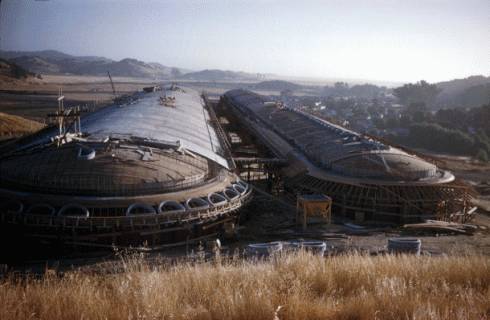
Frank Lloyd Wright and the Marin County Civic Center Photo Album, showing the construction of one of FLW’s few West coast buildings. It was later used as the set for Star Trek: Next Generation.

All of these things within just a few miles of one another. Browse the full archive listing.

Administration Building Construction. South end of the Administration Building looking North. Photograph by John Trimble. Harold Stockstad Slide Collection. Courtesy Anne T. Kent California Room, Marin County Free Library.

View of the Golden Gate way with the Palace of Fine Arts in the foreground; circa March 9, 1935. Courtesy Anne T. Kent California Room, Marin County Free Library.

Francis Nielson as Isaac in Abraham & Isaac, the first Mountain Play, performed in 1913. Courtesy Anne T. Kent California Room, Marin County Free Library.

Former Vietnam veteran, prison inmate and junkie (“once the needle goes in it never comes out”), Clark has a kind of coiled, unpredictable energy.

– Tobias Grey (Photographer Larry Clark’s muses’, Financial Times, Oct. 30, 2010)

Billy Mann 1963. © Larry Clark/Luhring Augustine, New York and Simon Lee Gallery, London.

Printed on the salmon-pink pages of the FT (the global leader in financial news), Larry Clark‘s latest interview about his counterculture subjects and his casual anti-commercial philosophy carries some irony.

Then again, perhaps not. Clark’s refusal to market and remarket his books and prints has led to scarcity – the result? Prices have been driven up:

“Clark refused to let either of his most famous books, the harrowing and explicit Tulsa and Teenage Lust, be republished. He finally did a couple of print-runs with Tulsa 10 years ago, but Teenage Lust is still out of circulation and as such a valuable collector’s item. Earlier this year, at an auction at Sotheby’s in London, a single print from Teenage Lust sold for £7,800.”

In his fifties, Clark learnt to skate to keep up with his cast for Kids. He believes that to photograph a youth culture you have to be in it. It must be difficult for Clark to have the city hall in Paris ban under-18s from entry to Kiss the Past Hello, his exhibition at Musée d’Art Moderne, “I think it’s just the stupidest thing in the world,” says Clark. “I think it’s an attack on youth and on teenagers in general.”

It’s difficult to argue against Clark’s indelible mark on American visual culture. Every hipster, skater, urban-wannabee and romantic sees their lives through the American-Apparel-Levi’s-Ryan-McGinley-Dash-Snow-Hamburger-Eyes-Zoolander-Derelicte images that advertisers, Polaroid & film enthusiasts create as facsimiles to Clark’s seductive and brutal works.

Again, irony reigns as advertisers define a slightly mucky but not diseased world in which they can place their products; a world that looks like Clark’s but is some distance from it. With that in mind, I think Tobias Grey‘s point has some weight:

“As a contemporary and admirer of Diane Arbus and W Eugene Smith, Clark is perhaps the last survivor to bridge the classic era of black-and-white photography and the present.”

Clark has ran and defined the continuum.

Read the article. Clark’s closing empathy for childhood movie stars is surprising and honest; he made collages to honor them.

Kiss the Past Hello’, Musée d’Art Moderne de la Ville de Paris, until January 2 2011.

PHOTOGRAPHY COVERAGE IN THE FINANCIAL TIMES

Like last weeks FT article on Leibowitz’s interaction with the market, this portrayal of Clark and his motives is well-written, even endearing. The FT Weekend has had articles on Martin Parr and Cameraless Photography in recent weeks too.

It was a mandatory choice of an airmiles-earned printed daily that brought the FT to my door, but I’ll admit I’m looking forward to my Saturday morning reads more and more.

Last month, I published a piece for Wired.com about Philipp Lohöfener‘s photographs from the Stasi Prison Museum in Berlin.

I make the point that “the prison has been the subject for other photographers including Martin Roemers, Daniel & Geo Fuchs and Daniel Etter, but Lohoefener’s work is the most cohesive essay in describing the cold horror of the site.”

I am a big fan of former prisons that have been reconstituted as sites for education; they will inform about the specifics of the political era in question, but they will also usually double as sites of pedagogy against oppression of human rights applying the narrative at a global level.

Check out Lohöfener’s photographs.

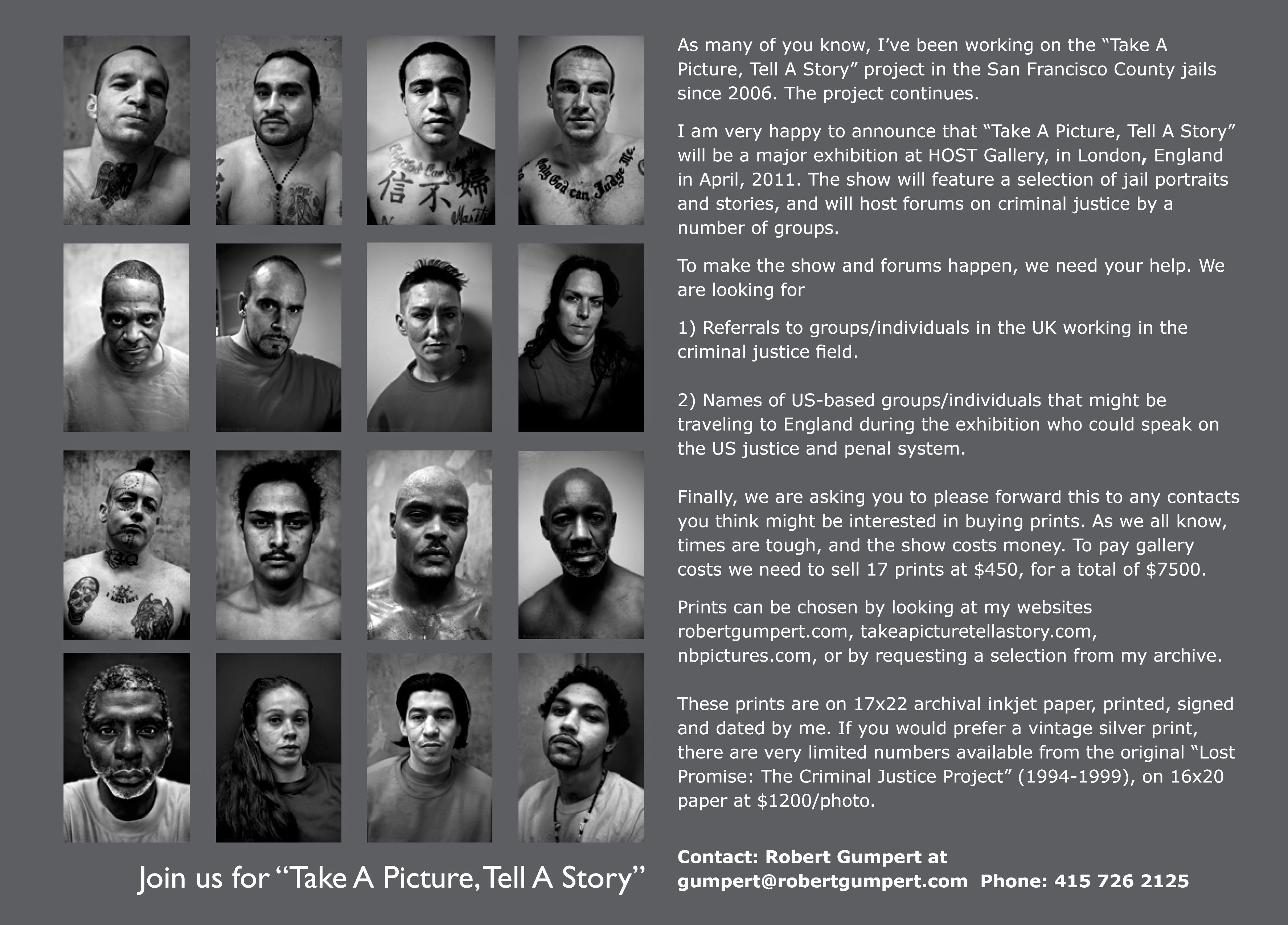
Good friend Bob Gumpert will be showing his portraiture from the San Francisco and San Bruno county jails at HOST gallery in London in April of next year.

From Bob’s email this week:

As many of you know I’ve been working since 2006 on the “Take A Picture, Tell A Story” project in the San Francisco County jails. The project continues.  I go into the jails about three times a month and post to takeapicturetellastory.com as time and stories allow.

The show will host forums on criminal justice by a number of groups. To make the show and outreach happen we need your help with the following:

1)     Referrals with groups/individuals in the UK working in the criminal justice field.
2)    Names at US based groups/individuals that might be traveling to England during the exhibit who could speak on the US system.
3)    Forwarding this note and flyer to your any of your contacts that might be able to help with contacts or might be able to help with funding by purchasing a print.

Obviously, I have a wild bias in seeing work such as Bob’s getting a wide audience.

Yet, photography from prisons/jails tests the theory that photography shows and delivers stories we otherwise would not see. Bob’s portraits and audio gives voice to the marginalised. Whatever the reasons for their incarceration, no one deserves to be made invisible. Bob’s work empowers his subjects and reveals the limitations of our criminal justice systems.

So, friends stateside and over there in Blighty, get your thinking caps on and see if you can help spread the word and find him some allies (and cash?)


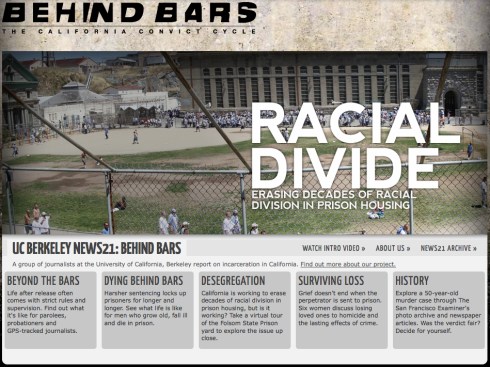
It took “eight tubs of candy and endless cups of coffee” and I presume a whole lot of talent for 14 journalists from the UC Berkeley Graduate School of Journalism, University of Nebraska and City University London to produce Behind Bars.

It is a multimedia project worth everybody’s time, thought and appreciation.

Behind Bars looks at man angles of the prison experience – Victims, Survivors, Parole Dept. Sweeps, Policing, Racial Segregation, Criminal Justice Law, Three Strikes, Geo-Tagging, Probation, Second Chances.

Behind Bars has 19 videos to view. I picked one out about lifer, Marvin Caldwell, in for 29 years to life for his third strike, a non-capital crime.

Behind Bars is a project of News 21, a national initiative led by 12 of America’s leading research universities with the support of two major foundations to advance the U.S. news business by helping revitalize schools of journalism. Universities integrate the schools of journalism more closely with the entire campus in an effort to better teach, challenge and prepare the next generation of news industry leaders for an increasingly complex world.


EMAIL

prisonphotography [at] gmail [dot] com

Prison Photography Archives

Post Categories