“SnapScouts was designed and developed for children to use, before they form stereotypes of other people. They’re the perfect reporters, unbiased and unprejudiced by media concepts.”

“[SnapScouts] leverages modern technology to address the timeless threats to democracy and freedom.”

THIS is one of the best pieces of satire in a long time, at least I think, I hope, I know it is satire.

A NEW WAY OF EARNING BADGES

From SnapScouts:

Want to earn tons of cool badges and prizes while competing with you friends to see who can be the best American? Download the SnapScouts app for your Android phone (iPhone app coming soon) and get started patrolling your neighborhood.

It’s up to you to keep America safe! If you see something suspicious, Snap it! If you see someone who doesn’t belong, Snap it! Not sure if someone or something is suspicious? Snap it anyway!

All this is a great play off America’s worst paranoia and best humor. Good stuff!

The FAQ page is hilarious combining fears of soft drugs and illegal immigration with a contempt for foreign CCTV culture.

“My eight-year old caught the gardener smoking something suspicious. It wasn’t marijuana, but it turns out he was illegal!” – Phyllis Specter, 32, Idaho

and

“After only a three-month trial of SnapScouts in England, Indonesia, and Germany, we are proud to report over 600 crimes reported.”

Nothing to do with anything prisons, but a hilarious story that I can’t resist … and, yes, I do want a U-Boat Barge!


Tijuana — Young men sit on the 3-foot-wide floor of a holding cell in the old Tijuana jail. © Don Bartletti/Los Angeles Times


Don Bartletti provided photos for Richard Marosi’s story “Notorious Tijuana jail to be just a dark memory.”

From the LA Times: “A cacophony of shouts and clanging metal. The overpowering stench of vomit and urine. This is the Tijuana jail, nicknamed “La Ocho” because it is on Eighth Street. The lockup, known for decades to hard-partying hordes of Americans and locals, is closing.”

My guess would be anyone who suffered a night or more in this hole will be glad no-one else has to endure the same?

© Sebastian Friedman

A reader got in touch recently to point me in the direction of Sebastian Friedman’s work Segurismos. Friedman deals with self-imposed imprisonment of individuals and families brought on by their personal wealth above and beyond the norms of their “host” society.

Sure there are elements of humor to the work, but also a great misfortunes. When I have visited countries with economic inequality and histories of instability, I wonder if I’d put myself behind bars too. (I have stayed in what could only be described as “compounds” in both Cochabamba and La Paz in Bolivia). I conclude, in a similar position of wealth, I would probably lock myself up too.

I imagine that the peculiar stresses of living behind “voluntary” bars become normative after an amount of time, especially if one considers in how many cities across the globe in which these simplistic security measures are put in place?

– – –

Thomas Locke Hobbs (who offered the tip for this post) has been featuring some interesting work from South America on his blog recently, notably Felipe Russo, Cyrille Weiner, Marcos Lopez, and Pietro Paolini.

Inmates are taught how to grow mushrooms. The bottles contain fungus which is left to sprout in a dark and damp bamboo hut. Prisoners classed as a low security risk are entitled to participate in rehabilitation schemes. Prisoners can learn new skills and earn some money to smooth the transition back into society once released from prison. © Charles Fox

Often one presumes the prisons of a country have been put in place by the ruling party, coalition, dictator or whatever power base dominates.

Rarely does it occur that prisons and criminal justice systems could be established not by political forces per se, but by aid or reconstruction efforts.

(It’s worth noting, part of the responsibility of the allied occupiers in Afghanistan was to construct humane prisons that catered separately for men. women and children, which I have written about before).*

In Cambodia, $1 million dollars of the Australian government’s aid agency AusAid went toward the construction of Kandal Provincial Prison. It opened in 2006 and was designed to set the standard for humane incarceration in Cambodia. Sadly, overcrowding remains.

Photojournalist Charles Fox visited Kandal and I was interested in his images of culturally-appropriate rehabilitation. Seems to me that curd factories and mushroom cultivation are Cambodia’s equivalent to the US’ prison industries that press license plates and manufacture the executive suites for state attorney offices.

Fox:

“Kandal Provincial Prison houses 885 inmates including 38 women and 68 minors. Prisoners sleep in one of eight large buildings. The buildings are open dorm rooms, there are no cells at Kandal Provincial Prison. Prisoners classed as a low security risk are entitled to participate in rehabilitation schemes. Prisoners can learn new skills and earn some money to smooth the transition back into society once released from prison.

Overcrowding is a big concern across Cambodia’s prisons. Kandal Provincial Prison is no exception and  is currently operating at around twice its capacity. The Cambodian Government has announced plans to build a new prison in Phnom Kravanh district to house an additional 2500 inmates to ease overcrowding.”

*No organisation is apolitical. All govt, non-govt, religious and social justice organisations are invested in politics – they just don’t sit in parliament or power-broker offices.

Inmates can work in a bean curd factory. The curd is left to dry in the sun and then used to feed both inmates and staff and also sold at market. © Charles Fox

Kandal Provincial Prison houses a garment factory as part of the rehabilitation scheme to give inmates a trade for when they leave prison. The factory has over 150 textile machines which produce plain cotton blend material. The garments are sold back to a Chinese garment factory which provided the machines to the prison. In mates can earn $10 dollars a month working in the factory. © Charles Fox
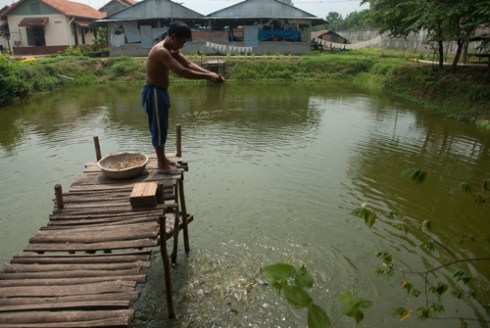
Inmate feeds fish which are farmed at Kandal Provincial Prison. The fish is used to feed the inmates and staff and also sold at market. © Charles Fox

Love this. Found over at Elodie Drouard‘s twitter page  –@elodienelson

Reminds me of A Photo Editor, Rob Haggart‘s twitter background – @aphotoeditor

Some items banned by the Oregon Department of Corrections are understandable, ie, “Weapons or Explosives” and “Escape Device”.

The mail-rooms at all Oregon prisons are instructed to refuse sexually explicit material. Fair enough, you might think (maybe not?) but it is the definitions they provide that make me chuckle. I quote, “Personal Photographs (i.e. individual print or copy or photograph extracted from another source) in which the subject is nude … or exposes any portion of the female breast below the top of the areola.”

Also banned, “Polaroid type photographs with a chemical substance on the back of the photograph.”

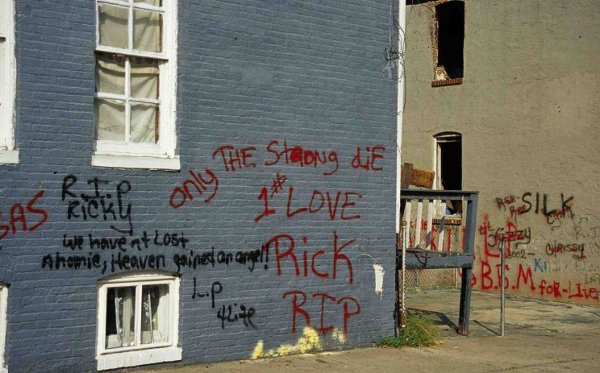
Peter Barry has been documenting the Rest In Peace tags in Baltimore for over ten years:

“In 1999 I started documenting these. I have lived in Baltimore Maryland twice, from 1969 to 1974, and 1985 to present. Statistics of Baltimore Maryland, since 1990, POPULATION DROP: 100,000, HOUSES DEMOLISHED: 50,000+, READING GRADE LEVEL: Low, HIV/AIDS: High, HEROIN ADDICTION: High, and a MURDER RATE of approximately 300 per year. It is this murder rate as manifest through the graffiti “R.I.P.” that I have been documenting since 1999.”

I wanted to post this and try to figure out how this tallies with Daniel Shea’s project Baltimore, which I featured earlier this year.

More on R.I.P. Baltimore here and here.


EMAIL

prisonphotography [at] gmail [dot] com

Prison Photography Archives

Post Categories