Joshua Bilton built a project to challenge “the fictions” of prisons in the UK.

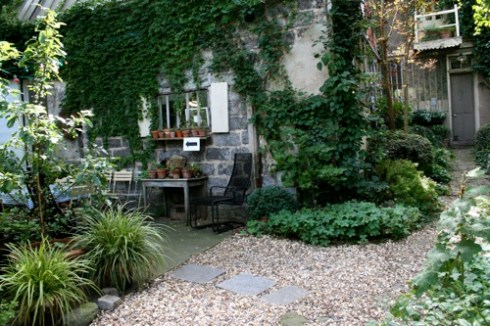
Ectopia, a series of portraits place the subject in a dominant environment. Bilton’s skill is in evoking the dominance of space without presenting the prison per se. He’s staying away from the dark holes, cell tiers and bars with which we are usually presented. Bilton describes a more nuanced and inter-relational notion of enclosure.

What is more remarkable was his process. The British Journal of Photography writes:

[Bilton] started Ectopia during his BA at the London College of Communication. He finished it the year after graduation, writing to every prison governor in the UK and getting access to 45 inmates. The governors picked them out, and they varied from age 18 to 40+, and from category A (high risk) to D, but that was OK with Bilton – he felt that if he selected them, he’d be influenced by prison clichés. “In the end, some completely fitted in with my preconceived ideas, others completely broke them,” he says. “That’s the point – there is no type, no simplified idea. There’s no way of accessing what it is, you can only shift the perspective.”

Every prison governor in the UK!

All images © Joshua Bilton. Images via Nova Gallery

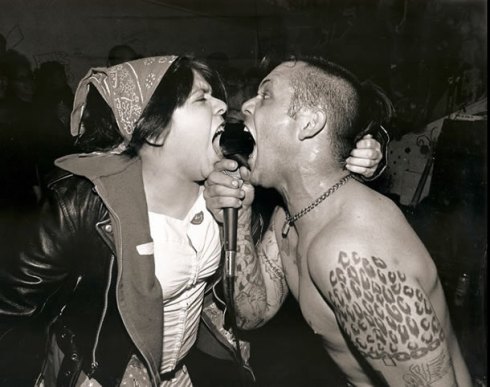
© Larry Wolfley

Last month, on a flight from Oakland to Seattle, I sat next to an energetic, punky, wide-eyed young lady. Her view of the world was full of naivete, optimism and anti-capitalism. She lived for music and she talked about the Gilman Club … a lot.

I lived in the SF Bay Area for several years but not being punk, garage, shed or synth-krunk I’d never heard of it. A week later I came across Larry Wolfley‘s photography. As well as photographing at underground shows and East Bay clubs, Wolfley has been a makeshift “house photographer” at the Gilman Club for 12 years.

Wolfley recently did an interview with Maximum Rock and Roll. He has a PhD in English Lit from Berkeley, he taught at The University of Nebraska-Lincoln in the seventies, abandoned academia, returned to Berkeley, became a carpenter, had a son, took photos, realised he knew nothing, resolved to teach himself photography, and decided street punks on Telegraph Avenue were a good topic. The homeless punks told Wolfley he had to go to the Gilman Club if he were to understand their culture. He’s been shooting punk and music gigs since.

Wolfley is more than twice the age than the majority of the crowd. All the kids know him, his Canon and his black beanie hat.

Just wanted to give a shout out to a local hero whose recognition has been a long time coming. Visit his website.

Source: http://www.artbusiness.com/1open/021210.html

I saw this TED talk by Ethan Zuckerman a couple of months ago and I’ve been meaning to post it since.

Zuckerman is a guy that is trying to work out how the web functions, more specifically how it is used. His research tests the claim that the web unites people from diverse communities.

In truth, the majority of us surround ourselves with like-minded people on line as we do in real life; in other words, the web isn’t used to develop wider world views – contrary to many folks’ lip service to the idea.

Zuckerman explains, “Much of my writing focuses on questions of whether the Internet is leading us to have a wider view of the world, or whether we’re becoming trapped in the “echo chambers” described by Cass Sunstein or the “filter bubbles” discussed by Eli Pariser. At Berkman, I’m running a number of small experiments that try to discover how parochial or cosmopolitan the use of the internet is in different communities – these questions are inspired in part by Pippa Norris’s work, especially her book Cosmopolitan Communications. I’ve been writing for the past several years on ways to make the internet work better for creating transnational connections, focusing on making translation transparent, engineering serendipity, monitoring what content we consume and leaning on bridge figures and xenophiles – I talk at length about these ideas in my TED talk, and am (slowly, painfully) working on a book on the subject.” (Source)

“If life is art and art is life, an arts center must breathe.”

Brendan Seibel for Vingt profiles FACE French/American Creative Exchange, collective in the depressed northern reaches of Paris, set up by Monte Laster, an immigrant from Texas. The project’s centerpiece is the transcendence of the individual above the proscribed traps of generalization:

“A far-reaching social experiment threading together disparate populations is set to commence. Prisoners will join their wardens, expectant mothers will join school children, rappers will join poets, all in an effort to examine how environmental conditions reflect people’s expression.”

What I like most about FACE isn’t just that it’s community arts, but that prisons are considered as a matter of course part of the community. That’s a refreshing alternative to prevailing attitudes elsewhere which think of prisons as dumping grounds; sites to be ignored, buried, distanced.

American Suburb X republished an Art Voice interview with Bruce Jackson.

Bruce Jackson is one of the greats of prison photography, up there with Danny Lyon, Deborah Luster and Alan Pogue.

Jackson: “The people who are in penitentiaries are no different than the people outside, except that they’ve done a certain thing that got them classified as the kind of person that goes to the penitentiary. But they’re in a penitentiary, and being in a penitentiary does something to people. It puts you in a position. All the things that Foucault writes about—about power and what it does and the way it’s used—are there. Prison is a place where power rules. Prison is about power; if it were not, people would walk out the gate. You see it in the way people walk and in people’s faces and the way they present themselves.”

© Jordis Antonia Schlösser, from the series ‘City Behind Walls’

Without exception, the authorities of every prison I’ve visited have described their complex as its own contained city.

For German photographer, Jordis Antonia Schlösser the self-sufficiency and the false independence it imposed on Moabit prison, Berlin was her abiding impression:

“For me the prison is a city within the city. There are many of the same things inside that exist outside. There are workshops – gardening, tailoring, carpentry. There are services – a kitchen, a post office, a bank, a barber. What is lacking is entertainment – like cinemas, theaters, or concerts – but the inmates replace this with television, which almost all of them have in their cells, just like people on the outside in their apartments. I was surprised how similar the trappings of freedom and captivity look.”

Moabit prison is a pre-trial detention center for men. Here’s the 30 image essay. This is one of the better, less hurried and quieter photo studies of prison life I’ve come across.

Arbeit Arbeit Arbeit” written on the blackboard behind the cloth-cutting prisoner, is an anachronistic visual detail that sent my mind of in all directions. Its inclusion must have been deliberate.

© Jordis Antonia Schlösser, from the series ‘City Behind Walls’

© Jordis Antonia Schlösser, from the series ‘City Behind Walls’

© Jordis Antonia Schlösser, from the series ‘City Behind Walls’

Jordis Antonia Schlösser

Jordis Antonia Schlösser (b. 1967, Goettingen) studied sociology and ethnology at the University of Cologne (1987-1988) and photography design under Prof. Arno Fischer at the technical college in Dortmund (1988-1996). She has been a member of OSTKREUZ since 1997. Schlösser lives in Berlin and Paris.

Her publications include GEO, GEO Spezial, Stern, National Geographic, DU, Merian, Spiegel, Lufthansa Magazin, Brigitte, High Life (British Airways Magazine), NZZ am Sonntag, Granta Magazine, Corriere della Sera Magazine, Marie Claire (It.), El Pais Semanal, et al.

Schlösser is the recipient of the Hansel-Mieth-Prize for ‘Before disappearance – Report from the Lower Rhine brown coal belt’ (2002); 2nd prize of the World Press Photo Award in the ‘Arts’ category (2001); 1st prize at the International Yann Geoffroy Competition for ‘Living on the dump’ (2000); DAAD Scholarship for the continuance of the work ‘Havanna between the times’ (1999); Honorable mention ‘Grand Prix Care International du Reportage Humanitaire’ (1999); Admission to the World Press Joop Swart Masterclass; Special prize at the UNESCO Courier/Nikon competition ‘Peace in everyday Life’ for ‘Havanna between the times’ (1998)

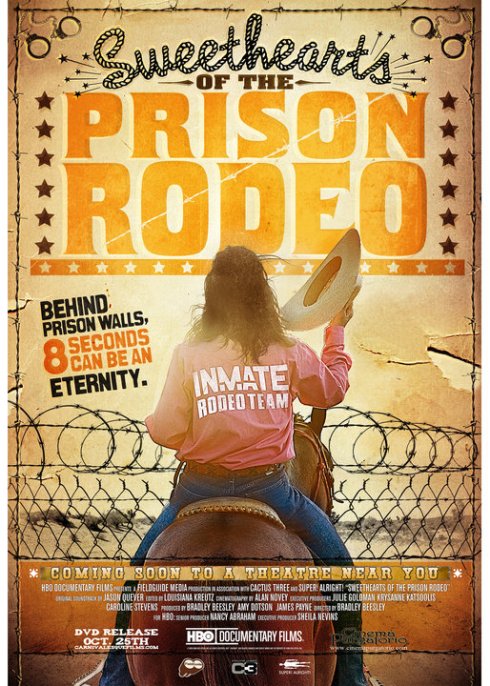
Filmmaker Bradley Beesley and his team admit beginning the project “mostly informed by the cultural lore of prison through film and music such as Cool Hand Luke, Stir Crazy, and Folsom Prison Blues.” That quickly changed. Sweethearts of the Prison Rodeo was released Friday.

I’ve talked about prison rodeos before (Damon Winter, Tim McKulka and Gary Winogrand). The Oklahoma State Penitentiary Rodeo is new to me; didn’t know it existed. It’s the largest “Behind the Walls” rodeo in the US.

From the synopsis, “In 2006, female inmates were allowed to participate in the rodeo for the first time. In a state with the highest female incarceration rate in the country, these women share common experiences such as broken homes, drug abuse and alienation from their children. Since 1940, the Oklahoma State Penitentiary has held an annual ‘Prison Rodeo’. Part Wild West show and part coliseum-esque spectacle, it’s one of the last of its kind – a relic of the American penal system […] Within this strange arena the prisoners become the heroes while the public and guards applaud.”

I was also happy to find a Q&A with three ladies from Sweethearts of the Prison Rodeo at SXSW 2009. They’d been out a year at the time. They are optimistic and they are role models.

Since last year, Sweethearts of the Prison Rodeo has shown around the world and inside prisons.

The self-respect gained by the ladies necessarily tempers my reservations toward prison rodeos. It seems like they’ve genuinely benefited from the activity, but this could have as much to do with the film-making around the activity. The entire package was a program in team building, setting and achieving goals.

The film also has a much needed outreach component:

“We’d like to use this documentary and the stories of the people connected with the film to help recognize the lives of inmates and those re-integrating into society. We’d like to create grassroots dialogue to improve awareness of issues and create opportunities. In addition, Sweethearts of the Prison Rodeo is establishing a Scholarship for inmates attending college while incarcerated.”

Bravo, bravo … I don’t want an encore though. I want the ladies to keep kicking recidivism rates into touch.

Twenty four pages of images here.

EMAIL

prisonphotography [at] gmail [dot] com

RSS PETE BROOK ON MEDIUM

  • An error has occurred; the feed is probably down. Try again later.

Prison Photography Archives

Post Categories