Prisoners wash the floor of a cell with a rolled-up carpet. Joao Silva for The New York Times

The photojournalist community was shocked to hear that experienced war photographer Joao Silva, 44, was seriously injured after stepping on a land mine in Afghanistan. Nick Kristof describes Silva as “humble, uncomplaining, dogged — and always returns with spectacular images”

Joao Silva‘s website certainly displays a wealth of important stories. Alongside dispatches on Afghanistan, insurgency in Iraq, war in Lebanon, the war in Georgia, ethnic violence in Kenya and the siege of Sadir City is Silva’s 2005 dispatch from Malawi prisons.

The New York Times’ story, The Forgotten of Africa, Wasting Away in Jails Without Trial (Nov. 2005), by Michael Wines at the time was vital. As Chris Tapscott describes in Human Rights in African Prisons, the increase of 35% in Malawi’s prison population in the first four years of the millennium was one of the highest on the continent, second only to Ghana (38%).

As Wines describes, the result of overcrowding was an unsustainable system with inadequate nutrition, prisoners literally sleeping on top of each other, summary killings of prisoners deemed “incorrigible” and case files lost with the prisoner left to wallow.

Lackson Sikayayenera in his cell at Malua Prison, where he has been for six years. His case file has been lost. Joao Silva for The New York Times

At the same time, Wines acknowledges that Malawi’s prison conditions were not out of the ordinary for African prison standards and in many cases better than those in other countries. This is a position backed up by various chapters in Human Rights in African Prisons (ed. Jeremy Sarkin). Since 2005, the Malawi Prison Service has developed a sustainable approach incorporating farms to provide food and directed work for inmates. One of the largest issues for African prisons is that populations are left idle while they wait for trial, often for years.

Tapscott also notes that the Malawi Prison Service is one of the most amenable to outside inspections; the culture of oversight is not prioritised or even realised in many African nations.

From the same book, in his chapter on pre-trial detention in Africa, Martin Schonteich explains that across all nations poverty is one of the largest causes for prison overcrowding:

“In cases where pre-trial release is granted with conditions, it is again often indigent who have the greatest difficulty complying with such conditions. In many African countries, accused persons are granted bail provided they deposit a sum of money with the court. In a report on prisons in Malawi, the Special Rapporteur found that a reason for overcrowding was that ‘prisoners cannot pay bail or provide any surety.’ (ACHPR 2001c:34)”

It is worth noting the inequalities and vagaries of the bail system also plague the American criminal justice system too, and likely plenty of other Western nations. It is with some irony therefore that we might – based on Silva’s images – differentiate between prison systems. They may look incredibly different but the underlying structural shortcomings are shockingly familiar.

I wish Joao Silva all the best in his recovery (you can follow updates on the NYT Lens blog) and I am reminded that without photographers and a robust media, stories of hidden, disappeared and forgotten humans would not see the light of day … and that applies to every country of every continent.

The only food in the prison is nsima, com must leavened with beans or meat from the prison rabbit hutch. Joao Silva for The New York Times

MORE IMAGES HERE

“It’s More Expensive to Do Nothing explores the dark and often disregarded world of criminal justice, the revolving door of institutionalization, the complexities of remediation, and the programs that have worked to help nonviolent ex-offenders succeed as self-sufficient members of society.”

“The math is staggeringly simple: It will cost $75,000 year if a nonviolent offender returns to prison, whereas $5,000 a year will help that individual lead a productive life outside.”

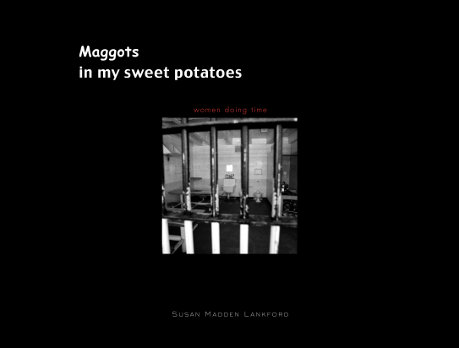
maggots-book-cover-2
Book cover: Maggots in My Sweet Potatoes

In the early 1990s, photographer Susan Madden Lankford rented an old San Diego jail for commercial photography. She soon attracted the interest of the homeless in the area, who before long they began to befriend her, trust her intentions and to tell her about their world. She was making a living as a successful studio photographer but was not fulfilled.

“My life and my photography were full of plastic portraiture. Images of individuals wanting the ‘right image’ and not the one with real expression and life.”

She soon embarked on a three publication project looking at the underclass of her home city. downTown U.S.A.: A Personal Journey with the Homeless was her first book, soon followed by Maggots in My Sweet Potatoes about the incarceration of women and children. Lankford is soon to release a documentary film about the criminal justice system.

Inmate Behind Chain Link Fence. Las Colinas Detention Facility for Women in Santee, California. Photo by Susan Madden Lankford. Taken from the book, “Maggots in My Sweet Potatoes: Women Doing Time,” by Susan Madden Lankford, Humane Exposures Publishing. All Rights Reserved. Reprinted with permission.

The “Safety Cell” Used for Solitary Confinement. Las Colinas Detention Facility for Women in Santee, California. Photo by Susan Madden Lankford. Taken from the book, “Maggots in My Sweet Potatoes: Women Doing Time,” by Susan Madden Lankford, Humane Exposures Publishing. All Rights Reserved. Reprinted with permission.

This Is My Family. Las Colinas Detention Facility for Women in Santee, California. Photo by Susan Madden Lankford. Taken from the book, “Maggots in My Sweet Potatoes: Women Doing Time,” by Susan Madden Lankford, Humane Exposures Publishing. All Rights Reserved. Reprinted with permission.

BIOGRAPHY

Lankford studied with Ansel Adams and is a graduate of the Brooks Institute in San Diego. Maggots in My Sweet Potatoes won the following awards: Publishers Weekly – Best Books of the Year, Web Pick of the Week; ForeWord Magazine – Book of the Year, Silver Award – Social Science; ForeWord Magazine – Book of the Year, Bronze Award – Women’s Issues; Independent Publisher Book Awards – Gold Medal, Women’s Issues; 2008 DIY Book Festival – Grand Prize Best Book of the Year; 2009 Eric Hoffer Book Awards – Grand Prize. Lankford’s work is the basis for the new film, It’s More Expensive to Do Nothing releasing this fall 2010.

More on Lankford from the San Diego Union-Tribune here.

Five-part lecture given by Lankford can be viewed. First part here.

You can find out more about her projects at Humane Exposures and get updates on the Humane Exposures Blog.

Prison, Castaic, CA, 2007. Stephen Tourlentes

Stephen Tourlentes‘ work is without doubt one of the most significant photographic responses to American landscape. If Ansel Adams had lived in an era of mass incarceration, I am certain the discard of persons, nature and sustainability in prisons would have captured his activist streak as much as that of our beloved National Parks.

Eighteen months ago, I interviewed Tourlentes, and that contribution to photographic discourse remains one of my proudest moments. Recently, Tourlentes launched his own website.

His work is of yesterday, for today and hopefully of a changed future.

The nocturnal glow of prisons is his subject; it is a subject we own and the weight of its injustices is ours. Across States, we voted for the mass warehousing of human lives. Tourlentes’ prison-scapes capture the “feedback of exile.”

Thirty years ago, Tourlentes would have no subject, but today he presents us with the spectres of our sprawling and unforgiving prison industrial complex. Glowing bright at night, he shows us sites usually lost on the horizon in daytime heat and haze.

Tourlentes has photographed many different prisons, but has now focused his series on the institutions of that accommodate the State execution chamber –  he refers to these prisons as “death houses”. Many new (and superior) works are included in his newly presented portfolio. Tourlentes calls the project Of Lengths and Measures:

These institutions tend to sit on the periphery of a society’s consciousness. Many older prisons are situated in towns or along rivers and reflect the use of the land at the time of their construction. By comparison newly opened “Super Max” prisons utilize modern high technology to control their population and offers an updated contrast to the stone castles that preceded them. The rapid construction of new prisons is a result of overcrowding caused by tough new sentencing laws, as well as an economic program to help depressed communities that vie to host them. The land that these prisons sit on is never allowed to go dark. The use of light and surveillance technology has changed the architecture of confinement.  The tools of electronic surveillance and computer technology are used as the new keys inside the modern corrections system.

This morning I bemoaned America’s use of the criminal justice system to manage and punish unfairly the poorest people in America – a population Michelle Alexander describes as those from “ghetto neighbourhoods” and mostly African American.

Well, it seems Britain’s criminal justice is even more punitive to Black people – within its criminal justice system and particularly in its prisons.

From yesterdays Guardian:

“The proportion of black people in prison in England and Wales is higher than in the United States, a landmark report released today by the Equality and Human Rights Commission reveals.

The commission’s first triennial report into the subject, How Fair is Britain, shows that the proportion of people of African-Caribbean and African descent incarcerated here is almost seven times greater to their share of the population. In the United States, the proportion of black prisoners to population is about four times greater.”


The title of Michelle Alexander‘s book The New Jim Crow: Mass Incarceration in the Age of Colorblindness may seem incendiary to some, but when you get to know the facts about the disenfranchisement of felons there can be no doubt that minorities and African Americans in particular suffer most inside and following prison.

2010 has been a break through year for Alexander and she has described with clarity the injustice of the justice system.

I am late to post about her important writing, but I’ve enjoyed her commentary throughout this past year. I even had the privilege of sitting in on her first ever presentation about the book within a prison. Unsurprisingly, the men were very familiar with her arguments.

Listen to her explanation of Reagan’s legal and media blitz in efforts to construct the war on drugs in the early eighties.

Photographer Mohamed Bourouissa asked a friend – known only as JC – detained in a French prison to share the banality of his confinement via cell phones pictures and over 300 SMS messages.

Bourouissa’s exhibition ‘Temps Mort’ (‘Time Out’ or ‘Dead Time’) which closed at the Galerie Kamel Mennour today featured nine images and an 18 minute film montage of the correspondence.

Earlier this year, Algerian-born Bourouissa gained significant attention in the US with his show Périphéries at Yossi Milo Gallery which depicted the lives of youth in the depressed banlieue neighbourhoods on the outskirts of Paris. (Reviews here and here.) ‘Temps Mort’ confirms Bourouissa’s commitment to the underprivileged in French society.

JC and Bourouissa worked together over a period of 6 months. Initially Bourouissa had to instruct JC closely describing the shots he was looking for. Bourouissa broke down the boundary between the imprisoned JC and himself as a free man by filming repeated actions outside the walls on his own camera phone – at one point in the film the JC’s steps on a jail corridor blur into Bourouissa’s steps through snow in the free world. (I concede this blog post cannot come close to describing the mood of the finished video.)

For exhibition, nine pixelated images were blown-up; the degraded resolution mocking the Parisian preoccupations with Impressionism and Pointilism. As Bourouissa’s press release explains, images were hung adjacent to prison newspapers “reconstructing a comprehensive representation of the prison world, and mentally filling in the blanks of the images, the spaces between the bed pan, radio, barred window, lamp, etc.” The viewer sees the abnormality of confined life.

We should bear in mind that in 2008, Bourouissa and JC were working against a national debate in France about the appalling state of their prison system. Again from the Temps Mort press release, “How not to express our outrage at the French prisons? Their infamous exercise cages, their areas of lawlessness, their unhealthy showers and four rolls of toilet paper monthly.”

Gleaning available information from poorly translated sources (1A, 1B, 2A, 2B, 3A, 3B, 4A, 4B), I am still not sure how the images were secured. Reviews suggest that cell phones are banned within French prisons – which I would expect to be the case – so the feat seems even more remarkable. (I have detailed a short-lived case of cell phone photography behind UK bars.)

Whatever, first impressions may offer, Temps Mort is not a lazy presentation of “vernacudigi” photos. In many of his projects Bourouissa wants to “make the illegal legal”. Just as with Peripheries he gives over much of the creative process to his subjects. Many images for Peripheries were staged simulations of actual events experienced previously by the photographer and subjects. After a period, Bourouissa gave JC very little direction and their output synchronised. Alone the photographs would fall short, but Bourouissa always intended to pair them with the film.

Of course we should not miss the obvious here. Low-res imagery is associated with the spontaneous capture of event, with protest, with skirmish, with citizen documentation and more often than not with the testimony of the individual against the (violent) uncertainties of the State in which they exist.

Low-res is about the privilege of witness beyond any inherent privilege of existence. Romantically, low-res photography is thought of as a tool for use against dominate conglomerate forces; practically low-res photography is the evidence of the effects of those forces.

Bourouissa presents the incarcerated masses as the disenfranchised and the dispossessed.

MOHAMED BOUROUISSA

A student at le Fresnoy, Mohamed Bourouissa graduated from the National School of Decorative Arts and also holds a DEA (M.A.) in Plastic Arts from the Sorbonne (2004). He recently benefited from a solo exhibition at the Finnish Museum of Photography in Helsinki and has participated in numerous group exhibitions, most notably at the New Museum in New York. In 2010, the artist will show his work at the Berlin Biennial and at Manifesta. Born in Blida, Algeria, in 1978. Lives and works in Paris. Represented by gallery Les Filles du Calvaire, Paris / Brussels. (Source)

via Vingt


Anonymous Mexican Men photographed in Altar, Mexico, 2006 © Chris Floyd/Getty Images


Photographer, Chris Floyd was shocked to find one of his photographs depicting three Mexicans IN Mexico from a 2006 editorial assignment being used by Republican candidates Sharron Angle (Nevada) and Sen. David Vitters (Louisiana) for “reds under the bed” scare-mongering TV campaign ads.

Floyd doesn’t know how the Angle and Vitters campaigns acquired the image. It’s feasible they did so legally via Getty Images. But if that were the case why would they ignore the lengthy caption detailing the non-illegal status and circumstances of the three men?

Floyd provides the full caption included on the Getty site:

“ALTAR, MEXICO: Mexicans pose for a portrait whilst gathered in the town square of Altar, Mexico. Altar is located 40 miles from the US border and is the last major town that Mexicans reach before the dangerous crossing. Much of its economy is dependant upon these congregated Mexicans who can purchase numerous necessary provisions. The Minutemen, most of whom are white, retired, armed citizens devote much of their time to musters or vigilante border watches in the Arizona desert, preventing Mexican illegal immigrants flooding into the US. These Minutemen, who claim to simply watch and report to the border police, have received criticism for being a cover for white supremacists whilst others hail them as heroes. Either way, they have struck a cord with many Americans who sympathise with their mission to make an impact on the illegal immigrants that are flooding across the Mexican border at a faster rate than ever. It is estimated that around 750,000 illegal immigrants entered America in 2005, amounting to more than 2000 per day, joining the 12 million that already live there. (Photo by Chris Floyd/Getty Images)”

Read it.

More from WaPo here.

EMAIL

prisonphotography [at] gmail [dot] com

Prison Photography Archives

Post Categories