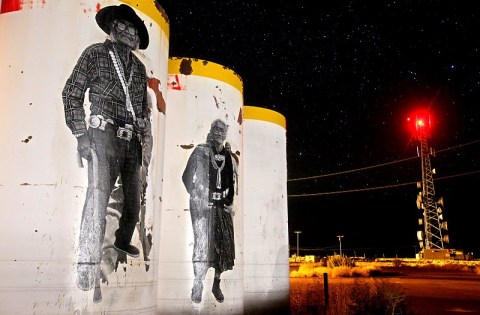
Grey Mountain, artwork by Chip Thomas © Erika Schultz

Just got in from the NW Photojournalism meet. Room chock full of talent including Matt Lutton (of Dvafoto fame) Theo Stroomer, Tim Matsui, Ken Lambert, David Ryder and John Malsbary.

Let me track back a week though.

SOME THOUGHTS AND CONTEXT ON NAVAJO GRAFFITI

A friend of mine who I’ve seen only twice in two years visited Seattle last weekend. He’s Native American … what white folks would call Navajo, but what he refers to as Dineh or Dine (pronounced d-Nay). We were talking about youth culture on the reservation and I mentioned passing through Window Rock (a junction with two gas stations, some vernacular murals and loose packs of dogs). He tells me I was in the wrong part of Navajo Reservation …

Anyway, the murals had me thinking. I saw graffiti on Navajo land – some of it good, some of it terrible; some of it lazy tags, some of it a bit more invested – and I wondered about the social context of these scrawls, paintings and artwork. I proposed to him that a long term photography project NAVAJO GRAFFITI could capture these temporary art interventions. The project would include interviews about the grafs and the social strata from which they emerge. It seemed like it  could be a meaningful, novel photography project, a stellar book. Maybe?

In my mind (a place I often invent projects I’d like to see and promote) I envisioned image-making that could incorporate the narratives of a marginalised people without relying on cliches of documentary photography. The grafs could be photographed in the medium format stillness that is all too often wasted on garages, topiary and mall parking lots.

Just a thought.

Thinking on, my friend was as stumped as I to think of any photography work that the Navajo had been able to present, let alone self-represent.

BACK TO NW PHOTOJOURNALISM

The co-organiser of NW Photojournalism is Erika Schultz a PJ at the Seattle Times. When I got home, I checked out her blog. On which, I was blown away to find graffiti on Navajo land. I’d call it street art, except there’s only the open Black Mesa surrounding.

Grey Mountain, artwork by Chip Thomas © Erika Schultz

The work is by Chip Thomas an artist, self taught photographer and Health Services Physician who has lived on Navajo land for 16 years or more. He may not be Navajo by blood but I can be quite certain he has the rights of the Navajo/Dineh people close to his pounding heart.

I want to see more of this. I am not a photographer. Why aren’t photogs out on Native American lands finding more nuanced ways of telling the stories of the people?

The only Native American photographer I’ve identified is Tom Jones of the Ho Chunk Nation, and he is a long, long ways from the Western Deserts; of a different people.

So, two things: 1) Tell me about more Native American photographers (I want to stand corrected) and 2.) Somebody consider a project along the lines of NAVAJO GRAFFITI (I would if I could, but I don’t know cameras).
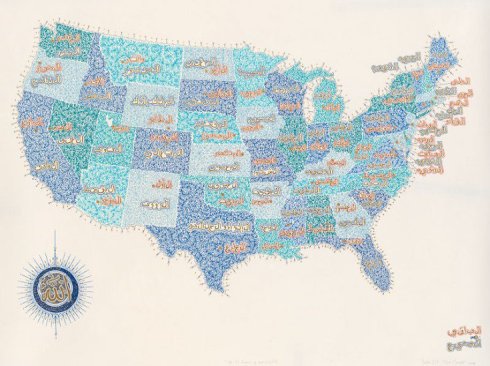
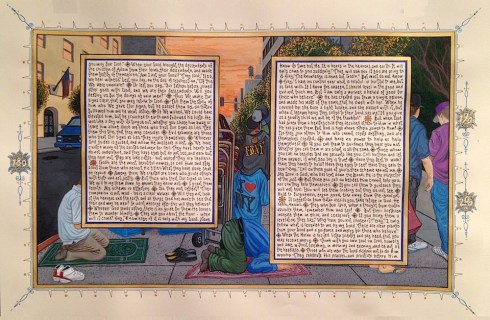
Birk-Pignolet_The_99_Names_of_God_USA_-_2011_web_big

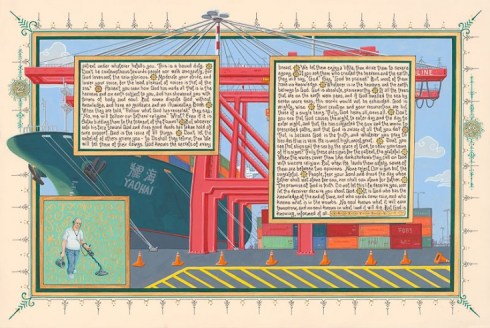
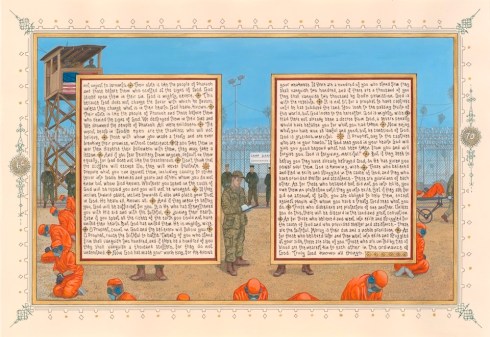
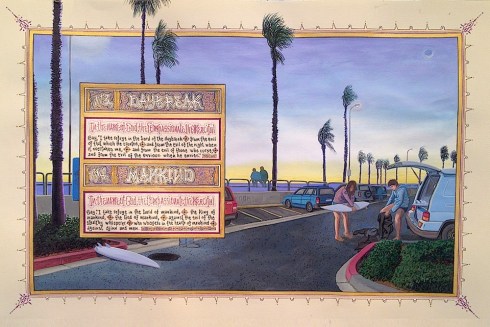
“Through the American Qur’an series, Birk presents a new version of this holy book that is more accessible and also shows how the teachings can be applied to the daily experiences of American life.” (Source)

Not photography, not prisons, but very timely; Sandow Birk’s American Qur’an.

Since 2004 Birk has been transcribing the entire Qur’an into English, illustrating each sura (or chapter) with paintings evoking Persian miniatures, but depicting everyday scenes in America. According to the press release, the Detroit-born, California-based artist “hopes to reflect how consistent the similarities are in the teachings of Islam, Judaism and Christianity. To bring this to light enables more understanding and compassion, versus fear of the unknown … ” (Source)

This is the type of reflection that should be made in our current times, instead of this nutter and his offensive fetish for fire. Thankfully, the AP will not distribute images of idiots burning Qu’rans, during the so-called International Qu’ran Burning Day. Ugh.

– – – – –

To my mind, Sandow Birk is the greatest working political illustrator. His clever manipulation of the landscape genre for his Prisonation series was an intelligent, elegiac take on California’s 33 facility prison industrial complex. (I referenced his work reviewing the recent and excellent City Lights publication PRISON/CULTURE.)

– – – – –

4a6e65af2

5f472001d
36fff29cf

Birk_American_Quran_Sura_31A_TX

Birk_American_Quran_Sura_31B_TX

efc05b0d1

f75202637

lead_960

4ff3cb1a4


The FRANCE24-Radio France International Web Documentary Award has been won by “Prison Valley”, created by French journalists David Dufresne and Philippe Brault. (@davduf, @prisonvalley)

I am excited about this because I’d got behind Prison Valley when it was first launched.

That post drew efforts of correction and sentiment of complaint from Canon City’s chamber of commerce along with a response from the film makers.

Prison Valley was a controversial production in that it displeased the folk it portrayed. From what I can understand the small town Americans felt as if they’d been hoodwinked and did not think a dystopic frame would be put on the whole thing.

But there we go.

The format and interactivity is the type of use that many think the web has been slow to deliver. It’s pioneer.

Innovative Interactivity has an interview with the makers about the concept and design process:

“At the beginning of Prison Valley, we only though about doing an audio slideshow (Portfolio). At the end, it will be a web documentary, a documentary, a book, an iPhone application and even an exhibition this May in Paris.”

Two photographers featured in the awards at Visa pour l’Image Perpignan for their work in Haiti. One of them photographed the aftermath of Fabienne Cherisma’s shooting.

DAMON

From Lens Blog:

Damon Winter, a New York Times staff photographer, won the Visa d’Or news award for his photographs of Haiti. “Prayers in the Dark,” Jan. 15, 2010; “Where Is the Help?” Jan. 17, 2010; “Prison Break,” Jan. 19, 2010; and “Vignettes,” Feb. 3, 2010.”

Church Service, Haiti. © Damon Winter/The New York Times

Damon deserves the award. He succeeded where almost all other photojournalists failed and that was to dispatch thoughtful, emotionally affected work. He avoided some, not all, but some of the tropes of disaster photography.

Whether it was his or the New York Times’ decision to get him on the phone I don’t know, but the mix of audio and images was heartfelt. Michele McNally, director of photography at the Times backs this up.

Damon’s coverage of the broken Haiti prison was a story I followed (here, here and here). I interviewed Damon last year and I am sure he’ll take the honor with all the humility it demands.

Damon Winter was not witness to Fabienne’s death or its aftermath.

FABIENNE & FREDERIC

As many of you may know, I spent a lot of time looking at one particular incident in Haiti – the death of Fabienne Cherisma and the photographic activity about it.

Fabienne’s Father, Osama, and Fabienne’s sister mourn over the dead body of Fabienne Cherisma. Port-au-Prince, Haiti, January 19th, 2010

Frederic Sautereau, who was one of the last of the fifteen photographers I identified at Fabienne’s side.

Sautereau won the Visa d’Or daily press award for his work in Gaza for the French newspaper La Croix. He was also nominated this year for the Visa d’Or news award for his photos of Haiti after the earthquake.

In his Haiti portfolio, Sautereau has 7 or 8 images from around the time of Fabienne’s death. I am quite ambivalent about the work. Some of the images are as bloody as the ones I’ve chosen not to show previously on this blog.

ME

I must be wary of solipsism here. This isn’t about me. I want to convince you it shouldn’t be about Winter or Sautereau either. I want to bend your arm behind your back and tell you its all about Fabienne.

But, really, don’t I only care because I noted the story in January? And, despite all my efforts, I feel like I explained the circumstances of her death without actually improving her lot (in terms of justice) nor the lot of her family (in terms of healing or moving on or however you might measure that).

I guess I would just like to have handed out hard-copies of my inquiry and a CD of images to the Perpignan judges so that at least the possibility for remembrance could have carried with the awards.

Carandiru, Sao Paulo, SP, Brazil – 2003 © Pedro Lobo

Four South American penitentiaries feature in Pedro Lobo‘s series Espacos Aprisionados/ Imprisoned Spaces; Itaguy, Bon Pastor and Bela Vista prisons in Medellin, Columbia and the infamous Brazilian prison Carandiru in Sao Paulo.

Pedro Lobo has posted an edit of prison images on his website (27 images). A larger selection can be found at Lobo’s Photoshelter gallery (86 images). Selected works are also posted to Lightstalkers (13 of 30).

I think his images from Carandiru – which he shot shortly after its 2002 closure and demolition – are the most cohesive as a group, and it is a selection of those I include here.

Carandiru, Sao Paulo, SP, Brazil – 2003 © Pedro Lobo

Lobo adopts a common approach to prison interiors as he does to the vernacular architecture of slums and to adapted religious spaces. Lobo is interested in the strain between the inhabitants control over the space, and the control of the space over its inhabitant. Read in the details, it is – strangely – a very compelling tension.

Lobo: Brazilian inmates call their cells “barracos” (barracks, tents, shacks) the same word used for their houses in the “favelas”, where most of them come from. As in my previous work, I tried to show their efforts to make their living quarters as dignified as their meager resources allowed for.

In this prison, inmates were allowed intimate visits twice a month and made all efforts to clean and decorate their cells prior to these encounters. The art work on walls and doors are reflections of order and chaos – creativity in adversity – and revealing of their desire for freedom, material residues of the only allowed forms of self-expression. It is sad to know that all vanished when the buildings were demolished.

These images reflect the responsibility with which I use my work. They are not about crime, or criminals, poverty, or misery, but about human beings who found, or placed, themselves in extremely adverse situations and decided not to give up the struggle for a dignified existence. (Source)

Carandiru, Sao Paulo, SP, Brazil – 2003 © Pedro Lobo

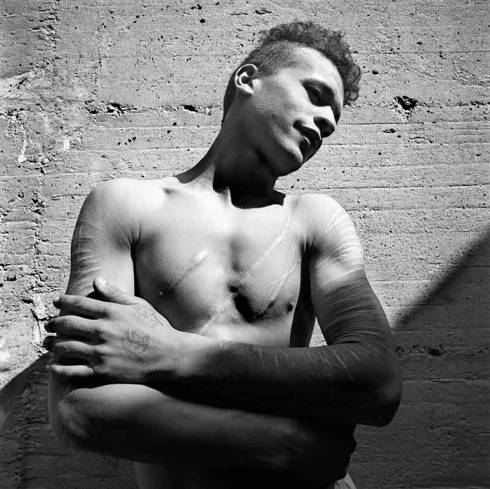
In some cases the interiors are bare and contemplative; images 2 and 3 could be the cells of religious devotees. In other cases (image 1) the intrigue is in the particulars. Look closer. What’s behind the curtain?

Especially because Carandiru no longer stands (it has, like so many former prisons, become a museum) Lobo’s pictures should be treasured. Don’t be surprised if these images reemerge, possibly in the form of a book, and probably tied into his wider body of work.

PEDRO LOBO

Pedro Lobo (Rio de Janeiro, 1954) is a Brazilian photographer currently living in Portugal.

He has exhibited his work in Brazil, Denmark, Germany, Colombia and in the United States. He has photographed slums, favelas and prisons. His images of  known as Carandiru (later demolished) in Sao Paulo were shown in the exhibition “Imprisoned spaces/Espaços aprisionados” at Blue Sky Gallery, in Portland, Oregon, in 2005.

His first one-man show in Portugal was Favelas: Architecture of Survival at Museu Municipal Prof. Joaquim Vermelho in Estremoz.

He has taken part in other exhibitions such as REtalhar2007 in Centro Cultural do Banco do Brasil in Rio de Janeiro and “Via BR 040 – Serra Cerrado”, with Miguel Rio Branco, Elder Rocha, etc in Plataforma Contemporânea of the Museu Imperial of Petropolis, in 2004 and 2005.

Pedro Lobo, a Fulbright Scholar, studied photography at the school of the Boston Museum of Fine Arts with Elaine O’Neil and Bill Burke and at New York’s International Center of Photography (ICP). From 1978 to 1985 he worked for the Brazilian Landmark Commission (Fundação Pró-Memória) as a photographer and researcher. In 2008, he was awarded the first prize at Tops Festival in China.

I just came across Francesco Rocco‘s Prisons portfolio and it was a punch to the gut.

Cocco portrays the self-afflicted and architectural violence wrought in Italian penitentiaries with visceral power that – even within the genre of prison photography – is rare.

The work was made against the ongoing outcry of suicides in Italian prisons, “Italian prisons are increasingly overcrowded. In eight years, 449 suicides have been counted in Italian jails, out of a total of 1243 deaths behind bars. Is this a way to resolve a social issue? Unfortunately, a neon light isn’t enough to take away a man from darkness and hand back to him his dignity.”

In 2002, Cocco embarked on a long study of men’s and women’s prison conditions in Italy, creating work shown at the Modena, 55th Festa Provinciale de l’Unità, September 2006; and later at Rome, Sala Santa Rita, March 2007.

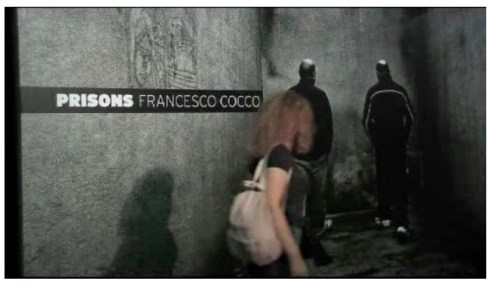
A video of the exhibition installation with comments from the Modena curators (Italian language) can be watched here or by clicking the image below.

Prisons was published as a book format by Logos, with texts by Adriano Sofri and Renata Ferri.

A well-designed fold out accompaniment to the exhibition (pictured below) was also produced. More here.

ITALIAN PRISONS

Previously on Prison Photography, as regards Italian prisons, I have featured Melania Comoretto‘s portraits of women, Danilo Murru‘s large format architectural studies of Sicilian prisons and Luca Ferrari‘s B&W portraits from Rebbibia prison, Rome.

FRANCESCO COCCO

Francesco Cocco was born in Recanati, Italy in 1960. He began working as a photographer in 1989. Keenly interested in social marginalization and the world of children, he immediately started visiting ‘difficult’ countries, especially in Asia. In Bangladesh, he photographed the living conditions of street kids and documented child labor practices. In Vietnam, just after the borders reopened, he created a photo essay for the exhibition Vietnam Oggi (Modena, Italy, 1993). In Cambodia, working with Emergency, he tackled the dramatic story of landmine victims. In the same country, with the support of the NGO New Humanity, he collected images of child prostitution. In Brazil, he photographed blind people at the Benjamin Constant Institute in Rio de Janeiro and the exploitation of child labor on the island of Marajoa, in the Amazon basin.

Ex-warden Rick Lamonda at the site of America’s deadliest prison riot causing reform in 1980. Aqua Fria, NM. 2009

Photographer, Jesse Rieser was inside New Mexico’s decommissioned Federal Prison. From the four images on his site, I can’t work out whats going on. Possibly outtakes from a fashion shoot (see photo Elizabeth) although the picture above looks like it should belong to a confessions “human- interest” story … y’know the type … the sort of tale that only comes out when almost everyone involved is almost dead.

This laconic portrait reflects what I picture Sheriff Ed Tom Bell to look like. Bell is the protagonist and part narrator character in Cormac McCarthey’s No Country For Old Men.

Photo: Chris Mottalini

Quilting as a form of rehabilitation for prisoners may seem unorthodox, even beyond the pale, but really it doesn’t surprise me. It’s been put in place at Jefferson City Correctional Center, Missouri.

I was intrigued impressed by how the practice was described by this UTNE Reader article:

They quilt, from 8:30 a.m. to 3:30 p.m. five days a week, as part of a program called restorative justice, an ancient practice turned curriculum that equates a crime committed with a debt to be repaid. The world was introduced to elements of it by South Africa’s Truth and Reconciliation Commission, which sought to heal the wounds of apartheid through conversation and confrontation between the victims of human rights violations and the perpetrators. In the past decade, restorative justice programs, which promote similar dialogues and reparative activities like quilting and gardening, have emerged in prisons and communities across America.

Restorative justice, which focuses on the victims needs, is potentially the sharp-end of a positive trend that deals with the emotional repercussions of crime, beyond simple notions of retribution … and its widespread implementation might just drive down US prison populations.

– – –

Photographer, Chris Mottalini‘s other work can be viewed at http://www.mottalini.com/

EMAIL

prisonphotography [at] gmail [dot] com

Prison Photography Archives

Post Categories