All this appreciation of Lego brings to mind Legofesto‘s more sinister, reality-based Lego sculptures of abuses at Abu Ghraib and Guantanamo – here, here, here and here.
It has been a while since I took a step back for an objective look. And – believe it or not – it is the first time someone has asked me to name Prison Photography‘s best article.
Ken Light won Round One in the small claims division of the Superior Court of California in San Francisco on December 23. He claimed unfair business practices under state law because Current TV used his 1994 image of Texas death row inmate Cameron Todd Willingham without permission. Light won and Current TV was ordered to pay a retroactive licensing fee and damages to the tune of $588.
Well, Gore survived the count and is up for Round Two. Current TV are claiming their use was “fair use”. Conor Risch of PDN Pulse:
Current TV has appealed to San Francisco Superior Court, where its lawyers will be able to mount a more vigorous defense against Light’s claim.
That will cost Current Media a lot more than simply paying the small claims judgment. But the media company has a self-interested principle to defend: the right to use news photos at will without permission, and without payment. A trial date has been set for April 14.
It might be that the anniversary of the most famous riot in the history of the British prison system will become an annual feature on Prison Photography?
Last year, I noted the 19th anniversary of the Strangeways Riot with looks at the work of Ged Murray and Don McPhee. This year for the big 20, I’ll point you in the direction of Ciara Leeming, fellow blogger, Northerner and Thatcher-basher. (Why is it that we children of the late seventies/early eighties can’t get out from under the iron lady’s shadow?)
Ciara’s just written a piece for Big Issue in the North, the UK’s magazine sold by homeless vendors in cities up and down the Isle. Download Ciara’s Big Issue feature here.
Since the March 23rd censure and closure of Shahidul Alam’s exhibition at the Drik Gallery by Bangladeshi police, events have been well reported and BLOGGED!
LENS Blog followed up its preview by catching a soundbite of Alam‘s and reflecting his pride in the mobilisation of protestors:
“It really has galvanized public opinion. People were angry and ready — they just needed a catalyst. The exhibit has become in a sense iconic of the resistance.”
100Eyes also had the scoop with a large image of the human chains an d protestors. Robert Godden returned to the issue highlighting the very serious issue of Death threats issued to organisers. Eyeteeth (a new favourite of mine) also followed the shut-down.
Of course, if you only have time for one source it should be Shahidul Alam’s own blog, to which two posts have been posted – firstly, Siege of Drik Gallery and secondly Drik: Photo power.
– – –
What’s my point? My point is that if we bloggers are to be be labelled prairie dogs (here and here), perhaps we should be noted for our hard work, solidarity and a long gaze that goes further than the end of a trustee’s vault?
Sometimes the name of this weblog-journal means that I simply cannot overlook certain stories or acts of publishing.
@ Tim Dirven / Panos Pictures
In the past couple of hours, the Guardian website ran a nine image Guantanamo photo-gallery. The gallery launches from the largest and most prominent rectangle of the new Guardian redesign, i.e. it is the top story on the home page.
I can only assume that this is an editorial decision to keep Guantanamo in people’s minds? After all. we’ve been distracted by healthcare reform in the US, the chancellor’s TV debate in the UK, Israeli obstinacy in the Middle East and a new guise of terrorism in Russia for which our numbed minds must recalibrate.
I can only assume this is the Guardian’s decision because the essay is totally non-descriptive – in that it is nothing new. We know there are Uighurs, Chinese separatists, who shouldn’t be there; we know they play soccer in cages, we know there are well-cushioned shackles bolted to pristine concrete floors; and we know detainees on hunger strike are force-fed Ensure by tube.
None of this reflects on Tim Dirven. Dirven is a good photographer and photojournalist (check out his work on Orthodox Christians in Ethiopia).
It’s simply impossible to produce a novel photo-essay when the Joint Task Force of Guantanamo walks you around the camp … and they do it every week … with different journalists.
The US military’s media detail is as well-drilled as any other detail at Guantanamo. In fact, I’d go as far to say that the media-liaisons are, at this point, the most critical employees on the base.
“We never sat down, as far as I know, and came up with a grand strategy. Everything was very reactive. That’s how you get to a situation where you pick people up, send them into a netherworld and don’t say, ‘What are we going to do with them afterwards?’ “
Mihail Kogalniceanu air base. Romania. @ 44.36043300, 28.49149700
Since 2001, the US has operated a program of rendition, illegal torture and operated a network of secret prisons and CIA “Black Sites”.
Men captured as part of the Bush and Obama administrations’ program were are interrogated, physically & psychologically beaten and denied human rights.
Images of these secret prisons are not common, but I’ve peppered this piece with a few just for the sake of the exercise.
At the top of this article is Mihail Kogalniceanu air base, Romania. It was used for “high-level” detainees from as early as 2005. Beneath is Kiejkuty Stare an illegal CIA prison just 20 miles away from Szymany airport, Poland. (source) It was used as early as 2005 and its function was confirmed in 2007. (source)
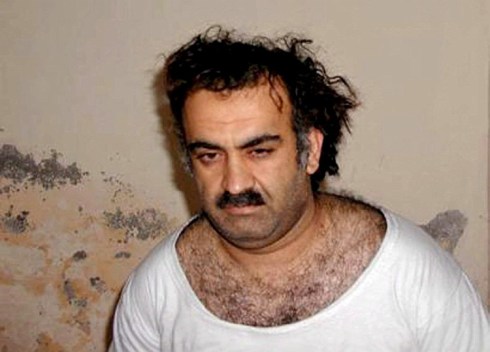
Khalid Sheikh Mohammed, “the mastermind of 9/11”, claims he was submitted to waterboarding 183 times over a one-month period. New evidence suggests he was interrogated in Poland. (More from Der Spiegel here and here).
Kiejkuty Stare
Khalid Shiekh Mohammed
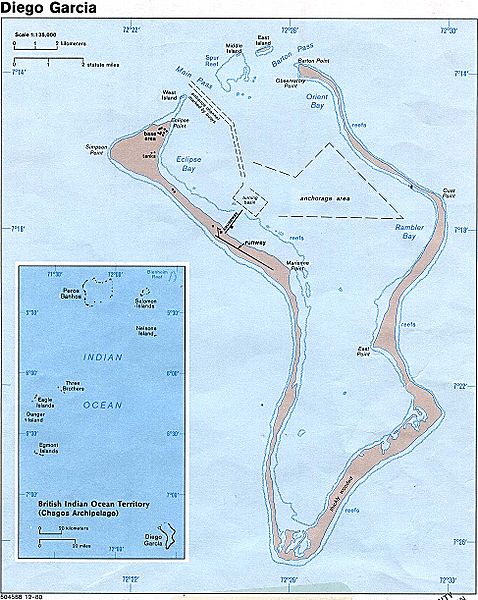
Diego Garcia Island, Indian Ocean, United Kingdom Territory. Rendition Flights Refuelled on the Island in 2002.
The UK Government provided infrastructural support for America’s extraordinary rendition program allowing rendition flights to refuel on Diego Garcia (above), a British territory in the Indian Ocean. (More here and here).
– – –
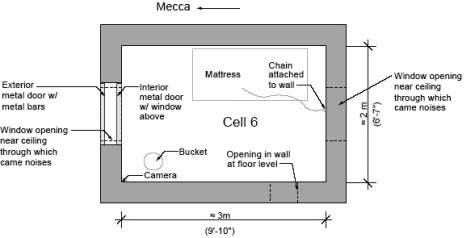
Below is the plan of a cell used during the 19 month illegal detention of Mohamed Farag Ahmad Bashmilah, a Yemeni national. Salon reports:
Bashmilah’s story also appears to show in clear terms that he was an innocent man. After 19 months of imprisonment and torment at the hands of the CIA, the agency released him with no explanation, just as he had been imprisoned in the first place. He faced no terrorism charges. He was given no lawyer. He saw no judge. He was simply released, his life shattered.
In 2007, Salon did a thorough job in describing his detention and its aftermath, even presenting plans based on Bashmilah’s descriptions of torture and interrogation rooms. No-one knows for certain where these cells were, but it is suspected they were within Afghanistan.
Exhibit I: Rendering of Mohamed Farag Ahmad Bashmilah's first cell in Afghanistan (based on Bashmilah's own drawings). Source: Salon.com
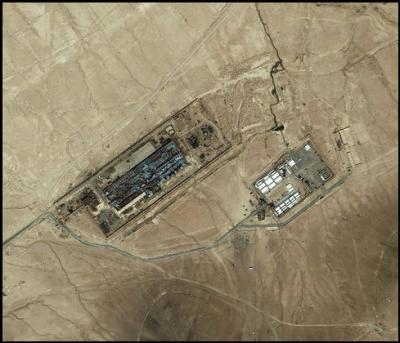
In Afghanistan, the largest CIA covert prison was code-named the Salt Pit, at center left above. (Space Imaging Middle East). Source: Washington Post
The most notorious Black Site in Afghanistan is referred to as ‘The Salt Pit’.
The Salt Pit brings us to Trevor Paglen‘s geography, photography and investigative academics, but first let me point out a couple more excellent resources.
When the details of rendition broke in 2007, Jane Mayer led the exposé with her book The Dark Side. Read a book review here and her extended New Yorker essay here.
FRONTLINE produced this astonishing interactive graphic showing all the illegal prisons and all the US aviation front-companies used for the rendition flights. That map is part of a larger presentation with interviews, time-lines and further resources.
More recently, Anand Gopal has revealed the US military’s still recent tactic against the Taliban in Afghanistan of by-night kidnappings. The result? The US has lost the support of the Afghan people toward the American project. Read America’s Secret Afghan Prisonshere.
Just this month, Stephen Lendmansummarised the January 26th UN Human Rights Council (HRC) report ‘Joint study on global practices in relation to secret detention in the context of countering terrorism’ which details practices by various countries “including America, by far the world’s worst offender in its war on terror.” The full report is here (Word) or here (pdf).
Lendman’s words The truth is shocking:
“Besides Guantanamo, Afghanistan and Iraq, HRC said the CIA runs scores of offshore secret prisons in over 66 countries worldwide for dissidents and alleged terrorists – in Egypt, Algeria, Jordan, Morocco, Syria, Libya, Tunisia, India, Pakistan, Russia, Uzbekistan, Sudan, Zimbabwe, Ethopia, Djibouti, Kenya, Poland, Romania, Bosnia, Kosovo, Thailand, Diego Garcia, and elsewhere.” (Source)
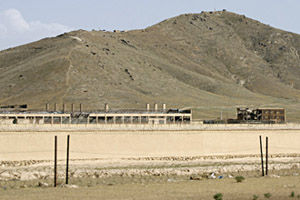
The two images below are by Trevor Paglen. The first is the Salt Pit and the second is a military jail in Kabul. They are also his most ordinary of images … the only images he could capture in the circumstances.
Paglen isn’t primarily concerned with prisons; he is concerned with all the unseen activity of the military industrial complex – aviation companies, air strips, covert ops, air bases, Pentagon annual budget projections, spy satellites, shadow NASA reconnaissance agencies … the list goes on.
After meeting Emiliano Granado last Summer, he posted a good one-stop description of Paglen’s work. Granado also posted some good examples of Paglen’s Limit Telephotography and The Other Night Sky series. Check those out and then skip to Paglen’s lecture at the foot of this post.
The Salt Pit, Shomali Plains Northeast of Kabul, Afghanistan. Trevor Paglen: The Salt Pit is located in an old brick factory a few miles northeast of Kabul, along an isolated back-road connecting Kabul to Bagram.
Black Site, Kabul, Afghanistan. Trevor Paglen: This site was brought to my attention by Afghan journalists and human rights activists in Kabul. The code name of this site remains unknown.
LECTURE
I have waited for a long time for an online presentation of Paglen’s oeuvre to which I could refer PP readers. (Thanks Alejandro!)
It’s quite the thrill to be brought in on Paglen’s sleuth work, as he walks us through the various public records used to piece together the rendition program. If you can spare an hour this weekend, you’ll be thankful for the education!
FORTHCOMING BOOK
Paglen’s work is to be published by Aperture in a book titled INVISIBLE. You can see Paglen and publisher Lesley Martin discussing the project here.
“In France, photography and prisons have rarely got along” says Clair Guillot for Le Monde (translated). Guillot, prompted by the current exhibition L’Impossible Photographie, Prisons Parisiennes (1851-2010), speculates on the common conditions for prison photographers listing limited access, lack of light and space, constant supervision and uncertain scheduling.Guillot quotes Mathieu Pernot, a photographer occupied by issues of the Panopticon, ‘In prison, the main body is the eye, because the buildings are designed to improve monitoring. At the same time prisoners are held [partly] to deprive them of self-image [and held to deny society his image and presence.]’ I paraphrase due to the vagaries of translation.
(Pernot is flavour-of-the-month, right now, exhibiting in Fotodok’s State Of Prison show in Amsterdam as well as this Parisian outing.)
Guillot goes on to suggest that there has been a recent rise in the practice of prison photography, yet she doesn’t provide projects or practitioners on which she bases that statement.
Whether or not praxis and interest in prison photography is on the up, the ever-existing requirement of French law not to show the faces of prisoners is a steady constant. This is a paradox that needs explaining and, to some extent, apologising for. The effort and will of prison photographers to reveal the hidden arguably achieves the opposite; images of faceless prisoners only contribute more abstracted views of prisons.
Is photography the right tool for the job of describing prisons and the lives within?
Let’s take a look at the work of a couple of the prison photographers in the l’Impossible Photographie show, and evaluate their contributions to this proposed fledgling genre. Matheiu Pernot, Jacqueline Salmon and Michel Semeniako were commissioned for the show. A request was made access for five photographers, but the authorities only allowed three.JACQUELINE SALMON
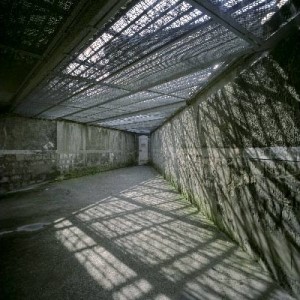
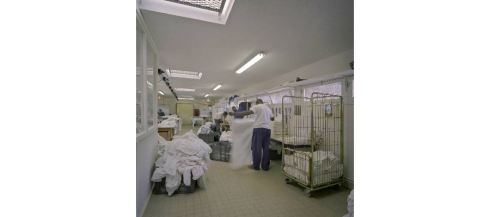
Jacqueline Salmon‘s photograph are straight environmental studies. In some works she uses the silhouettes of cage, fence and shadow. Often Salmon’s images will offer the promise of a window or vista only to present a barrier or razor wire immediately behind the promise. These are images of frustration. When Salmon documents open doors, they are within larger areas of containment, not strategically imperative and are not policed by the disciplining authority. Through some of these are the work and leisure activities offered at Le Santa Prison, Paris; gymnasium, family rooms, kitchen, chapel and laundry.
Salmon’s use of orange is occasionally reminiscent of Mikhael Subotzky’s studies in South African prisons and of course echoes the jumpsuits we’ve come to associate with the global and most lawless of prisons – allied sites of detention, Guantanamo, Bagram and beyond …
It is very difficult to be a fair judge when one only has 300 pixel wide website images to go by, but there are 40 images to browse and take in. Aside of the debates about artistic merit, the project as a contemporary document of an old and famous prison in the French capital is an achievement in itself.
MICHEL SEMENIAKO
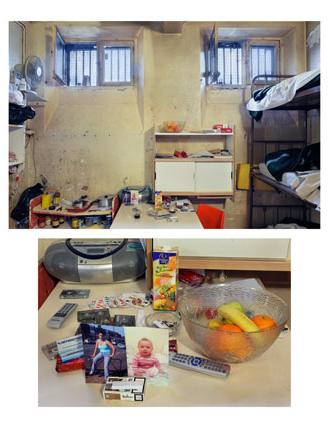
Salmon’s impartial observations lie in contrast to Michel Semeniako‘s close engagement with the inmates. Semeniako conducted portrait workshops but not permitted to exhibit this work he collaborated with inmates on still lives of their possessions; portraits of men as evidenced by the objects they possess.
It’s an interesting concept and an approach used by other prison photographers (Jeff Barnett-Winsby and Edmund Clark spring to mind). For Semeniako’s project, each prisoner is a co-author of the images. Could we argue that this is part rehabilitation, part art, part documentary? I guess one must decide on how wants to judge Semeniako’s project first.
I’ll judge it on two criteria; firstly, on the self-esteem and therapeutic advantages for the prisoners in discussing and constructing ones own environment for presentation; and secondly, on the otherwise impossible connection to prisoners’ lives which is afforded to viewers of the photographs. This connection informs (just a little) and in so doing completes a minor but profound transaction initiated by Semeniako and each prisoner during their discussion on how to assemble their still lives.
“Tying the exhibition together is not chronology but classification. Rooms are broken down by location, with contributions by a steady cast of photographers spread throughout. Women’s prisons La Petite Roquette and Saint-Lazare reveal a jarring juxtaposition of nuns and incarceration, the role of religion in rehabilitation. The men’s – Grand Roquette, Sainte-Pelagie, Mazas and Santé – lay clustered together, more barren and austere. Throughout the exhibition essays on each prison, brief summations of photographers, developments in regulations and politics accompany each turn of the corner.”
Seibel was particularly engaged by the archive of Henri Manuel from the 20s and 30s. Manuel was employed by the French government to document the prison and justice systems. He gained unprecedented access and his prints are pivotal in the genre of prison photography.
Other artists include photographer Pierre Jouve (talking here, in French, about his juvenile detention photographs), also designer/photographer Anne-lise Dees and the photographer/oral historian Catherine Rechard.
All in all, this exhibit is a significant attempt to reconcile the curiosity and desire to see the activities of the state (think about the ethics and standards debates about military embedded journalists) with the work of artists who endeavour in to do so. Perhaps Guillot is right, perhaps following this exhibition, prison photography may be defining the parameters of its own genre?
– – –
The Carnavalet is hosting a series of tours, discussions and other events related to the exhibition. A schedule can be found here.
l’Impossible Photographie
From now until 4 July 2010
7€/5€ Reduced 10:00-18:00
Closed Mondays and Holidays Musée Carnavalet
23 rue de Sévigné
Mº St-Paul/Chemin Vert





 “In France, photography and prisons have rarely got along” says Clair Guillot for Le Monde (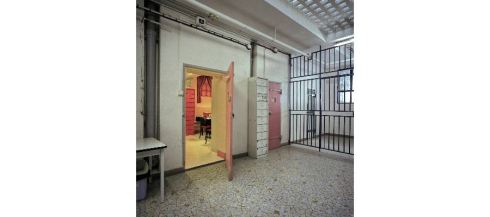



 Prison Photography