The greatest priority for sentencing reform must be to dismantle the Three Strikes Law.

Three Strikes has not made society safer, it has only handed down overly-punitively long sentences.

Familial support during incarceration is the largest deciding factor in helping released prisoners to stay clean. It is therefore great to see Families to Amend California’s Three Strikes, a grassroots activist group focusing the voices of disenfranchised family members against unjust sentencing policy … and doing it well. Check out the videos and the resources page.

This post is a while overdue. As I am sure you know, Medecins Sans Frontier launched Condition: Critical this year. It is a website to bring together the many stories of victims of the war, assemble video and photo tools for activism and to leave messages of support. That’s right … no money, just a letter and awareness.

As part of the effort, my mate Ben has had his hand in the first four videos pushed out to the world. Ben’s summary of this conflict and humanitarian situation;

“Its the world’s deadliest conflict since the second world war and yet the majority of people have never heard of it. According to the IRC at least at least 5 million Congolese have died in more than a decade of conflict sparked off by the 1994 genocide in neighboring Rwanda.  Most of the deaths are linked to a lack of medical facilities as the ability to access medical care in Eastern Congo has crumbled with the war.”

Ben’s team trained the comms people out in the field to gather stories and then they edited it to relay the stories in a powerful, respectful way. First hand tales and simple honest images. No gore, only testimony.

Drawing the War is the troubling tale of a boy carried away by opposition forces and set to work.

There are four videos from the MSF Condition Critical campaign on duckrabbit vimeo profile. The other three are Mishoka’s Story, Bahati’s Story, and Francoise’s Story.

So it seems that Ben has had some success in challenging and changing the public relations that non-profits and charities have to their global audience. Now all he, us and the people of Congo require it awareness, effort and mindshare.

Ben has asked us to do one or four of four things: 1. Leave a message of solidarity on the map; 2. Twitter about it and link to it on Facebook (for Twitter use #conditioncritical); 3. Embed one of the video’s on their blogs; 4. Write something about the project. Tewfic, Mark, Charlie, Mediastorm, Daniel and Boing have done their bit. Pass it along.

WHILE WE ARE ON MSF

I also recommend following the MSF Photoblog, managed by Bruno Decock (I think) as it endeavours (commendably) in public to deliver relevant balanced, effective, non-sensational and representative photographs of Africa. Not easy!

Photographers Dominic Nahr, Julie Remy, Martin Beaulieu, Robin Meldrum, Yasuyoshi Chiba and Cedric Gerbehaye have been involved in the collaborations with MSF for Condition Critical.

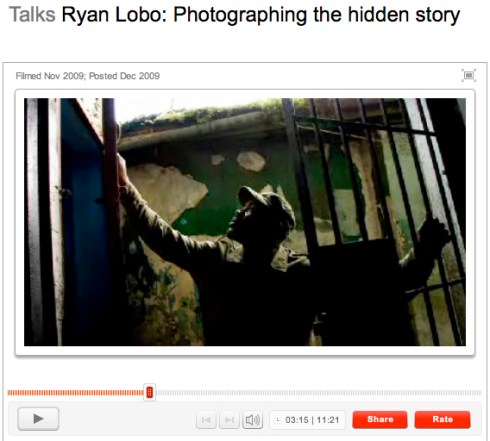
Ryan Lobo talked about three of his projects at a recent TED conference. The first story Lobo told stopped me in my tracks.

Lobo photographed Joshua, a man formerly known as General Buttnaked, who had committed heinous crimes against humanity during Liberia’s civil war. Joshua is now a baptised evangelist and as he entered villages across Liberia again, he did so not to destroy them but to ask for forgiveness.

The level of forgiveness that he asks for is galling to the Western mind. 10,000 lives. The ask itself is cruel.

During the war Joshua fought naked (hence the name). He murdered, raped and tortured thousands of Liberians. He corrupted hundreds of youngsters inducting them into war, enforcing his command over the boy-soldiers with unspeakable brutality. They are now destitute; many addicted to drugs. Heroin is commonly abused.

Joshua spoke from a soap box to crowds often including his victims. Lobo admits he thought Joshua would be killed by the mob in a short time after beginning the tour.

But Joshua was not killed.

How do we tally this story of redemption (if that term is not obnoxious in this instance) and this version of restorative engagement between perpetrator and victim with our Western codes of justice?

And as Lobo asks, does forgiveness replace justice?

I have no answers.

Larry Sultan is gone. When someone is gone I try to identify a piece of wisdom that should not go with them. (Go straight to the bottom of this post for Sultan’s wisdom without my preface.)

Six years ago, my partner and I stood in front of one of his large Valley prints at SAM’s Baja to Vancouver exhibition. During the early months of our relationship, we’d picked apart topics of passive violence, misogyny and late capitalism as a matter of course. Sultan’s photograph spurred debate on, again, and in novel directions.

Sultan’s photographic series are all deliberate, different and exemplary. He identified something that needed to be done (differently) and worked his way to a solution. This was his genius.

Evidence shifted thinking not only the fine art world and the academy but also in popular culture. It preempted a widening reverence for the tangible image – a trend that dominates our post-film nostalgia for found and vernacular photography. Joerg’s recent musings about curator and editor can predate self-publishing online technologies and hark back to Sultan and Mandel ferreting about government archives.

The Valley is iconic. Although, it is interesting to hear Sultan describe a project that I thought stripped (pun intended) the porn industry to its boring facts. Not so:

“The sex industry can be such a tired, worn out subject but when it’s imported into kitchens and dining rooms of a middle class suburban home something new opens up. At least for me it did.”

Pictures from Home goes alongside Toledano’s Days with My Father for the privilege of emotional inclusion it gives the audience.

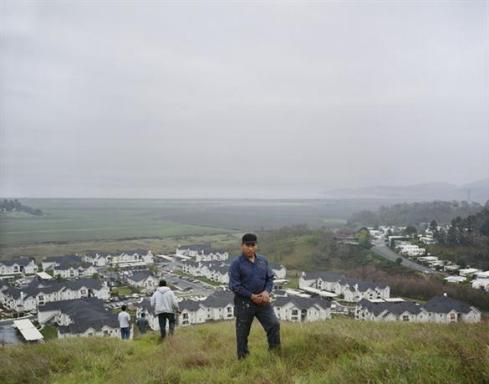
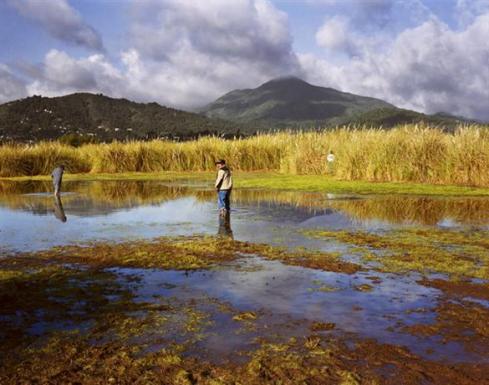
And, finally, Homeland is a beautiful reconciliation of Sultan’s new Bay Area living:

“Light’s too hard where I live, it’s hard to work in it. The character of light means a lot to me. It’s how I begin to photograph, it’s usually with the light. So it’s a bit problematic. L.A. light, that kind of foggy, smoggy, soft light—I miss that. It’s the light of my childhood. There are certain sounds, feelings of the air, and all of that which you can’t photograph but you can find the equivalent of, in light. But who knows, maybe I can find a new version of that in Northern California.”

The marshes of Corte Madera and fog of Marin County provided Sultan his respite from direct San Francisco sunshine.
Sultan died at 63. Relatively young. Yet, the inquisitive spirit of his work means he got more than enough done before his early departure. A oeuvre by which one is humbled.

Sultan’s interview with Ben Sloat featured on American Suburb X yesterday originally appeared on Big, Red and Shiny in April, 2008.

The stand-out quote is simultaneously a lament AND a call for rigorous photographic practice:

“Part of the difficulty facing photographers is that almost any subject matter has accumulated a representational history, so to find a new discursive space, a space to wander around those subject matters, is a real challenge. If I know too much, if the narrative is too well formed, I’m making pictures that are illustrative, and as a maker, that’s not interesting. As a viewer, that’s not interesting.”

Which accumulated representations are you battling with? What do you need to stop doing because its been done before?
I’ve shared this before on Photography Prison, but it’s been ringing in my brain all night.

Your midweek menace:

… it is a Journal.

That wasn’t always the case. Two days ago, I’d have said I was a blogger .. and all the time before that.

But describing yourself as a blogger is a lot like describing yourself as a tax-payer – regardless of one’s contribution, induction into either role is without obstruction; neither role describes the contribution but merely acknowledges sign-up to the system; and, if either role is entered into with ambivalence the reality of the commitment is soon apparent.

Blogging is a much maligned activity … and rightly so. There’s too much noise. Several types survive in the blogging ecosystem. The truly inventive and readable bloggers sit top of the tree – it is they in whom we invest energies and time .. and they are a rarer breed. That group is outnumbered by other types – the martyr, the sycophant, the gossip, the marketer, the angry, the bored, the pedant, the populist, the rich and the wasteful.

I am not in the first bunch and I want to stay clear of the second.

And, one wants to be defined by more than the [blogging] tool that one uses, right?

On Monday, a buddy said rather nicely, “I like what you’re up to. That journal you keep about prisons and photography is cool. You know, like in the tradition of poets or theorists or madmen who don’t really know where they’re headed but are just exploring a theme to see where it takes them. Because they’re compelled.” Right on.

My mate Wikipedia says, “Strong psychological effects may arise from having an audience for one’s self-expression, even if the journal one writes in is only read by oneself.”

I guess I am happy with the thought experiment alone as justification for this journal.

I’ve always answered people’s inquiries about Prison Photography by describing my various interests and the fact I couldn’t describe (or really expect) an audience for them in one package. Also, that I don’t know if there’s a product or how ‘product’ is quantified.

But, then, who among this company of distinguished diarists knew their audience?

My rather nice buddy is also now a published photographer:

Somebody Wrote “Shit” on a Sign Advertising Condominiums, Seattle. (2009).

From the ‘Mobile Phone, Arm, Car, Sidewalk’ series. © Maia Ipp.

Of course, everyone in the photobooks debate had their own preface and a necessary confirmation bias to bolster. Andy and Miki unleashed a monster. Great stuff.

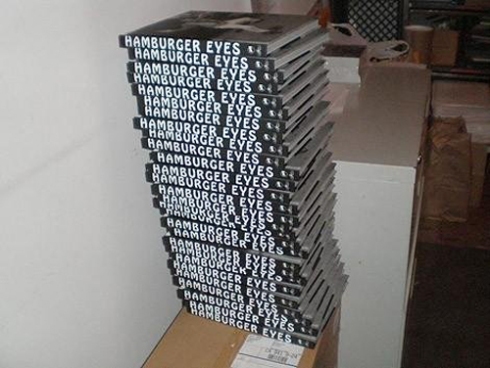
IT’S THE EYE OF THE BURGER, IT’S THE CREAM OF THE FIGHT …

Hamburger Eyes has my mostest respect so far. HE is rightly confident in the book as a medium; HE doesn’t uphold a naive belief in the internet or technologies to deliver ALL the goods; and they make a call for real life.

Photos and photographers should “get into some shit” away from the web.

Hamburger says:

I was asked to write my thoughts on this subject as part of a forum in the form a blog, meaning FLAK PHOTO and LIVEBOOKS are writing about the subject and inviting others to join in by writing something, linking it, then they re-link it up for an ultimate future post of all of it together in one blog? I don’t know I’m confused too. Blogs eat blogs, and they never be not hungry.

Blogging is a good segway into my thoughts about the future of photo books. I’m thinking the internet is turning into a library or more like jail for your photos. Yes, libraries are way awesome and yes we are all photo nerds forever learning, but how long can you stay in there. It’s like detention for your photos. Saturday school. Your photos need to get out, go on dates, and get into some shit.

What happens next is what’s already happening now. Photogs are deleting their flickr and their blogs and crewing up with only the hardest realist ninjas. It’s hyper attack mode. Photogs are scrambling because their agency just cut them and their editors got laid off. Not to mention, “Oh, you shot this or that, someone else caught it before you on their cell phone and New York Times already spent their budget on those.”

HERE’S WHAT I SAY

I wrote a huge treatise not only on the future of books, but on the future of the image and the future of our existence based upon our surrender to the image. We will soon all be docile slaves.

I shelved the piece. I’ll need to chew on it for a while until the next photoblog debate about the future of photography/contracts/journalism/print/distribution/consumption comes along. My main points will still apply:

– E-books is an oxymoron. Hopefully, all digital text will be referred to as E-words.
– Actual books will be fewer in quantity and higher in quality.
– Open source will dominate, because ownership of any digital matter will become useless.
– Micropayments are bogus. In the future if a creator unleashes it on the web, they will hold no claim to it
– Every household will have access to rapidly improving printing technology; any available online material will be printable to spec.
– Handhelds will have instance access to every non-proprietary file on the internet.
– People will have self-facilitated projections to the sides of buildings as a legitimate alternative to books when experiencing images.
– We will become detached from one another. Those who question the mediation of technology – even moderately – will be ostracised. In this regard, book ownership will become a slightly perverse political act.

No, not this type.

The type that is a) the Anglican Church’s leading expert on St. Nicholas of Myra; b) accompanied by a distinguished Anglican cleric; c) dressed as St. Nicholas rather than Santa Claus; d) understands that St. Nicholas is the patron saint of children and of the imprisoned, and; e) decided to show some Christmas cheer down the local immigration detention centre!

But when the Anglican church’s leading expert on Father Christmas, dressed as St Nicholas himself, arrived at the Yarl’s Wood immigration removal centre in Bedfordshire, things took a turn straight out of Dickens.

An unedifying standoff developed that saw the security personnel who guard the perimeter fence prevent St Nicholas, the patron saint of children and the imprisoned, from delivering £300 worth of presents donated by congregations of several London churches.

In a red robe and long white beard, clutching a bishop’s mitre and crook, St Nick – in real life, the Rev Canon James Rosenthal, a world authority on St Nicholas of Myra, the inspiration for Father Christmas – gently protested that he was not a security threat, but to no avail.

EMAIL

prisonphotography [at] gmail [dot] com

Prison Photography Archives

Post Categories