Daniel Etter‘s project from Hohenschonhausen piggybacks on the story of Norbert Krebs to shape the narrative. Krebs was imprisoned in Hohenschonhausen – the primary Stasi Prison in the GDR – for questioning the reliability of election results. He now leads guided tours. In sites such as these, it is a solemn privilege to hear the first-hand experiences of anyone persecuted by prior political powers.

It is as much a dilemma for communities and nations as it is an opportunity to write and affirm history, when former prisons are repurposed. Prison museums, peace museums and memorials are all common solutions to the troublesome, contested and understandably hated sites.

Prison museums are very common – here’s a (non exhaustive) list of links.

US

Alcatraz Island
Texas Prison Museum
Angola Prison Museum, Louisiana
San Quentin Prison Museum
Folsom Prison Museum
Eastern State Penitentiary
Sing Sing Prison Museum
Old Montana Prison Museum
Burlington County Prison Museum
Museum of Colorado Prisons
Wyoming Frontier Prison

Elsewheres

Dartmoor Prison Museum, England
Lancaster Castle, England
The Clink Prison Museum, London
Robben Island Museum, South Africa
Port Arthur Historic Site, Tasmania, Australia
Fremantle Prison, Western Australia
Abashiri Prison Museum, Japan
The Changi Museum, Singapore
Kresty Prison Museum, St. Petersburg, Russia

If your interest is piqued, consult this huge inventory of prison museums from across the globe.

And here’s a random selection of photographs of a selection of prison museums.

Note: I have touched upon Hohenschonhausen before here and here.

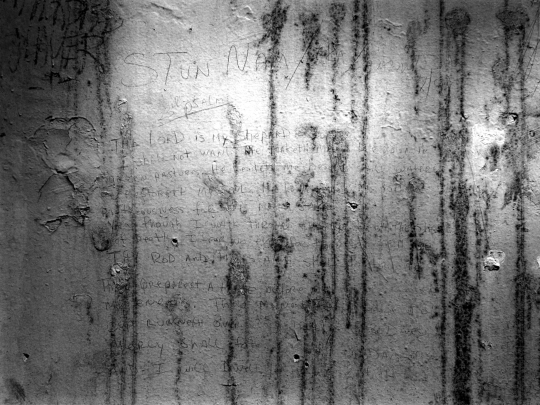
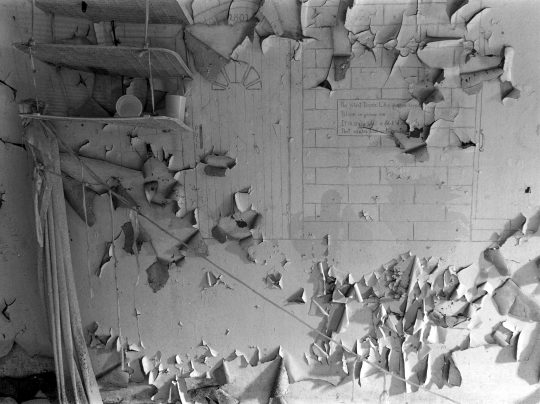
In 2005, Powerhouse Books published Thomas Roma‘s book In Prison Air: The Cells of Holmesburg Prison.

Arguably, the introduction by John Szarkowski is more interesting – or at least more complex – than Roma’s images. Szarkowski tackles head on the common question that looms over photographic studies of prisons:

“Roma’s book is in fact an odd and possibly perverse work, designed for who knows what audience. There are probably a few aging sociologists, still completing their works on what prisoners write on their walls, to whom the book might be useful (although it might be faulted on the basis of a lack of systematic rigor), and there might be another small but dedicated segment of our population that is interested in thinking about what life in prison might be like – not in terms of dramatic narrative, as with Cagney, Bogart, Robinson, etc., but rather (I am tempted to say) in terms of the aesthetics of incarceration.”

“But that is only a quick, superficial and comfortably middle-class response; and on second thought it is surely wrong.”

“Perhaps it might be more useful to ask why a photographer of high talent and conspicuous achievement might decide to make a book of photographs looking into empty prison cells. This is the same photographer who gave us the great, free-spirited dogs of Brooklyn, and the great open pastures of Sicily; and it is not unreasonable to ask why a photographer dedicated (or half-dedicated) to the cause of freedom should make this extended, serious, hermetic effort to produce a book of photographs concerning the very essence of subjugation.”

Szarkwoski then meanders through speculations about the photographs as a warning – even preparation – for forthcoming and unknown (possibly increasing) uses of incarceration:

“We might therefore, to be on the safe side, consider whether their evidence might help us prepare us for our possible future.”

To hammer the point home, Szarkowski lists common human preoccupations:

“According to their wall drawings and other graffiti, it would seem that the principled interests of Roma’s inmates were God, sex, time and to a lesser degree, art, the last being perhaps merely a method of dealing with the first three. These issues have been historically important to men in and out of prison.”

Szarkowski flourishes the introduction with reference to Conrad and Kafka and ends on an unfinished train of thought about medical experimentation on humans. Relevant, but not finished.

All in all, it is a bizarre essay. Szarkowski seems to grapple with the fact he has no connection to the content nor anchor with which to investigate and make sense of Roma’s work. But maybe that is the point he’s [un]intentionally making about photographs of prisons and of places one’s never been?

Christmas tree at the District Jail, Washington, D.C. and some of the prisoners (circa 1909-1932). National Photo Company Collection, Library of Congress. # LOT 12342-9

Christmas tree at the District Jail, Washington, D.C. and some of the prisoners (circa 1909-1932). National Photo Company Collection, Library of Congress. # LOT 12342-9

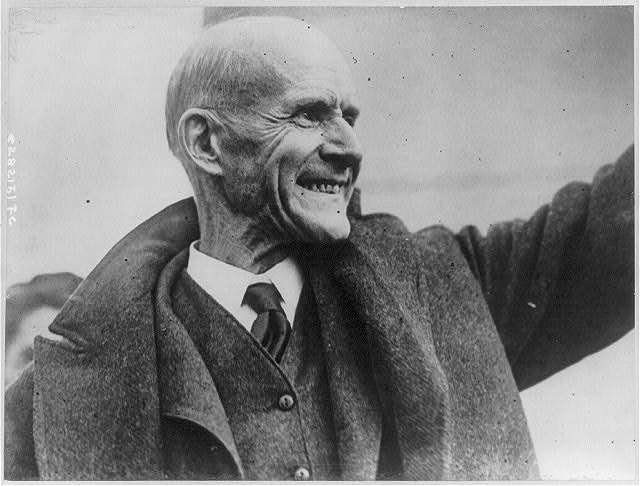
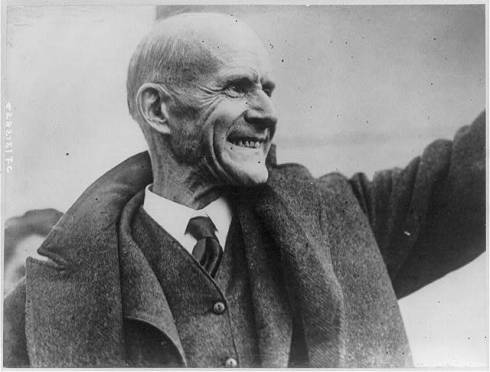
Eugene V. Debs, Five times Socialist candidate for President, as he leaves the Federal Peniteniary at Atlanta, Georgia on Christmas Day, 1921 Library of Congress Prints and Photographs Division, # LC-USZ62-75578 (b&w film copy neg). Photoprint copyrighted by Underwood & Underwood, No. S/282,151/FC.

Eugene V. Debs, Five times Socialist candidate for President, as he leaves the Federal Penitentiary at Atlanta, Georgia on Christmas Day, 1921. Library of Congress Prints and Photographs Division, LC-USZ62-75578 (B&W film copy neg). Photoprint copyrighted by Underwood & Underwood, No. S/282,151/FC.

Eugene V. Debs is a hero for the prison reform movement. Which is strange given that prison reform per se wasn’t his main cause. Debs was a labor rights advocate, union organiser and Socialist Party pioneer.

Debs was a harsh critic of American draft policies of the First World War; he was accused of sedition and labeled a traitor by Woodrow Wilson. Debs’ June 1918 anti-war speech saw him arrested under the war-time espionage law. He was sentenced to 10 years. He was effectively a political prisoner.

It is the statement Debs delivered in his court hearing that has inspired generations of prison activists:

Your Honor, years ago I recognized my kinship with all living beings, and I made up my mind that I was not one bit better than the meanest on earth. I said then, and I say now, that while there is a lower class, I am in it, and while there is a criminal element I am of it, and while there is a soul in prison, I am not free.

Given that Marx’s Das Kapital was published in 1867, Debs’ adoption of Socialism is relatively late. Ironically, it was while he was imprisoned in Woostock, Illinois during 1895 that he read Marx’s work and upon release became an avowed Socialist.

Debs ran for the US Presidency five times; first as a member of the Social Democratic Party of the United States (1900) and later as the candidate for the Socialist Party of America (1904, 1908, 1912 & 1920). In both the 1912 and 1920 elections Debs’ received nearly one million votes, 6% and 3.4% of the popular vote, respectively.

The 1920 campaign was run from within prison – after his 1918 speech he was convicted in April of 1919. The photograph above is of Debs’ release on Christmas Day, 1921 when his sentence was commuted to time served.

Debs legacy lives on partly in the form of the Eugene V. Debs Award. Past winner include Studs Terkel, Howard Zinn, Kurt Vonnegut, Molly Ivins, Pete Seeger and Ralph Nader.

Musings on the ‘Third Candidate’

I am always fascinated by the presence of historical figures who have disturbed the prevalent two party system of America. As unsavory as George Wallace was, his impact as a third candidate is worth measuring. Today, Ralph Nader’s name is synonymous with the term ‘third candidate’ and for his involvement in the 2000 general election his is vilified as the reason Al Gore did not become president. I am sick of hearing such a whinging and backward logic. Al Gore did not become president of the United States because he failed to win enough Electoral College votes and we well know the hanging, Floridian chaddy reasons for that.

People’s criticism of Nader says more about their surrender to a seemingly perpetual two party system than it does of his perceived faults.

Nader has made the point that neither the suffragettes or civil rights activists made it to elected office but that didn’t prevent them effecting massive change. If people are criticising any third candidate it is because they are more focused on the intractable two-party system than they are on their own agency and potential to effect change.

Image source.

Related to crime and tangentially to prisons, Colin Pantall has been examining the cult, mythologies and obfuscations at the point where visual media and female criminals cross. He does so over four posts.

Pantall summarises: In Media and Crime, Yvonne Jewkes identifies seven standard narratives to describe women who commit serious crimes:
• Sexuality and sexual deviance
• (Absence of) physical attractiveness
• Bad wives
• Bad mothers
• Mythical monsters
• Mad cows
• Evil manipulators

Pantall challenges:

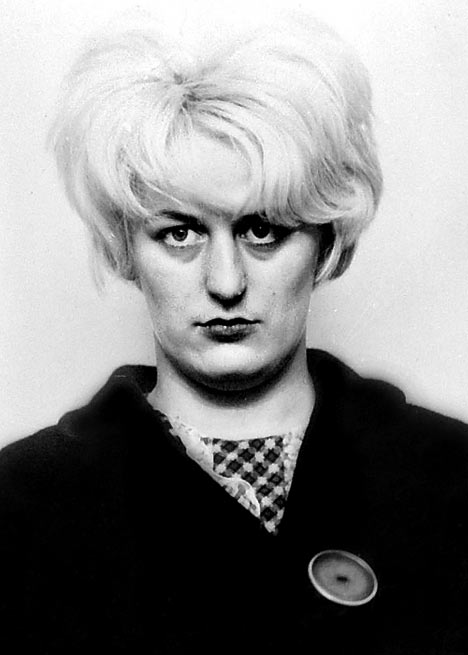
He takes on the common consumption of Myra Hindley’s mugshot:

“The world brought bored indifference to her mentor, the sadistic, fascistic Ian Brady. He was just another bad bloke.”

“It is a police photograph taken in maximum light in a dungeon. That stark, sinister expression could also be one of fright, ­ the antithesis of the transgressive transcendence conceived by Brady.”

Pantall compares: the national disgust at a smirking bully with the forgiveness of the victims parents.

Finally, Pantall confesses he has no idea if Amanda Knox is guilty or not.

In his ‘Trial by Photography’ post he points out that she’s already been judged for not behaving – or looking – innocent in front of the cameras.

He closes, astutely noting, “A virtual reconstruction of the murder of Meredith Kercher was shown in court, with the screen fading to red at the end. Which puts everything about the trial into question.”

Now we know what the six jurors and two judges think. Did the visual aides used by the prosecution disproportionally affect Knox’s guilty verdict?

I’ve gotten to know Adam Westbrook‘s work through mutual online friends. I signed up for his Twitter feed about the same time I did for the RSS feed on John Hirst’s Jailhouselawyer’s Blog.

John Hirst served 35 years for murder and now writes and advocates for prisoners rights. This year he has contributed at the Guardian.

It’s good to see these two folk collaborate.

© Jon Lowenstein for NOOR IMages. From the series ' Tent City'. Image: LOJ020

© Jon Lowenstein/NOOR Images. From the series ' Tent City'. Image: LOJ020

This image by Jon Lowenstein of NOOR Images from his series Tent City reminded me of some pictures I featured last year when considering the context and readings of images of prison confrontations.

Training Exercise, Team Portrait. Photo Credit: I.M.T.T. 2004

Which in turn reminded me off a tight group of Somali Pirates by Jehad Nga.

Eight Somali pirates sat at the Kenya Ports Authority Port Police station in Mombasa, where they are being held after being handed over to the Kenyan authorities by the Royal Navy. The eight pirates were arrested, and three others killed, by sailors of HMS Cumberland, as they attempted to hijack a cargo ship off the Horn of Africa. The pirates will be charged in a Mombasa court. Credit: AP

Eight Somali pirates sat at the Kenya Ports Authority Port Police station in Mombasa, where they are being held after being handed over to the Kenyan authorities by the Royal Navy. The eight pirates were arrested, and three others killed, by sailors of HMS Cumberland, as they attempted to hijack a cargo ship off the Horn of Africa. The pirates will be charged in a Mombasa court. Credit: AP

Serco is a UK based multinational company, with many fingers in many pies. The Guardian has called them “The biggest company you’ve never heard of.”

Serco sees profit in many things, including the private prison of the UK and Australia. Are you caught in the web?

The wikipedia profile supplies many valuable news sources for further learning.

EMAIL

prisonphotography [at] gmail [dot] com

Prison Photography Archives

Post Categories

RSS PETE BROOK’S TUMBLR ‘PHOTOGRAPHY PRISON’

  • An error has occurred; the feed is probably down. Try again later.