[Author’s Note: This is the first in a three part series on prisons in Africa. Through the lens of three different photojournalists, we will see the conditions and lives within prisons of Guinea, Burundi and Sierra Leone.]

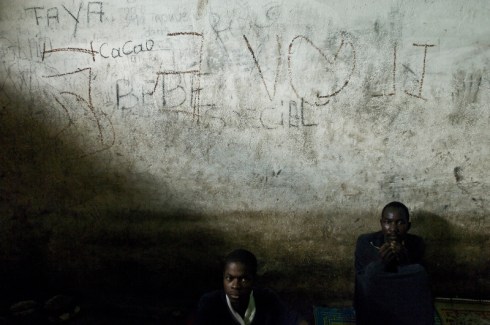
© Julie Remy. Inscriptions by young prisoners.

Julie Remy has photographed stories in Rwanda, Mali, Zambia, Malawi, and for her series on prisoners – Guinea.

In September 2008, Médecins Sans Frontières (MSF) began an emergency intervention in the civilian prison of Guéckédou in southeastern Republic of Guinea. Remy’s documented the food and medical aid effort.

“We have problems with food and illness here. There are no medications. There is no doctor. Since 2007, 30 people have died here and the doctor didn’t come.” Inmate, 19 months in prison

Guéckédou was over-crowded, unhygienic and without proper ventilation. As a result, some inmates were malnourished, most dehydrated and many with respiratory and skin diseases. It was recorded that prisoners with tuberculosis shared cells with the general population. Incubation of disease was a major concern.

I have no idea how the prison conditions of Guéckédou compare fifteen months on.

© Julie Remy. At the Guéckédou Civilian Prison, inmates wash only with water on a non regular basis. This prisoner shows the photographer his scabies. Due to poor sanitation prisoners suffer various skin diseases.

Remy worked in dark surroundings. As MSF vouched, “The scene that meets the eye upon entering the chambre noire “dark room” is beyond belief. Some 26 prisoners, crammed into a space of about three by four meters, can only be made out by squinting.” These images are part of a specific, urgent campaign, so it would be offensive of me to pay them any aesthetic critique. The awareness is what matters here.

MSF made good use of Remy’s photographs to produce a short video explaining the situation and dire need for intervention.

I’d like to emphasise that Remy (as a photographer) and MSF were in Guéckédou because of extreme circumstances at the national level. The poor conditions in the prison can be attributed to a number of larger structural instabilities. The men in these photos are one constituency suffering from a regional crisis. MSF explains; “The failure to ensure basic minimum standards in Guinea’s prisons can be linked to the country’s generally poor human and economic development. Ongoing instability and conflict in neighboring countries have long impacted on Guinea, while strikes and civil unrest have emerged in-country over the past few years. The ongoing international increase in food prices, especially in 2008, has exacerbated Guineans’ already precarious living standards and food insecurity.”
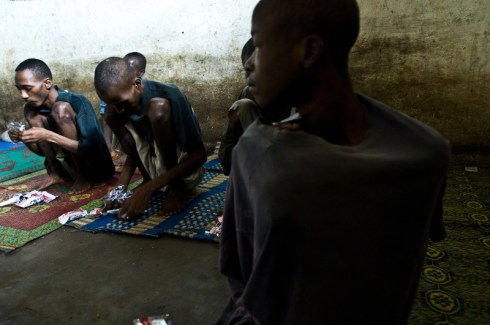
© Julie Remy. Malnourished prisoners received plumpy nut provided by MSF at the Guéckédou civil prison.
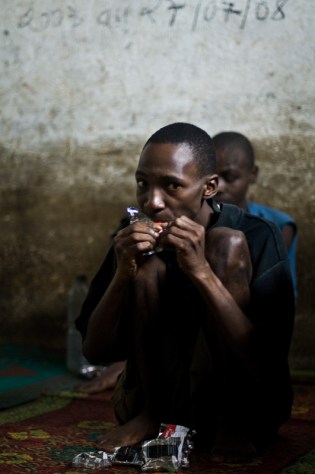
© Julie Remy. Malnourished prisoners received plumpy nut provided by MSF at the Guéckédou civil prison.
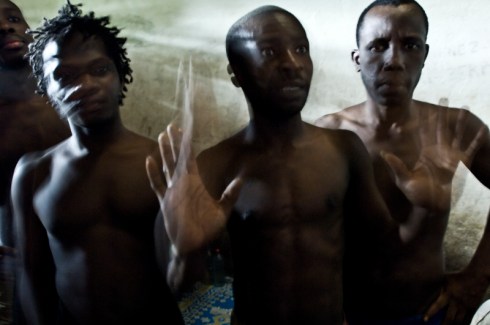
© Julie Remy. A prisoner tells us that he is innocent. That he has done nothing and still has not been judged. He says he does not know why he is held here in the  “Chambre noire” where a dozen prisoners are tied to a bar and held with another dozen in a barely lit cell. Guéckédou civil prison.
© Julie Remy
© Julie Remy

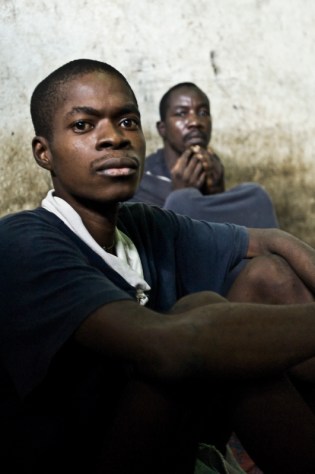
When the opportunity arises, I think it is important for audiences to view images like those two above within each others context. The first image is a dank, alienating environment in which the oppressive shadows and walls dominate. Whereas the second image (probably taken within a matter of seconds) is a well lit portrait centred on the gaze and associated emotions of the man; the prison environment is not stated. Precisely because MSF and Remy were present due to the physical effects of this environment on these men, both are valid photographic approaches.

The consequent written report from this aid intervention released in February 2009 continued with a call for systemic reform:

“Although the sub-standard conditions in Guinean prisons can be attributed partly to poverty and the country’s limited resources, these factors alone do not explain the absence of response to recurring malnutrition and the unacceptable living conditions in Guéckédou and other prisons. Guinean national authorities bear the ultimate responsibility to uphold the fundamental human rights of its inhabitants, including its incarcerated population.”

I, like many others invested in the photojournalism/documentary community, want to see less images of suffering in Africa and more images of the uneventful days; the boring normal times, perhaps some quiet smiles and tears. Add to that some local African photographers and we’re on the right track. (See recent commentary by Paul Melcher, Daniel Cuthbert and Ben Chesterton for more on this).

© Julie Remy

In closing I’d like to offer a caveat for the three part ‘Prisons in Africa’ series.

African prisons – that is, sites of incarceration across a land mass the size of Western Europe, Argentina, China, India and the USA combined – are each unique. Generally, conditions will be poorer than in prisons of developed nations, but every prison has its own culture, rules and circumstance. In Africa, as in the rest of the world, prisons usually exhibit the worst of a nation; retribution and anger, neglect and apathy.

Photographers are compelled to visit prisons known to them through local knowledge or national notoriety; we must expect there is a story to be told. The prisons I will feature in this three-part series will not be pleasant, but I think the three featured photographers are sincere and the stories are important.

While the men in these images may deserve pity, Africa as a continent does not. Africa deserves our respect and our time.

Nations in Africa, as with all places featured in the photojournalism we consume, should be places we think about visiting. I seriously encourage anyone and everyone to make an extended visit. Opportunities to dilute the media images of places and people with first hand interaction with those places and people will only have positive results. If only we had the opportunities, good reason and resources to visit and live in new places frequently.

(Disclosure: I lived in East Africa for five months. That time made more complex and less harried my perspective of the world. The largest culture shock was returning to the UK.)

__________________________________________________________

Official Bio: Julie Remy is an award winning documentary photographer specializing in human rights, health, travel and the environment. What she captures through her viewfinder and what she tells in written word she believes will contribute to bringing hope and respect and perhaps assist in gaining access to the care and knowledge they deserve.

One glaring omission from Prison Photography is ICE detention centres and the prisons specifically designed for immigrants. Apart from the public stunts of Sheriff Arpaio (here and here) I have not featured any photography of immigrant detention or prisons.

This is partly because immigration policy and deportation infrastructures aren’t an area I know much about, but mainly because immigrant jails and prisons are the most invisible of all prisons in America. The media simply cannot get access like they can into state and county sites of incarceration.

As a course of policy, ICE detention sites are kept hidden. Allow me to push back against that a little:

Map courtesy of Global Detention Project.
More resources at the Detention Watch Network

In an attempt to redress this dearth of immigration coverage on Prison Photography, I point you in the direction of Tom Barry’s interview on Fresh Air yesterday. Thanks to Bob for the tip-off.

Here’s some things I learnt:

– Over the past five years immigrant imprisonment has increased 400%
– The policy of immediate deportation for illegal immigrants was replaced by imprisonment and deportation; a deliberate tactic intended to punish and deter future attempts to cross the US border illegally.
– Legal definitions of crime have broadened since 1996. Couple this with a syncopation of agency databases means constant threats of stop, search, detention and deportation of immigrants (both legal and illegal) now exist that did not 5 years ago.
– In this new era distinctions between legal and illegal immigrants have shrunk.
– Legal immigrants are subject to “a separate penal system”.
– 30% of deportees to Mexico don’t speak Spanish.
– The 11 border prisons are intentionally remote and located in economically depressed towns along the US/Mexico border.
– Immigrant prisons have a structure of financing and ownership that is unique. Tom Barry calls it “The Public/Private Prison Complex”, in which tax dollars and private corporations mix and match the funding. In many instances, administrators could not actually state who owned the facilities. This results in diluted accountability.
– The Corrections Corporation of America (CCA) and the Geo group are the two largest private prison companies involved in immigrant detention.
– Privatised prisons were once a rarity in America. CCA and Geo got their start under Reagan winning contracts to house immigrants.
– CCA and Geo have enjoyed record profits over the past 8 years. 45% of their income derives from from state and federal contracts outsourcing immigrant detention.
– The perversely named ‘Operation Reservation Guaranteed’ means that detainees will always be sent to a bed/cell even if it is on the other side of the country. The transportation costs are met by the tax-payer.
– Wackenhut, an arm of Geo group, is the sub-contractor for these long, expensive and unnecessary transportations.
– It is common that detainees are moved without warning or reason. It is common that detainees cannot be located by the private prison companies for long periods.
– And much, much more. Listen, I highly recommend.

Tom Barry covers border security and immigration issues as the Senior Policy Analyst at the Center for International Policy. He has written several books, including The Great Divide and Zapata’s Revenge.

Tom just published A Death in Texas a piece for the Boston Review about a riot at an ICE prison in Texas. The riot was an “act of solidarity” by the detained population following the death of a young prisoner.

Tom maintains the Border Lines blog for the TransBorder Project is a project of the Americas Policy Program in Mexico City and the Center for International Policy in Washington, DC..

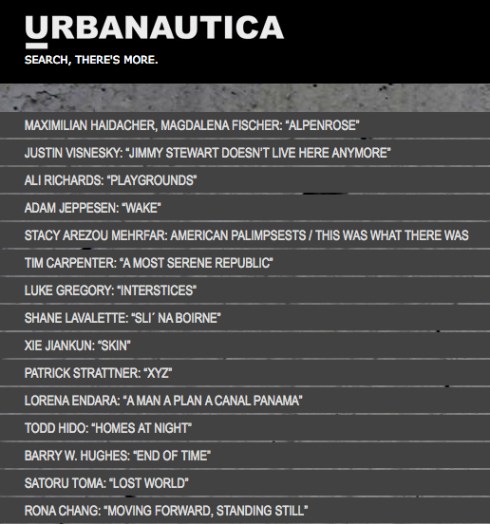
Steve Bisson and Andrea Filippin facilitate Urbanautica a research project on photography and human landscapes.

“Dealing with studies on urban and industrial sociology lead us to the idea of a website, without commercial purposes, that tries to bring back people’s looks on the “ways of doing” territories.”

“The featured projects are the result of our research, even though we receive several submissions that we are happy to evaluate from time to time. We do not take in consideration portraits, commercial, fashion or those things as we are sticked to our research.”

“By the way, we are interested in art and conceptual deviations from the main theme as probable evolutions of landscape photography.”

Found via Bryan

Yusuf Sayman‘s work looks at the struggles of reentry into society following incarceration. I have mentioned his work once before.

This picture plays literally with notions of  ‘the road to be traveled’ and ‘obstacles to cross’, but it also depicts the loneliness of a new reality for Doris.

Doris spent 27 years in prison. Even amidst bustling streets her experience must quite solitary?

See feature at GOOD.

In “Free Again,” the photographer Yusuf Sayman chronicles the day-to-day challenges associated with the re-entry process that follows a long prison sentence. His subjects are Tarik, a man in his third week of freedom after a four-year prison sentence (which began when he was just 16), and Doris, who has just completed 27 years of incarceration. “In prison they get used to a very different set of rules and social behaviors,” says Sayman. “Doris said she never had to make decisions like what to wear. New-found freedoms as simple as shopping or taking the bus become very significant, very big deals.”

Brilliant!

Source

UNKNOWN DETAINEES

Stan posted this a couple of days ago. Three suicides covered up in 2006.

Now a 58-page study prepared by law faculty and students at Seton Hall University in New Jersey starkly challenges the Pentagon’s claims. It notes serious and unresolved contradictions within a Naval Criminal Investigative Service (NCIS) report – which was publicly released only in fragmentary form, two years after the fact – and declares the military’s internal investigation an obvious cover-up. The only question is: of what?

I have highlighted the death of prisoners in US military custody  before, in Iraq and in Pakistan.

These deaths seem to be suicide. Should we be surprised? Doesn’t the military deal in death. Prisons are miserable. Locking enemies and captors up behind closed doors is eventually going to lead to homocide or suicide. The stresses and stressors are too large.

Inevitably the question is why would the authorities usher a cover up? My guess because they didn’t want a closer look at the entire operation at Guantanamo.

Just another tragedy in the long list to come from that corner of Cuba.

Elsewheres, the Detainee 063 has launched a blog and twitter feed of the Guantanamo interrogation log of Mohammed al-Qahtani. It is being published in real time. Each entry appears exactly seven years after it was first recorded.

This is the best deadpan and frigid use of twitter since Jenny Holzer, who incidentally has done her own amazing work on the ‘war about terrorism’.

Talk about instructing your audience.

Today, Aline features Mark Laita‘s diptychs; (somewhat) obvious pairings of rich/poor, winner/victim. The couplet of astronaut/alien abductee is unexpected and clever.

I am always reluctant to use violent as an adjective to describe prisoners. I know that most prisoners are not in their nature violent. Most of the time, hard appearances are necessary as a front to aggression that may or may not exist.

In this instance, the counter-portrait of cheerleaders compels me to use violent as an adjective. Regardless of it’s uniform, “the group” is a menace. After spending just a minute with this diptych, I feel quite on edge. The two quintets both wield the tools of their activity and confront the camera. Aggressive.

Psychologically, it’s a dead heat. But culturally, for me at least, the cheerleaders are more sinister.

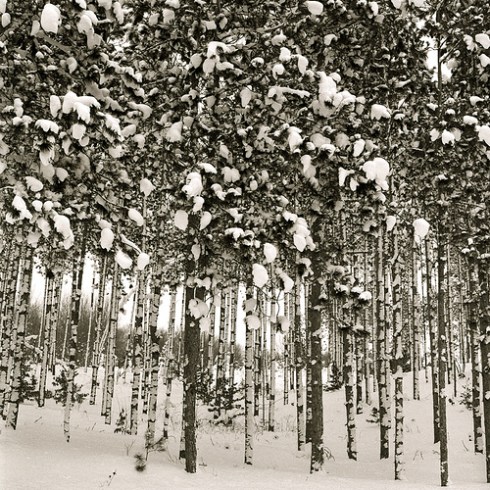
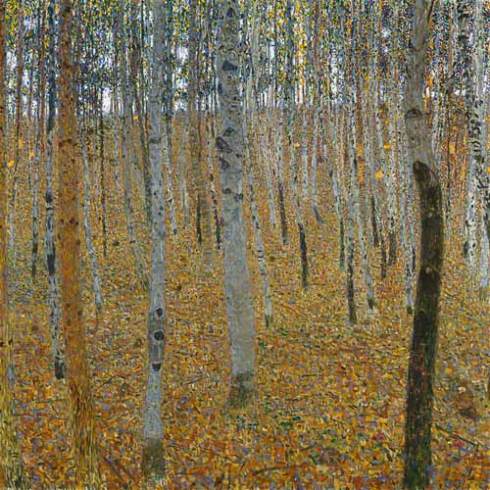
I just wanted to share this convergence. Bill Schwab above, Gustav Klimt below.

EMAIL

prisonphotography [at] gmail [dot] com

Prison Photography Archives

Post Categories