© Philippe Bazin

Last month, Melinda Hawtin contacted me about her interest and graduate research into the representations of prisons in French contemporary photography.

My position in the world is a little more comfortable knowing that another human has the niche commitment to prison photography!

Hawtin’s geography-specific project is even more narrowly defined as mine. She humbly referred to her blog as “yet a vessel for my (mostly) unresearched musings but I am hoping that in time it will take on a more coherent form”. Martin’s posts are far more than her modesty suggests – they are important introductions to academics, works and points of analysis.

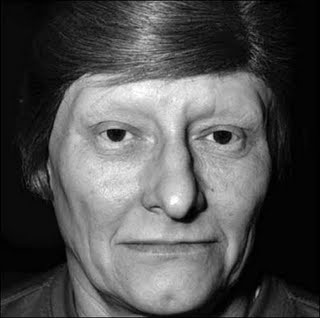
Hawtin introduced me to the work of Philippe Bazin, whose series Détenus is a straight photographic study of French prisoners. Hawtin is discomforted somewhat by Bazin’s sentimentalisation of prisoners, “it seems strange and rather naive that artists like Bazin are so keen to portray the humanity of inmates. I’m not suggesting that they demonise them instead but monochrome, close-up images of prisoners could be seen to be over-romanticising the prisoner”.

© Philippe Bazin

My take? Intimate shots do not automatically translate to sentimentalisation or captures of “true” humanity. It is always hazardous to prescribe the reaction of an audience to a photographic style. I would step back (possibly cowardly) and suggest that Bazin’s portraits are worthwhile simply because they differ in tone from the vast majority of other photographic studies of prisoners.

Hawtin and I swapped resources and names including the excellent Visa pour L’Image web documentary winner, Jean Gaumy and Lizzie Sadin, whose photography focuses on juveniles in prisons across the globe, including her own nation of France.

Investigations into the portrayal of French prisoners could not be more timely:

French President Nicolas Sarkozy has called French prisons “the shame of the nation”, and the European Union has demanded that France improve the detention conditions of its inmates to meet minimum European standards.

I’ll be sure to check in with Hawtin’s blog regularly.
Let me be clear, I don’t like private prisons. The need for profit to satisfy shareholders allows for cost cutting that can deprive a system (and its inmates) much-needed resources and possibly rehabilitative opportunities.

This is a general opposition but I currently see nothing to suggest the mandate of private prisons is anything more than that to securely hold its wards.

Andrew Leigh, an Australian economist is suggesting a third way which conjoins market incentives with successful reentry practices. He wants to see prisons with the lowest recidivism rates among its released inmates to reap financial award.

“Unfortunately, the contracts for private jails bear a close similarity to sheep agistment contracts,” alleges Leigh.

“Providers are penalised if inmates harm themselves or others and rewarded if they do the paperwork correctly. Yet the contracts say nothing about life after release. A private prison operator receives the same remuneration regardless of whether released inmates lead healthy and productive lives, or become serial killers.

“A smarter way to run private jails would be to contract for the outcomes that matter most. For example, why not pay bonuses for every prisoner who retains a job after release and does not re-offend? Given the right incentives, private prisons might be able to actually teach the public sector a few lessons on how to run an effective rehabilitation program.”

This comes from an article “Shock, An Economist Has a Good Idea!” While I’d temper such enthusiasm, I would like to see the idea investigated a little more. It could lead to private prisons committed to aggressive Research and Development in practices that lower recidivism.

My only worry would be that they’d compete for a finite amount of money and merely create a static ecosystem of excelling, well-funded prisons vs. forsaken, poor-funded prisons.

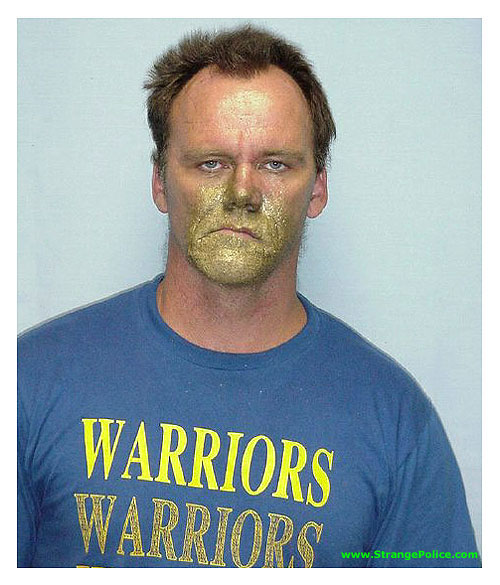
No one owns the rights on a mugshot. Mugshots are in the public domain.

This might be a problem for Patrick Tribett (now 8 weeks clean) who is trying to stop the use of his likeness on commercial t-shirts. Change.org has the full scoop.

Tribett’s best hope is the sanction against the use of names or portraits for commercial gain. We will see if this law can be applied to existing mugshots.

James Pomerantz recently posted on Movies About Photography. Not surprisingly I added Standard Operating Procedure to the fray in the comments section.

Not a movie, but every part cinematic, I implore you to watch Shooting the Past by the stellar Stephen Poliakoff. It is a three part mini series. Back when it was first released (1999) I watched it alone in my parents house for three Thursdays running … even refusing trips to the pub to watch it undisturbed. It’s a glorious, delicate piece of television; tragic, persuasive and eventually uplifting. One of those that leaves you sat still and quiet five minutes after the credits have rolled.

The premise is simple. Big, faceless American corporation sends business-like minion (Liam Cunningham) to oversee the break-up and sale of an old photography archive in a mid-sized, regional, musty museum. The museum is staffed by an eccentric archivist (Timothy Spall) and a strong, caring custodian-director (Lindsay Duncan).

The staff must – over the course of a few days – convince the administrator to turn his focus from the bottom-line value of the collection to the intangible value of stories, histories and truths within the photographic collection, thus transforming his heart and ultimately his decision on the fate of the collection.

Spall and Duncan are a delight … Cunningham less so, but an American accent is difficult to do. In defence of Cunningham, his performance a decade later in Hunger (another of my favourites) was remarkable.

So, there you are. My most heartfelt recommendation.

I earnestly urged someone to watch Shooting the Past a few years back, but the last time I was round at their place I saw it still wrapped in cellophane in the DVD cupboard. That hurt. Shooting the Past should be relished.

Some of you might know that I volunteer for Books to Prisoners. Our book donations fall into a few categories: the majority go on the stacks for future dispatch to prisoners; other books not suitable/requested in prisons go to the bargain bins (25c-$1) at Left Bank Books; and good quality titles we sell online (I think?) for the $5 or $10 we anticipate. This third scenario crops up infrequently.

All monies raised from book-sales goes toward postage … and it is postage that accounts for most of BTP expenditure.

Last night, I was sorting some old donations – the usual suspects were there (Alice Walker, Louis L’Amour, John Le Carre, James Patterson) as were the much-needed non-fiction (Spanish dictionaries, parenting books, American history titles, etc.)

I did not expect to come across an original edition fine art photography book. I put Images a la Sauvette, Photographies par Henri Cartier Bresson aside while I sorted the thrillers from the biographies from the media studies text books.

At the end of the night I picked Images a la Sauvette up again. It was obviously too large and too heavy to go on the stacks. During my induction, I remember high end monographs were mentioned specifically as candidates for sale rather than dispatch. I new this was a special book, but I didn’t realise it was Cartier-Bresson’s foundational work, fully illustrating his ‘Decisive Moment’ philosophy.

The book is beautiful. Published by Editions Verve, Paris in 1952. The cover was designed by Matisse purposefully for the book. There are 126 pages of full-sized (37 x 27.5 cm) black-and-white gravure reproductions. The cover is strong, the spine a little discoloured. The pages are in fine fettle. The pages are bound to one another tightly but as a group have come away from the spine. Still, gorgeous.

I instantly thought it might be worth more than your average book – I hoped maybe $100, perhaps even $200. That amount would pay for a fair whack of postage, right? A few hundred books, right?

After getting home, I checked out the specifics. The proceeds from the sale of this book are to pay for postage on thousands rather than hundreds of books. Depending on which source you credit, make allowances for the condition of this copy and factor in the state of the book market, it could be worth anything between $1,000 and $3,200.

Antiqbook pegs it at $1,053; AbeBooks start it at $1,260 running it up to $7,700 (for what I guess is a pristine copy); Franklin Books values it at just shy of three grand and Bauman Books pushes it a little further to $3,200. In 2007, PhotoEye auctioned a copy for $2,250.

Books to Prisoners has never sold a book of such high value before so we’re a little stumped. I guess we’ll get a local dealer to stick a valuation on it and then carefully search out buyers. We’ll likely use AbeBooks. I’ll let you know in due course. If you have any advice or interest, please drop me a line.

In the mean time, salivate over these images:

Michigan Central Station. Disused since 1988. Pic by Romain Meffre

Darulaman Palace, Kabul. Pic by SirFin at Panoramio.

Over the past nine months I’ve enjoyed Jamblichus‘ persistent and meta-disciplined research and writing. Alas, Jamblichus is taking an extended holiday until the new year. He explains, “Terra Firma is going to have to take precedence, for it is a demanding place …”

I want to mark Jamblichus’ sabbatical with a big hat-tip. Fortunately for you he has kindly listed his most treasured works from 2009.

Be absolutely certain to read A Tale of Two Cities: Detroit and Kabul.

The piece goes from to Motor City’s 29% unemployment to Paul Simon’s ‘air of carbon and monoxide’; from poppy fields to the ‘Daisy-cutter’ ordinance “designed to kill your wife and your kids”; from Detroit’s new casinos and wild dogs to the hippie trail of the sixties experienced from vans “likely built in Detroit”; from the first Marks & Spencer in Central Asia (Kabul, 1960) to the necessary down-sizing of America’s failed urban expansions … and of course there’s the decay.

It is the best of opinion writing, replete with links that make your head spin and a fecund smattering of profanity.

BANNED BOOK S PETITION

Two weeks ago I penned an article about the banning of books in Texas prisons. Attached to the article was a petition to Brad Livingston, Director of the Texas Department of Criminal Justice.

If you are opposed to politically motivated censorship, I urge you to sign the petition. Let me remind you that the book was about the conditions of women in American prisons and it was banned for describing the abuses two females had suffered early in life; abuses that had shaped self-destructive behaviour and consequent incarceration. The descriptions were not graphic. The descriptions were essential for discussion of cycles of violence, perpetrators and victims, and hopes for help instead of punishment.

If you need convincing that petition’s have an effect, I point to Change.org’s previous direct action that caused the Virginia Department of Corrections to overturn their ban on the Virginia Books Behind Bars program.

Signing the petition does mean making a profile at Change.org. Profiles are often a barrier to action but I ask that you put on your hurdling shoes in this instance.

Thanks, Pete

UPDATE: ALL PETITIONS

Change.org is so confident of the power of petitions they have set up a platform to deliver the petition tools of national non-profits to the hands of individuals.

“Our bloggers have recently begun using this tool to start petitions in response to news stories and have won close to a dozen campaigns – successfully pressuring companies and federal agencies to change their policies.”

Sister Marina, Walton Prison. Copyright Liverpool Daily Post and Echo

About the photo: “I photographed Sister Marina visiting Walton Prison. Her smile and compassion were for all – she was there to comfort those who needed her faith, solace, prayers and hope.” Source.

___________________________________________________________

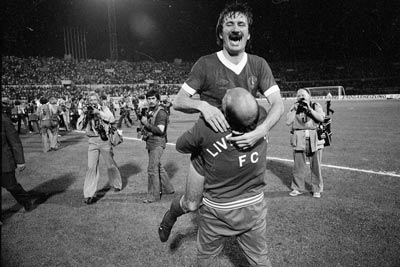
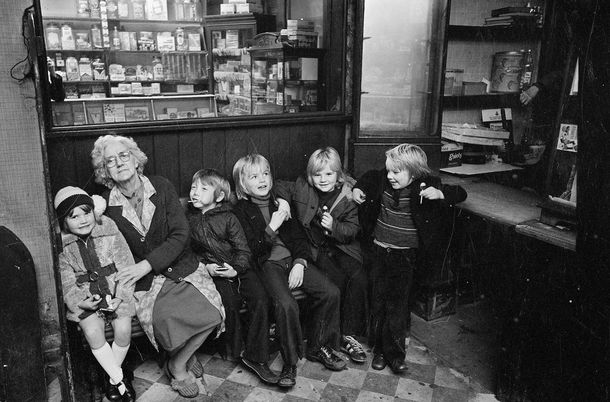
Stephen Shakeshaft is subject of a retrospective at the National Conservation Centre in Liverpool, England. Having photographed The Beatles, street urchins, dock-workers, Cilla Black’s mum, the Toxteth Riots, Willy Russell, Liverpool F.C. in European glory and the tragedy of the Hillsborough aftermath, Shakeshaft is knee-deep in the love, lore and history of the Merseyside region.

I’d argue Shakeshaft is to Liverpool as Anthony Friedkin is to California.

Shakeshaft started his career as a copy boy in 1962, running typed stories from the sub-editors’ desk to the print room for the Liverpool Daily Post and Echo. Later he was accepted as an apprentice, learning his trade and his art. He rose to become chief photographer and picture editor of both papers.

Kenny Daglish in bed with the European Cup. Copyright: Stephen Shakeshaft/ Liverpool Daily Post & Echo.

Celebrations after Liverpool won the European Cup Final in Rome, 1977. Copyright Liverpool Daily Post and Echo

All the information from the Liverpool Museum’s blog, associated videos from the exhibition and podcast.

Media articles and photos here, here, here and here.

© Stephen Shakeshaft

EMAIL

prisonphotography [at] gmail [dot] com

Prison Photography Archives

Post Categories