
From Thomas Mailaender’s book ‘Illustrated People’ which won the Paris Photo+ Aperture Foundation Award for “Photobook of the Year 2015”
–
THREE WEEKS AFTER THE PARIS ATTACKS, I’D LIKE TO SAY THESE THINGS
Paris Photo 2015 will be remembered for reasons we never wanted.
Photographers went to Paris to see old-friends, hob-nob with moneyed institutions and to blur the lines between work and vacation. Some of them ended up documenting one of recent memory’s worst terror attacks.
Paris Photo opened the doors to the Grand Palais the day before the bombs shook Paris and 130 lives were taken. One of the biggest international photo events on the calendar, artists, publishers, gallerists, collectors and enthusiasts descended on the French capital for four days of viewing, networking, buying and selling.
After the tragic events of November 13th, Paris Photo was cancelled. No one was thinking about art sales. No one was talking about awards. Shuttering the event was the only sensible and respectful decision to make.
As with any massive event, though, the activity and conversation surrounding Paris Photo had long led up to the long-weekend. Check the social media timelines of any of the 147 galleries or the 60,000 visitors to understand anticipation and the pre-sales hype. Paris Photo can be career-defining, it can provide a crucial contact, it might be a platform to test or showcase ideas. And then there’s awards too.
On Thursday November 12th, Aperture announced the winners of the 2015 edition of the Paris Photo–Aperture Foundation Photobook Awards.
Some people say the best way to move forward is, after the memorials, to live life as you would. To continue with a full life. I would have written about these awards before the attacks and so now, three weeks on, I feel I should write about them still. I cannot make sense of murderous ideology, but I can make sense of books, photos and how they exist in the world.
Below, in each of the four categories, I offer some analysis followed by Aperture’s official blurb and videos. I end with some concluding thoughts about the four entrants considered in unison.
What To Make of the Winners?
Let’s do things the backward way round and start with the Special Jurors’ Mention category as opposed to the three main categories.
Special Jurors’ Mention
Will Steacy
Deadline. b.frank books (Philadelphia, 2015)
Designed by Will Steacy
MY THOUGHTS
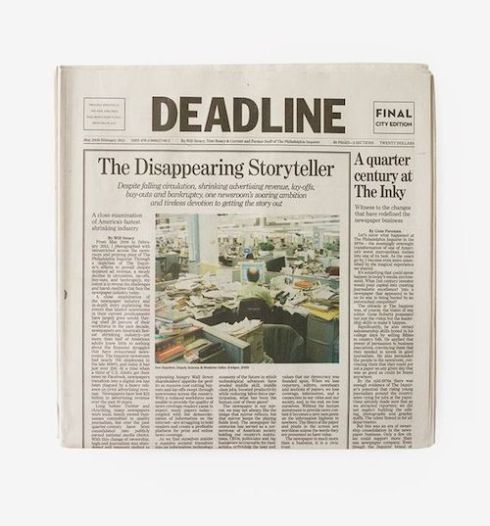
Will Steacy’s Deadline is my book of the year (slide 42), so a tip-of-the-hat here is no surprise. Deadline is about the heritage of storied newspaper Philadelphia Inquirer and about the forecasted chaos of downsizing. It was printed on the same presses that churned out the Inquirer over decades.
Deadline is a look to the past with an eye on the future. Most of all, it’s a tribute to the working man. When labor movements are usually talked of in the past tense, Steacy is putting workers’ issues into art world discourse, reconnecting art with politics.

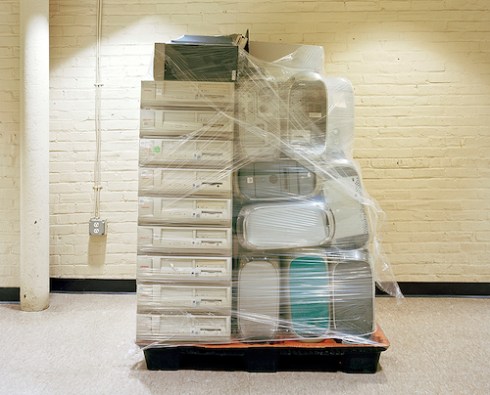

Union membership has fallen from 1 in 3 workers to 1 in 10, over the past 50 years. I’m no blind preservationist, but I do want to know that progress is made for the benefit of all and not at the expense of any. As I wrote for time:
“Fanatical in its view of both the newsroom and the printing presses, Deadline honors the labor of the copyboys, the reporters, the inkers and the editors equally. Decorated journalists reflect back on the Inquirer’s “Golden Age” and Steacy’s dad reflects on generations of their family working in newspapers. In five sections, the amount of research, fact-checking, phone-calls, line-editing and captioning in Deadline is astounding.

Deadline is dense, daring and difficult to pigeonhole; I think that’s why it got the special mention but not one of the category gongs. It didn’t fit neatly, but it was impossible to ignore.
OFFICIAL APERTURE BLURB
Will Steacy’s Deadline is a newspaper about a newspaper: the Philadelphia Inquirer, where he spent five years photographing the newsroom, employees, and printing plant. Thanks to the Internet, most newspaper staffs are a fraction of what they once were. The Inquirer is no exception, and Deadline chronicles its history — with texts by current and former staff, and archival photographs alongside Steacy’s own — through to its very uncertain future; the final pages see the formerly prominent newspaper moved into a much smaller office.
For Steacy, who comes from a family of newspapermen, this story is personal — his father was an editor at the Inquirer for nearly thirty years, till he was laid off while Steacy was working on this project. The materials, design, and printing quality of his son’s contribution are all in line with family tradition (it was even printed at the Inquirer’s own press), but the focus has been turned inward. As Christoph Wiesner comments, “it serves both as a history of the journalism sector and a work of subtexts, revealing a process of deconstruction or mise en abyme.” Deadline is less a case study than it is a eulogy.
Winner of Photobook of the Year
Thomas Mailaender
Illustrated People
Archive of Modern Conflict and RVB Books (Paris, 2014)
Designed by Thomas Mailaender and Rémi Faucheux.
MY THOUGHTS
One thing’s for sure: there’s no other photobook like it. Whatever gaveThomas Mailaender the idea to burn images onto people’s skin with UV light? I can’t work out if Illustrated People is fringe genius or just a gimmick, but the answer to the question is less important than the inquiry. For the deeper you go on these photos the more disturbing shit gets.
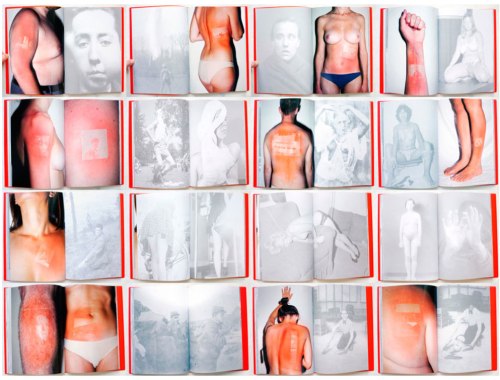
Let’s start with the easy obvious stuff, though. The coupling of images from the Archive of Modern Conflict on dull paper in washed out B&Ws with glossy glaring blood reds is very striking. It’s a catchy reference to red-top newspapers, so activist posters, to Soviet graphics to political and military propaganda.
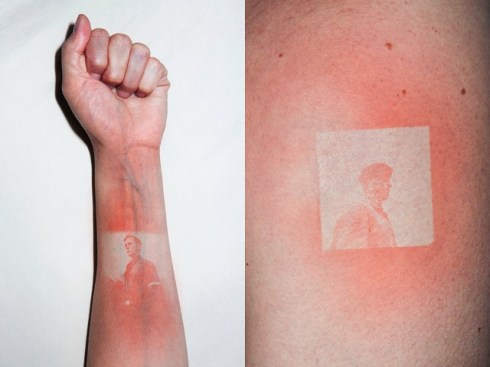

It’s strange that we might be put off by Mailaender’s violence toward his volunteers’ bodies. After all, these are images are taken from an archive devoted to war and technological chaos fo the 20th century. By comparison to any bullet or nuke, Mailaender’s work is playful. Maybe that’s the point? Is Illustrated People a manic embrace of disorder and a Dr. Strangelove-esque riding of the bomb?
Yet, even in acknowledgement — and some celebration of — Mailaender’s flippant wit, I can’t stop thinking that these are like some scorched-earth futuristic nightmare. Like this is sci-fi gone awry; a vision of a time in which humans are branded with culture, not creators of it, and a dystopia in which bodies are a drain on resources on an overheated, water-scarce planet. Or given the side-boobs and pin-up girls, is Illustrated People just a photo-sadist’s wet dream? That I’m still guessing is (and talking) is a good sign. Can. Not. Unsee.
OFFICIAL APERTURE BLURB
When artist Thomas Mailaender was given access to the Archive of Modern Conflict’s photo archives, he decided to “print” some of the negatives he found onto a whole new medium: the human body. Using a UV lamp, Mailaender projected these negatives onto models’ pale skin, leaving sunburnt imprints of the images.
Full-color documentation of this performance alternates with archival images inIllustrated People, a playful softcover book encased in a translucent red plastic jacket. While the archival images have a faded appearance, printed in black-and-white on plain matte paper, the “sunburn” pages are bright and glossy. “What’s interesting to me is the relationship between the immaterial archive and the living bodies,” says Yannick Bouillis. “He made something that goes beyond just the selection of images — he’s putting pure culture onto something natural, the body.”
Winner of Photography Catalogue of the Year
Diane Dufour and Xavier Barral
Images of Conviction: The Construction of Visual Evidence
LE BAL and Éditions Xavier Barral (Paris, 2015)
Designed by Coline Aguettaz and Xavier Barral.

The Images a Charge/Images of Conviction book cover features a photo by Rodolphe A. Reiss, rendered in the negative, showing a demonstration of the Bertillon metric photography system.
MY THOUGHTS
Images of Conviction was one of the curatorial highlights of 2015, but a great exhibition doesn’t always guarantee a great catalogue, so it’s wonderful that the excellence of Dufour and Barral’s presentation of material on walls is matched by their presentation of content on paper.
Coincidentally, like Mailaender’s book, the only time grayscale is punctuated in this catalogue is by the red tones and exacting dots. Many of the images here are drawn from government archives, official reports, military imaging or sites of forensic investigation (even if the photographers, Meiselas below for example, are not forensic photographers).

Grace A-South, Koreme, North of Iraq, June 1992 © Susan Meiselas, Magnum Photos.
Images Of Conviction brings together ten case studies in which images were used to establish truth and narrative in the wake of death — be that of a single person, of a religious tale or of an entire people.
I think of Images Of Conviction as the sister exhibition to the Tate’s epicConflict Time Photography in 2014. But whereas the Tate focused on the changing types of photographs made in response to conflict over time, Dufour and Barral focus on the changing technologies use to make photographs. Whereas the Tate considered subjective response (prints, photobooks, memorial), Dufour and Barral are concerned with the application of objective fact. Whereas Tate was sympathetic to artistic response, Dufour and Barral’s framework has little room for it.
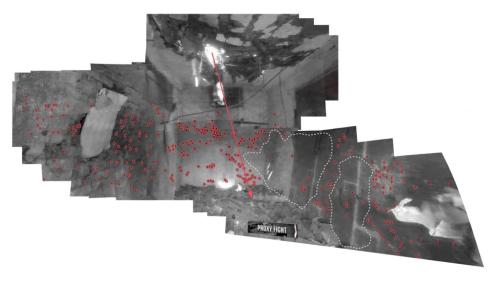
Photography extract from Decoding video testimony, Miranshah, Pakistan, March 30, 2012 © Forensic Architecture in collaboration with SITU Research.
In an uncomfortable echo of Mailaender’s work we see the body as a battle ground. Mailaender subjects are willing participants but, by contrast, Dufour and Barral show us images in which the dead are drawn into space of the contested narrative. Here, dead bodies are used to to deliver or deny accusations of a fatal crime against them.
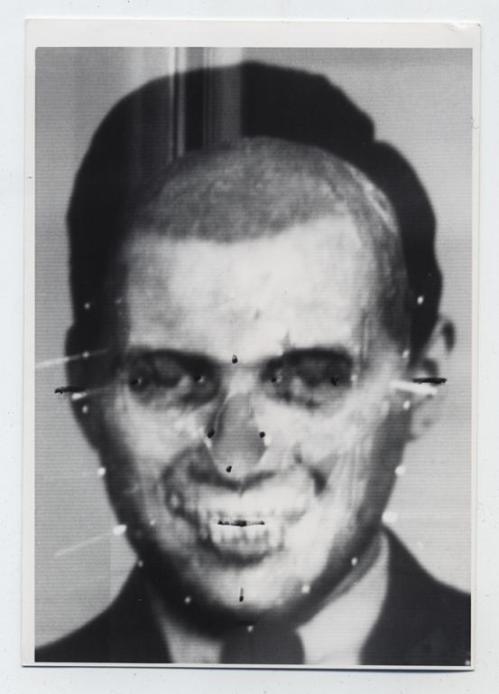
Richard Helmer’s face/skull Mengele superimposition 1985 © Photo Richard Helmer Courtesy Maja Helmer, 1985.
Folks in the art-world often forget that photography underpins judicial, political, labour and territorial infrastructures. Images Of Conviction reminds us that pretty pictures are just papering the cracks over fizzing, and sometimes terrifying, realities.
OFFICIAL APERTURE BLURB
In this meticulously designed catalogue, photography itself is put on the witness stand. Published to accompany an exhibition of the same name that originated at LE BAL, Paris, Images of Conviction is a fascinating historical survey of the ways photography has shaped official versions of truth — from the Shroud of Turin to crime-scene photography of the freshly dead, to video evidence of drone strikes.
The design is sedate but never boring, alternating between pale gray and clean white paper. The images are all reproduced in black and white, with a chilling negative image printed on the cover. “Everything is made so that the catalogue stays neutral, but not cold,” says Julien Frydman, who also praises the diverse, well-edited texts. The volume offers a variety of answers to the question posed by editor Diane Dufour in her introduction — “How does the image take shape in truth-seeking scientific and historical discourse?” — without losing its sense of mystery.
Winner of First Photobook
Daniel Mayrit
You Haven’t Seen Their Faces
RIOT BOOKS (Madrid, 2015)
Designed by Verónica Fieiras and Daniel Mayrit

MY THOUGHTS
The former Arsenal and Brazil midfielder Gilberto Silva expressed his dismay this week that next to no professional footballers were speaking outabout the FIFA corruption scandal that is tearing the heart out of the beautiful game. Maybe it’s that the story is old or maybe it’s that we don’t know how or where to pinpoint our anger at white collar crimes?
Despite millions of people losings their homes, pensions and security, still no-one has been prosecuted for their role in the housing crisis and consequent global meltdown. Daniel Mayrit’sYou Haven’t Seen Their Faces uses news and public domain images to mimic CCTV captures. The 100 people featured in this stack of butcher-paper fly-posters are those deemed most powerful in the City of London in terms of policy, politics, and those in control of banks, corporations and regulatory bodies.

The title is a cheeky inversion of Margaret Bourke-White’s landmark You Have Seen Their Faces (1937) a book about poverty in the Southern states. In the 20th-century we thought we could, as a society, come together and solve social ills. Now, however, we struggle to know from where the confusion festers and we rely pathetically on mischievous artists to out the beneficiaries of 21st-century capitalism.
Images were once tools of humanitarian witness, now they’re cheapened, desperate and frustrated gestures toward the insulated power-classes.
OFFICIAL APERTURE BLURB
Daniel Mayrit plays with the semiotics of law enforcement in You Haven’t Seen Their Faces. Full-bleed close-ups of the declared “100 most powerful people in the city of London” are printed in the style of grainy CCTV footage, with condemning information against them scrawled on every image. The book is a response to police fliers handed out after the 2011 riots in London, when surveillance images of alleged rioters’ faces were publicly distributed in a presumption of guilt. Mayrit flips this visual language on those believed responsible for events that are arguably far more damaging: the recent economic crises that have wracked Europe.
Yannick Bouillis calls the design “streetwise”; held together by screws at the top, the images are printed on lightweight brown pages akin to butcher paper, and fastened to stiff cardboard. A map of the suspects’ headquarters is tucked into the back.
Conclusions
It was not obvious to me until I really approached the final drafts of this review how depressing the four photobooks are in conglomeration. In them we have the slow death of free press, corporate criminals at large, homicide, dispute, intimate violence, microcosms of global warming, total surveillance, harrowing medical procedures, genocide, labor camps and the havoc of the markets.
The Paris attacks exploded out of fear, hatred, deep-level antipathy and dehumanisation. ISIS’ acts of terror are a symptom of profound division: Western military meddling and foreign bombs in the Middle East + Whackball religious ideology = Crumbling social fabric. Unfortunately, I think that the attacks will also serve as cause; the cause of more military meddling and fundamentalism.
The international community, and the French people in particular, have already shown that they will not be divided by murderous acts. Nor should France sacrifice its ideals of liberty, equality and brotherhood in response to the extremist nutters. However, increased military incursions into Syria and strikes on ISIS will, I fear, only poor flames on the fire.
France launched attacks on ISIS positions the Monday after the attacks. President Obama has sent U.S. troops to carry out raids throughout ISIS-held territory. This week, the British and German governments voted to launch airstrikes in Syria.
Seeing Is Power
And so we have two types of “sight” in the Global War on Terror (GWOT). Abroad, is drone recognizance, military mapping and satellite imagery providing data upon which awesome bombardments are planned. At home, throughout European cities and transit hubs, citizens are subject to pernicious and exacting CCTV. In both cases, the application of these technologies is meant to prevent further killing (perversely, in the case of guided-bombs, by killing targets not civilians) but also to establish moral cause and “truth” in the aftermath of death. CCTV will be used as evidence. News channels will be fed footage of bombs striking combatants through air vents. Facial recognition software will identify people IRL and in the digital realm at exponentially faster rates.
This writer cannot see how more bombs in a region already pummeled into unknown levels of chaos is likely to help, but geopolitical strategy is above my pay grade. Righteous anger is an understandable response, but should it make for armed retaliation? Let’s just say this writer is comfortable deferring to Nicolas Hénin, a man who was held hostage by ISIS, who cautions against massive military airstrikes:
While we are trying to destroy Isis, what of the 500,000 civilians still living and trapped in Raqqa? What of their safety? What of the very real prospect that by failing to think this through, we turn many of them into extremists? The priority must be to protect these people, not to take more bombs to Syria. We need no-fly zones — zones closed to Russians, the regime, the coalition. The Syrian people need security or they themselves will turn to groups such as Isis.
The fallout from the tragic events of November 13th will inevitably involve more bloodshed.
Anxiety reigns currently. That is understandable. Some reaction to the anxiety is less understandable. Sometimes, it is easy to overlook or downplay the constant state of vigilance in which people, and especially government agencies, operate. The Paris attacks revealed the threat is real.
As much as the Paris Photo-Aperture Photobook Awards reflect cultural production, and as much as cultural production reflects common concerns and public psyche, we can identify in these four winners the trauma and violence that bubbles constantly under the surface in our global community
These four books are not entirely unrelated to the violence that broke the peace in Paris three weeks ago. They are documents of our time and, sadly, they deal with miseries that harken back long before these tense times.
The Paris Photo-Aperture Foundation award winning photobooks on view
Aperture Gallery, New York (December 12, 2015–February 8, 2016); Huis Marseille, Amsterdam (December 2015–January 2016); Scotiabank CONTACT Photography Festival, Toronto (May 1–31, 2016); Self Publish Riga, Riga Photomonth, Latvia (May 12–June 3, 2016); 15th International Festival of Photography in Łódź, Fotofestiwal 2016, Poland (June 9–19, 2016); Landskrona Foto Festival, Landskrona, Sweden (August 19–27, 2016).





 Prison Photography