mousa

Still from video shown to the Baha Mousa public Inquiry showing Corporal Donald Payne, formerly of the Queen's Lancashire Regiment, shouting and swearing at hooded Iraqi detainees.

The British Army is facing accusations as serious as those leveled against the US military at Abu Ghraib.

Let me offer some context of UK Army abuses in Iraq.

Only one British soldier has ever been sentenced to prison for detainee abuses in Iraq. He is Corporal Donald Payne. Above is a still from this very disturbing video which was released in June of this year into the inquiry of Baha Mousa‘s death. A long-running and contradicting narrative followed this case since Mousa’s death in 2003 and the opening of the first inquiry in 2006. BBC has a timeline.

It seems that Corporal Payne and the six other soldiers aquitted during this inquiry may not have been the only British soldiers involved in abuse. I must say that these allegations are still just that – they are unproven, yet to be fully investigated.

Robert Verkaik of the Independent has pursued this story here and here:

One claimants says he as raped by two British soldiers, and others say they were stripped naked, abused and photographed. For the first time, British female soldiers are accused of aiding in the sexual and physical abuse of detainees.

The 33 new cases, which form part of a pre-action protocol letter served on the MoD last week, include allegations of mock executions, dog attacks, rape, exposure to lewd acts and exposure to pornography. The abuses are alleged to have occurred in 2003 – the time as Baha Mousa’s torture and death.

It is suggested it has taken so long for the allegations to come about because the Iraqi’s were fearful of reprisals during the British occupation of Southern Iraq. UK forces pulled out in April, 2009. Three camps are named: Shaat-al-Arab camp (shown below), Shaaibah British camp and Akka in Al-Zubayr.

Shaat-al-Arab camp, Southern Iraq

Shaat-al-Arab camp, Southern Iraq

Details of abuse:

In May 2003, a 16-year-old Iraqi was among a group of Iraqis taken to the Shatt-al-Arab British camp to help fill sandbags. When the Iraqi youth, who wishes to remain anonymous, and his friends had filled the available sandbags, a British soldier indicated that he should enter a room, from where he assumed that he was to retrieve more sand bags, he says.

On entering the room, he claims he saw two British male soldiers engaged in oral sex. As soon as the two men saw him enter, they started to beat and kick him, he alleges. When he fell to the floor, one of the men held a blade to his neck while the other soldier stripped him naked. Although he screamed in protest, the two British soldiers, one after the other, raped him.

More:

They took off our blindfolds and I could see that we were surrounded by seven or eight soldiers. There were five of us. They asked us to pick fights with one another, or fight them. They were laughing at us and taking photos with digital cameras. They made us squeeze in pile-up, as in Abu Ghraib prison photos, while a soldier stood on top of us and started shouting and laughing. I felt so humiliated and treated as a toy they messed up with.

They picked further on a younger man who was good-looking. They made him strip naked and started messing with his penis and taking photos. “On one occasion I refused to pick a fight, then a soldier kicked me hard on my back, which made me fall on the floor. He started hitting me with a baton on my knees. Then he used an electric baton on different parts of my body.”

Source: Independent Saturday, 14 November 2009

Of course one wonders now whether the investigations will publish the photographic evidence or if it will be used only internally.

Personally, I have no desire to see these images. I sympathise with arguments to say that only through release of such images can the world know the full extent of what happened, but I also doubt what we can actually and accurately “know” from photographs that we wouldn’t otherwise learn through full disclosure and description of events.

It is extremely unfortunate that both Google and Daylife image searches for “Shaat-al-Arab camp” result in this image.

IRAQ-BRITAIN-CHRISTMAS

British soldiers share a laugh as their comrade walks around dressed as Borat, the Kazakh journalist played by British comedian Sacha Baron Cohen, during Christmas celebrations at the Shatt al-Arab camp in the southern Iraqi port city of Basra on December 25, 2008. The Iraqi parliament has voted to allow the presence of non-US foreign troops after December 31, giving British troops a legal basis to remain beyond the expiry of a UN mandate. © ESSAM AL-SUDANI/AFP/Getty Images

But the madness, brevity, violence, stress, justified escapism, testosterone and “laws” of war are vastly different than in any other milieu.

It just seems to me that the internet has collided stories and images here that could be as valid a critique of 20th century war as any of the great American Vietnam films.

____________________________________________________________

Interestingly, Shaat-al-Arab camp was erased by Google from their maps three years ago for security reasons. This action seems warranted as Shaat-al-Arab camp was a common target for insurgents – as Abu Ghraib was. Details are described half way through this article.

Thanks to Sean for the tip off.
Errol Morris has kept us entertained recently in the New York Times.

You should know about Standard Operating Procedure, but given the remarkably well suppressed distribution last year, it might have bypassed your radar.

The Geneva Convention on handling prisoners bans:

– Cruel treatment
– Physical and mental torture
– Humiliating and degrading treatment
– Outrages upon personal dignity
– Reprisals

prisonnursery_05

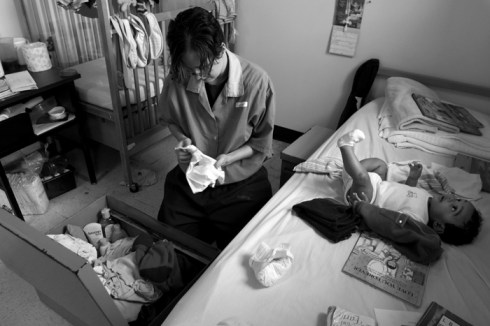
Jessica changes Kyree inside the 12-by-6-foot cell they share at the Ohio Reformatory for Women. The inmate mothers have special privileges the other inmates don’t have like leaving their cell at night to warm a bottle and a special outdoor play area.

I while back I posted a nod to Angela Shoemaker and her work at the Prison Nursery at Ohio Reformatory for Women, Marysville, OH.

Since then, Angela has been busy with her multimedia work on families and the recession, updating her website theme & images and securing a Fulbright Grant to photograph Muslim youth in the Netherlands.

Check out Angela’s series about mothers and babies in prison. She has provided us with good background information to the program.

The stand out stat for me was that only 16 of the 138 women who have passed through this program have re-offended which is good for them and very good for us as a society.

Angela also teamed with Dustin Franz on the multimedia piece Hope is on the Horizon.

On Will Steacy’s blog this week:

aryan

Silverstein pulled a nearly foot-long knife from his conspirator’s waistband.“This is between me and Clutts,” Silverstein hollered as he rushed toward him. One of the other guards screamed, “He’s got a shank!” But Clutts was already cornered, without a weapon. He raised his hands while Silverstein stabbed him in the stomach. “He was just sticking Officer Clutts with that knife,” another guard later recalled. “He was just sticking and sticking and sticking.” By the time Silverstein relinquished the knife—“The man disrespected me,” he told the guards. “I had to get him”— Clutts had been stabbed forty times. He died shortly afterward.”

David Grann. ‘The Brand’, The New Yorker, February 23rd, 2004

It may be helpful for my readership if I state that I am not a prison abolitionist.

It occurred to me that I may not have shared that with you. There is a legitimate need for prisons when incorrigible and dangerous men or women must be controlled for the safety of all.

Unfortunately, over the past three decades, prisons in America have been used to test the “incapacitation theory” – which as Ruth Gilmore posits in Golden Gulag is not much of a theory, in fact it is not really a theory because it doesn’t propose to do or enact much at all [I paraphrase].

Prisons are many things; the parts of an expensive social experiment, the dumping-grounds for citizens caught up in the war on drugs; the accidental and damaging substitutions for mental health institutions; and in very few (and just as real) circumstances the necessary lock-ups for extremely violent offenders.

One problem I have in communicating the need for real prison reform is created by the fact that violent offenders are those that seize the public’s attention. Violent criminals are a tiny fraction of America’s prison population yet they’re the ones that trigger fear instincts and sway public opinion. I understand why this is the case and why it takes a lot to get past that.

Men like Silverstein, who’s actions are described above, should be behind bars for a long, long time. But the vast majority of the 2.3 million prisoners of the US are not like Silverstein. This same vast majority would also want Silverstein behind bars … and they’d make good argument as to why they shouldn’t be there with him.

screen

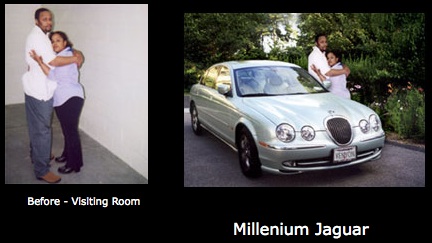
Aside the Coca-cola vending machines and Cheetos, portraits and photo-keepsakes are probably the most ubiquitous objects in prison visiting rooms.

I have speculated before about a massive, dispersed collection-without-walls made up of the millions of prison Polaroids; a sprawling, bittersweet and neglected vernacular photo-archive of true American experience.

Polaroid cameras are still the standard for prison visiting rooms as they provide instant results and they don’t have the “security issues” associated with he transferability of digital files. No matter the format, Friends Beyond the Walls will help construct your photo-idyll:

Through the use of digital technology, Composite Magic brings you, your family and loved one(s) together in an exciting new way, featuring dozens of the most beautiful full-color dramatic background locations that make ALL the difference!

Just send us your favorite Polaroid or 35mm snapshot … We’ll take your image out of those prison photo backgrounds, and place you and yours “inside” the romantic or exotic location that has previously been outside your reach!

No more explaining where the photos were taken!

Some companies simply “paste” your image on a photo background. For the most realistic and unique effect, Photos Beyond The Wall specializes in placing you “inside” the photo! See how the Composite Magic process works! ESCAPE from the confines of those boring “click click” backgrounds, and be released to the free world … right into the photo location of your choice!

There is plenty of scope here to pour scorn upon the low-brow photo-manipulation, and there is (justifiable) reason to question the financial gains of the company involved in providing such a basic service, but I won’t go there.

People aren’t stupid. They won’t invest their emotions in “Composite Magic” if they don’t want to. But if someone does make use of this service then so be it – we all spend silly money on items foreign and bizarre to one another.

3

4

I will say this: prisoners and their families develop fast and hardened interactions with correctional authority. The procedures of the visit become as routine as picking up the paper or grabbing a morning coffee. It makes sense that some of that population would take the opportunity to leave that dictated reality behind and reclaim (visual) identifiers that don’t belong to  departments of corrections and criminal justice.

Therefore, the only real way to discuss this niche photo-aesthetic and grow a legitimate appreciation would be to talk to the sitters, consumers and owners of this niche photo-aesthetic. That could be the territory for anthropologists and sociologists or, as easily, it could be the chatter of ordinary people who still take an interest in other ordinary people.

1

2

devstory

A Developing Story is a new joint venture by Johnny Bennett, Phil Maguire and Benjamin Chesterton of duckrabbit.

In an email a few months ago, Ben said to me his interest lies in “getting under the skin of NGOs” and have them realise that they can deliver their stories and campaigns in far more effective ways. A Developing Story wants the stories told in Government & NGO international development campaigns to outlast the short term objectives of said campaigns.

A Developing Story proposes that the media of these campaigns is deposited in a common silo, accessible by all (usually under a Creative Commons license) so stories – once created – can tell themselves infinitum.

While we believe that there’s clear value in bringing together this public-facing, awareness-raising communication material, we also want to do something similar for communications that are used in international development – e.g. radio scripts, posters, mobile text messaging campaigns, etc, used in health campaigns, etc.

Unfortunately, almost none of this material is available in the public domain. A public health campaign about the risks of HIV is run in South Africa, for example, but the artwork and radio scripts aren’t available to someone doing the same thing in Malawi six months later. And that’s what we want to change.

We believe that all Government funded communications for use in international development should be available in a central, easily accessible database under Creative Commons licenses. A database where photographs, posters, scripts, public information leaflets, etc, can be downloaded, copied, translated and adapted for local audiences, saving practitioners time and money and therefore ultimately saving lives.

In an age where we recycle many of our physical objects, it seems strange that most of the international development communications work funded by Governments, IGOs and even NGOs is completely lost after the short campaigns they promote.

Given the primacy of Creative Commons and open-source content, Matt and Scott at DVAfoto needed clarification on A Developing Story‘s impact on the photographer (which was provided). I have fewer worries as I feel this venture is aimed at transforming media sharing practices among government funded and NGO initiatives rather than another pressure on the distribution and remuneration of individuals’ works.

I would anticipate that the payments made to photographers and journalists by media campaign management will continue and that photographers will take on assignments in the knowledge that their work can be used repeatedly for non-profit purposes.

That said, A Developing Story is very open to individual contributions. This is the most relaxed approach to collaboration I’ve witnessed!

We’re always looking for contributing editors. So whether you’re a blogger, a photographer, an academic or an aid worker we’re keen to hear from original voices.

We’re particularly interested in multimedia work, so if you want to post monthly podcasts from the Congo, or a slideshow from Myanmar, then do get in touch. There’s no obligation attached to being a contributing editor, you only have to contribute once, and you can post as infrequently as you like.

So, as Ben asked, “Can You Help?”

DSCN0174_edit

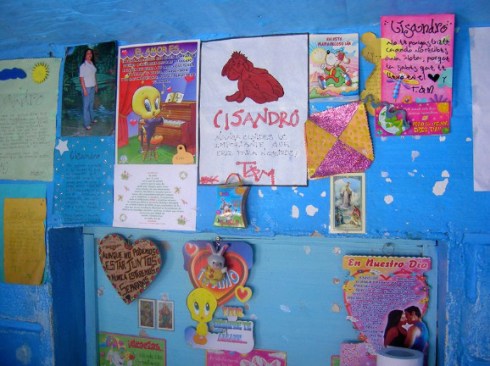
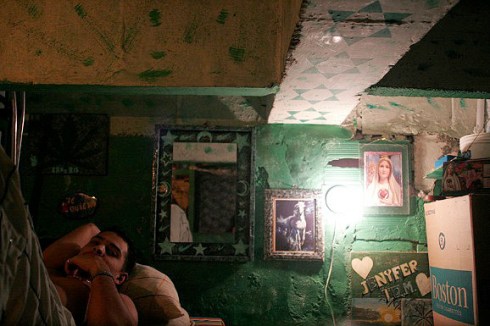
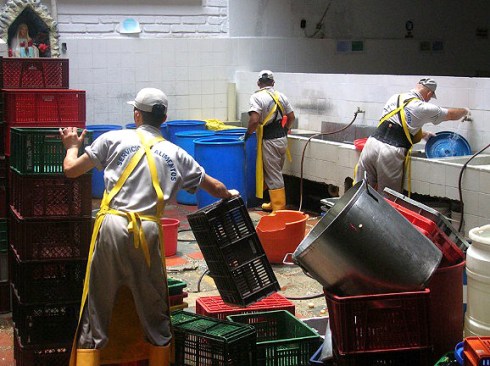
Often it seems photographs of South American prisons are presented in North American media only to emphasise the gulf that exists between the conditions of incarceration in the two regions.

I have posted before about prison beauty pageants in Bogota, Colombia; about the rise and fall of prison tourism at San Pedro in La Paz, Bolivia, and I have looked twice at Gary Knight‘s photography at Polinter prison in Rio de Janeiro – latterly featuring the conspicuous acts of a celebrity evangelical minister.

(Nearly) all photo essays I see coming out of prisons in South or Central America fall into one of two categories, or both:

1) A colourful contradiction to the dour, authoritarian environments depicted in US prison photojournalism.
2) A claustrophobic assault on our emotions as witnesses to desperate overcrowding and poor hygiene. The example par excellence of this is Marco Baroncini’s series from Guatemala.

What leads me to a narrow, ‘boxed’ categorisation of such documentary series is that I am convinced photographers know either the media or their editors well enough to know what flies with Western consumers and as such deliver an expected aesthetic.

I was therefore left without anchor when cyber-friend Nick Calcott sent over this latest offering by GOOD magazine on Medellin’s prison in Colombia. The images are by the inmates themselves:

On the invitation of the Centro Colombo Americano, an English language school for Colombians in Medellín, Vance Jacobs ventured to the Bellavista Prison with an inspired assignment: to teach documentary photography to eight inmates in one week.

“One of the things that gets the inmates’ attention is responsibility, that there is a stake in what they do. In this case, their ability to work together as a team, and to pull this together in a very short amount of time would determine whether other similar projects were done not only at this prison but at other prisons in Colombia,” says Jacobs. “Once they bought into the idea that there was a lot at stake, they really applied themselves.”

MG_3316_edit

DSCN0965_edit

In the past, I have wondered how the camera can be used as a rehabilitative tool and it is a question that can be answered from different angles. In this case the responsibility given to the inmates is how we can derive worth. I have shown before that performance and team work in front of a camera can be good for exploring the self and ones own identity (and the results are of huge intrigue). The common denominator for any photography project is surely that it immediately relieves the boredom of incarceration.

DSCN0154_edit

EMAIL

prisonphotography [at] gmail [dot] com

Prison Photography Archives

Post Categories