IMG_7250

Three months ago, I wrote about Silja Talvi‘s excellent book Women Behind Bars.

It turns out the Texas Department of Criminal Justice also noticed it. They banned it – along with another book, Perpetual Prison Machine by Joel Dyer. Both books are distributed by Prison Legal News – a phenomenal non-profit based here in Seattle that educates America’s incarcerated class on its human and legal rights.

Prison Legal News has launched a lawsuit against staff and senior officials of the TDCJ. Money is not as issue here, principle is. “PLN is seeking compensatory, punitive and nominal damages plus declaratory and injunctive relief for violation of its rights under the First and Fourteenth Amendments, as well as attorney fees and costs.”

“It is a sad commentary when government officials censor books sent to prisoners – particularly books that deal with prisoners’ rights and conditions in our nation’s prisons,” stated PLN editor Paul Wright. “Apparently, the TDCJ prefers that prisoners remain uninformed about issues that directly affect them. We believe this is a poor rationale for censorship.”

WHAT TO DO

Visit Change.org and read my brief article.

Download the full PLN lawsuit (PDF).

Sign the petition to the TDCJ for reversal of their censorship policy.

In the past I have provided varied perspective on Guantanamo. I put together a rudimentary Directory of Visual Resources. I alerted readers to important coverage of exceptional events here and here (granted, all events related to Gitmo are out of the extraordinary) and I have provided reflection on Guantanamo through the lenses of Bronstein, Clark, Gilden, Linsley, Pellegrin, Toledano and Lieutenant Sarah Cleveland.

Ultimately, none of these posts come close to describing or making sense of that most nonsensical of places. And so to ACLU’s latest video. My good mate Stan (cheers pal) posted earlier today:

Elsewhere, a friend of Prison Photography alerted me to the online journal JumpCut. Julia Lesage has assembled the most comprehensive webpage of Guantanamo links I’ve ever come across. Some of the links are already 404, but I would encourage you to peruse – I have still not exhausted the many resources. Leasge also contributes to the Spring 2009 issue with a section on ‘Documenting Torture’.

Today, I read this wonderful article about community acting cooperatively to send a message to the highest authorities.

Ruth Hooke contributing in the Guardian’s Comment Is Free:

A step has been taken to right the injustices being done to the remaining detainees at the Guantánamo naval base. On 4 November the representative town meeting of Amherst, Massachusetts, overwhelmingly passed article 14 of its warrant, which urges Congress to repeal the ban on releasing cleared detainees into the US and welcomes such cleared detainees into our community as soon as the ban is lifted.

To Sarah Palin, I’d state that this is true America.

Wendy Watriss, co-director of Fotofest, really digs Chinese photography. In 2008, Fotofest set up camp in China reaching out for the sakes of diversity, discovery and commerce.

Today, Fotofest announced its International Discoveries II. They include Alejandro Cartagena, Wei Bi, Minstrel Kuik Ching Chieh, Christine Laptuta, Rizwan Mirza, Takeshi Shikama, Kurt Tong, MiMi Youn, and Vee Speers (although Peter Marshall points out Speers isn’t that “new”).

The most comprehensive information available remains the Fotofest Press Release (PDF)

The most tantalising prospect for me personally is Wei Bi. Partly because of his project and partly because there’s nothing out on the web about him.

I skanked this screenshot of the Fotofest website. Sorry FF!

Wei Bi, Untitled, 2008

Wei Bi, Untitled, 2008

Here’s the blurb: “Issues of justice are embedded in Chinese artist Wei Bi’s re-staging of his 80–day experience in a Chinese prison — a sentence received for making a photograph. His large black and white photographs are minimal, showing a surreal relationship between near expressionless guards and disoriented prisoners. Despite the constructed nature of his work, Mr. Wei insists his “photography is not aimed to reveal, but to record, recording the existence of my life.” Wei Bi’s work was “discovered” at the Guangzhou 2009 Photo Biennial in Guangzhou, China.

How can we not be drawn to this work? He was imprisoned for his photography! Potentially, it is a narrative against adversity in which creativity triumphs.

If anyone reading this makes it to the exhibition please get in touch and tell me what you think of Bi’s prison photographs.

14414.jpeg

Past and present ruminations about what is and isn’t a photograph have been a source of frustration for me. For one, people can draw whatever lines they wish to determine the point at which manipulation tricks out a photograph and thus qualifies it as photo-illustration. And for another, as Errol Morris keeps banging on about, ALL photography is lies (and manipulation).

These debates are not about truth. Interventions – power relations, habit, photographic custom, complicity among subjects, props, political agendas (and framing), cropping, tweaking of exposure levels before and after development, digital alterations – mean that photography can never be, will never be truthful.

People forget that often it is the ingenious tricks that have spurred the largest wonder among viewing public – think Oscar Rejlander’s Two Ways of Life, Spirit Photography and – in a different sense – Ansel Adams’ Zone System.

It is therefore, with some relief that an artist like Azzarella comes along using photo-manipulation as the tactic and purpose for his work.

7069.jpeg

7060.jpeg

Last week, I questioned Anton Kratochvil’s Homage to Abu Ghraib, mainly because I think it makes little contribution to the discourse on the political aesthetics of Abu Ghraib. The blurry references to torture in Kratochvil’s images are in response only to a personal, conscious and willing point of view. I understand that Kratochvil’s work was an exercise in self-therapy but that shouldn’t stop me comparing it to Azzarella’s broader concerns about more general and unconscious reactions to well-circulated images.

If I w re to wr t th s sent nce wi h lette s m ss ng, you can still read it. The human brain is a wonderful instrument drawing on past experience to quickly filter out the non-possibilities. Just as the brain instantaneously deciphers gaps in text so it does with gaps in images.

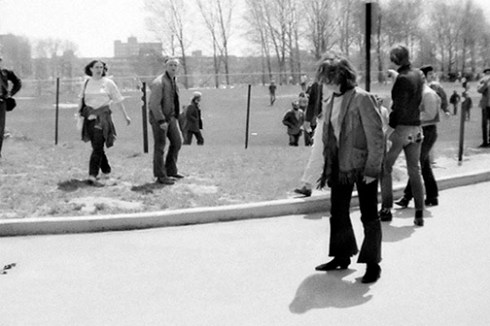
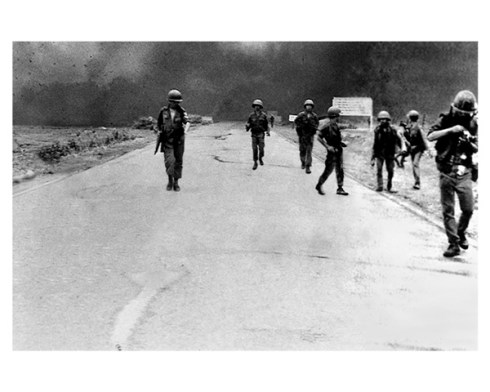
With every passing hour the Spectacle suffuses itself further. It isn’t so much us reading images but images reading us. Our involuntary responses to images are predictable, predicted, precoded. The redacted action of violence in Azzarella’s pictures plays second fiddle to the original image, for it is the original image we drooled over and devoured.

The hooded detainee, dead student, wailing child or falling soldier needn’t even be present; our internal, emotional feedback spun by these images will forever be the same. We fill in the gaps and short circuit to prescribed disgust, sadness and politics, thus confirming our prevailing bias.

Azzarella’s works expose the fraud in us all … and our cheapened, robotic response to image.

7165.jpeg

11060.jpeg

7066.jpeg

11357.jpeg

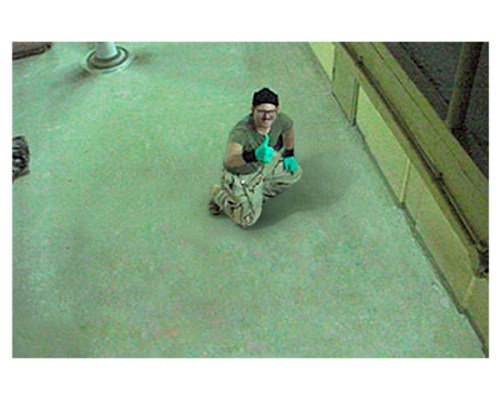
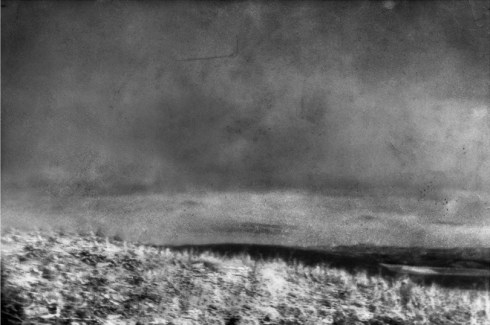
ALL IMAGES © JOSH AZZARELLA. FROM TOP TO BOTTOM: UNTITLED #13 (AHSF); UNTITLED (SSG FREDERICK); UNTITLED #24 (GREEN GLOVES); UNTITLED #35 (CAFETERIA); UNTITLED #39 (265); UNTITLED #20 TRANG BANG; UNTITLED #43 (PAR115311).

© Damon Winter

Too Much Chocolate

When Jake Stangel put out a call to interview Damon Winter for Too Much Chocolate I didn’t hesitate. How often do you get to bend the ear of a Pulitzer Prize winning photographer?

Jake assured me that Damon was – is – “a super-nice guy” as well. I might argue that Damon is too nice; he carried, without complaint, a sinus-busting cold to deliver the interview.

Damon and I spoke about his assignments in Dallas, L.A. and New York, the Obama campaign coverage, making portraits, Dan Winters, Irving Penn and Bruce Gilden. Read the full interview here.

_____________________________________________________________

Angola Rodeo

Not without my own agenda, I also asked Damon about his experience down at the Angola Prison Rodeo:

PP: Why were you there?

DW: I had gone out for two trips. It was when I worked at the Dallas Morning News. The way I pitched it was that the prison was expanding the program to launch a spring rodeo. I wanted any excuse I could get to go down there and photograph. It sounded absolutely incredible.

DW: And the paper ended up not being that interested. They may have run a small little blurb about it, but I did it for my own interest. It was fascinating – a completely wild situation. Most of these guys came from the cities. Some had never even seen a cow let alone roped a horse.

© Damon Winter

PP: Describe the atmosphere.

DW: The closest thing to modern day gladiators – something you’d see in a Roman Coliseum. The crowd is chanting for blood, they want to see a violent spectacle where prison inmates are the subjects. It’s the same reason people go to see a horror movie or stare at a wreck on the highway. It is a very strange situation but they want to see blood.

PP: Do you think it helpful to the local community?

DW: There is no interaction between public and inmates. The public is there to observe and the inmates are there to entertain. The benefit the inmates gain is at a level very specific to their situation. They risk injury being in the ring with massive bulls, and their prize is something I think anyone in the free world would laugh at, you know? Maybe a couple hundred bucks. But it is substantial in their environment.

It speaks to the bleak situation that those guys are in that this would be enticing – to risk bodily harm for a couple of hundred dollars.

I don’t know how constructive it is for relations between prison and non-prison populations.

PP: Which is unusual because in any other state across the country, there is no interaction between the public and the incarcerated population.

DW: What’s your feeling?

PP: I think it builds a division at a local level, but it also feeds a national view that excludes the realities of prisons. The inmates are put out there to be observed, photographed and consumed. Such a presentation is not unpalatable to the American public. To the contrary, the public feels as though it gains from it. I think here unexamined (and abusive) interactions can be confused with relationships.

I think the wasteful and very boring reality of prisons in America is not going to make it into newspapers or media, but the rodeo does. It skews perception. I think the rodeo is problematic.

DW: I felt the event was dehumanizing. It was done in a manner so that the inmates are reduced to the level of the beasts they are competing against. It seems the field has been leveled between animals and inmates and the feeling that you get from that is that they themselves are like animals. They are not seen terribly differently from the way that the animals are seen.

PP: I am not sure that that sort of spectacle would take place outside of Louisiana, certainly outside the South. Granted, Angola’s warden Burl Cain jumps at the chance to get the cameras in at any opportunity.

DW: Yes, I saw The Farm, a documentary filmed at Angola.

PP: I think Cain’s administration paired with the history of the event creates a spectacle at the rodeo that goes unexamined.

PP: Cameras are common at Angola; documentary shorts on the football team and photo essays on the hospice. It is a complex that has 92% of its population.

DW: You should look at Mona Reeder’s work. She works at the Dallas Morning News. I think it was called The Bottom Line and she turned the stats into photo essays and one of the stats was the number of prisoners in juvenile facilities. She got some pretty good access. She received a R.F. Kennedy Award.

PP: I certainly will. Thanks Damon.

DW: Thank you.

_____________________________________________________________

Below are three of Damon’s photographs from Afghanistan which stopped me in my tracks. Unfortunately, I discovered them after the interview so didn’t get Damon’s take on them.

Winter1

The images of the boys really affected me. We see so many images of bearded men, U.S. Marines in the dirt, explosions, women in burqas, etc, but it is the children of Afghanistan who will carry the violent legacy for the longest. What pictures reflect that fact?

It is an impossible task of any image to near ‘truth’ or reality, but these two pictures get very close to the sad reality of conflict and the impressionability of youth.

Winter2

Winter15

DeCarava

Roy DeCarava’s life and work has been noted by every source that should be seen to care following his recent passing.

There’s no doubt, DeCarava was a photographic great, a pioneer and a fine craftsman … but he had barely registered on my own personal radar. Until I found the story below courtesy of Dawoud Bey, I did not intend to comment upon DeCarava’s death. It would be inappropriate: I didn’t know about his work when he lived, why should I put on a show of knowing when he died?

Bey says:

DeCarava is too often grouped within a kind of black photographic trinity, which usually includes James Van DerZee and Gordon Parks. Many years ago I myself made the mistake of naively calling DeCarava to ask if I might interview him for inclusion in an article that I was writing about Black photographers for American Arts magazine. Roy asked me who the other photographers were and bristled when I mentioned James Van DerZee. I tried to explain that my inclusion of Van DerZee had more to do with the historical reach I wanted for the article and that I was also including Anthony Barboza, and other younger black photographers. I can still hear Roy’s response ringing in my ears. In no uncertain terms he attempted to educate me and set me straight. “Listen, James Van DerZee was a studio photographer, making pictures of people in the neighborhood who paid him. His pictures are interesting for a whole different reason. That’s not what I do. If you want to do an article on them, do an article on them. If you want to do an article on me, then do an article on me. But you will not do an article on them and me. I’m not a commercial photographer. What does our work have to do with each other?”

Dawoud goes on:

Roy was right … He wanted me to understand the difference between his intentions and theirs and not to merely and carelessly group them together because of race, as often happens with black photographers, often finding themselves grouped together in conceptually dubious exhibitions in which the rubric of race is often the only unifying factor. It was Roy DeCarava who first gave me a healthy skepticism about these kinds of shows, given their often spotty scholarship and thematic diffusion.

I guess the lesson – for all things – is that one should only comment if the comment is vital, relevant and fair.

Thanks for sharing Dawoud.

___________________________________________________

Elsewhere, from a 1996 NPR interview, it was fascinating to hear DeCarava’s matter-of-fact memory and experience of serving in the US Army, “In those days there were two US Army’s. One Black, one White.”

SashaMaslov_PrisonTheatre_03_large

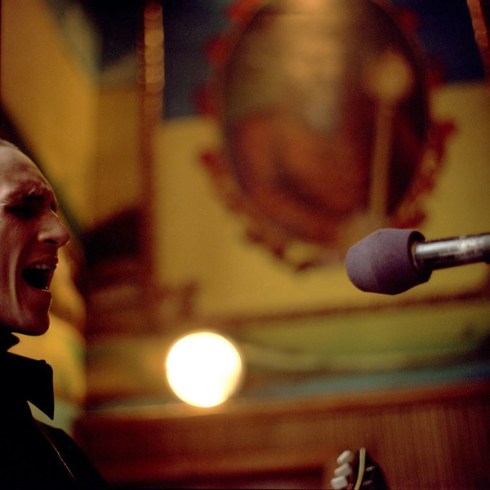
It sounds asinine to describe a prison as beautiful. Perhaps, the warm tones of the theatre-house in Kharkiv’s penal colony are a lure. But, I don’t want to budge on this; Maslov’s images are sumptuous.

Let us not forget though, the photographic series, however beautiful, is the product of specific circumstances. The more we know about these circumstances the better equipped we are to understand them and their content. Last week, Sasha and I talked over Skype about the details of the project.

How did you arrive upon the subject?
I had a couple of friends who had been running a theatre class in a prison in Kharkiv, Ukraine. I thought it was a great subject so I went along. Theatre performers aren’t what you expect to see in a prison. Being an actor is a ridiculous notion for criminals; you’re basically putting yourself in the position of the fool. The prison was maximum security so they were in there for serious crimes. At the beginning it was … kind of creepy, but then I got used to it.

I wanted to shoot with film. Initially, the warden said I’d have to use digital equipment, but I explained it was essential I used film and showed him some of my images. In the end, he permitted it.

It looks like you were you there for the final performances. How long had they been rehearsing and how many times did you visit?
They’d been working on the play for 9 months. I went in three times, but most of the shots from the project were taken on the day of the main performance.

What message did you hope to communicate with the project?
I go into all projects very open, without really knowing what it’s going to be like and if I will actually have anything at all in the end; what can I see? What can I tell? I think this is best.

SashaMaslov2

SashaMaslov_PrisonTheatre_06_large

Some of your subjects seem uncomfortable with the camera?
Yes. It is understandable as cameras aren’t something they are used to. Some don’t want to be seen for obvious reasons. Those acting in the troupe were more open to being photographed. I felt like during the new experience for them with this theatre they opened new horizons, but generally in prison the feeling is that the camera is not your friend.

I actually tried to shoot in two  prisons, they other being a women’s prison but nothing came out of that project. The women acted very differently around the camera. Every time they saw the camera they’d change something. They’d usually smile. They would present themselves for the camera. The women always smiled.  Once, I caught a glance of a female prisoners glaring at a male guard. It was a real wolf glare. I lifted the camera, but instantly she saw me and changed her look. Her eyes became those of kittens.

Perhaps this desire to perform or adapt for the camera by female prisoners is something you could work with in the future? Deborah Luster worked with the females in the Louisiana prison system making portraits of them in full theatrical costumes.
Yes, it would be interesting to shoot there again.  But also, people aren’t totally truthful. They can’t talk about things that are difficult. I wasn’t allowed in their cells.  The experience changed me. Not massively, but it did make me look at things a little differently.

SashaMaslov_PrisonTheatre_11_large

In Ukraine can one assume certain things about the prison population? I ask this because in America’s medium security prisons where men can be serving long to life sentences, some may not be there because they are violent offenders. It is the non-violent men who are warehoused who seem to lose most through harsh sentencing. Does this mix of offender-types occur in Ukraine?

I cannot say. Of course, I never asked. One inmate did say to me, “You don’t have to pretend to respect me. You know I am in here because of something terrible I did.” But, I wasn’t pretending to respect anyone. These people were new for me, if you don’t consider the place where the [project] took place you are not able to form any prejudice.

Do you know what percentage of the men would eventually be released?
No, but I know some were due to be released very soon. One actor was due to be released one day before of the performance, but he preferred to stay for another week so that he could perform the show.

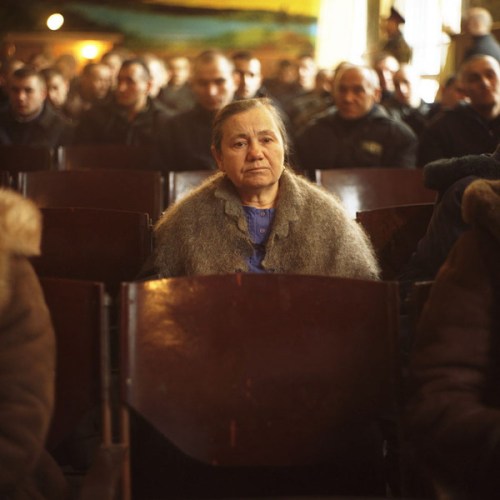
Right before show began I took a shot of a woman in the audience. I will never forget this moment. Later I found out she was a mother of one of the inmates in the troupe. She had come to tell him that his brother had died on the outside. She waited until after he’d finished the show because she didn’t want to ruin his performance. It was only afterward when I found this out I understood why she did not smile during the show.
SashaMaslov_PrisonTheatre_05_large

And how was the show?
The dramatics were amazing to see. Many of the men struggled over and above their usual habits to get the lines out. The play was The House that Swift Built, which is a fiction about a house full of ridiculous items and fantastic people. Jonathan Swift tells unbelievable stories and plays practical jokes, the nature of existence in and outside the house is questioned. The players have the potential to transform their lives. Of course it was interesting to see this done by prisoners.

Still, many of the lines were delivered with arrogance. Even in soft conversation, the actors came across as brash. They are used to being in a defensive position so there was always a strange arrogance … or little aggression.

Did the inmates see your prints?
Yes, I sent prints to the prison. If there was a shot with two prisoners in it, I’d send two copies. I don’t know how they divided all the works among the guys but I know they got them.

Did you ever have to secure model release forms?
[Laughs] No. I only had to agree on the project with the warden. The fact my friends had been there a while also made my case easier. The warden was forward thinking by Ukrainian standards. He was interested in the publicity it would gain for his prison.

What are the general thoughts of prisons among the Ukrainian public?
That they are places you shouldn’t go. Prisons are tough everywhere. After you get out, you just have a new set of complexes.

How do former-prisoners fare in Ukraine? For example, ex-prisoners in the US have to petition to gain their right to vote back. How does it compare?
Ukrainian prisoners can vote in prison. But, more generally, prison is forever a stain on your character. Human rights violations occur in prisons all the time – stabbings, abuses of power by the guards. You hear about these things on the news. But these instances are just pieces of sand on the beach. It could be a much larger problem. Perhaps it is but we don’t hear about it.

Well, it is an amazing glimpse for us all to get at an arts program inside a Ukrainian prison. What equipment did you use?
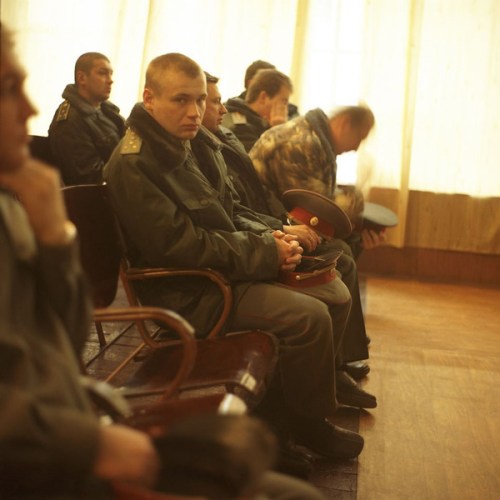
I shot with a Kiev 6S, a 6×6 medium format camera. It is bulky and heavy. I really liked working with it but I was always very visible to the prisoners with this thing in my hands. And the sound that it makes is beyond any politeness.
SashaMaslov_PrisonTheatre_07_large

What comes next?
I have two things on. I have just got back from Donbass, a region in Eastern Ukraine where I was doing a story on coal miners. It was an amazing experience, because for 20 years nothing has changed there except dramatic decline of population. There are small towns that lived off coal mines in Soviet period, but many mines were shut down or there are places where 5-6 thousands people worked and now there are 50-70 miners. It’s sad and fascinating area. The story will be out in a few weeks. I am also working on a show of photographic portraits for a gallery in Ukraine.

How do you pick your subjects?
I do what I think is important. I don’t plan too far ahead. I’ll be interested to see what happens in the near future with the industry.

You heard this month about Christopher Anderson saying, “The death of journalism is bad for society, but we’ll be better off with less photojournalism. I won’t miss the self-important, self-congratulatory, hypocritical part of photojournalism at all. The industry has been a fraud for some time.”

I didn’t but he could be right. There are trends in photography. When the trends change, there seems to be two types of response. The first is to chase and feed the trend. The second is – in the uncertainty – to stick to what is valuable to you, and that will usually be something you like. The best work will always come form that second approach. And as for the market; the market is like the ocean. It can change three or four times a day. There’s no use in trying to predict that.

True. Thanks Sasha
Thank You.

Sasha Maslov has shown this work before at Vewd and at his Lightstalkers profile.

SashaMaslov_PrisonTheatre_10_large

EMAIL

prisonphotography [at] gmail [dot] com

Prison Photography Archives

Post Categories