Steve Bisson and Andrea Filippin facilitate Urbanautica a research project on photography and human landscapes.

“Dealing with studies on urban and industrial sociology lead us to the idea of a website, without commercial purposes, that tries to bring back people’s looks on the “ways of doing” territories.”

“The featured projects are the result of our research, even though we receive several submissions that we are happy to evaluate from time to time. We do not take in consideration portraits, commercial, fashion or those things as we are sticked to our research.”

“By the way, we are interested in art and conceptual deviations from the main theme as probable evolutions of landscape photography.”

Found via Bryan

Yusuf Sayman‘s work looks at the struggles of reentry into society following incarceration. I have mentioned his work once before.

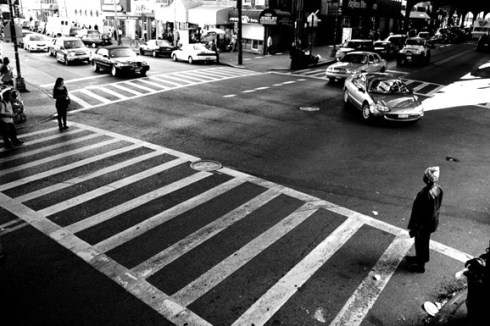
This picture plays literally with notions of  ‘the road to be traveled’ and ‘obstacles to cross’, but it also depicts the loneliness of a new reality for Doris.

Doris spent 27 years in prison. Even amidst bustling streets her experience must quite solitary?

See feature at GOOD.

In “Free Again,” the photographer Yusuf Sayman chronicles the day-to-day challenges associated with the re-entry process that follows a long prison sentence. His subjects are Tarik, a man in his third week of freedom after a four-year prison sentence (which began when he was just 16), and Doris, who has just completed 27 years of incarceration. “In prison they get used to a very different set of rules and social behaviors,” says Sayman. “Doris said she never had to make decisions like what to wear. New-found freedoms as simple as shopping or taking the bus become very significant, very big deals.”

Brilliant!

Source

UNKNOWN DETAINEES

Stan posted this a couple of days ago. Three suicides covered up in 2006.

Now a 58-page study prepared by law faculty and students at Seton Hall University in New Jersey starkly challenges the Pentagon’s claims. It notes serious and unresolved contradictions within a Naval Criminal Investigative Service (NCIS) report – which was publicly released only in fragmentary form, two years after the fact – and declares the military’s internal investigation an obvious cover-up. The only question is: of what?

I have highlighted the death of prisoners in US military custody  before, in Iraq and in Pakistan.

These deaths seem to be suicide. Should we be surprised? Doesn’t the military deal in death. Prisons are miserable. Locking enemies and captors up behind closed doors is eventually going to lead to homocide or suicide. The stresses and stressors are too large.

Inevitably the question is why would the authorities usher a cover up? My guess because they didn’t want a closer look at the entire operation at Guantanamo.

Just another tragedy in the long list to come from that corner of Cuba.

Elsewheres, the Detainee 063 has launched a blog and twitter feed of the Guantanamo interrogation log of Mohammed al-Qahtani. It is being published in real time. Each entry appears exactly seven years after it was first recorded.

This is the best deadpan and frigid use of twitter since Jenny Holzer, who incidentally has done her own amazing work on the ‘war about terrorism’.

Talk about instructing your audience.

Today, Aline features Mark Laita‘s diptychs; (somewhat) obvious pairings of rich/poor, winner/victim. The couplet of astronaut/alien abductee is unexpected and clever.

I am always reluctant to use violent as an adjective to describe prisoners. I know that most prisoners are not in their nature violent. Most of the time, hard appearances are necessary as a front to aggression that may or may not exist.

In this instance, the counter-portrait of cheerleaders compels me to use violent as an adjective. Regardless of it’s uniform, “the group” is a menace. After spending just a minute with this diptych, I feel quite on edge. The two quintets both wield the tools of their activity and confront the camera. Aggressive.

Psychologically, it’s a dead heat. But culturally, for me at least, the cheerleaders are more sinister.

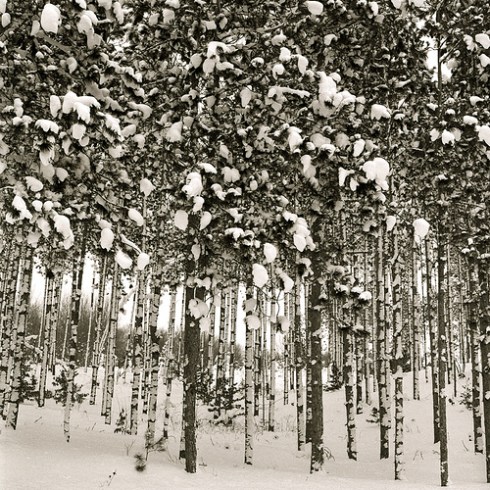
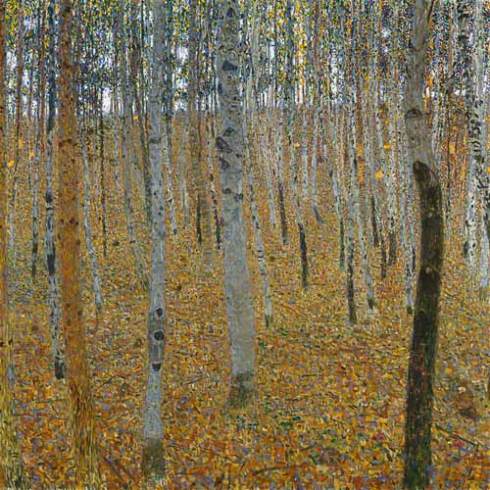
I just wanted to share this convergence. Bill Schwab above, Gustav Klimt below.

© Philippe Bazin

Last month, Melinda Hawtin contacted me about her interest and graduate research into the representations of prisons in French contemporary photography.

My position in the world is a little more comfortable knowing that another human has the niche commitment to prison photography!

Hawtin’s geography-specific project is even more narrowly defined as mine. She humbly referred to her blog as “yet a vessel for my (mostly) unresearched musings but I am hoping that in time it will take on a more coherent form”. Martin’s posts are far more than her modesty suggests – they are important introductions to academics, works and points of analysis.

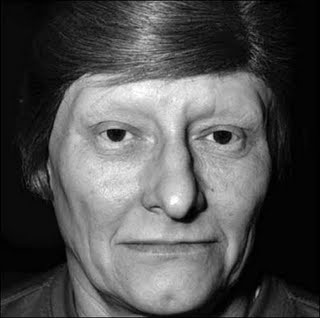
Hawtin introduced me to the work of Philippe Bazin, whose series Détenus is a straight photographic study of French prisoners. Hawtin is discomforted somewhat by Bazin’s sentimentalisation of prisoners, “it seems strange and rather naive that artists like Bazin are so keen to portray the humanity of inmates. I’m not suggesting that they demonise them instead but monochrome, close-up images of prisoners could be seen to be over-romanticising the prisoner”.

© Philippe Bazin

My take? Intimate shots do not automatically translate to sentimentalisation or captures of “true” humanity. It is always hazardous to prescribe the reaction of an audience to a photographic style. I would step back (possibly cowardly) and suggest that Bazin’s portraits are worthwhile simply because they differ in tone from the vast majority of other photographic studies of prisoners.

Hawtin and I swapped resources and names including the excellent Visa pour L’Image web documentary winner, Jean Gaumy and Lizzie Sadin, whose photography focuses on juveniles in prisons across the globe, including her own nation of France.

Investigations into the portrayal of French prisoners could not be more timely:

French President Nicolas Sarkozy has called French prisons “the shame of the nation”, and the European Union has demanded that France improve the detention conditions of its inmates to meet minimum European standards.

I’ll be sure to check in with Hawtin’s blog regularly.

Let me be clear, I don’t like private prisons. The need for profit to satisfy shareholders allows for cost cutting that can deprive a system (and its inmates) much-needed resources and possibly rehabilitative opportunities.

This is a general opposition but I currently see nothing to suggest the mandate of private prisons is anything more than that to securely hold its wards.

Andrew Leigh, an Australian economist is suggesting a third way which conjoins market incentives with successful reentry practices. He wants to see prisons with the lowest recidivism rates among its released inmates to reap financial award.

“Unfortunately, the contracts for private jails bear a close similarity to sheep agistment contracts,” alleges Leigh.

“Providers are penalised if inmates harm themselves or others and rewarded if they do the paperwork correctly. Yet the contracts say nothing about life after release. A private prison operator receives the same remuneration regardless of whether released inmates lead healthy and productive lives, or become serial killers.

“A smarter way to run private jails would be to contract for the outcomes that matter most. For example, why not pay bonuses for every prisoner who retains a job after release and does not re-offend? Given the right incentives, private prisons might be able to actually teach the public sector a few lessons on how to run an effective rehabilitation program.”

This comes from an article “Shock, An Economist Has a Good Idea!” While I’d temper such enthusiasm, I would like to see the idea investigated a little more. It could lead to private prisons committed to aggressive Research and Development in practices that lower recidivism.

My only worry would be that they’d compete for a finite amount of money and merely create a static ecosystem of excelling, well-funded prisons vs. forsaken, poor-funded prisons.

EMAIL

prisonphotography [at] gmail [dot] com

Prison Photography Archives

Post Categories