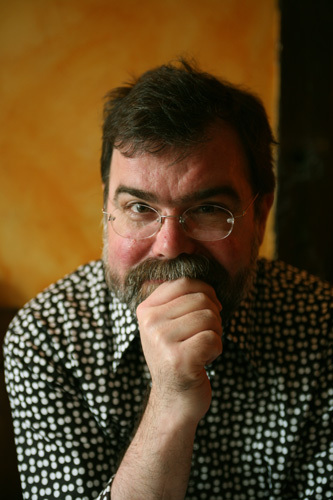
Larry Sultan is gone. When someone is gone I try to identify a piece of wisdom that should not go with them. (Go straight to the bottom of this post for Sultan’s wisdom without my preface.)

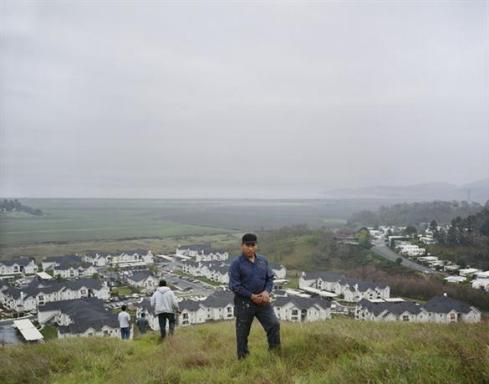
Six years ago, my partner and I stood in front of one of his large Valley prints at SAM’s Baja to Vancouver exhibition. During the early months of our relationship, we’d picked apart topics of passive violence, misogyny and late capitalism as a matter of course. Sultan’s photograph spurred debate on, again, and in novel directions.

Sultan’s photographic series are all deliberate, different and exemplary. He identified something that needed to be done (differently) and worked his way to a solution. This was his genius.

Evidence shifted thinking not only the fine art world and the academy but also in popular culture. It preempted a widening reverence for the tangible image – a trend that dominates our post-film nostalgia for found and vernacular photography. Joerg’s recent musings about curator and editor can predate self-publishing online technologies and hark back to Sultan and Mandel ferreting about government archives.

The Valley is iconic. Although, it is interesting to hear Sultan describe a project that I thought stripped (pun intended) the porn industry to its boring facts. Not so:

“The sex industry can be such a tired, worn out subject but when it’s imported into kitchens and dining rooms of a middle class suburban home something new opens up. At least for me it did.”

Pictures from Home goes alongside Toledano’s Days with My Father for the privilege of emotional inclusion it gives the audience.

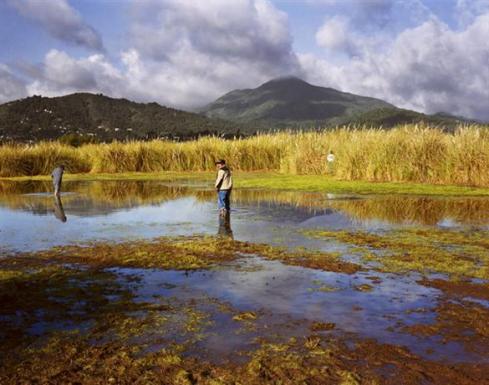
And, finally, Homeland is a beautiful reconciliation of Sultan’s new Bay Area living:

“Light’s too hard where I live, it’s hard to work in it. The character of light means a lot to me. It’s how I begin to photograph, it’s usually with the light. So it’s a bit problematic. L.A. light, that kind of foggy, smoggy, soft light—I miss that. It’s the light of my childhood. There are certain sounds, feelings of the air, and all of that which you can’t photograph but you can find the equivalent of, in light. But who knows, maybe I can find a new version of that in Northern California.”

The marshes of Corte Madera and fog of Marin County provided Sultan his respite from direct San Francisco sunshine.

Sultan died at 63. Relatively young. Yet, the inquisitive spirit of his work means he got more than enough done before his early departure. A oeuvre by which one is humbled.

Sultan’s interview with Ben Sloat featured on American Suburb X yesterday originally appeared on Big, Red and Shiny in April, 2008.

The stand-out quote is simultaneously a lament AND a call for rigorous photographic practice:

“Part of the difficulty facing photographers is that almost any subject matter has accumulated a representational history, so to find a new discursive space, a space to wander around those subject matters, is a real challenge. If I know too much, if the narrative is too well formed, I’m making pictures that are illustrative, and as a maker, that’s not interesting. As a viewer, that’s not interesting.”

Which accumulated representations are you battling with? What do you need to stop doing because its been done before?

I’ve shared this before on Photography Prison, but it’s been ringing in my brain all night.

Your midweek menace:

Jim Casper, founder, creator and overlord of LensCulture has asked for a helping hand. I expect it takes a lot of time and resources to keep LensCulture ticking. What has he delivered for you this year, and what are you going to give back?

For me, his interview with Klavdij was this years highlight.

… it is a Journal.

That wasn’t always the case. Two days ago, I’d have said I was a blogger .. and all the time before that.

But describing yourself as a blogger is a lot like describing yourself as a tax-payer – regardless of one’s contribution, induction into either role is without obstruction; neither role describes the contribution but merely acknowledges sign-up to the system; and, if either role is entered into with ambivalence the reality of the commitment is soon apparent.

Blogging is a much maligned activity … and rightly so. There’s too much noise. Several types survive in the blogging ecosystem. The truly inventive and readable bloggers sit top of the tree – it is they in whom we invest energies and time .. and they are a rarer breed. That group is outnumbered by other types – the martyr, the sycophant, the gossip, the marketer, the angry, the bored, the pedant, the populist, the rich and the wasteful.

I am not in the first bunch and I want to stay clear of the second.

And, one wants to be defined by more than the [blogging] tool that one uses, right?

On Monday, a buddy said rather nicely, “I like what you’re up to. That journal you keep about prisons and photography is cool. You know, like in the tradition of poets or theorists or madmen who don’t really know where they’re headed but are just exploring a theme to see where it takes them. Because they’re compelled.” Right on.

My mate Wikipedia says, “Strong psychological effects may arise from having an audience for one’s self-expression, even if the journal one writes in is only read by oneself.”

I guess I am happy with the thought experiment alone as justification for this journal.

I’ve always answered people’s inquiries about Prison Photography by describing my various interests and the fact I couldn’t describe (or really expect) an audience for them in one package. Also, that I don’t know if there’s a product or how ‘product’ is quantified.

But, then, who among this company of distinguished diarists knew their audience?

My rather nice buddy is also now a published photographer:

Somebody Wrote “Shit” on a Sign Advertising Condominiums, Seattle. (2009).

From the ‘Mobile Phone, Arm, Car, Sidewalk’ series. © Maia Ipp.

Of course, everyone in the photobooks debate had their own preface and a necessary confirmation bias to bolster. Andy and Miki unleashed a monster. Great stuff.

IT’S THE EYE OF THE BURGER, IT’S THE CREAM OF THE FIGHT …

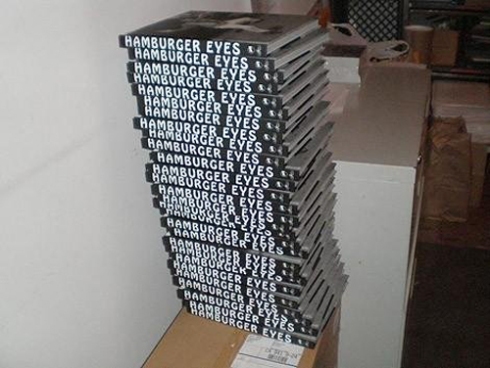
Hamburger Eyes has my mostest respect so far. HE is rightly confident in the book as a medium; HE doesn’t uphold a naive belief in the internet or technologies to deliver ALL the goods; and they make a call for real life.

Photos and photographers should “get into some shit” away from the web.

Hamburger says:

I was asked to write my thoughts on this subject as part of a forum in the form a blog, meaning FLAK PHOTO and LIVEBOOKS are writing about the subject and inviting others to join in by writing something, linking it, then they re-link it up for an ultimate future post of all of it together in one blog? I don’t know I’m confused too. Blogs eat blogs, and they never be not hungry.

Blogging is a good segway into my thoughts about the future of photo books. I’m thinking the internet is turning into a library or more like jail for your photos. Yes, libraries are way awesome and yes we are all photo nerds forever learning, but how long can you stay in there. It’s like detention for your photos. Saturday school. Your photos need to get out, go on dates, and get into some shit.

What happens next is what’s already happening now. Photogs are deleting their flickr and their blogs and crewing up with only the hardest realist ninjas. It’s hyper attack mode. Photogs are scrambling because their agency just cut them and their editors got laid off. Not to mention, “Oh, you shot this or that, someone else caught it before you on their cell phone and New York Times already spent their budget on those.”

HERE’S WHAT I SAY

I wrote a huge treatise not only on the future of books, but on the future of the image and the future of our existence based upon our surrender to the image. We will soon all be docile slaves.

I shelved the piece. I’ll need to chew on it for a while until the next photoblog debate about the future of photography/contracts/journalism/print/distribution/consumption comes along. My main points will still apply:

– E-books is an oxymoron. Hopefully, all digital text will be referred to as E-words.
– Actual books will be fewer in quantity and higher in quality.
– Open source will dominate, because ownership of any digital matter will become useless.
– Micropayments are bogus. In the future if a creator unleashes it on the web, they will hold no claim to it
– Every household will have access to rapidly improving printing technology; any available online material will be printable to spec.
– Handhelds will have instance access to every non-proprietary file on the internet.
– People will have self-facilitated projections to the sides of buildings as a legitimate alternative to books when experiencing images.
– We will become detached from one another. Those who question the mediation of technology – even moderately – will be ostracised. In this regard, book ownership will become a slightly perverse political act.

No, not this type.

The type that is a) the Anglican Church’s leading expert on St. Nicholas of Myra; b) accompanied by a distinguished Anglican cleric; c) dressed as St. Nicholas rather than Santa Claus; d) understands that St. Nicholas is the patron saint of children and of the imprisoned, and; e) decided to show some Christmas cheer down the local immigration detention centre!

But when the Anglican church’s leading expert on Father Christmas, dressed as St Nicholas himself, arrived at the Yarl’s Wood immigration removal centre in Bedfordshire, things took a turn straight out of Dickens.

An unedifying standoff developed that saw the security personnel who guard the perimeter fence prevent St Nicholas, the patron saint of children and the imprisoned, from delivering £300 worth of presents donated by congregations of several London churches.

In a red robe and long white beard, clutching a bishop’s mitre and crook, St Nick – in real life, the Rev Canon James Rosenthal, a world authority on St Nicholas of Myra, the inspiration for Father Christmas – gently protested that he was not a security threat, but to no avail.

[Author’s Note: This is the first in a three part series on prisons in Africa. Through the lens of three different photojournalists, we will see the conditions and lives within prisons of Guinea, Burundi and Sierra Leone.]

© Julie Remy. Inscriptions by young prisoners.

Julie Remy has photographed stories in Rwanda, Mali, Zambia, Malawi, and for her series on prisoners – Guinea.

In September 2008, Médecins Sans Frontières (MSF) began an emergency intervention in the civilian prison of Guéckédou in southeastern Republic of Guinea. Remy’s documented the food and medical aid effort.

“We have problems with food and illness here. There are no medications. There is no doctor. Since 2007, 30 people have died here and the doctor didn’t come.” Inmate, 19 months in prison

Guéckédou was over-crowded, unhygienic and without proper ventilation. As a result, some inmates were malnourished, most dehydrated and many with respiratory and skin diseases. It was recorded that prisoners with tuberculosis shared cells with the general population. Incubation of disease was a major concern.

I have no idea how the prison conditions of Guéckédou compare fifteen months on.

© Julie Remy. At the Guéckédou Civilian Prison, inmates wash only with water on a non regular basis. This prisoner shows the photographer his scabies. Due to poor sanitation prisoners suffer various skin diseases.

Remy worked in dark surroundings. As MSF vouched, “The scene that meets the eye upon entering the chambre noire “dark room” is beyond belief. Some 26 prisoners, crammed into a space of about three by four meters, can only be made out by squinting.” These images are part of a specific, urgent campaign, so it would be offensive of me to pay them any aesthetic critique. The awareness is what matters here.

MSF made good use of Remy’s photographs to produce a short video explaining the situation and dire need for intervention.

I’d like to emphasise that Remy (as a photographer) and MSF were in Guéckédou because of extreme circumstances at the national level. The poor conditions in the prison can be attributed to a number of larger structural instabilities. The men in these photos are one constituency suffering from a regional crisis. MSF explains; “The failure to ensure basic minimum standards in Guinea’s prisons can be linked to the country’s generally poor human and economic development. Ongoing instability and conflict in neighboring countries have long impacted on Guinea, while strikes and civil unrest have emerged in-country over the past few years. The ongoing international increase in food prices, especially in 2008, has exacerbated Guineans’ already precarious living standards and food insecurity.”
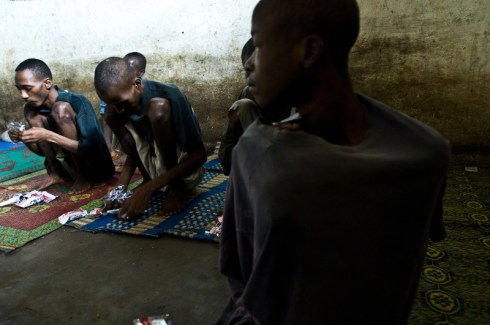
© Julie Remy. Malnourished prisoners received plumpy nut provided by MSF at the Guéckédou civil prison.
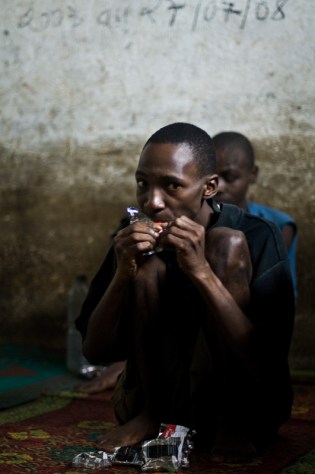
© Julie Remy. Malnourished prisoners received plumpy nut provided by MSF at the Guéckédou civil prison.
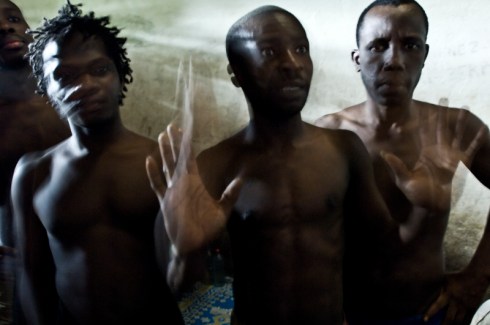
© Julie Remy. A prisoner tells us that he is innocent. That he has done nothing and still has not been judged. He says he does not know why he is held here in the  “Chambre noire” where a dozen prisoners are tied to a bar and held with another dozen in a barely lit cell. Guéckédou civil prison.
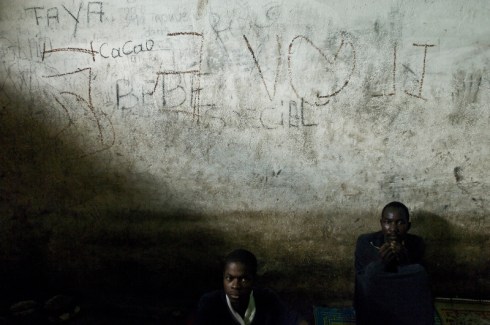
© Julie Remy
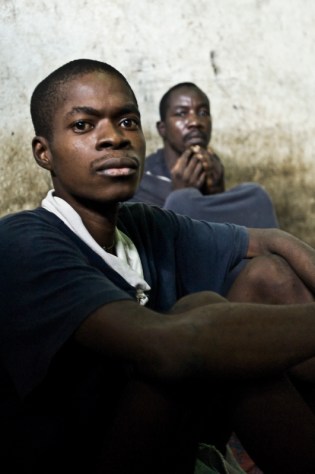
© Julie Remy

When the opportunity arises, I think it is important for audiences to view images like those two above within each others context. The first image is a dank, alienating environment in which the oppressive shadows and walls dominate. Whereas the second image (probably taken within a matter of seconds) is a well lit portrait centred on the gaze and associated emotions of the man; the prison environment is not stated. Precisely because MSF and Remy were present due to the physical effects of this environment on these men, both are valid photographic approaches.

The consequent written report from this aid intervention released in February 2009 continued with a call for systemic reform:

“Although the sub-standard conditions in Guinean prisons can be attributed partly to poverty and the country’s limited resources, these factors alone do not explain the absence of response to recurring malnutrition and the unacceptable living conditions in Guéckédou and other prisons. Guinean national authorities bear the ultimate responsibility to uphold the fundamental human rights of its inhabitants, including its incarcerated population.”

I, like many others invested in the photojournalism/documentary community, want to see less images of suffering in Africa and more images of the uneventful days; the boring normal times, perhaps some quiet smiles and tears. Add to that some local African photographers and we’re on the right track. (See recent commentary by Paul Melcher, Daniel Cuthbert and Ben Chesterton for more on this).

© Julie Remy

In closing I’d like to offer a caveat for the three part ‘Prisons in Africa’ series.

African prisons – that is, sites of incarceration across a land mass the size of Western Europe, Argentina, China, India and the USA combined – are each unique. Generally, conditions will be poorer than in prisons of developed nations, but every prison has its own culture, rules and circumstance. In Africa, as in the rest of the world, prisons usually exhibit the worst of a nation; retribution and anger, neglect and apathy.

Photographers are compelled to visit prisons known to them through local knowledge or national notoriety; we must expect there is a story to be told. The prisons I will feature in this three-part series will not be pleasant, but I think the three featured photographers are sincere and the stories are important.

While the men in these images may deserve pity, Africa as a continent does not. Africa deserves our respect and our time.

Nations in Africa, as with all places featured in the photojournalism we consume, should be places we think about visiting. I seriously encourage anyone and everyone to make an extended visit. Opportunities to dilute the media images of places and people with first hand interaction with those places and people will only have positive results. If only we had the opportunities, good reason and resources to visit and live in new places frequently.

(Disclosure: I lived in East Africa for five months. That time made more complex and less harried my perspective of the world. The largest culture shock was returning to the UK.)

__________________________________________________________

Official Bio: Julie Remy is an award winning documentary photographer specializing in human rights, health, travel and the environment. What she captures through her viewfinder and what she tells in written word she believes will contribute to bringing hope and respect and perhaps assist in gaining access to the care and knowledge they deserve.

One glaring omission from Prison Photography is ICE detention centres and the prisons specifically designed for immigrants. Apart from the public stunts of Sheriff Arpaio (here and here) I have not featured any photography of immigrant detention or prisons.

This is partly because immigration policy and deportation infrastructures aren’t an area I know much about, but mainly because immigrant jails and prisons are the most invisible of all prisons in America. The media simply cannot get access like they can into state and county sites of incarceration.

As a course of policy, ICE detention sites are kept hidden. Allow me to push back against that a little:

Map courtesy of Global Detention Project.
More resources at the Detention Watch Network

In an attempt to redress this dearth of immigration coverage on Prison Photography, I point you in the direction of Tom Barry’s interview on Fresh Air yesterday. Thanks to Bob for the tip-off.

Here’s some things I learnt:

– Over the past five years immigrant imprisonment has increased 400%
– The policy of immediate deportation for illegal immigrants was replaced by imprisonment and deportation; a deliberate tactic intended to punish and deter future attempts to cross the US border illegally.
– Legal definitions of crime have broadened since 1996. Couple this with a syncopation of agency databases means constant threats of stop, search, detention and deportation of immigrants (both legal and illegal) now exist that did not 5 years ago.
– In this new era distinctions between legal and illegal immigrants have shrunk.
– Legal immigrants are subject to “a separate penal system”.
– 30% of deportees to Mexico don’t speak Spanish.
– The 11 border prisons are intentionally remote and located in economically depressed towns along the US/Mexico border.
– Immigrant prisons have a structure of financing and ownership that is unique. Tom Barry calls it “The Public/Private Prison Complex”, in which tax dollars and private corporations mix and match the funding. In many instances, administrators could not actually state who owned the facilities. This results in diluted accountability.
– The Corrections Corporation of America (CCA) and the Geo group are the two largest private prison companies involved in immigrant detention.
– Privatised prisons were once a rarity in America. CCA and Geo got their start under Reagan winning contracts to house immigrants.
– CCA and Geo have enjoyed record profits over the past 8 years. 45% of their income derives from from state and federal contracts outsourcing immigrant detention.
– The perversely named ‘Operation Reservation Guaranteed’ means that detainees will always be sent to a bed/cell even if it is on the other side of the country. The transportation costs are met by the tax-payer.
– Wackenhut, an arm of Geo group, is the sub-contractor for these long, expensive and unnecessary transportations.
– It is common that detainees are moved without warning or reason. It is common that detainees cannot be located by the private prison companies for long periods.
– And much, much more. Listen, I highly recommend.

Tom Barry covers border security and immigration issues as the Senior Policy Analyst at the Center for International Policy. He has written several books, including The Great Divide and Zapata’s Revenge.

Tom just published A Death in Texas a piece for the Boston Review about a riot at an ICE prison in Texas. The riot was an “act of solidarity” by the detained population following the death of a young prisoner.

Tom maintains the Border Lines blog for the TransBorder Project is a project of the Americas Policy Program in Mexico City and the Center for International Policy in Washington, DC..

EMAIL

prisonphotography [at] gmail [dot] com

Prison Photography Archives

Post Categories