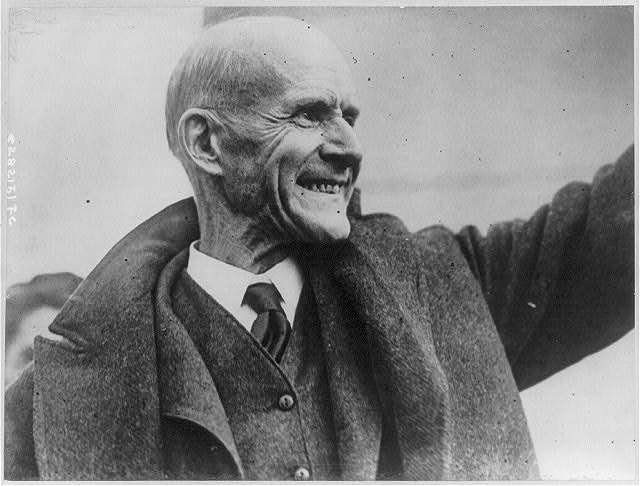
Eugene V. Debs, Five times Socialist candidate for President, as he leaves the Federal Peniteniary at Atlanta, Georgia on Christmas Day, 1921 Library of Congress Prints and Photographs Division, # LC-USZ62-75578 (b&w film copy neg). Photoprint copyrighted by Underwood & Underwood, No. S/282,151/FC.

Eugene V. Debs, Five times Socialist candidate for President, as he leaves the Federal Penitentiary at Atlanta, Georgia on Christmas Day, 1921. Library of Congress Prints and Photographs Division, LC-USZ62-75578 (B&W film copy neg). Photoprint copyrighted by Underwood & Underwood, No. S/282,151/FC.

Eugene V. Debs is a hero for the prison reform movement. Which is strange given that prison reform per se wasn’t his main cause. Debs was a labor rights advocate, union organiser and Socialist Party pioneer.

Debs was a harsh critic of American draft policies of the First World War; he was accused of sedition and labeled a traitor by Woodrow Wilson. Debs’ June 1918 anti-war speech saw him arrested under the war-time espionage law. He was sentenced to 10 years. He was effectively a political prisoner.

It is the statement Debs delivered in his court hearing that has inspired generations of prison activists:

Your Honor, years ago I recognized my kinship with all living beings, and I made up my mind that I was not one bit better than the meanest on earth. I said then, and I say now, that while there is a lower class, I am in it, and while there is a criminal element I am of it, and while there is a soul in prison, I am not free.

Given that Marx’s Das Kapital was published in 1867, Debs’ adoption of Socialism is relatively late. Ironically, it was while he was imprisoned in Woostock, Illinois during 1895 that he read Marx’s work and upon release became an avowed Socialist.

Debs ran for the US Presidency five times; first as a member of the Social Democratic Party of the United States (1900) and later as the candidate for the Socialist Party of America (1904, 1908, 1912 & 1920). In both the 1912 and 1920 elections Debs’ received nearly one million votes, 6% and 3.4% of the popular vote, respectively.

The 1920 campaign was run from within prison – after his 1918 speech he was convicted in April of 1919. The photograph above is of Debs’ release on Christmas Day, 1921 when his sentence was commuted to time served.

Debs legacy lives on partly in the form of the Eugene V. Debs Award. Past winner include Studs Terkel, Howard Zinn, Kurt Vonnegut, Molly Ivins, Pete Seeger and Ralph Nader.

Musings on the ‘Third Candidate’

I am always fascinated by the presence of historical figures who have disturbed the prevalent two party system of America. As unsavory as George Wallace was, his impact as a third candidate is worth measuring. Today, Ralph Nader’s name is synonymous with the term ‘third candidate’ and for his involvement in the 2000 general election his is vilified as the reason Al Gore did not become president. I am sick of hearing such a whinging and backward logic. Al Gore did not become president of the United States because he failed to win enough Electoral College votes and we well know the hanging, Floridian chaddy reasons for that.

People’s criticism of Nader says more about their surrender to a seemingly perpetual two party system than it does of his perceived faults.

Nader has made the point that neither the suffragettes or civil rights activists made it to elected office but that didn’t prevent them effecting massive change. If people are criticising any third candidate it is because they are more focused on the intractable two-party system than they are on their own agency and potential to effect change.

Image source.

Related to crime and tangentially to prisons, Colin Pantall has been examining the cult, mythologies and obfuscations at the point where visual media and female criminals cross. He does so over four posts.

Pantall summarises: In Media and Crime, Yvonne Jewkes identifies seven standard narratives to describe women who commit serious crimes:
• Sexuality and sexual deviance
• (Absence of) physical attractiveness
• Bad wives
• Bad mothers
• Mythical monsters
• Mad cows
• Evil manipulators

Pantall challenges:

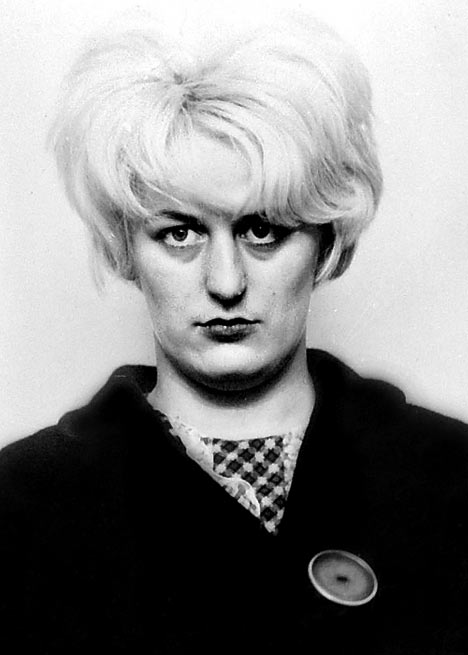
He takes on the common consumption of Myra Hindley’s mugshot:

“The world brought bored indifference to her mentor, the sadistic, fascistic Ian Brady. He was just another bad bloke.”

“It is a police photograph taken in maximum light in a dungeon. That stark, sinister expression could also be one of fright, ­ the antithesis of the transgressive transcendence conceived by Brady.”

Pantall compares: the national disgust at a smirking bully with the forgiveness of the victims parents.

Finally, Pantall confesses he has no idea if Amanda Knox is guilty or not.

In his ‘Trial by Photography’ post he points out that she’s already been judged for not behaving – or looking – innocent in front of the cameras.

He closes, astutely noting, “A virtual reconstruction of the murder of Meredith Kercher was shown in court, with the screen fading to red at the end. Which puts everything about the trial into question.”

Now we know what the six jurors and two judges think. Did the visual aides used by the prosecution disproportionally affect Knox’s guilty verdict?

I’ve gotten to know Adam Westbrook‘s work through mutual online friends. I signed up for his Twitter feed about the same time I did for the RSS feed on John Hirst’s Jailhouselawyer’s Blog.

John Hirst served 35 years for murder and now writes and advocates for prisoners rights. This year he has contributed at the Guardian.

It’s good to see these two folk collaborate.

© Jon Lowenstein for NOOR IMages. From the series ' Tent City'. Image: LOJ020

© Jon Lowenstein/NOOR Images. From the series ' Tent City'. Image: LOJ020

This image by Jon Lowenstein of NOOR Images from his series Tent City reminded me of some pictures I featured last year when considering the context and readings of images of prison confrontations.

Training Exercise, Team Portrait. Photo Credit: I.M.T.T. 2004

Which in turn reminded me off a tight group of Somali Pirates by Jehad Nga.

Eight Somali pirates sat at the Kenya Ports Authority Port Police station in Mombasa, where they are being held after being handed over to the Kenyan authorities by the Royal Navy. The eight pirates were arrested, and three others killed, by sailors of HMS Cumberland, as they attempted to hijack a cargo ship off the Horn of Africa. The pirates will be charged in a Mombasa court. Credit: AP

Eight Somali pirates sat at the Kenya Ports Authority Port Police station in Mombasa, where they are being held after being handed over to the Kenyan authorities by the Royal Navy. The eight pirates were arrested, and three others killed, by sailors of HMS Cumberland, as they attempted to hijack a cargo ship off the Horn of Africa. The pirates will be charged in a Mombasa court. Credit: AP

Serco is a UK based multinational company, with many fingers in many pies. The Guardian has called them “The biggest company you’ve never heard of.”

Serco sees profit in many things, including the private prison of the UK and Australia. Are you caught in the web?

The wikipedia profile supplies many valuable news sources for further learning.

The greatest priority for sentencing reform must be to dismantle the Three Strikes Law.

Three Strikes has not made society safer, it has only handed down overly-punitively long sentences.

Familial support during incarceration is the largest deciding factor in helping released prisoners to stay clean. It is therefore great to see Families to Amend California’s Three Strikes, a grassroots activist group focusing the voices of disenfranchised family members against unjust sentencing policy … and doing it well. Check out the videos and the resources page.

This post is a while overdue. As I am sure you know, Medecins Sans Frontier launched Condition: Critical this year. It is a website to bring together the many stories of victims of the war, assemble video and photo tools for activism and to leave messages of support. That’s right … no money, just a letter and awareness.

As part of the effort, my mate Ben has had his hand in the first four videos pushed out to the world. Ben’s summary of this conflict and humanitarian situation;

“Its the world’s deadliest conflict since the second world war and yet the majority of people have never heard of it. According to the IRC at least at least 5 million Congolese have died in more than a decade of conflict sparked off by the 1994 genocide in neighboring Rwanda.  Most of the deaths are linked to a lack of medical facilities as the ability to access medical care in Eastern Congo has crumbled with the war.”

Ben’s team trained the comms people out in the field to gather stories and then they edited it to relay the stories in a powerful, respectful way. First hand tales and simple honest images. No gore, only testimony.

Drawing the War is the troubling tale of a boy carried away by opposition forces and set to work.

There are four videos from the MSF Condition Critical campaign on duckrabbit vimeo profile. The other three are Mishoka’s Story, Bahati’s Story, and Francoise’s Story.

So it seems that Ben has had some success in challenging and changing the public relations that non-profits and charities have to their global audience. Now all he, us and the people of Congo require it awareness, effort and mindshare.

Ben has asked us to do one or four of four things: 1. Leave a message of solidarity on the map; 2. Twitter about it and link to it on Facebook (for Twitter use #conditioncritical); 3. Embed one of the video’s on their blogs; 4. Write something about the project. Tewfic, Mark, Charlie, Mediastorm, Daniel and Boing have done their bit. Pass it along.

WHILE WE ARE ON MSF

I also recommend following the MSF Photoblog, managed by Bruno Decock (I think) as it endeavours (commendably) in public to deliver relevant balanced, effective, non-sensational and representative photographs of Africa. Not easy!

Photographers Dominic Nahr, Julie Remy, Martin Beaulieu, Robin Meldrum, Yasuyoshi Chiba and Cedric Gerbehaye have been involved in the collaborations with MSF for Condition Critical.

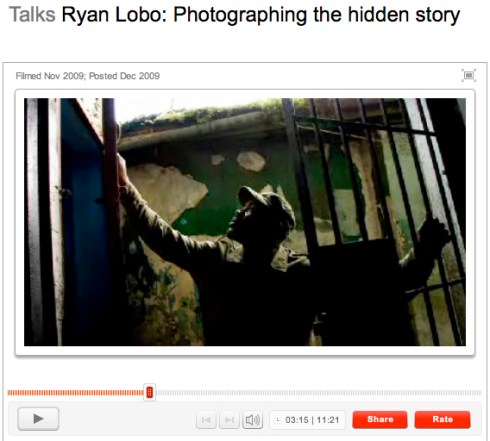
Ryan Lobo talked about three of his projects at a recent TED conference. The first story Lobo told stopped me in my tracks.

Lobo photographed Joshua, a man formerly known as General Buttnaked, who had committed heinous crimes against humanity during Liberia’s civil war. Joshua is now a baptised evangelist and as he entered villages across Liberia again, he did so not to destroy them but to ask for forgiveness.

The level of forgiveness that he asks for is galling to the Western mind. 10,000 lives. The ask itself is cruel.

During the war Joshua fought naked (hence the name). He murdered, raped and tortured thousands of Liberians. He corrupted hundreds of youngsters inducting them into war, enforcing his command over the boy-soldiers with unspeakable brutality. They are now destitute; many addicted to drugs. Heroin is commonly abused.

Joshua spoke from a soap box to crowds often including his victims. Lobo admits he thought Joshua would be killed by the mob in a short time after beginning the tour.

But Joshua was not killed.

How do we tally this story of redemption (if that term is not obnoxious in this instance) and this version of restorative engagement between perpetrator and victim with our Western codes of justice?

And as Lobo asks, does forgiveness replace justice?

I have no answers.

EMAIL

prisonphotography [at] gmail [dot] com

Prison Photography Archives

Post Categories