TYWKIWDBI is garish and off putting to anyone who judges sites on appearance alone. Fortunately for it, and us, it is also one of the best aggregators of online content. It is a one man operation to compete with Digg!

Roy Brown

Roy Brown

I picked up this story and had to relay it. While Christian Milton, former AIG executive, got 4 years for his involvement in $500million fraud, Roy Brown was sentenced to 15 years in Louisiana for stealing $100 from a bank. Brown only took $100 dollars from thousands the cashier handed him and subsequently surrendered himself the next day, ashamed of his actions stating “My mother didn’t raise me that way.”

I don’t know how tied the judges hands were by Louisiana law, but I would resign in disgust if I was a cog in such an abusive system. Fucking disgrace.

Christian Milton

Christian Milton

Searching for images didn’t come up with much (admittedly, it didn’t spend too long) but it occurred to me that the mugshot is the aesthetic of the poor and the street “trialshot” is the aesthetic of the rich. I understand they are captured at different moments in the judicial process, but the qualities and circumstances of the Mugshot vs Trialshot make interesting comparison.

MUGSHOT: Regimented, Artificial light, Institutional, Accompanied by booking information, Less likely recipient of bail, Controlled & private space, Everyday clothes.

TRIALSHOT: Unrestricted, Natural light, Public, Accompanied by caption and news article, Certain recipient of bail, Public space, Selected wardrobe.

These comparisons go some length to describe the influence money and status can have in the legal process and how the procedures accommodate those with money and resources to work with/within the system vs. those who are simply subject to its machinations. Just to drive the point home, when charges were first brought against Milton in February 2008, the probation office recommended a 14 to 17 year sentence. An absolute disgrace. A mockery.

Screenshot of fate. The rise and fall of individuals.

Screenshot of fate. The rise and fall of individuals.

Bernie Ledesma, 2008

Prisoners of the Cebu Provincial Detention and Rehabilitation Centre dance the Rico Mambo. Photo Credit: Bernie Ledesma, 2008

UPDATE 10.05.12: They just did Gangham Sytle

– – – – – – – – – – – – – – – – – – – – – – – –

My general endeavour with Prison Photography is to ask readers to assess the visual culture surrounding prisons and prison populations more critically. The videos and photos in which prisoners present themselves beyond all stereotypes are important. The back story is revelatory too.

The routines are the result of a new approach to rehabilitation in Philippine prisons (8 facilities at last count) beginning at Cebu Provincial Detention and Rehabilitation Center (CPDRC). The program was initiated by Byron Garcia the brother of Cebu Governor (Warden) Gwendolyn Garcia. Ms. Garcia was the first female warden at Cebu, which leaves me wondering if the novel dance program is the result of progressive governorship or just an accident of uncomplicated nepotism.

Byron Garcia introduced an exercise program where the prisoners marched in unison, starting out with marching to the beat of a drum, but moved on to dancing to pop music; he began with one of his favourite songs,  Another Brick in the Wall (Part 2) by Pink Floyd. Early on, Garcia selected camp hits In The Navy and Y.M.C.A. by The Village People for the program.

All of this is well known to webnerds who follow the biggest viral videos. Thriller has had over 50 million views.

The list continues – MC Hammer’s Can’t Touch This, Laura Brannigan’s Gloria, Bonnie Tyler’s I Need a Hero, Van Halen’s Jump, and Queen’s Radio Ga Ga. The dancing inmates of CPDRC are self-proclaimed “World Entertainers” now and have been featured on pretty much every major global news source. Here’s the BBC’s article.

The routines are endearing to the point that one’s will to know the perhaps-less-than-shiny-happy-reality behind the dancing program is shoved to the back of the mind.

Predictably, as with all things related to penology it is not quite as simple as clapping inmates dancing together, forgetting their rivalries and jigging toward reform.

The dance program is compulsory. “The British Channel 4 Documentary Murderers on the Dancefloor broadcast in January 2008 portrayed life in the prison. The program showed various inmates praising Byron Garcia, the founder of the initiative – many of whom had tattoos praising Mr Garcia. However, it also featured an anonymous ex-inmate who claimed Mr Garcia employs certain prisoners to beat prisoners who refuse to dance. Garcia was filmed in the documentary holding an American M4 Carbine, saying, “This is an M16 M4 rifle, and it can make people dance”, before aiming the gun at the cameraman. This statement was acknowledged as a joke by the narrator. His Youtube account states any accusation that any form of abuse goes on as part of the program is false, and the program serves the purpose of reforming the inmates.” (Source: Wikipedia)

Prisoners at Cebu Provincial Detention and Rehabilitation Centre form a cross shape. Photo Credit Bernie Ledesma, 2008

Prisoners at Cebu Provincial Detention and Rehabilitation Centre form a cross shape. Photo Credit Bernie Ledesma, 2008

Garcia maintains that prisoners dance in honour of Peace Advocates, their Catholic Archbishop and against dissenters of the church. I find it hard to believe that all 1,500+ prisoners dance to voice the exact same political or religious opinion. There is certainly coercion at work here, but I think it is that of forced empty comment than of physical torture for those who abstain.

The show is put on monthly and the gantry around the yard is full of fans; likely family and friends but also genuine admirers. I heard of one spectator’s description of goose-bumps each time she watches a new routine. I can’t go that far but I must admit that the exercise, diversion, surface camaraderie and sincere adulation the prisoners enjoy must be extremely positive. It is worth noting that male and female inmates dance together. Could you really expect to see co-ed dance therapy in any US prison?

UPDATE

Read Marco Bohr’s The Story Behind the Dancing Inmates for a 2011 critique of CEBU and some images of the collapse of the shocking regime prior to Garcia’s arrival.

For the best still photography of CPDRC inmates in action go to Bernie Ledesma’s Flickr Set or his JPG Magazine “Jailhouse Rock” Feature.

POSTSCRIPT

All of this, while focusing on the policies of progressive prison authorities distracts us from the ongoing heinous conditions in Philippine prisons, the detention of children alongside dangerous adults and the ongoing abuse of those minors.

Special Emergency Response Teams (SERTs) are commonplace. Less so perhaps are the “sports team” group shots seen here at the end of a good days work out.

I.M.T.T. 2004

Training Exercise, Team Portrait. Photo Credit: I.M.T.T. 2004

Personal politics dictates how one feels about these constructed scenarios. To me they just seem unfortunate sad – not because of what they are, but because of what they represent. However, we must accept that tactical training within prisons is conducted with the same professional intent as that of any police authority or force of shock and awe. With caution, I’d say these trainings are a reality of prison management, but insist that they should not be considered an inevitability.

Once you get past the unnerving brevity of the group portrait, it is the second unposed image (below) that arrests the attention. It differs from other official images from within prison walls because of its ambiguity. As an isolated image, it is not clear whether the confrontation shown is genuine or not. Without the referenced source, could this be read as an actual suppression of inmate violence? How many eyes would be keen or informed enough to tell if the prisoner and guard uniforms were those of controlled dress rehearsal?
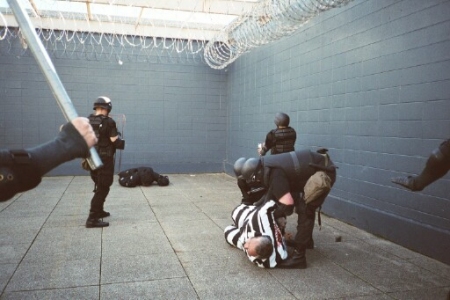
I.M.T.T. 2004

Training Exercise. Photo Credit: I.M.T.T. 2004

From building arguments of fact concerning the Abu Ghraib photographs, Errol Morris talks about the inherent traps for viewers of images, “You look at a photograph and you think you know all you need to know. That here you have a veridical piece of reality to look at. And, you need look no further. It, of in itself, is enough. You look as these infamous photographs that came out of Abu Ghraib. You look at the photographs of Gilligan, the prisoner on the box with leads, and of Gus, the prisoner on the leash, and you think you know what these are images of. ‘This is despicable, blah, blah, blah’ … You need look no further … and I believe noone looked any further, [they] presumed to know what the images were about and wrote articles accordingly.”

Morris adds to his general point, “We try to figure out the world by looking at things, and nothing we ever create is complete but you try to figure out what our relationship is to reality – to the real world.”
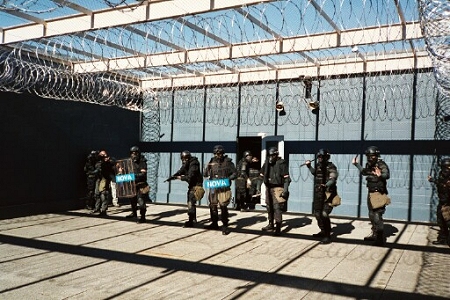
I.M.T.T. 2004

Training Exercise. Photo Credit: I.M.T.T. 2004

In a world of visual bombardment where deliberate disturbances between reality and fantasy are now commonplace have we lost interest in the strength of imagery and its testimonies? Images are mistakenly and willfully misrepresented and misinterpreted. In many ways, this is a fine game – a novel game. But does the game keep people on their toes or does it lead to apathy and disinterest? As Morris asks “What is true and what is false?” Without the proud group portrait to provide context would viewers have cared to question the seeming brutality of the second photograph?

Or am I missing the mark here? Is a lack of visual curiosity and/or sophistication really the problem here? Or, is the real problem the viewers normalisation to images of violence? Do the two issues compound one another? I would argue that many folk are too familiar with images (often involving wire, concrete walls and the ephemera of incarceration) to presume that the attacks meted out are a) unjustified or b) outside of the legal allowances of a prison authority. The issue of ‘Reality’ almost becomes redundant.

Perhaps, even, this worrisome trend of anesthetised reaction to human suffering can even be stretched through the interwoven spectacle of modern society and placed at the door of second rate video games. Prison Tycoon 4: Supermax, as featured recently on BLDGBLOG challenges the gamer to draw the most profit from prison administration; “Grow your facility to SuperMax capabilities, housing the most dangerous and diabolical criminals on earth – all for the bottom line.”

IGN.com

Prison Tycoon 4: Supermax. Screenshot. Source: IGN.com

I have never liked role playing video games that incorporate violence. But I am not an opponent pointing to them as the cause of delinquency among societies youth. I just don’t like them. Prison Tycoon is less gratuitous than Grand Theft Auto and the like. But I don’t know if this is any comfort. To manipulate a virtual prison population with “friendly interaction and fighting between inmates dependent upon mood and gang affiliation” and to rely on “guards [who] will subdue aggressive prisoners, medical staff to treat injuries, chaplains administer to prisoner’s spiritual needs and therapists talk to prisoners to lift their spirits” seems a bit too sinister and calculated for an evening of gaming.

And the ability to use “96 detailed prisoner model variations created to allow for a wide and varied prison population” and use a “unique ‘builder within a builder’ system to open your buildings and place their interior content wherever you like” in addition to the “over 100 different rooms and objects to place within the prison buildings, each one allowing prisoners to interact with them on various levels and each one having different effects on the prisoner’s mood.” seems like a gamer’s invitation to unleash virtual gang violence akin to those most unfortunate of prisoner abuses in real life.

Really, why does this game exist? I suppose it is just completing the loop – the gamer, as a God of Pixels, can create criminals in his other games and then manipulate them in this one.

For more information about High Risk Prisoner Transportation, Corrections Crisis Response, Cell Extraction, Escape Apprehension Training, Suicide Bomber Mitigation Tactics, Tactical Weapon and Explosive Training, Athermal Weapon Sight Usage and Finnish Sniper Training please visit the International Mobile Training Team Website. If all that seems like too much reading then just go to the IMTT promotional video and watch grown men in costume run around with guns to a butt-rock soundtrack.

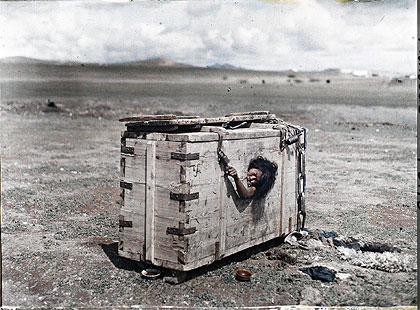
A good friend sent me a link to a Telegraph gallery featuring images from the early 20th century. Almost 2 years ago, BBC4 aired its five-part series Edwardians in Colour. It gave the full treatment to an era distant for most but still within the memory and grasp of older generations.

Stéphane Passet. Mongolian prisoner in a box, July 1913. Image courtesy of BBC. © Musée Albert Kahn

Stéphane Passet. Mongolian prisoner in a box, July 1913. Image courtesy of BBC. © Musée Albert Kahn

When I see mainstream historicisation as this, I can’t help suspect (just a little) that it is done in order to define the times, facts and lessons of the era. Like all endeavours, it is a play of power (however unintentional). At face, Edwardians in Colour is a noble pedagogical effort and one trusts the BBC to handle the history responsibly. I am no post modernist – I don’t balk at all historical narratives – but I do shrink a little when the writing of history is clearly seen in documentary projects. I wonder if the construction of history in one place means the burying of history somepleace else. Is it the subtlest or the most dogmatic narratives that bed themselves into history? What happens when those with eye-witness testimony pass? Who determines the ‘facts’ of the past?

The Lumiere Brothers marketed the autochrome only a year before French banker and philanthropist, Albert Kahn began his own collection of history colour photography in 1908. Kahn called it the “Archive of the Planet.” The fact that these photographs are brought to us in colour brings us no closer to the times, but I would say they do bring us closer to an appreciation of time. It is a sad appreciation of time, just as the dwindling number of WW1 veterans at war memorials each Armistice Day are a poignant reminder of our dislocation from previous ages. History: How do you take yours? With distant awe or with confident conclusion?

Needless to say, the image above is foreign to us. Without struggle, I would add cultural remoteness to historical remoteness and utterly compound its ‘otherness’.

You can view the original image here, and a youtube video with incongruous funky music here.

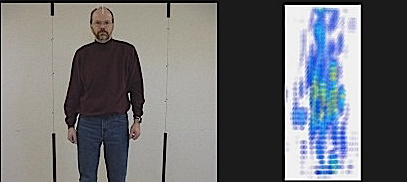
Through the wall surveillance (TWS) is still a technology in it’s infancy, but strategic needs and gushing public awe will perfect this fledgling military toy. It will be driven down marketing channels and into our living rooms. Perhaps TWS, like GPS, will be assimilated into middle class families across America. However, before TWS assumes mass commodity status, I am sure it’s advantages, limitations and in-combat-uses will have been fully tested and exhausted by multiple state and federal enforcement agencies.

Product Information Library, Defense Research & Development Canada

Human SAR signatures. Image: Product Information Library, Defense Research & Development Canada

These images are from Defense Research & Development Canada. This model is from the laboratory – probably a scientist. He is not an inmate or prisoner. In 2006, the National Institute for Justice (the research and development agency for the Department of Justice) sought “applications for funding research and development of sensor or surveillance technologies, or novel applications of those technologies, to address specific needs in criminal justice.”

This request included three specific interests: 1) Concealed weapon detection systems; 2) TWS technologies; and 3) “other novel sensor or surveillance technologies, applications, or support functions for specific criminal justice applications.” I guess that third was to keep the DoJ feeling lucky.

Do these images represent a future representation of a prison inmate? Could Prison SERT Teams adopt more surveillance paraphernalia into its existing observational apparatus? Given the opportunity will future media beam TWS images of hostage or seize scenarios, relying on the abstracted “Pixelated Prisoner” to impress the “otherness” – the other worldliness – of America’s incarcerated masses?

California Department of Corrections, SERT Badge

California Department of Corrections, SERT Badge

Don’t get me wrong, TWS technologies will be used more widely by agencies other than correctional agencies. One presumes city police departments would want their SWAT teams armed with TWS in hostile neighbourhoods. TWS is of most value in unfamiliar built environments. The prison is ordered and known to the extent that TWS would be needed only in crises such as riots in which prison authorities lose control of buildings or complexes.

Noteworthy of this upturn of interest in – and development of – TWS technologies, is the rabid integration of military strategy into American policing and correctional systems. Should energy and money be spent on equipment that has very limited use? Or could those resources go toward the ‘Research and Development’ of rehabilitation?

Product Information Library, Defense Research & Development Canada

Human SAR signatures. Image: Product Information Library, Defense Research & Development Canada

I have found two developers of TWS. The first is the government’s Strategic Technology Office (STO) which is itself a branch of Defense Advanced Research Projects Agency (DARPA). The second is “your dependable ally” Camero, a private company that has developed the Xaver 400 and Xaver 800. Watch this ludicrous drama presenting the soldier-game applications of the Xaver – try not to be carried away by the macho snare drum and power chords.

My speculations about TWS use in correctional facilities may or may not prove out. I think the need for TWS is so limited in prison environments that it will not be widely adopted. That said, TWS imaging equipment could make future representations of prisoners. I cannot escape the ironic turn this possibility allows. To witness these images is to “see” through the walls – it is a technology that undermines the crude and necessary walls of prison. Appreciating such irony is to understand a power and philosophy that is only interested in making visible the invisible when it is strategically advantageous. Furthermore, this scenario should be interpreted as insidious as it is ironic. In societies of the Supermax, the prisoner is barely evident. The prisoner is not a memory even; possibly a concept. The prisoner is an abstraction, nay, an apparition – a weightless collection of pixels.

After spending the last 50 years of his life behind bars, 75 year old Earl Reinhardt is about to be set free. He is completely unprepared and has no money, no destination, and no family or friends to help him when he walks out the prison door. Sarah Bones

After spending the last 50 years of his life behind bars, 75 year old Earl Reinhardt is about to be set free. He is completely unprepared and has no money, no destination, and no family or friends to help him when he walks out the prison door. Sarah Bones

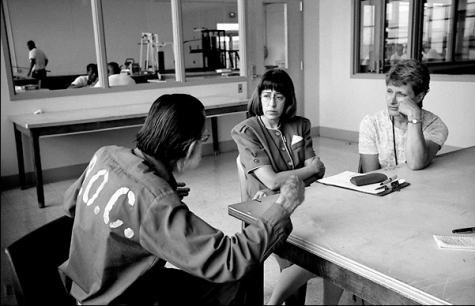
“What happens when a 75 year old who has spent his last 50 years behind bars gets released?” This is the questions Sarah Bones asks in a careful study of Earl. Earl has no plans, no money and no destination. He makes this clear to those in positions to aid his assimilation into society and yet, after he leaves prison, he predictably turns up homeless and seemingly alone.

At an exit interview in Laural Highlands SCI in Somerset, Pennsylvania, Earl tells the prison social workers that he doesn't want to leave and he is confused about where to go and how to survive. Sarah Bones

At an exit interview in Laural Highlands SCI in Somerset, Pennsylvania, Earl tells the prison social workers that he doesn't want to leave and he is confused about where to go and how to survive. Sarah Bones

Bones does an excellent job with the captions pointing out the realities of Earl’s modest life – keeping warm in the library, eating at soup kitchens, avoiding queues at the health center, unable to find work, wearing the same prison jacket – only with his name crossed out. Earl explains over coffee that living homeless is tough and he wishes he was back inside. Bones’ photography is evidence that for a lot of former inmates the common experience after release is homelessness. Being outside the prison walls is to be outside all walls.

Earl thinks that if he keeps a low profile and stays quiet they will forget to release him. Sarah Bones

Earl thinks that if he keeps a low profile and stays quiet they will forget to release him. Sarah Bones

Earl is unable to wrap his head around his imminent reentry into the free world so he shuffles and hides around the prison hoping the prison authorities will forget about him. I think the same denial would strike pensioner who hadn’t walked free since the early 1950s as a young twenty-something.

Still wearing his prison jacket only now with his name crossed out, Earl stands underneath an abandoned storefront roof to stay dry. Sarah Bones.

Still wearing his prison jacket only now with his name crossed out, Earl stands underneath an abandoned storefront roof to stay dry. Sarah Bones.

After Earl’s release Bones searched for him. She found him in his home town a few hours from the prison. He had taken greyhound. For three months, Earl lived on the streets. He fell down some stairs, and thereafter was admitted to Reading hospital. Earl was hospitalised for 8 weeks and then taken into permanent nursing home care. During his three months on the street, Earl often showed his prison ID to people he met. His institutional identity was one of the few things he had, and when he ended in up in permanent nursing care one feels that a return to an institution, without the stresses of life outside, was a positive result for Earl. Maybe.

Earl flashes his prison ID photo card when approached. It is all that he has to show for himself. Sarah Bones

Earl flashes his prison ID photo card when approached. It is all that he has to show for himself. Sarah Bones

There have been several photo essays done about prison release, but often they feature men with a story to define based on their own choices. These men are younger prisoners who usually return to complex communities, daily decisions, and family interaction. Or the inmate is the exonerated after an overturned sentence. Vance Jacobs did a great series covering Alan Crotzer’s story of exoneration after 25 years for a crime he didn’t commit.

Earl’s case seems very different. It doesn’t seem Earl had many choices … or ones that he was aware of. Sarah Bones completed this series in 2002/03. Earl died in July 2005.

Of Bones’ other work, I am particularly struck by three photographs from East Africa which includes two heartwrenching portraits of AIDS sufferers shunned by their families and a top-drawer portrait which deserves an essay in itself. Please view Bones’ other photo essays on Rwandans lives 15 years after the genocide and her Lightstalkers gallery which includes her work for the Sierra Leone Global Action Foundation.

Sarah S. Bones is a self-taught, award-winning, internationally-exhibited photographer. Sarah saved for her first 35mm camera at age 13. She has documented peoples’ stories in Cuba, Guatemala, Kenya, India, Rwanda, Sierra Leone, Somalia and Tanzania. In the Pennsylvania area, she has photographed in prisons, homeless shelters and on political campaigns. Bones tells the stories of men, women, and children who are voiceless and too often ignored by the popular media.

This has absolutely nothing to do with photography. The matter-of-fact second answer is outshone by the hasty confusion of the first.

Question: How much is a card from prison worth?

Answer: Like, if you sold a letter from someone in prison?! Nothing. Why would people want to buy a letter from a criminal?!

Answer: In a game of monopoly, depending on the house rules, around $50.

Get Out Of Jail Free Card

Get Out Of Jail Free Card

Source: Original Wiki Page

Update: Prison Photography collated a Directory of Photographic & Visual Resources for Guantanamo in May 2009.

U.S. Army 1st Lt. Sarah Cleveland
A detainee kicks a soccer ball around the central recreation yard at Camp 4, Joint Task Force (JTF) Guantánamo Bay, Cuba, June 10, 2008, during his daily outdoor recreation time. Detainees in Camp 4 get up to 12 hours of daily of outdoor recreation, including two hours in a central recreation yard. Photo Credit: U.S. Army 1st Lt. Sarah Cleveland

Just gratefully recieved a nudge from an urban conspirator to check out these 30 vetted photographs posted on the Boston Globe website. Obviously, many were taken during the same media tour I mentioned in the last post. Enjoy!

EMAIL

prisonphotography [at] gmail [dot] com

Prison Photography Archives

Post Categories