Spurred by the wonderful news over at The Impossible Project that Polaroid Film is getting a second chance, I delved (via its “friends” links) into Polanoid.net. Whereupon, I found this small and particular photo-series by Lars.blumen.

lars.blumen

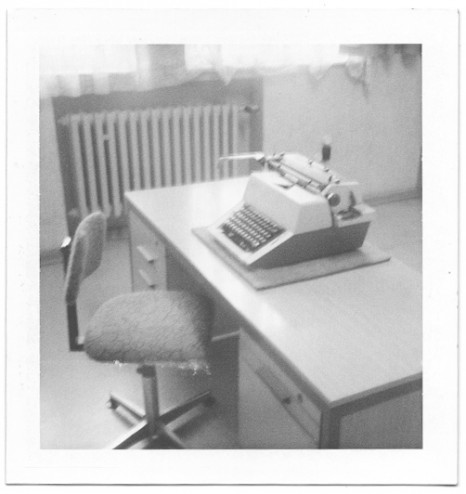
Hohenschönhausen. Credit: lars.blumen

The Hohenschönhausen Memorial in Berlin is an active community/museum organization that fosters education and understanding with regards political imprisonment. The refreshingly transparent website even concedes crucial gaps in knowledge. “The history of the Berlin-Hohenschönhausen prison site has not yet been researched in sufficient detail. There is, as yet, no general overview detailing the social background of the prisoners, nor the reasons for their imprisonment, nor their length of stay. In fact, we do not even know exactly how many prisoners were kept here over the years.”

I am given the impression a precious sense of purpose & justice drives this shared project. Elsewhere on the site, their call for research is inspiring.

lars.blumen

Hohenschönhausen. Credit: lars.blumen

The reason this set fascinated me so much was that it seemed so immediately incongruous. It is wonderful incongruity. With Polaroid one expects sanctified family portraits (60s, 70s) or blurred disco memories (80s, 90s). Polaroid of the 21st century has been largely an indulgent affair. Lars.blumen has given us a rare treat. He ‘captured’ the most infamous site of Soviet Secret Police interrogation and detention within 10 single polaroid frames.

lars.blumen

Hohenschönhausen. Credit: lars.blumen

Lars.blumen’s project, done without fanfare nor nostalgia, uses the visual vocabulary of the past. Just to make things interesting, the prison (at he time of Polaroid) would never have been observed, nor documented, in this same manner.

The polaroids are remarkable for what they aren’t. They aren’t actual images from the era of the Stasi. And this era is that to which now all energy – as a Memorial – is focussed. The photos are a requiem for the stories and faces of the prisoners never recorded. I think this is why the Hohenschönhausen Memorial has such an emphasis on documenting oral testimony and experiences of prisoners.

lars.blumen

Hohenschönhausen. Credit: lars.blumen

No people, no prisoners, no players in these scenes. The hardware of the site and the illusion of time passed. Understated.

lars.blumen

Hohenschönhausen. Credit: lars.blumen

The texture reminds me of old family portraits in front of the brick of Yorkshire and Merseyside. In front of churches and on door steps.

lars.blumen

Hohenschönhausen. Credit: lars.blumen

Outside are cameras, inside is bureaucracy. Still lured by Polaroid nostalgia, the sinister reality of the images creeps up slowly. The minimalist composition of the Frankfurt school is at use here, but Lars.blumen uses a medium that predates the movement. It’s all very disconcerting.

lars.blumen

Hohenschönhausen. Credit: lars.blumen

Why do I respect these images? Because they are unique and, even to some degree, challenging. I cannot celebrate these images because of their history – they have no history. I cannot celebrate a familiar style – they are recuperations of contemporary German photography. They are idiosyncratic one-offs.

lars.blumen

Hohenschönhausen. Credit: lars.blumen

Is it really this intentional? I wonder now if Lars.blumen just had a reel of Polaroid film to burn and that day he happened to be at the Hohenschönhausen Memorial?

If anyone cane help me with Lars.blumen’s identity I’d be grateful!

Official Blurb: The site of the main remand prison for people detained by the former East German Ministry of State Security (MfS), or ‘Stasi’, has been a Memorial since 1994 and, from 2000 on, has been an independent Foundation under public law. The Berlin state government has assigned the Foundation, without charge. The Foundation’s work is supported by an annual contribution from the Federal Government and the Berlin state government.

The Memorial’s charter specifically entrusts it with the task of researching the history of the Hohenschönhausen prison between 1945 and 1989, supplying information via exhibitions, events and publications, and encouraging a critical awareness of the methods and consequences of political persecution and suppression in the communist dictatorship. The former Stasi remand prison is also intended to provide an insight into the workings of the GDR’s political justice system.

Since the vast majority of the buildings, equipment and furniture and fittings have survived intact, the Memorial provides a very authentic picture of prison conditions in the GDR. The Memorial’s location in Germany’s capital city makes it the key site in Germany for victims of communist tyranny.

One last thing. May I recommend you spend time with the lovingly assembled staff portrait gallery at the Impossible Project.

Heidi Schumann for The New York Times

During the warm-ups, Ms. Barr asked the crew, "How cold does it have to be to get hypothermia? Only 50 degrees. But if you're cold you're probably not working hard enough." Photo: Heidi Schumann for The New York Times

Sunday’s depressing article in the  New York Times detailed the political battle in Sacramento to keep hold of California Conservation Corps (CCC) through this period of recession. Gov. Schwarzenegger wants to cut the program to eat into the $45billion deficit California currently bears. Interestingly, Jerry Brown – who initiated the program as Governor in 1976 – is one of the leading voices to save the CCC from the chop.

The Corps. offers low paid work, but work nonetheless, to youth who for whatever reason do not fit the typical work history. Consider not the gaps in your work history, but work histories in your gap! This is a program that considers the individual and not the CV first – which is truly noble these days. The Corps is an employment gateway and an opportunity for young persons to complete unquestionably worthwhile work.

California’s program is modeled on the Civilian Conservation Corps, which put three million young, unemployed men to work from 1933 to 1942. Last year, I may have argued that the model was out of date, but given recent twitter comparing today with the Great Depression, I wouldn’t now question programs indebted to good ol’ fashioned graft. Indeed for many work crew, this is one of the few structures of employment that makes any sense.

Heidi Schumann for The New York Times

Jason Prue, 21, said he was living as a drifter in an old Dodge Intrepid with a dog named Buddy before joining the corps. "I decided I needed to do something, to find a job I loved." Photo: Heidi Schumann for The New York Times

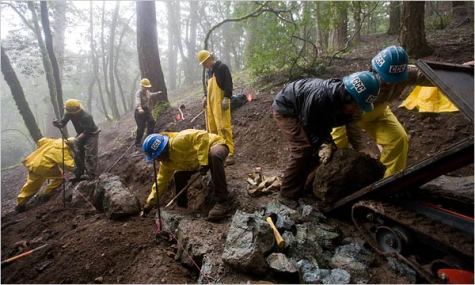
A California Conservation Corps crew repaired trails in Mount Tamalpais State Park. The corps employs 1,300 young adults. Heidi Schumann for The New York Times

A California Conservation Corps crew repaired trails in Mount Tamalpais State Park. The corps employs 1,300 young adults. Heidi Schumann for The New York Times

While reading this article in the hairdressers, I was surprised to see Van Jones’ name once again. I have mentioned his previous work with incarcerated youth and now with sustainable energy policy. He sees the necessary link between these two issues and calls for former prisons, alienated youth, new unemployed and urban poor all to jump on to Obama’s “green economy employment juggernaut”.

“To cut off the opportunity for disadvantaged kids to get their feet on the first rung of the ladder to future green careers is criminal,” said Van Jones, author of the best-selling “Green Collar Economy” and founding president of the Oakland-based nonprofit agency Green for All.

Mr. Jones said the California program was the prototype for at least 13 similar corps in other states and an inspiration for conservation work programs being considered by the Obama administration.

“How can you be a green governor and be taking the tools to green the state out of the hands of young people?” Mr. Jones said.

That Schwarzenegger might gut the corps even as President Obama’s new administration evokes themes of public works, national service and overcoming odds galls some youth advocates, who say the program serves as a model for the type of “green collar” jobs promised by the Congressional stimulus package.

Heidi Schumann for The New York Times

Members of the corps cleaned their breakfast dishes in the dark before going out to repair trails and build a wheelchair-accessible trail in Mount Tamalpais State Park in Marin County. Photo: Heidi Schumann for The New York Times

Heidi Schumann for The New York Times

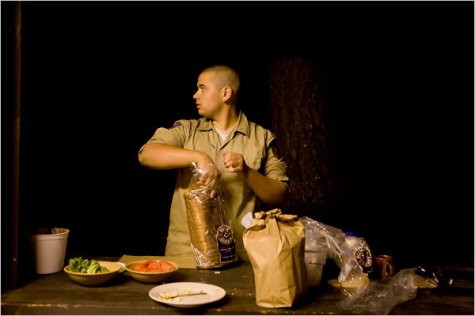
Edward Alvarez, 18, packing the group's lunches for the day. Mr. Alvarez comes from a long line of corps members. His father fought fires with the California Conservation Corps in the 1980s and his great-grandfather served in the Civilian Conservation Corps established by President Franklin D. Roosevelt. Photo: Heidi Schumann for The New York Times

Does this effort to eradicate the CCC in order to save $34million/year suggest we have become too over ambitious? Are we realistic with the number and type of programs Obama’s stimulus package may bring? Is it really the “Christmas Tree” the Republican’s describe? How are we to design, support and administer a new movement in green jobs and environmental agri-service if we can’t maintain the simpler, tried-and-tested, restoration based programs?

For more pictures please view the full California Conservation Corps photo essay by Heidi Schumann for the New York Times

…. was today’s New York Times’ rueful statement of fact.

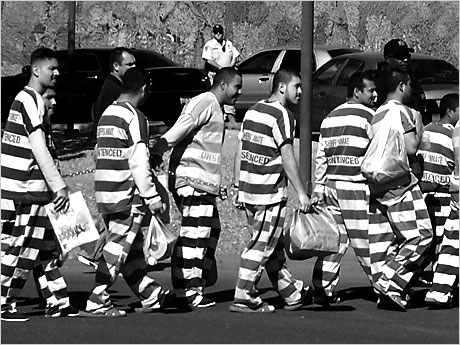
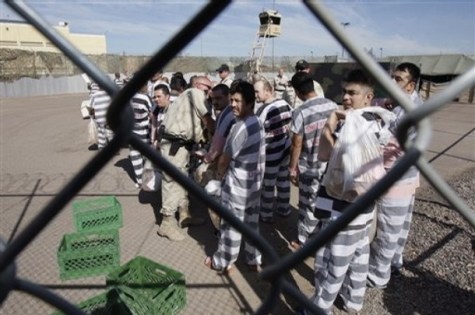
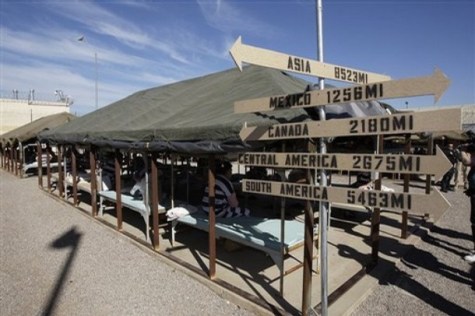
Writers note: These immigrants are undocumented and unsentenced. They are not criminals. This is not prison. This situation is of acute interest to Prison Photography blog because Maricopa County Sheriff’s office is deliberately trying to blur the distinction between these two very different populations.

I recently commented on Sheriff Joe Arpaio’s scurrilous publicity stunt and parading of immigrants in Maricopa County, Arizona. Not only does Arpaio don his ensnared with the stripes of historical chain gangs, he actually puts them to work as such.

Carlos Garcia for the New York Times

Carlos Garcia for the New York Times

Arpaio’s continued antics are firmly in the national spotlight. The New York Times has a long and varied history of comment. His mob-rule is increasingly divisive because a) we now hope for a just application of the law under an Obama administration and b) Janet Napolitano, former Governor of Arizona, and new Secretary of Homeland Security has yet to prove whether she can run the department without trampling human rights AND in so doing put pay to Arpaio’s abuses. The New York Times notes:

The burden of action is particularly high on Ms. Napolitano, who as Arizona’s governor handled Sheriff Arpaio with a gingerly caution that looked to some of his critics and victims as calculated and timid.

Ms. Napolitano, who is known as a serious and moderate voice on immigration, recently directed her agency to review its enforcement efforts, including looking at ways to expand the 287(g) program. Sheriff Arpaio is a powerful argument for doing just the opposite.

Now that she has left Arizona politics behind, Ms. Napolitano is free to prove this is not Arpaio’s America, where the mob rules and immigrants are subject to ritual humiliation. The country should expect no less.

All eyes are rightfully on this situation. It cuts right to the heart of the ideals America professes to uphold. Watch closely.

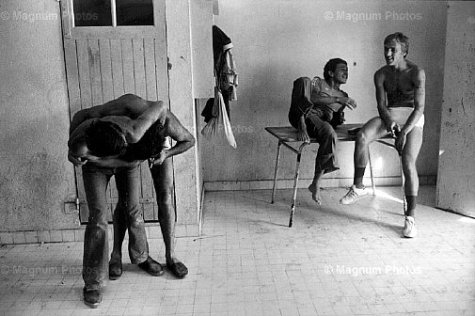
Jean Gaumy, Prisoners' horseplay. St Martin de Ré. Prison. France. 1978

Jean Gaumy, Prisoners' horseplay. St Martin de Ré. Prison. France. 1978

Preamble: Jean Gaumy puts the fear of God into me. As an art historian, I am supposed to know how to describe and relate his ouevre. Quite honestly, the thought of discussing his work paralyses me. He embodies almost all attributes I respect in fine artists. What words build on his thoughtful photography?
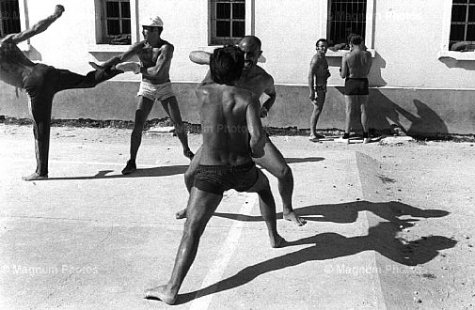
Jean Gaumy. Sports training of prisonners in the walking court. St-Martin-de-Ré. La Citadelle. Prison. 1976

Jean Gaumy. Sports training of prisonners in the walking court. St-Martin-de-Ré. La Citadelle. Prison. 1976

Gaumy’s intellectual curiosity in his subjects – which translates as respect – was an atypical regard for prisoners during the 70s. At that time, he was one of the few photographers paying attention to criminal justice systems. He was the first photojournalist allowed inside French prisons. Les Incarcérés established Gaumy’s reputation as a thoughtful artist who revealed to society its lesser known undertakings.

Sure enough, Danny Lyon was working in Huntsville, Texas in the early 70’s but he was an inheritor of civil rights awareness and his project Conversations with the Dead has always been discussed in political terms first. Perhaps it is an unfair comparison of two great artists working in two different penal systems; perhaps it was easier for Gaumy in France to be neutral and curious. Gaumy operated without the spectre of racism and violence as existed in the South, in Texas and on death row.
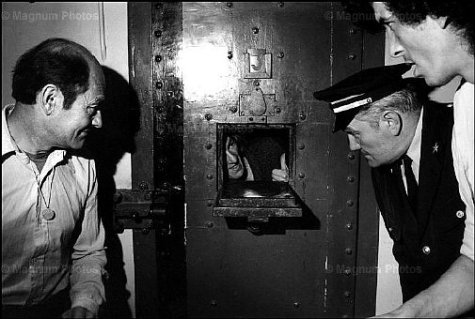
the old system for serving meals and delivering mail to convicts.

Jean Gaumy. Seine-Maritime. Rouen. Prison. France. 1979. Cell-door grating: the old system for serving meals and delivering mail to convicts.

The impression that Gaumy actually cares for his subjects may be a confusion with the possibility he just understood them. A great many of his pictures are so unique (and one presumes a long-time-making) it can be said without doubt he knew his subjects. They knew him well enough to either ignore the camera or look directly at it to communicate clear messages. Let me explain: when a camera first enters an environment it steals the attention and comfort of most subjects. At this point a great many images are of subjects reacting directly to the camera’s novel presence, and of subjects calculating the nature of their relationship to the camera and operator. For this to pass the camera must be around long enough for it to ‘become invisible’. Thereafter, when the subject addresses the camera directly, it is purposeful – with a message – a not as a reflex reaction.
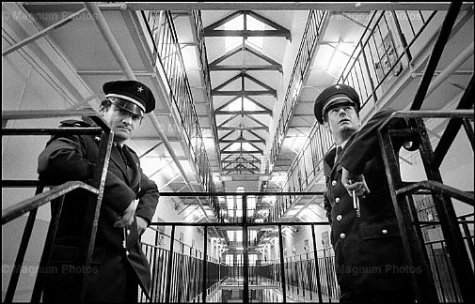
Jean Gaumy, Maison d'arrêt. Caen, France, 1976. Surveillance in the Passageway.

Jean Gaumy, Maison d'arrêt. Caen, France, 1976. Surveillance in the Passageway.

His work is that which enriches the viewer the longer they spend with it. These are not platitudes. Over the course of several years, with craftsmanlike rigour and repeated visits to many institutions, Gaumy pieced together a body of work (ultimately for his 1983 book, Les Incarcérés) that held a mirror to the multitude of attitudes and realities of prison life.

Jean Gaumy. Convict in his Cell, St-Martin-de-Ré. La Citadelle. Prison. 1976

Jean Gaumy. Convict in his Cell, St-Martin-de-Ré. La Citadelle. Prison. 1976

Rather than taking a position or preferring the stories of one group over another Gaumy flits about the different prisons and – through (as I suspect) thorough editing – presents prisons as predictable places that are occasionally enlivened by quirks of human behaviour. Gaumy’s photography shows the machismo of a minority of inmates only after it has shown the solitude of some, the collective boredom of others, the routine awareness of guards and the bureaucratic tasks of the prison itself. There are no stereotypes in Gaumy’s work, and there a very few visual clichés.

Jean Gaumy, St-Martin-de-Ré. Prison. La Citadelle. France. 1976. Administrative procedure for the release of a prisoner.

Jean Gaumy, St-Martin-de-Ré. Prison. La Citadelle. France. 1976. Administrative procedure for the release of a prisoner.

Gaumy’s craft is the manner in which he casts an even hand over all objects and subjects. His studies of guards at their most relaxed and animated are as interesting as that of the lounging inmate reading his paper (as if a photographer stands in his cell every day). Well perhaps Gaumy did stand in his cell every day … for a period. Such is the familiarity of Gaumy’s portraits some could be mistaken for subjects in their own houses. Now is this Gaumy’s fabrication, or were the institutions of St. Martin-de-Ré; Maison d’arrêt, Caen; Seine-Maritime, Rouen; Ile-de-France, Seine-et-Marne, Melun; and the Calvados, Basse Normandie really as calm as he depicts? There is no violence, barely even tension among the inmate or guard populations.

Jean Gaumy. Transit lock chamber between the walking courts and the cells. St-Martin-de-Ré. Prison. La Citadelle. 1976

Jean Gaumy. Transit lock chamber between the walking courts and the cells. St-Martin-de-Ré. Prison. La Citadelle. 1976

Jean Gaumy. Tattooed Prisoner. 1978. Charente Maritime region. Poitou Charentes department. Village of Saint Martin de Ré. La Citadelle. Prison. Saint-Martin de Ré was the departure point for prisoners who were sent to the Cayenne prison in French Guyana. The last shipment of convicts was in 1938.

Jean Gaumy. Tattooed Prisoner. 1978. Charente Maritime region. Poitou Charentes department. Village of Saint Martin de Ré. La Citadelle. Prison. Saint-Martin de Ré was the departure point for prisoners who were sent to the Cayenne prison in French Guyana. The last shipment of convicts was in 1938.

The only suggestions of violence power Gaumy portrays are the immediate exertions of the weightlifter and, alternatively, the viewers semantically-derived understanding of violence as exhibited in tattoos.

Gaumy makes four individual studies of tattoos. It is hard to comprehend whether Gaumy was original in this. Today we are saturated with images of the tattoo, to the extent that street graffiti, body art and gallery hangings are one and the same; not a year passes without a photojournalist embedding themselves among gangs (either within or without prison) to study the pervasiveness of ink and brevity. Maybe I am biased, but I like to think of Gaumy’s interest in the tattoos of social transgressors, as an artist pioneering a genre in its infancy.
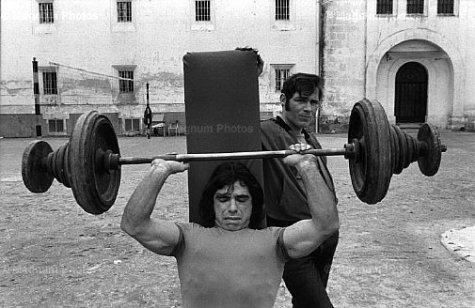
Jean Gaumy. Sports training of prisonners in the walking court. City of Caen. Prison. 1976.

Jean Gaumy. Sports training of prisonners in the walking court. City of Caen. Prison. 1976.

Jean Gaumy. Coming on watch of warders' team. Ile-de-France. Seine-et-Marne. Melun. Prison. 1978

Jean Gaumy. Coming on watch of warders' team. Ile-de-France. Seine-et-Marne. Melun. Prison. 1978

Gaumy kept adding the layers. Unwilling to present only the palatable human side – and seemingly unable to present the darker side of prison life – Gaumy changed his viewpoint. At times his lens was that of a fine artist concerned with shadow and form, at others his eye was that of a faux-Precisionist prompted by the reductive lines of prison architecture. Only Gaumy’s work differed from Charles Sheeler’s et al because of the presence of people – ants; dots; inhabitants. Gaumy’s work, inclusive of crowds, repeats the affections of Lowry. Gaumy’s act of recording is a testament to the physical imprisonment of these French men as Lowry’s was a testament to the social imprisonment of Salford’s working class.

A Street Scene in Clitheroe, L.S. Lowry.

A Street Scene in Clitheroe, L.S. Lowry.

As I write, another (probably meaningless) similarity between the two men springs to mind. Lowry was always drawn to the sea, particularly England’s Northeast coast and the North Sea. He returned to it into his old age. Gaumy late in his career has grappled with the enormity of the oceans. I could hypothesise both artist’s careful handling of mankind derives from an ever-present haunting of that which is larger than mankind. To appreciate the awesome scale of the sea is to wonder at the fragility of man. Ask a surfer … or a fisherman.

Gaumy also manages to reconcile – If one presumes them at opposite ends of the same spectrum – the human scale and the systemic scale of prisons. Couldn’t the three pictures below be by that of a different hand, and yet don’t they make perfect sense grouped together?

Jean Gaumy. "Bonne Nouvelle" prison ("Good news" prison). 2nd section. Walking court. Seine-Maritime. Rouen. Prison. 1979
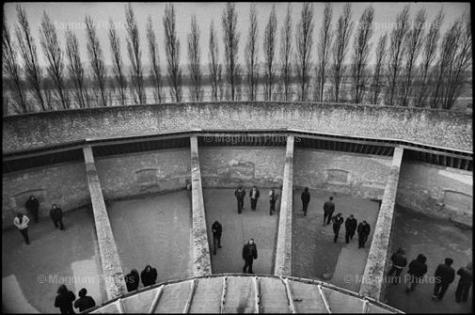
Jean Gaumy. "Bonne Nouvelle" prison ("Good news" prison). 2nd section. Walking court. Seine-Maritime. Rouen. Prison. 1979

Jean Gaumy. Walking Courts, Caen. Maison d'arrêt. 1976

Jean Gaumy. Walking Courts, Caen. Maison d'arrêt. 1976

Jean Gaumy. "Bonne Nouvelle" prison ("Good news" prison). 2nd section. Walking court. Seine-Maritime. Rouen. Prison. 1979

Jean Gaumy. "Bonne Nouvelle" prison ("Good news" prison). 2nd section. Walking court. Seine-Maritime. Rouen. Prison. 1979

Gaumy got close in and later retreated right back. Even if this is considered a privilege of a photographer with free passage through the walls of a prison, it does not guarantee good execution. My favourite image is the church service attended by a congregation of boxed men. Gaumy lays bare the crude and incongruous use of discipline and religion, and in doing mocks the scene. The viewer can’t fail but be in agreement with Gaumy; the interaction is absurd and directly contradicts the extraordinary ordinariness of Gaumy’s other scenes.

Jean Gaumy Mass in the chapel. The prisoners are isolated in individual compartments. Caen. Maison d'arrêt. 1976

Jean Gaumy Mass in the chapel. The prisoners are isolated in individual compartments. Caen. Maison d'arrêt. 1976

Gaumy, it seems, didn’t want to extricate himself from the action, nor from the space and time spent on the series. Unwilling to let himself nor the craft of photography off the hook, Gaumy includes three studies of the anthropometric photography room. This is not a Surrealist maneouver, but it does point toward the Postmodernist insistence that the practitioner is an inevitable part of the work. Gaumy never intended to be an objective viewer but rather an active participant (he only ever took photographs with the prisoners consent) and the images below are an open admission of photography’s classifying, even disciplining, function. The camera … the metre-rule … the artificial light … the document … the knowledge … the authority.

Jean Gaumy. Anthropometric photography of a convict at his arrival in prison. Basse Normandie. Calvados. Caen. Prison. 1976

Jean Gaumy. Anthropometric photography of a convict at his arrival in prison. Basse Normandie. Calvados. Caen. Prison. 1976

Jean Gaumy. Anthropometric photography of a convict at his arrival in prison. Basse Normandie. Calvados. Caen. Prison. 1976

Jean Gaumy. Anthropometric photography of a convict at his arrival in prison. Basse Normandie. Calvados. Caen. Prison. 1976

Without doubt, Gaumy was fortunate to have a wild-haired caricature sitting for this particular anthropometric observation. The docile subject is the perfect compliment to the act of observation and documentation. The treatment of this prisoner is akin to expedition-photography that attempted to measure the anatomical dimensions of colonised peoples and thus provide scientific evidence for Western genetic superiority. This appreciation is the perfect close to a series throughout which Gaumy balances his artistic aims, social purpose, photography’s interferences and the loaded history of Modern taxonomic praxis. Gaumy dismantles assumed norms and hierarchies of social order and allows the viewer to meditate on the subtleties of carceral systems.

I escaped my paralysis, jolted by the news that last week Jean Gaumy was awarded the Peintre de la Marine (Painter of the Fleet) by the French Ministry of Defence. Gaumy is only the fifth photographer to join the select circle, which is composed of only 40 members.

For a full biography and portfolio please visit the pages of Magnum Photo Agency.

The folkology (keyword tags) within the Magnum archive are inconsistent. Different sets of Gaumy’s images turn up for different searches. Here is another isolated set for St-Martin-de-Ré. La Citadelle also from 1976. I would encourage readers to search at length Gaumy’s work throughout the different institutions with permutations on keyword searches.

Approximately 200 convicted illegal immigrants handcuffed together arrive at their new part of the jail as they are moved into a separate area of Tent City, by orders of Maricopa County Sheriff Joe Arpaio, for incarceration until their sentences are served and they are deported to their home countries Wednesday, Feb. 4, 2009, in Phoenix. (AP Photo/Ross D. Franklin)

Approximately 200 convicted illegal immigrants handcuffed together arrive at their new part of the jail as they are moved into a separate area of Tent City, by orders of Maricopa County Sheriff Joe Arpaio, for incarceration until their sentences are served and they are deported to their home countries Wednesday, Feb. 4, 2009, in Phoenix. (AP Photo/Ross D. Franklin)

Hopefully, Prison Photography helps to clarify the facts behind images. In Maricopa County, Arizona yesterday the zealous Sheriff Joe Arpaio, ordered a parade of guarded, unsentenced & undocumented immigrants. Hand-cuffed and dressed in stripes, the men walked from one facility to Tent City. Hatewatch summarised the scene:

Along the way they were filmed by television news crews and guarded by at least 50 Maricopa County Sheriff’s Office (MCSO) deputies, wearing body armor and combat fatigues, armed with shotguns and automatic rifles. At least two canine units were present; a Sheriff’s Department helicopter hovered overhead.

The massive show of force was pure stagecraft for a blatant and dehumanizing publicity stunt orchestrated by Maricopa County sheriff Joe Arpaio. The MCSO gave no indication that any of the immigrant prisoners were particularly violent or presented a grave danger to the public.

Maricopa County Sheriff Joe Arpaio, left, orders approximately 200 convicted illegal immigrants handcuffed together and moved into a separate area of Tent City, inmates behind Arpaio, for incarceration until their sentences are served and they are deported to their home countries Wednesday, Feb. 4, 2009, in Phoenix. (AP Photo/Ross D. Franklin)

Maricopa County Sheriff Joe Arpaio, left, orders approximately 200 convicted illegal immigrants handcuffed together and moved into a separate area of Tent City, inmates behind Arpaio, for incarceration until their sentences are served and they are deported to their home countries Wednesday, Feb. 4, 2009, in Phoenix. (AP Photo/Ross D. Franklin)

Arpaio, the self proclaimed “toughest sheriff in America”, has been roundly condemned by civil rights advocates, most of the regional media and clear-thinking locals for his colourful publicity stunt. Arpaio is a man hell bent on cleansing his county of undocumented immigrants and has done so by targeting Latino neighbourhoods, stopping Latinos for minor infractions (as an excuse for searching), and frequently deployed mask-wearing/gun-toting forces in petty shows of strength. Hatewatch elaborates on how all this is possible:

Arpaio is lionized by Minutemen vigilantes and other nativist extremists for his controversial “287(g)” arrangement with U.S. Immigration and Customs Enforcement, which empowers the MCSO, a local agency, to enforce federal immigration law.

Many Latinos taken into custody in recent months by MCSO 287(g) squads have been pulled over for minor traffic violations, such as a broken headlight or an improper lane change, and then arrested when they’re unable to produce proof of citizenship or a valid visa.

Feb. 4, 2009, in Phoenix. (AP Photo/Ross D. Franklin)

Feb. 4, 2009, in Phoenix. (AP Photo/Ross D. Franklin)

Arpaio is a nasty piece of work and it is unlikely he will let up. Alessandra Soler Meetze, executive director of the ACLU of Arizona, said “You’re sort of giving the message that it’s OK to treat these inmates differently. It’s OK to treat them like circus animals.” Meetze added, “He didn’t have to make a spectacle. He could’ve moved them on buses.” In the meantime, Arpaio said his office has received $1.6 million funding from the state that will go toward tackling illegal immigration.

Is dehumanisation is the issue? The point has been made on the blogs that when Iraqi forces paraded five US marines in March 2003, Rumsfeld cited it as a breach of the Geneva Convention, and yet here on American soil we have men defined as criminals, reduced to visual cliché and props in a vulgar display of power. Do these images shock? They shock me. Are they not images of racist control by the state?

Feb. 4, 2009, in Phoenix. Arpaio said housing the illegal immigrants separately would save money, although he did not explain how other than to say it's cheaper to house inmates in tents than at traditional jails. He also said the move will be more convenient for consulate officials visiting foreign inmates and for Immigration and Customs Enforcement agents charged with deporting the inmates after they have served sentences in county jails. (AP Photo/Ross D. Franklin)

Feb. 4, 2009, in Phoenix. Arpaio said housing the illegal immigrants separately would save money, although he did not explain how other than to say it's cheaper to house inmates in tents than at traditional jails. He also said the move will be more convenient for consulate officials visiting foreign inmates and for Immigration and Customs Enforcement agents charged with deporting the inmates after they have served sentences in county jails. (AP Photo/Ross D. Franklin)

Fortunately, Arpaio, try as he might, is not winning the public relations war. His brand of policing is considered by many as direct challenge to law.

Speaking of law. The Phoenix New Times noted, this pantomime just happened to fall “on the same day that his employee and political helper, Captain Joel Fox, is set to appear at a hearing to context a massive $315,000 fine for making an illegal campaign donation in the name of the mysterious “Sheriff’s Command Association,”

Which event do you think average news consumers will remember on Thursday – an administrative hearing concerning a convoluted tale of campaign finance laws, or the image of 200 Mexicans in stripes marching in chains down a public street?

Last year, Arpaio paid a visit to one of his tent jails. It gave him the opportunity for yet another photo opportunity!

Former world heavyweight boxing champion Mike Tyson listens to Sheriff Joe Arpaio (R) in the tent Tyson will stay in for 24 hours at  Maricopa County Jail's tent city for prisoners in Phoenix, Arizona November 20, 2007. Tyson was sentenced on Monday to three years probation and one day in jail for drug possession and driving under the influence. Tyson is holding a copy of the book "American Gangster"  according to Maricopa County Sheriff Joe Arpaio. REUTERS/Photo Courtesy of Maricopa County Sheriffs Department/Handout

Former world heavyweight boxing champion Mike Tyson listens to Sheriff Joe Arpaio (R) in the tent Tyson will stay in for 24 hours at Maricopa County Jail's tent city for prisoners in Phoenix, Arizona November 20, 2007. Tyson was sentenced on Monday to three years probation and one day in jail for drug possession and driving under the influence. Tyson is holding a copy of the book "American Gangster" according to Maricopa County Sheriff Joe Arpaio. REUTERS/Photo Courtesy of Maricopa County Sheriffs Department/Handout

I’ll leave you with this eloquent summary of Arpaio’s antics from Kevin Appleby, the Director of Migration and Refugee Policy with U.S. Conference of Catholic Bishops, “Shackling and marching fellow human beings for all to see is not in line with the values of the American people. While Guantanamo (Bay) is being closed, another one is being started in Arizona,”

For more images of this circus, see Jack Kurtz’s Blog or Ross D. Franklin’s AP Gallery. If you’d like to book a tour of the Tent City, Sheriff Arpaio’s office can make arrangements. Be sure to wear smart casual.

Thanks to Brendan at Anxiety Neurosis for sharing this through Google Reader

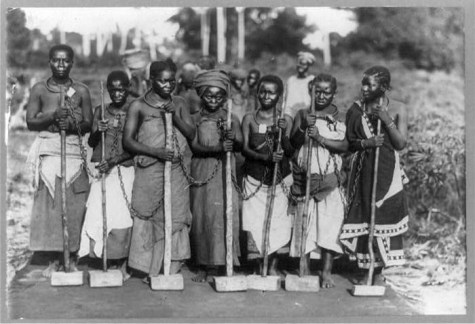
I came across this image on a ‘free media web hosting site’ where I lazily put in the term “Prison” to the search. I am unwilling to name the site as I do not wish you to suffer the same banner ads and unedited content.

Unknown

Women prisoners working on road, Tanzania. circa 1901. Source: Unknown

The search returned the usual images of pets in crates (1st-person caption optional), macro-shots of rusting locks and/or bars, stock images of barb wire, and photos from Eastern State Penitentiary (which does many photography workshops). There were three images that were worth a second glance – the other two being images WWII prisoners of war.

Despite having no means to confirm its authenticity or the accuracy of the caption, I thought the image worthy of a quick reflection. The image is contrary to the usual representation of incarcerated peoples – the era; the gender of the subjects; the continent; the anonymity of the photographer. De facto, this becomes a visual source in its most naive understanding; all we have to go on are the women depicted. The photograph wriggles away from all the contextual information one needs to assess its political purpose.

The responses of the women to the camera (pride, defiance, awkwardness, subjection – and even laughter from a lady in the background) compel me to presume nothing of this picture. I question the authority to which they are subject, I question the legitimacy of the charge by which they are held prisoner, I certainly can’t reconcile hard labour with a mode of justice for grown women. This is a depiction of slavery more than it is of criminal justice.

If the date in the caption is accurate, Tanzania (then Tanganyika) was under German rule. “Tanzania as it exists today consists of the union of what was once Tanganyika and the islands of Zanzibar. Formerly a German colony from the 1880s through 1919, the post-World War I accords and the League of Nations charter designated the area a British Mandate (except for a small area in the northwest, which was ceded to Belgium and later became Rwanda and Burundi). British rule came to an end and Tanganyika became officially independent in 1961.”

I rarely harp on about “the power of photography” because it is a subjective assessment, but I will vouch for that personal reaction to imagery that can stop you in your tracks and get you thinking.

lax |laks| adjective
1 not sufficiently strict or severe : lax security arrangements at the airport | he’d been a bit lax about discipline in school lately.
2 careless : why do software developers do little more than parrot their equally lax competitors?

It is perhaps easy to forget there once was an era when the prison in society was less useful. By 1905 when this picture was taken, there were only two prisons in California (San Quentin and Folsom) and it would remain that way for another 30 years. Much of the detention and incarceration was done through an smattering of local jails and jail houses for work crews.

Alum Rock Jail. Alice Iola Hare, ca. 1905. On the back of the photograph is written, "Much of the original road into Alum Rock Park was built by County Jail prisoners who were housed - and guarded - in these shacks. The roofed structures and the open one (stockade?) behind them stood for many years after the road building job was completed."

Alum Rock Jail. Alice Iola Hare, ca. 1905. On the back of the photograph is written, "Much of the original road into Alum Rock Park was built by County Jail prisoners who were housed - and guarded - in these shacks. The roofed structures and the open one (stockade?) behind them stood for many years after the road building job was completed."

This image of Alum Rock Jail, Santa Clara County was taken originally by Alice Iola Hare, was then part of the Arbuckle Collection and eventually went digital as part of Silicon Valley History online.

The description is right; this is a shack more than jail. The fabric of the structure did not discipline the inmates at Alum Rock, it was the guard’s rifles and the open countryside that asserted control. The physical make-up of this carceral structure is a world away from the SuperMax US society now relies upon. And for that reason, and for the indulgence of punnery, I want to refer to this example of historical jails as a “SuperLax” Prison.

What would people at the beginning of the 20th century have made of 16ft razor wire, heat sensing detection equipment, opticons and magnetic locks? I suppose the one piece of equipment they may have shared with their contemporary guards would be dogs, but they probably didn’t call them “K9 units” back then. I doubt they’d developed rubber bullets in 1905 either…

Chris Jordan was low on my list of priorities but this timely post by Mike Kelley at Change.org (a blog as impressive for its readers’ comments as it is for the straight forward presentation of Jordan’s work) compelled me to bump it up and champion the depressingly and unfathomable figures that arise when one simply runs the numbers.

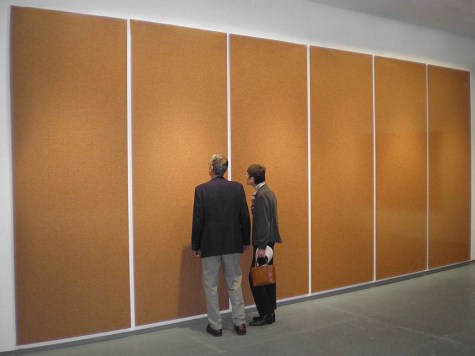
Chris Jordan. Depicts 2.3 million folded prison uniforms, equal to the number of Americans incarcerated in 2005. The U.S. has the largest prison population of any country in the world.

Chris Jordan. Prison Uniforms, 2007. 10x23 feet in six vertical panels. Depicts 2.3 million folded prison uniforms, equal to the number of Americans incarcerated in 2005. The U.S. has the largest prison population of any country in the world.

In reading Change.org’s straight forward commentary on America’s broken criminal justice system, I signed up for Change.org and read a few of their older posts. In doing so I was presented with the catalyst to comment on Obama’s momentous inauguration without repeating the media-lovefest that has surrounded the 44th’s swearing in. This post will cover Jordan’s astounding artwork, Obama’s astounding tasks-at-hand and where they politically overlap.

Chris Jordan. Prison Uniforms, 2007. Partial zoom.

Chris Jordan. Prison Uniforms, 2007. Partial zoom.

Chris Jordan has spent his time making larger and larger photographic constructions to communicate the scale at which American society wastes its resources, its environmental future and its grasp on logic. In his effort to catalogue the linear and thoughtless waste of the US, he has progressed from crushed automobiles, to cell phone chargers, to polystyrene cups to American prisoners.

Jordan is a bright guy, now consumed by his photography (which to be quite frank is eco-hip and brilliantly executed). He talks passionately about a sea-change in our cultural consumption. He specialises in highlighting “the behaviours that we all engage in unconsciously on a collective level … the actions we are in denial about and the ones that operate below our daily awareness … like when you’re mean to you wife because you’re mad about something else or when you drink too much at a party because you’re nervous.” Jordan is no prophet, he just sees the necessary u-turn we must all make in our habits and thoughts to move toward sustainable existence.

Prison Uniforms, 2007. 10x23 feet in six vertical panels. Detail at half actual size.

Chris Jordan. Prison Uniforms, 2007. 10x23 feet in six vertical panels. Detail at half actual size.

I like to think the strength of Jordan’s visual framework that deals with soda cans to the landfill as it does with prisoners to the cell blocks is deliberate. As hard as it is to acknowledge, the majority of Americans have turned their back on a seven-figure-minority as if it were worth no more thought than discarded packaging. Mass imprisonment is the result of widespread apathy, denial and unpinnable responsibility. How unconscionable is this situation? We are all responsible. Barack Obama talked very little about criminal justice and prison policy during his electioneering. This is not surprising as helping the invisible incarcerated masses is on the electorate’s mind as much as the whereabouts of their last twinkie wrapper. But, Obama also made it very clear that this was the time for personal responsibility and accountability.

Chris Jordan. Prison Uniforms, 2007. Installed at the Von Lintel Gallery, NY, June 2007.

Chris Jordan. Prison Uniforms, 2007. Installed at the Von Lintel Gallery, NY, June 2007.

So after a week of photography gallery after gallery, the militarised eye vs. the personal touch, Gigapan-assisted user-generated snooping, faux controversy, minor mishaps, cult worship, sentimental clap-trap, unending debate, media catfights, nerdcore details, celeb fluff and even UFO’s isn’t it time we adopt the same realism that Obama trusted in for his inaugural speech?

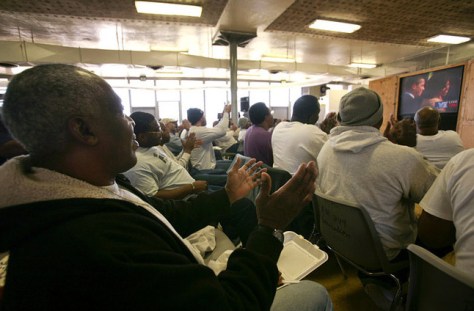
A wonderful article from the Wall Street Journal lays out the realism and “the audacity of hope behind bars”. (Via Change.org). Angola prisoner, Mr. Dennis served up some REALISM: “He’s got his hands full: Two wars, the economy is going in the tank and the health-care costs are skyrocketing – I’d be surprised if he has time to brush his teeth in the next four years.” While another prisoner took care of the HOPE: “If the men here can have hope, then why can’t the rest of the country?”

Prisoners at Louisiana State Penitentiary ("Angola") were given the day off to watch Barack Obama inaugurated as America's 44th president.

Prisoners at Louisiana State Penitentiary ("Angola") were given the day off to watch Barack Obama inaugurated as America's 44th president.

So how does this all connect? Jordan and Obama share the same call to think, with serious intent, about the things invisible to us. Both call us to consider the reality of our society and accept our shared responsibility for its faults, weaknesses and injustices. Both men challenge conventional wisdom; the logic that just because we didn’t turn the key nor bring down the gavel, we are not complicit – by our silence – in America’s mass incarceration.

What can you do? You can start by signing this petition immediately and by using web2.0 to access Obama’s administration as his team reached you during the election.

If you’d like to know more about Chris Jordan you could do worse than starting with this interview, this interview and this interview.

EMAIL

prisonphotography [at] gmail [dot] com

Prison Photography Archives

Post Categories