gitmo

On the final day of 2014, In These Times published George Lavender‘s thought-provoking and straightforward Q&A with some of the leading public voices on criminal justice reform.

Lavender asked for their “worst” and “best” moments in criminal justice in 2014, as well as inquiring what we should look out for in 2015. A good think piece.

Here’s my pick of the answers. From author Dan Berger on his “worst” moment:

“It is hard to pick an exact [worst 2014 criminal justice] moment; there are many contenders. But the combination of intransigence and self-congratulation displayed by various state officials who sustain mass incarceration and police violence. The conservative case for prison reform has attracted a lot of money and attention, and then gone on to claim victories for shrinking prison population through flawed “justice reinvestment” processes—the so-called Texas Miracle. But in fact, their politics of social austerity and expanded police power do not bring us any closer to ending mass incarceration; if anything, they have expanded the carceral state in the realms of policing and surveillance. Meanwhile, prison populations have not declined this year the way they did in year’s past; in some places they increased, while Guantanamo remains open and torture remains legal.”

— Dan Berger.

Follow Dan Berger and George Lavender on Twitter.

7

2015

Happy New Year.

I hope you’ve all had lovely holiday seasons and been provided with time to reflect on the good, to recognise the less-good, and to meet 2015 with strategies to promote the former and reduce the latter. That’s what I intend to do. We’ve an overwhelming amount of information to consume online, so my only resolution is to be efficient with my words, clear in thought, and to respect your time and mine. That means no faffing around; no dillydallying on photography that serves only ego and/or market; no reticence; and only honesty about the world in which we live. Prison Photography might be a modest platform, but it’s everything I have. [Thumbs up emoji].

This year I promise to deal readily and energetically with imagery upon which crucial political realities rest. I’ll only discuss aesthetics if they point toward necessary discussions of citizenship and inequality in society, and if they reveal characteristics of our prison industrial complex.
11So let me start as I mean to go on …

MEDIA CIRCUS

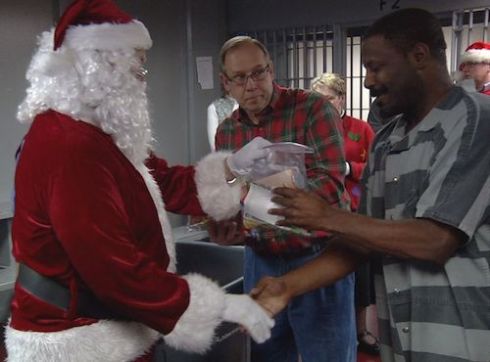
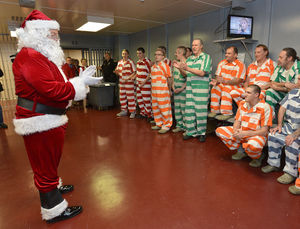
This story about a county sheriff delivering Christmas gifts to jail prisoners hit my radar a couple of weeks ago. Here’s a story that reminds us of our need to be diligent in the face of fluff-pieces, staged photo-ops and lazy journalism.

Here’s a story that reminds us of the uncritical eye that dominates media coverage of prisons and prisoners.

Here’s a story that reveals its true self through images. All we have to do is look. Look closely.
6

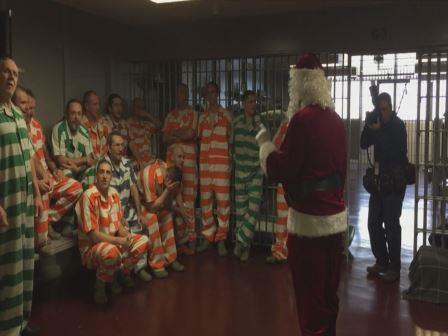
In the above photo, consider the prisoner in the green (far left) looking confusedly toward the camera, and us. What about the other prisoner in green (just to the left of Sheriif Santa in the photo) who peers to his left at the photographer stalking the edge of the group. How about the man in the centre with his head in his hands. Is he laughing out of embarrassment or is he hiding his face from the media cameras? Please, take your pick from any of the other prisoners with sideways glances, folded arms, smirks and obedient positioning which says that they know — and so should we — that they’ve been trotted out for a media photo op.

In the Santa outfit is Sheriff Wayne Anderson of Sullivan County, TN. Over a period of three hours, Anderson visits all 560 prisoners in his jail. The scene above, it would seem, is public show of gifting to a dozen or so privileged prisoners. This is a scene for the invited news teams. Prisoners with backs against a wall. News personnel buzzing around them.

This is cringeworthy stuff.

5

In the bags are soap, toothpaste, toothbrushes, shampoo and snacks. The gifts are provided by the Good News Jail & Prison Ministry. The Ministry has routinely provided useful small items to jail prisoners at Christmas down the years. Excellent. All for it.

Sheriff Anderson began dressing up as a benevolent Father at Christmas seven years ago. He and the Good News Jail & Prison Ministry work it out just fine.
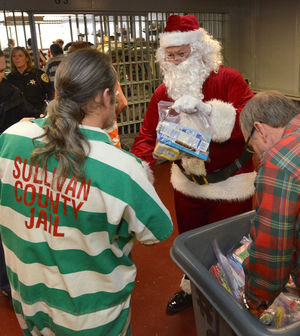
9Frankly, this whole thing is weird. Anderson might be well-meaning but this sort of God-infused pantomime serves he and the ministry more than it does the prisoners. Sure, toiletries are very welcome gifts in an institution where scarcity reigns, but the charity needn’t be played out for the cameras.

Anderson is decking his jail’s halls with bells and folly.

This set of photos oozes awkwardness and stage-set best behaviour. The Santa myth plays centrally here. American prisons and jails already do a great job of infantilizing their populations, and we don’t need a festive version.

Maybe there’s more fundamental issues to attend to at Sullivan County Jail? Say, reasonable conditions of confinement?

In September, Sheriff Anderson and County Mayor Richard Venable had to stand before Tennessee Corrections Institute board committee to explain what they were going to do about persistent overcrowding in Sullivan County Jail.

I want to see the cells for the 500+ other prisoners, not the be-striped docile prisoners chosen because they can presumably behave in front of the cameras.

If overcrowding and underfunding that stretches back years is the reality at Sullivan County Jail, why are we being spoon fed an yuletide act-out of child’s play?

2

For me, these photos present a scene quite different to that described in the local Tennessee “news” pieces they accompany.

Tricities.com quotes Anderson: “[Prisoners] look forward to this every year. If I walk through the jail the week before I do this, they want to know when Santa is going to be here. They get excited about it.” WATE.com adds that prisoners “showed their Christmas spirit by singing along to Christmas carols.”

Prisoners already suffer indignities. It is not surprising that they’d stand and sing (what choice do they actually have?) for some free swag, especially that which improves their daily lives.

Anderson is free to have his take on the afternoon’s events, but it’d be nice to see a prisoner quoted in the media coverage too.

CHEAP SHOTS

It might seem strange to protest so much at a bunch of poor photographs (in case you’re wondering, the aspect ratios are corrupted in the original publication by WATE) but just because the criticism is easy, or obvious, doesn’t mean that it is not needed. Local news stations feed our homes with information daily. They are powerful agents and require watchdogs as much as national cable outlets. There are prison/media collusions occurring everyday to peddle this type of chintzy reporting.

Ironically, these cheap and ill-considered photographs emerge from the ned to illustrate slipshod journalism while also revealing the process of the reporting itself. Without these photographs, I would have no jumping off point for my criticism.

In 2015, I hope to keep a keen critical eye and to not let up on image-makers who circulate photos under false pretenses or over misleading captions. Enough of these types of misguided and cycnical PR-stunts aimed at papering the cracks of broken prison systems.

Charity doesn’t need an audience. And prison administrations don’t need any more reason for me to doubt their operations.

3

6a02eefd3013dce54a128e1873c84929_large

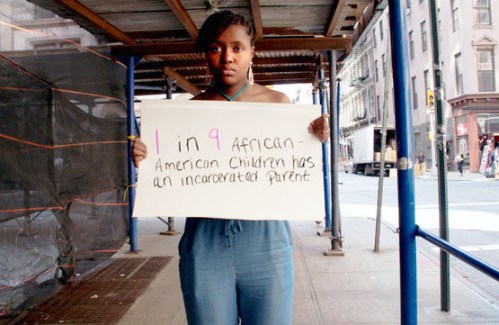
In the final two days of fundraising, Echoes Of Incarceration is a long term project that helps children of incarcerated parents to make documentary films about the effects of America’s prison industrial complex — on society, on us, on families, on communities, and mostly on children without one or both parents behind bars.

There are an estimated 2.7 million children in America with one or both parents in prison or jail. Mass incarceration has created fundamental weaknesses in society. Mass incarceration as easily impacts individuals as it does vulnerable groups (the poor, the under-educated, the discriminated against) and often we perceive the effects as lasting only years, or being contained within the experience of one identified moment, lifetime or geographical space. We neglect to recognise that mass incarceration is piling pressures on top of problems on top of expectations on top of America’s young, developing citizens.

We live in a society in which vast numbers of youth must negotiate formative years without parental support. The prison industrial complex has burdened our youth with an almost inconceivable set of problems that they did not ask for, and they do not deserve.

Echoes Of Incarceration brings much needed scrutiny to the issue of mass incarceration and crucially it does it through the lens of the innocent people who have inherited a broken, brutalising system we made. Their latest productions deal specifically with the Bill of Rights of Children with Incarcerated Parents.

Please, fund this important project.

Below is a 2009 production made by Echoes Of Incarceration

424f5143723015bd18527740bc32c593_large

52d6b990-f57c-4e4b-895f-5e0a8c5864ff

Art For Justice has a new exhibition opening in Philadelphia.

Free Library of Philadelphia, 
1901 Vine Street, Philadelphia, PA 19103. (Between 19th and 20th Streets on the Benjamin Franklin Parkway)

Jan. 12 – Feb. 15, 2015

FERGUSON, THE ZINE

David Butow is raising cash on Kickstarter to fund the printing of a zine of his images made in Ferguson over the past 3 months. The images have been made, the edit done and the sequencing finalised. I’ve seen a PDF of Ferguson and it is a zine that is taut and emotional. It is also quite different from other projects I’ve seen coming out of Ferguson. Many of the scenes framed by Butow have multiple vignettes playing out in them all at once. They’re considered and crafted images. It’s both a photographers’ photography project and a statement relevant to all. It works as art and as political marker. It is relevant to documentarians and also, I think, will stand up to the test of time. Butow travelled to Ferguson twice — once after Michael Brown’s death and once after the grand jury decision not to indict Darren Wilson. As well as 34 photographs, Ferguson also includes raw interview transcripts used in the grand jury deliberations. One offers a nuanced view of the neighborhood where the shooting took place and of Michael Brown himself. “The work goes beyond the violence to offer an intimate and emotional portrait of the community’s reaction – from conflict to prayer – and puts the meaning of what occurred in Ferguson in historical context,” says Butow. 1

——-

FUNDRAISING, KICKSTARTING

Please consider backing this timely, no-nonsense, self-starting publication. Printed in California, using recycled paper and inks. 64 pages, 34 original B&W photographs. 8.5″ x 11″

redaction

I was astounded when a press release (copied below) hit my inbox. Currently, private prison corporations have no legal requirement to provide the same types and amount of information that the public and journalists can demand of state and federal prisons!

A new law looks to correct this disparity.

Last week, U.S. Representative Sheila Jackson Lee (D-TX) reintroduced the Private Prison Information Act (PPIA) in Congress. The bill, HR 5838, requires non-federal correctional and detention facilities that house federal prisoners to comply with the Freedom of Information Act (FOIA).

The Human Rights Defense Center made the following press release last week:

Private Prison Information Act Reintroduced in Congress, to Ensure Public Accountability at Privately-Operated Prisons

Currently, private companies such as Corrections Corporation of America (CCA) and the GEO Group are not required to comply with FOIA requests even when they operate facilities that hold federal prisoners through contracts with federal agencies, and are paid with public taxpayer funds. This includes privately-operated facilities that house immigration detainees.

Alex Friedmann, associate director of the Human Rights Defense Center, and Christopher Petrella, a doctoral student at UC Berkeley, have worked closely with Rep. Jackson Lee’s staff over the past two years to reintroduce the PPIA during the 113th Congress.

Various versions of the PPIA have been introduced since 2005; however, private prison firms and their supporters have lobbied against the bills. For example, CCA’s federal lobbying disclosure statements have specifically referenced lobbying related to the PPIA.

Friedmann and Petrella argue that because private prison corporations rely almost entirely on taxpayer funds, and perform the inherently governmental function of incarceration, the public has a right to obtain information pertaining to private prison operations. In short, the government should not be able to contract away the public’s right to know through FOIA requests.

Friedmann testified before the House Subcommittee on Crime, Terrorism and Homeland Security in June 2008 in support of a previous version of the Private Prison Information Act.

A coalition of 34 criminal justice, civil rights and public interest organizations submitted a joint letter to Rep. Jackson Lee in December 2012, followed by a renewed letter on June 11, 2014, expressing support for the PPIA and encouraging her to reintroduce the bill.

The letter noted that “If private prison companies like CCA and GEO would like to continue to enjoy taxpayer-funded federal contracts, then they must be required to adhere to the same disclosure laws applicable to their public counterparts, including FOIA.”

The signatories to the joint letter included the Center for Constitutional Rights, Center for Media Justice, Ella Baker Center for Human Rights, Florida Justice Institute, Grassroots Leadership, Enlace, In the Public Interest, National CURE and FedCURE, Justice Policy Institute, Justice Strategies, Prison Policy Initiative, Private Corrections Institute, Southern Center for Human Rights, The Sentencing Project, Southern Poverty Law Center and Texas Civil Rights Project. The NAACP has also voiced support for the PPIA.

“This bill is about public accountability – to ensure that for-profit prison corporations, which assume the role of the government when incarcerating federal prisoners, must comply with the same Freedom of Information Act obligations as federal agencies such as the Bureau of Prisons,” said Friedmann. “That is only fair and reasonable, but private prison companies will most likely object to the bill, as they favor secrecy over fairness.”

“The introduction of the Private Prison Information Act constitutes just the first step in bringing transparency and accountability to an industry that’s funded almost entirely by your and my tax dollars,” Petrella added. “We’ll continue to work tirelessly until this bill is brought to fruition.”

For more information:

Visit the Private Prison Information Act website.

Alex Friedmann
Associate Director, Human Rights Defense Center
(615) 495-6568
afriedmann@prisonlegalnews.org

Christopher Petrella
(860) 341-1684
christopherfrancispetrella@gmail.com

Pigs' Disco by Stuart Griffiths

———

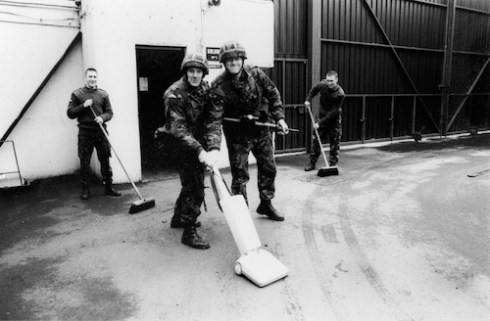
Stuart Griffiths was a kid when he went to Northern Ireland, in 1988, as a fresh recruit of the British Army. His first Christmas as an adult was spent on base. He dropped a tab of acid.

In the book Pigs’ Disco, Griffiths details his time serving for queen and country, his fear, boredom and struggle see what could possibly follow. I wrote about the body of work for Vantage, the new photography “collection’ published by Medium.

“At the turn of the nineties, Britain reveled in rave culture. From Bognor to Bangor, loved-up youth danced until dawn in clubs and beyond. A decade before cell phones, pill-popping kids were convening mass-raves in farmers’ fields and empty warehouses by word of mouth.

If there was one place you’d think this euphoric wave could not breach, it’d be the barracks of the British Army. But you’d be wrong. Pigs’ Disco details Griffiths’ drug addled misadventures from 1988 to 1993 while stationed, for the most part, in Northern Ireland as a paratrooper with Her Majesty’s finest.”

Read the full story: Tripping On Acid While In Her Majesty’s Service (Medium)

———

Stuart Griffiths - Pigs' Disco

Stuart Griffiths - Pigs' Disco

Pigs' Disco by Stuart Griffiths

Stuart Griffiths - Pigs' Disco

Pigs' Disco by Stuart Griffiths

Letters To Bill

Pigs' Disco by Stuart Griffiths

Pigs' Disco by Stuart Griffiths

——–

The book Pigs’ Disco, by Stuart Griffiths is published by Ditto Press.

Pigs' Disco by Stuart Griffiths


David_Levi_Strauss_words_not_spent_today


TORTURE REVELATIONS

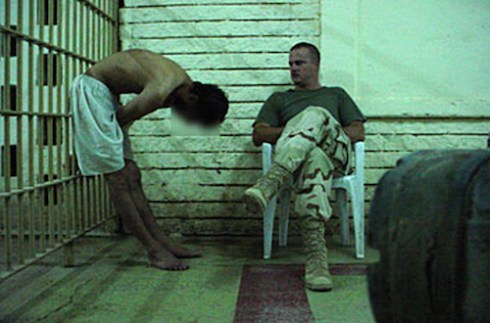
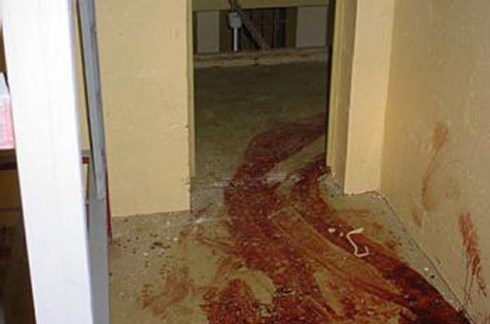
It was a double whammy this week. Everyone noticed the 6,000 page report into CIA torture. Many won’t know that today was the day that Justice Department attorneys presented the Obama administrations rationale for suppressing over 2,100 photos and videos of torture by American military personnel in Iraq, and Afghanistan.

Since 2009, the Obama administration has argued that releasing them would inflame anti-American sentiment abroad and place Americans at risk. Federal Judge Alvin Hellerstein of the United States District Court for the Southern District of New York is not so easily convinced and wants the government to explain, photograph by photograph, how each might pose a threat to national security. The fight to release these photos dates to 2004, when the American Civil Liberties Union filed a Freedom of Information Act request.

David Levi Strauss has tracked these developments from the very beginning. Several chapters in his new book is Words Not Spent Today Buy Smaller Images Tomorrow (Aperture, 2014) deal directly with the war over control of torture photos.

CONVERSATION

Strauss and I, for WIRED talked about state secrets, how the brain is wired, the political power of images and whether or not photos of Osama Bin Laden’s corpse actually exist.

WIRED: Why has the release of 2,000-plus remaining images and videos made by US military personnel in Abu Ghraib not been resolved?

Strauss: Because of the effectiveness of the images. They became the symbol of the change in US policy to include torture. Images are very powerful. That’s why the US government has become very afraid of the effects of these images worldwide.

The other amazing thing about the Abu Ghraib images was that they crossed the boundary between private and public. That is unusual. It changed things for photojournalism, for the military, certainly, and for the public at large. Prior to the release of the Abu Ghraib images, the military was handing out cameras to soldiers so that they could use photos to stay in touch with their families, and to be used operationally.

Read the full conversation: The War Over the US Government’s Unreleased Torture Pictures.

[All images for this Prison Photography post via Salon]

1

6

3

5

4

2

abughraib

EMAIL

prisonphotography [at] gmail [dot] com

Prison Photography Archives

Post Categories