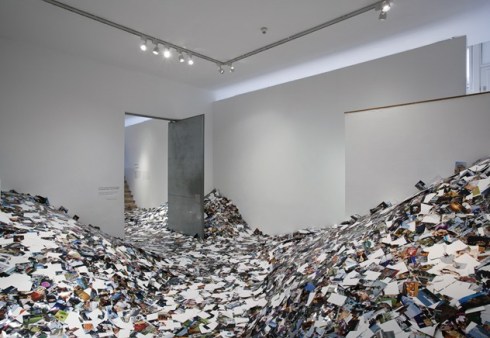
Installation shot of Erik Kessels’ 24 Hours Of Photo, at FOAM Gallery, Amsterdam, December 2011.
For the next few weeks, I am co-blogging Marvin Heiferman‘s posts at the Fotomuseum Winterthur’s Still Searching blog. I anticipate many of the ideas will overlap from previous conversations at Wired and Photoville between Marvin and I.
‘What is new now is that, as a result of advances in digital technology, options for the making, mining, and sharing images are increasing exponentially. As a result, what photography is, what photographs are, and what “the photographic” means have to be continually and, at times, dramatically rethought.’
Still Searching, which was launched in January 2012, is a smart, designed and long-term blogging project for the photo community. It is structured through the contributions of six “bloggers in residence” per year, each writing for six weeks. During which the blogger writes five to six statements on a specific theory or aspect of photography — or on anything else he or she is working on or thinking about — in photographic production, photography as art, as a communication and information tool in the context of social media or photojournalism, and as a form of scientific or legal evidence, techniques, applications, distribution strategies, contexts, theoretical foundations, ontology and perspectives on the medium.
Photography has innumerable uses, but one of its greatest qualities is it’s ability to tell stories. Sometimes that is through direct description of events and sometimes through evocation of emotion through colour and form.
In the rare cases when photography is used as a rehabilitative artistic tool for incarcerated peoples, straight documentation may be effected (even manipulated) by control and access privileges put in place by a prison administration. In the case of incarcerated youth, the essential and appropriate legal control which prevents identification of a child means that photo-education must be purposefully designed.
That is why when projects of light painting emerge from detention facilities such as the Rhode Island Training School (RITS), I applaud the invention and persistence of AS220, the Providence-based arts non-profit that conducts the program.
“In the striking images from AS220‘s If These Walls Could Talk, the magic made is not an illusion. Like a surrealist painting, the manipulated photos employ metaphor and symbol,” writes McCarthy.
The images are like electric bolts from the darkness; not something we’d necessarily expect but that is because our imagination may not soar like those of imprisoned children.
Photography has glorious potential to unlock the emotional needs of locked up youth. (A few weeks ago, I featured the work of those locked up in New Mexico, enrolled in the Fresh Eyes Project.) However, given the dearth of photo-education in juvenile detention facilities in the U.S., I can only conclude that the sensitivities to publication/distribution, and the road-blocks to getting a potentially security-threatening camera inside any prison inhibit the development of programs such as those run by AS220 at RITS and The Fresh Eyes Project in NM.
Are we missing massive opportunities to connect by not embracing the camera as we would embrace, say, a pen or paintbrush? Clearly, much more goes into helping children through emotional and behavioural difficulties — rounded and relevant education, vocational skills, counseling, substance abuse help — yet propping up these efforts is the need to steady emotional and self-esteem needs says Anne Kugler, AS220 Youth Director.
“Unless you address underlying emotional issues you can put all the services in place that you want and it doesn’t mean that they’ll necessarily be able to move through adolescent development in a positive way. That’s where I think self-expression and creativity come in. Unless children have the experience of being recognized for doing something creative and good it’s a hard road; inside in their heart they must feel there’s a purpose to moving forward with education and counseling,” says Kugler.
Youngsters are responsible for the lion’s share of the 1.3 billion images made everyday worldwide. It seems a little perverse to deny photo-based activities and visual literacy to incarcerated youth, no? Especially as it’s so relevant.
“When you watch young people with cameras they immediately want to use them,” says Kugler. “They know how to do so. They want to get their hands on the camera and they want to take pictures of themselves and they love being able to see — especially with digital cameras — their pictures right away. It’s fun and very accessible. Bear in mind, there are some children who — because of self-esteem issues — feel a sense of horror if you ask them to write a poem or draw a picture, but I think a photo in particular has accessibility that works great out there.”
Bravo to AS220. And let’s see more programs for incarcerated youth like AS220’s If These Walls Could Talk! A special shout out to Scott Lapham and Miguel Rosario who coordinate and teach the If These Walls Could Talk program.
Now, I’m not a photographer or an educator (formally speaking), but the theme of the conference Connecting Through Photography could not be more up my alley.
My plan is to rip through a full-bleed Powerpoint giving an overview of the history of photography in American prisons; to draw out the dominant aesthetics; to ask if what we’ve seen adequately describes the realities of prisons; and wonder about what we haven’t seen. To close, I will lay out what I feel are the most relevant and effective ways to think about, and to use, photography in our attempts to connect with America’s incarcerated class (which at 2.3 million men, women and children, is a significant portion of society to connect to, listen to, and understand.
I’m excited; it’ll be a live presentation of many ideas I’ve been quietly stewing over recently.
I’ll be pacing the stage in Room 632 at the Art Institute Seattle, on the morning of Friday, November 08th, 11:00am – 12:00pm.
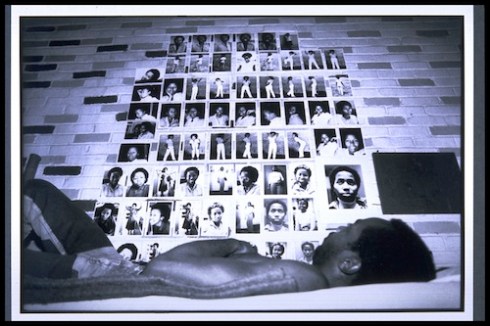
In 1981, freelance photographer Karen Ruckman stepped inside the notorious medium-security Lorton Prison to teach prisoners photography. Lorton was a sprawling barrack-like institution nestled in a rural pocket of the Virginia suburbs. Lorton, a Federal facility, closed in 2001. For decades it was where Washington D.C. sent its convicted felons. Initially, the administration didn’t think the program would last more than a few sessions and the students were cautious. Ruckman successfully won grants, donations from Kodak, cash from private donors, and support from then Mayor’s wife Effi Barry to support the photography workshops. Ruckman taught at Lorton until 1988.
When I recently learnt about Ruckman’s work, I was floored. For the longest time I have said that photography workshops inside of American mens prisons ended in the late seventies and mass incarceration had precluded the mere chance. Ruckman’s work at Lorton has forced me to reevaluate my timeline. I hope Ruckman’s work also brings you encouragement.
In 1985, Ruckman invited cameraman Gary Keith Griffin to film the class at work. Now, she and Griffin are working on a documentary about this unique moment in prison arts education. Ruckman and Griffin have followed some of the men since their release and the film, tentatively titled InsideOut, is slated for release in 2015 — the 30 years after Gary made those first reels.
Ruckman has routinely worked with populations considered to have less of a voice in our society – battered women, the poor, and at -risk youth for example. She also taught photography in the D.C. women’s jail, but that single summer program doesn’t feature in the film.
Karen Ruckman and I spoke about her access, the program’s successes and obstacles, the need for diverse image-makers in criminal justice and the lessons the project contains for us all three decades on.
Prison Photography (PP): I wasn’t aware of any prison photography workshop programs after the 70’s and so to find your work at Lorton is a revelation. It’s 25 years since the program ended, so let’s start with the basics, how did you get involved? Where did the idea come from?
Karen Ruckman (KR): I was doing work for the Volunteer Clearinghouse here in D.C. and they sent me to the prison to photograph volunteers who were tutoring inmates. I went to Lorton with George Strawn, the head of volunteer services and he asked if I’d be interested in teaching a class. I hadn’t really thought about it, but it happened to coincide with the funding for proposals coming in to the D.C. Arts Commission and I applied for a career development grant and I got it, much to my surprise.
I went down once a week and taught photography with a focus on career development. I approached it as a basic photography class and I brought in guest speakers, photographers from various newspapers, friends of mine in the community who were photographers. It went very well. The men worked hard, so after that I applied for another grant. Actually, D.C. had a category called ‘Arts in Prison’ during the 80s. I got my later funding through that grant category.
PP: Which photographers visited the class?
KR:Craig Herndon, from the Washington Post; Bernie Boston, from The Los Angeles Times, Gary Keith Griffin who works primarily in video and is working with me on the feature documentary now. I had executives from NBC who came in too, as well as local artists and fine arts photographers.
PP: What other arts program were being taught in D.C. prisons at the time?
KR: There were several theater programs and a woman who taught painting. That’s pretty much it.
PP: How did the program develop over the 8 years? Did the funding, scope or size of the class change?
KR: I had a cap on how many students I could have but I ended up doing two classes. Prisoners who had been in the earlier classes then became mentors to the new guys. Over time, I became more of a facilitator: bringing in supplies, bringing in expertise, working with them, training them and then they took on the job of mentoring each other.
They also ran the dark room when I wasn’t there. We built a dark room in a closet that was in the prison school where classes took place. I had a teaching assistant, Chuck Kennedy, who came with me from the community but I also had a prisoner who was a teaching assistant so the guys could work during the week. The program grew with more men participating, more prisoners developed skills. The inmates took on more of a teaching role; it was always my goal that they would.
PP: How many students would you say you taught over the seven years?
KR: I tried to figure this out once some years ago! More than 100 but less than 200. We had new intakes for each class and some guys stayed in year after year. They’d been charged for felonies in D.C. Some had written bad checks, others had been charged for murder.
PP: Lorton is now closed?
KR: It was closed in 2001. It was a rather controversial move. The prison was actually located in Virginia on hundreds of acres of land. There were different facilities there including two youth centers, Central, the medium security facility where I taught, and maximum. Virginia had been wanting that land for quite some time.
Lorton’s buildings needed a lot of work, and rather than renovate, they closed it. The Federal government transferred the land to Virginia and now D.C. prisoners are farmed out across all of the country.
PP: Ouch! That can’t be good for rehabilitation.
KR: It’s terrible, yes. And so there’s no programing, and they’re in federal facilities all over the country.
PP: What was the reaction and the response from the prison authority? Today, of course, these programs don’t exist and often the language-of-security is used to deny all sorts of things within prisons, and the camera in particular is quickly labelled as a security hazard. What was the feelings of the Lorton authorities at that time?
KR: I had to take on the job of educator. Many didn’t understood the need for the men to go outside the classroom to photograph, and the usefulness of exhibitions. They understood the photo class but part of that, part of each class was doing a show. We always did one in the community and one in the prison — it was a massive job of educating staff about how we could go about producing the program successfully.
I was very fortunate because Effi Barry, the mayor’s wife, had just opened an art gallery and I had her support. I always went top down. It took me a lot of time to go through the necessary channels and to get the permissions. The administrator at Central Facility, Salanda Whitfield, was a really nice guy who supported the program. He died some years ago.
Mr. Whitfield let the program come in, he let us break the rules, because of course cameras weren’t allowed, and of course inmates were not allowed to take photographs. Even with his backing I still had lots of paperwork to do in order to make the classes function well.
I found some resistance from the guards who felt like the inmates were getting something that was too nice, that wasn’t fair, that they shouldn’t get. So, my real problem when I had problems was always from the guards.
PP: Before you began the project, did you consider yourself an activist in that field of criminal justice?
KR: No, I was an activist generally but not particularly in prison reform.
PP: Did you ever have visitors that were inspired by the program and wanted to replicate it elsewhere? Or were you working in a bubble?
KR: I guess I worked in a bubble. I mean, I had visitors and help from others. I had photographers come in, other artists as well, but, no, I didn’t have anyone that wanted to replicate it.
PP: Did you understand at the time that you were doing something very pioneering?
KR: I don’t think so. I mean it was a really interesting time. Many of us were doing things in the community and were trying to think sideways, and I felt like it was something exciting. I had a passion about taking the camera to people who couldn’t normally tell their stories. By giving the men in my program this powerful communication tool, it was an opportunity for them to tell people who they were, it was a humanizing agent.
For the documentary, and since 2001, we’ve followed up with two of the men who were in Lorton and the program.
Michael Moses El had a fascination with guns. He found that when he came into the program that he was able to transfer this fascination with guns to the camera. It was a very exciting thing for him.
Calvin Gorham is an artist. He’s a singer; a soulful person and he used photography as an artistic tool to communicate how he felt. He said he saw a lot of dark things in the prison and he photographed to express that.
PP: And so there’s no doubt in your mind that photography is a rehabilitative tool?
KR: It’s a powerful rehabilitative tool. There are so many levels one could do with it as a storytelling device. Now, with digital imaging, possibilities are unlimited. Yes, absolutely. I worked with other groups in the city. In 1988, I also worked with women at D.C. Jail, then in the 90s with women at a pre-release halfway house. Also, women in various shelters and at-risk kids.
PP: And so tell us about the documentary, it’s been thirty years since you’ve been doing this work, how and why did you decide a documentary was necessary?
KR: In 1985, Gary Griffin, a friend and colleague, bought his first TV camera. Gary thought it would be valuable if we could do video about the program. So I got permission again, days of paperwork, but we went in with a crew for a week in 1985.
Some of the footage in the trailer is from ’85. We never were quite sure what it was going to be. We did put together a fundraising piece because I was always having to raise money.
PP: Right, you were constantly communicating with free society how important your work was and asking for help?
KR: To do the programing, I had to constantly write proposals and fundraise. I was somewhat burnt out by the end of the 80s. The funding for the prison program became very difficult to get. I went on to work with other groups and do different things. The guys would stay in touch with me, they had my business phone and they’d call me when they got out of prison and tell me what they were up to.
But, I still have the wonderful images. I was at a workshop in Santa Fe in the late 90s and showed some of the images to National Geographic photographer Sam Abell. I also had an audio tape from one of the graduations that I put with the images and it was a very powerful slideshow (of sorts) — one of the men at one of the graduations gave a marvelous speech about photography.
Sam was excited by the images and very supportive. He said. “You’ve got to do something with this.”
I decided along with my video production friends to do a reunion. We knew Lorton was closing. I tracked down as many of the guys as I could. We had about 20-25 at the reunion. Gary documented the reunion and then we documented some of the men periodically. We later settled on following Michael and Calvin.
KR: Number 1, they were interested in participating. Number 2, they’re very interesting people — Michael is business-oriented, very focused about his life. Calvin’s a musician, we have a lot of footage of him singing. We’ve seen them almost every year since 2001. Gary and I think 30 years is a good amount of time. When we get this feature documentary completed by 2015 it will have been 30 years since Gary began filming.
PP: The documentary is a few things, it seems? A record of a moment; the on-going stories of Michael and Calvin; and a call to action asking people to think about photography’s relationship to educational and rehabilitation?
KR: It is. It’s a character study that presents the power of photography, the power of art, and how important both can be in changing lives.
Only a few of the men now make pictures professionally, but they all make pictures still. The documentary is about the program and how the learning experience has stayed with the participants throughout their lives; how it continues to resonate and define their world view in a positive and powerful way.
The discipline required working in the dark room was critical. For example, one participant, David, spent two years learning how to make a good print. And he ultimately made beautiful prints. Two years. It was very impactful.
PP: Can you give us your thoughts of storytelling, self-representation and empowerment?
KR: It was always their story to tell. I came in, I gave them cameras. I didn’t take a lot of pictures. I was there as a facilitator. I gave them the tool to tell their stories. I think that’s enormously important.
During that period — and even now — there’s something that is bothersome to me when people go in and take pictures of powerless people. It’s important for people to tell their own story; that doesn’t just shift the viewer, it shifts the person telling the story.
PP: It does seem obvious that if one puts a camera into the hands of someone in the community that you’re trying to bring new information about and to the wider world, but there’s still so many people in the photo world who reject that.
KR: Yes. This is off topic, but probably the most amazing experience I had when I took exhibitions to the community was when I hung a show by women at a shelter for victim’s of domestic violence. We did a show of their work at the D.C. library, in the mid-90s. Visitors would ask me who took the photographs, and when I explained the women photographers were survivors of domestic violence, people would just stop and walk out of the room.
How do we relate to issues that we’re uncomfortable about? Do we not want to see these individuals?
PP: Well, what were attitudes like then about crime? What was the reputation of Lorton? What was the general community’s view of Lorton prison?
KR: Lorton and the D.C. community were very connected in the eighties. So many people from the city were incarcerated there that Lorton was just like a subset of the community. So, there wasn’t as much stigma with prisoners as I encountered among other groups that I worked with, at least in D.C. at that time.
Lorton was considered a very dangerous place. The facilities were old even when I was there. The men lived in dorms and there was one guard per dorm at night so you can imagine that there was some violence. I personally, I didn’t get too involved in that. I tried to go in and do my program with them without judgement.
Photo: Karen Ruckman/PhotoChange
PP: And then tell me about the dark room? Were there any issues with taking chemicals and other apparatus in?
KR: The dark room was fabulous! I brought the supplies and the men ran the dark room. Kodak gave me film and photographic paper. I bought chemicals. We had lots of applicants, but I could only take so many, so it was considered a reward for someone to get into the photography program.
PP: On what criteria did you decide admission?
KR: They had to have good behavior to be allowed in the program. When it started out I only admitted men that were within three years of parole because the lessons were about career development; it was my hope to actually help guys get jobs once they got out. After a while, we relaxed that rule and a few guys still had a lot of time to serve.
PP: And could students be removed from the program at the whim of the warden or the staff?
KR: Well, I lost a few people because they misbehaved in prison and were sent to the hole (solitary confinement), or to another prison. That happened.
PP: When you release the documentary have you got any plans for distribution. How do you plan to reach audiences?
KR: I’m taking that a step at a time. We are going to finish a 30-minute short this winter that we’ll take to film festivals. A local organization, Docs In Progress, is hosting a showing of the trailer. I’ll contact our local PBS station, but with the feature-length film I have to plan a more structured distribution plan. It’s very important to get it out. I’ve stayed in connection with people in the D.C. community, people like Marc Mauer at the Sentencing Project and others who care about the issue.
PP: What’s your personal position on prisons? What role does incarceration play in our society?
KR: There are people who commit violent crimes and they belong in prison. Some of the men that I worked with said that being in prison gave them an opportunity to really look at themselves and take a timeout and to correct their behavior. There is a role for prison if they have rehabilitation programs.
Of course, we all know that there are way too many people that are incarcerated and there are people that are incarcerated that just shouldn’t be there, so it’s very frustrating. Things haven’t changed all that much since the eighties except we’ve incarcerated more people.
D.C. incarcerates an enormous number of people. With the poverty and lack of good public education here. That’s the story of the documentary. Calvin’s son went to prison and Michael’s son went to prison. So, we talk about that story, it’s that legacy that’s just, it should be broken. Marian Wright Edelman‘s work with the Children’s Defense Fund deals with this issue, and has a program called the Cradle to Prison Pipeline.
Photo: Karen Ruckman/PhotoChange
PP: Do you think the American public gets reliable information on prisons?
It’s my sense that most people aren’t interested in prisons. When I tried to raise money for the program it was very hard. There’s little compassion. Around drugs and drug culture there’s some alternative sentencing programs happening but by and large, I don’t think people are interested. I mean, now, we have for-profit prisons which is even more atrocious because now we have to maintain the population so that profit lines can be maintained.
PP: I ask because, to my mind, if there were more photography programs like yours occurring in our prisons today, there would exist a more nuanced view of prisons; prisoners’ views. We’d all be in a better place in terms of being informed.
KR: Yes, absolutely. The program had a humanizing effect, both on the participants and in how they were viewed by the community. It provided a bridge, and it didn’t cost the tax payers much. I secured small grants and fundraised and so it was for tax payers a really good deal. That’s true of most arts programming.
PP: Often program funding is based on measurable impacts but a lot of time with prisons you can’t measure those so easily because some people are not getting out for ten or twenty years. You can’t correlate arts rehabilitation with recidivism because the prisoners don’t get out in any short space of time. So, what stories do you have about your students? Any stand out stories that convince you of the efficacy of a photography program?
KR: The men would be the ones to tell you. Sadly, a lot of the guys die; they don’t make it. Some of them die soon after they get out.
I think about Calvin and Michael — the program gave them discipline and an opportunity to evolve productively. Michael told us about a time soon after his release when he was very tempted to commit a violent act against another man. Something stopped him. It was, he said, it was the discipline and working relationships that he had developed during the program. He didn’t want to end up back at Lorton.
A couple of the guys do a lot of professional photography. It’s very hard to answer that question because people want to ask, “Okay, well how many guys got a job as a photographer?”
PP: How many people generally get jobs as photographers!
KR: Actually, Michael was hired by US News and World Report to shoot a cover story on poverty, and he took some amazing pictures. They were going to use one of his photos for the cover but when they found out he was an ex-offender they wouldn’t run his photo. He’s still very bitter about that.
PP: What’s his past history got to do with the suitability of a photograph?
KR: It was many years ago; it was the late 80s.
PP: But that’s complete discrimination.
KR: I was told by several photographers at the Post that they would be uncomfortable to have ex-offenders there because they would be afraid that they would steal equipment. These are the attitudes that make it really tough for ex-offenders to get jobs in fields other than construction or the food industry, though a few of them do get jobs driving Metro buses.
PP: Is there anything I’ve missed?
KR: I appreciate you finding and highlighting the work. We’re excited about finishing the film. The project has ended up — without me realizing it — a life work.
FOLLOW
You can follow Karen and Gary’s development of the film via the InsideOut website, on its Facebook page, Tumblr page and via Karen’s Twitter.
Between the California Prisoners Hunger Strike and battles over prison spending as part of the state budget there’s been an incredible amount going on in California these past few months and I want to hold my hands up by saying I’ve not done my part in bringing you timely updates. The battles in California are in some ways a bellwether for the country. Victories against California’s prison industrial complex indicate some movement toward fiscal and moral responsibility. More to come on this.
Guilkey’s video shows former prisoners — who were held in solitary — and family members making their pleas to politicians to end the psychological torture, telling of their family members slowly losing their minds, and themselves succumbing to emotion and sobbing through their words.
On September 4th, following a meeting between organisers and prison officials in a small prison law library, and after 60 days of striking and one death, prisoners suspended the strike, and California legislators committed to hold public hearings.
After all the words, news articles, claims and counter-claims, Guilkey’s video cuts to the heart of the matter. The use of solitary confinement is not about public safety; and the eradication of solitary confinement is all about decent human values.
“The U.S holds more prisoners and employs more prison staff than any other nation on earth. But there is no central location where the public, policy makers, students or researchers can benefit from the many years of first-hand experience of prisoners and prison workers,” read the email that landed in my inbox last week.
The American Prison Writing Archive (APWA) is an in-progress, internet-based, digital archive of non-fiction essays recently established by the Digital Humanities Initiative at Hamilton College, Clinton, New York.
APWA addresses a need and it could be of immeasurable value. It’s early days; the archive has yet to fill. Digital storage provides an almost limitless potential for growth. The accumulation of material is also without deadline.
Sure, there are many great places such as the PEN American Center, The Beat Within, Prison Legal News, The Angolite, San Quentin News, Prison Writing blog, where one can find expert prison writing, but how much of this is searchable by key terms? On what page of a Google search does it land? There’s so much good but untapped writing on prisons out there that to have a feasible search tool (designed by library-scientists) is very exciting.
FROM THE SOURCE
“We seek authors who write with the authority that only first-person experience can bring,” says APWA about it’s one parameter for submissions. I think that insistence gives the project weight and legitimacy.
While the APWA is open to all styles, they encourage first hand accounts from prisoners, prison employees, and prison volunteers of life and work conditions within American prisons.
Often prisoners and prison employees are in opposition, but with submissions from both groups who knows what cross-pollination of perspectives might emerge?
From here, I’ll leave you with APWA’s own description of the project:
All topics are of interest, including descriptions of sources of stress, ways of coping, health care, causes of violence and ways to reduce violence, material conditions, education, employment conditions and the challenges these conditions present, the environment for volunteers, the aging prison population, visions of a better way to operate (personally, politically, institutionally, etc.), reflections on the work of dealing with time inside (for workers as well as prisoners), the challenges of physical and psychological survival, public perception and popular depictions of prisoners and prison workers, the politics and economics of mass incarceration, what works and why it works, and what doesn’t work and why it doesn’t work (i.e. practical views on reform), etc. We are open to any testimony about the issues that matter to prison staff, administrators, corrections officers, teachers, volunteers, and prisoners.
We value writing that takes thoughtful, constructive positions even on passionately felt ideas.
The APWA is intended for researchers and for the general public, to help them understand American prison conditions and the prison’s practical effects and place in society. All the work in the APWA will be accessible to anyone, anywhere in the world with access to the Internet. The APWA will open the American prison to public observation, and showcase the thinking and writing being produced inside.
Once included in the APWA, work will be retained indefinitely. Contributors can write under pseudonyms or anonymously. We reserve the right to edit or reject work that advocates violence, names names in ongoing legal cases, or libels named individuals. The APWA is not currently accepting poetry or fiction.
We accept art (on a single 8.5×11 page) only if accompanied by an essay. A signed permission sheet must be included to post work on the APWA. By signing on the signature line below, you are granting us permission to include your work in the APWA. The questionnaire information will be used to offer researchers points of reference (for example, to study the specific concerns of staff who are veterans, or of Black and Latino men in maximum-security facilities).
There is no deadline. We seek the widest possible gathering of American prison writing, and we will read, scan, and transcribe essays into the APWA on a continuing basis. Previously published work is acceptable if authors retain copyright. Please let us know where and when your essay appeared in print.
Non-fiction essays, based on first-hand experience, should be limited to 5,000 words (15 double-spaced pages). Clearly hand-written pages are welcome. We charge no fees. We will read all writing submitted.
There is a PDF form to submit with your essay. It includes the usual stuff — name, age, address, date, prison facility. It also includes an optional questionnaire to help the archivists digitally tag and organise essays.
Please share the project, the link, and the address below far and wide.
Mail essays to: APWA, 198 College Hill Road, Clinton, NY 13323.
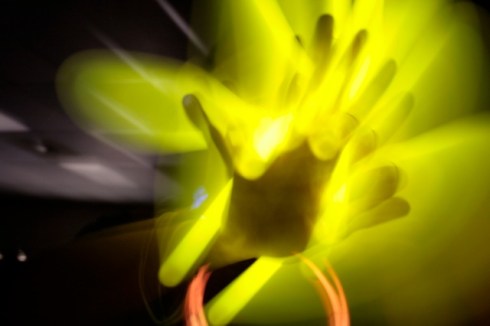
Yellow Hand With Orange Glow. Courtesy: Fresh Eyes Project
The potential for photography to change the lives of the incarcerated, particularly the young prisoners, is significant. Photography education provides all the therapeutic tenets of arts programming, but also develops new skills; visual literacy, computer and digital-darkroom skills, and (of course) the not-too-simple task of mastering the settings on a camera. Photography workshops flex different muscles than painting or writing workshops may. Photography allows storytelling beyond the pen and the paintbrush.
NOTE: I discuss many photography programs in this article, but all the images are by incarcerated children in New Mexico who’ve participated in the Fresh Eyes Project workshops.
The planning, structure and accountability reported on the Fresh Eyes Project website is impressive.
Volunteer programs, cameras or not, must be water-tight, well-designed and directed. The Fresh Eyes Project clearly states its scope of work, it’s objectives, its internal assessment and feedback opportunities for students. I very much appreciate programs that share curriculum and lesson plans. Very valuable.
“Our purpose is to help the youngsters to see themselves and the community into which they would be released with fresh eyes as and for the community to see the youngsters with fresh eyes not as ‘the Other’ but as ‘our own,'” says the Fresh Eyes Project founder, Cecilia Lewis.
SCARCITY OF PROGRAMS INSIDE JUVENILE DETENTION
Sadly, projects like the Fresh Eyes Project are rare. In America, inside locked facilities there have been some occasional photography workshops but few consistent ones. I’ve mentioned many times Steve Davis’ workshops (there’s still so many photographs that remain unpublished). Fatima Donaldson recently led a digital photography workshop at Fort Bend Juvenile Detention Center, Texas (info and video).
Probably the best and most consistent provider of photography workshops to incarcerated youth is AS220 in Providence, Rhode Island. AS220 delivers education, including photography training, at the Rhode Island Training School (RITS), the State’s only juvenile detention facility. Classes are delivered as part of AS220’s Youth Photography Program which also works out of a downtown location and in local schools too.*
The Fresh Eyes Project and AS220’s work are the only year-on-year prison photography programs delivered in the U.S. that I know of. Please, contact me if there’s current programs of which I should know.
Fear. Courtesy: Fresh Eyes Project
Ghost Hand. Courtesy: Fresh Eyes Project
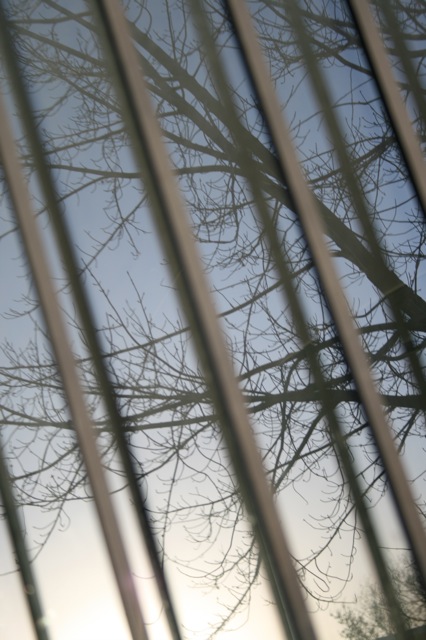
These Bars Keep Me In. Courtesy: Fresh Eyes Project
PHOTOGRAPHY FOR YOUTH STORYTELLING
Can a teen do without their phone? Is a phone ever without camera these days? Can that commonplace visual communication be leveraged to spark interest in other forms of image making? In other cameras? In film photography? I’d say so.
This summer, at Photoville, I saw an exhibit Perspectives featuring the photographs of teens from Red Hook, Brooklyn. Perspectives came out of a specific PhotoVoice program, that itself is part of the ongoing JustArts Photography Program (formerly the Red Hook Photo Project)
Whereas JustArts uses photography as inspiration, working with kids from less advantaged communities to envision great futures, Young New Yorkers actually uses photography (as well as video, illustration and design) as intervention in the cogs of the youth justice system.
“Young New Yorkers a restorative justice, arts program for 16- and 17-year-olds who have open criminal cases. The criminal court gives eligible defendants the option to participate in Young New Yorkers rather than do jail time, community service and have a lifelong criminal record. The curriculum is uniquely tailored to develop the emotional and behavioral skills of the young participants while facilitating responsible and creative self-expression.”
Young New Yorkers (YNY)is remarkable. More to come on Prison Photography about their successes. This little shout out is the least YNY deserve.
If you want to support YNY’s work right now, their Second Annual Silent Art Auction is on October 16, 6-10pm, at Allegra La Viola Gallery, 179 East Broadway, New York, NY 10002. You can bid online, if you’re not in New York.
So much good work being done across the country. These kids are our future.
Fin.
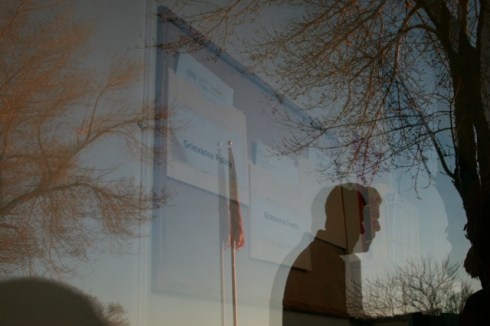
Shadow Portrait. Courtesy: Fresh Eyes Project
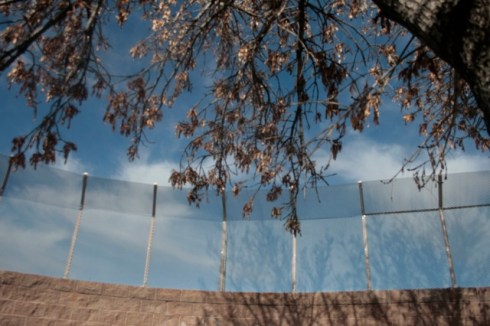
On The Outside. Courtesy: Fresh Eyes Project
Portrait Of My Teacher. Courtesy: Fresh Eyes Project
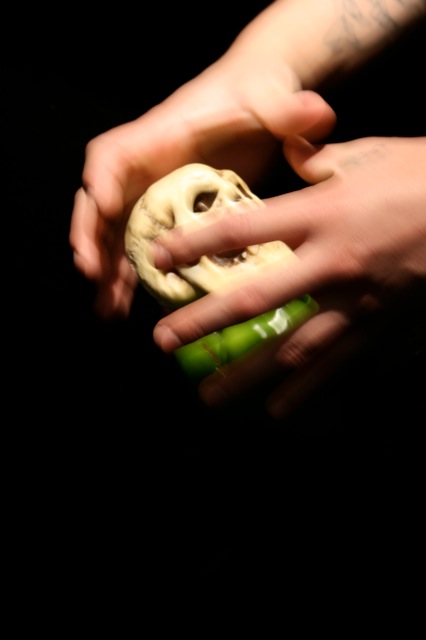
Scary Hands. Courtesy: Fresh Eyes Project
Mighty Me. Courtesy: Fresh Eyes Project
———————————————————
* A couple of years ago, I interviewed the director of AS220 youth programs, two of the photography instructors and a few kids. They also gifted me a portfolio of work and I’m long overdue to scan and present that material here on the blog. Please, stay tuned.










 Prison Photography