I knew something was going on when my blog stats spiked over the weekend. Prison Photography interviews with those who photographed Fabienne Cherisma’s body in Haiti were drawing readers … and they came from Sweden.

PAUL HANSEN’S SPoY WIN

At the Swedish Picture of the Year Awards, photojournalist Paul Hansen was recognised as International News Photographer and won the International News Image for his image of Fabienne (below).
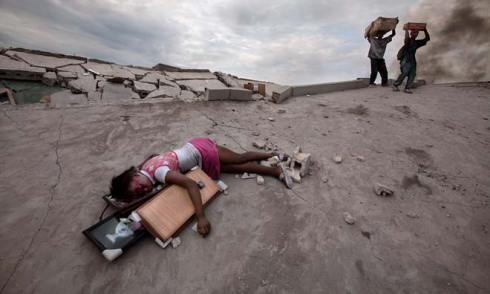
Fifteen year-old Fabienne Cherisma was shot dead by police at approximately 4pm, January 19th, 2010. Photo: Paul Hansen

In March 2010, Hansen answered some of my questions about the circumstances of Fabienne’s death, “For me, Fabienne’s death and her story is a poignant reminder of the need for a society to have basic security – with or without a disaster.”

Paul Hansen was one of eight journalists I quizzed about that fateful day in an inquiry that revealed that 14 photographers were present immediately after Fabienne’s death.

At the time, I noted how the Swedish media and public discussed the ethics of the image and that, by comparison, similar debates were absent elsewhere.

The debate has continued following Hansen’s award, focusing on Nathan Weber’s image (below) that was first published along with my interview with Weber.
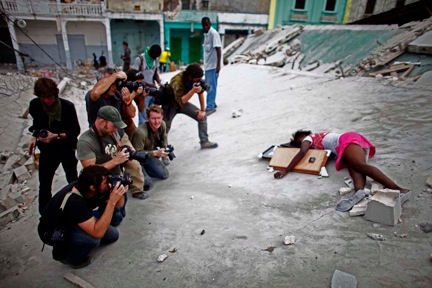
Photo: Nathan Weber

Weber’s image has unsettled many it seems. Judging by garbled Google translations here, here, and here it seems there are a few issues:
– General surprise that Weber’s image – and the revelations it brings – was not widely known before the SPoY award.
– Rhetorical questions about whether – given the scores of photographs made – Hansen’s image was “the best.”
– The expected accusations of exploitation and vulture behaviour by photographers.
– Fruitless thoughts on “truth” within this particular image.

Before they awarded Hansen, I wonder if SPoY were aware that so many photographers were present? Would it have altered the final decision? The image of Fabienne limp on the collapsed roof (whoever made a version) is the summary of innocent death, a society’s desperation and the man-made tragedies that compound natural disasters. It’s is a striking vision.

The circulation of Weber’s image has fueled skepticism toward photojournalism.

The problem with these types of brouhaha is that never are they able to measure if or what effect images – in this case Hansen’s – have. Did Hansen’s image secure a dollar amount of donations for the Haitian relief effort? Did it mobilise professionals and resources that would have otherwise not have moved?

If we are to talk about the “power of photography” then shouldn’t we expect and/or propose criteria for measuring and defining that “power”?

MICHAEL WINIARSKI, REPORTER AND HANSEN’S PARTNER

It should also be noted that Michael Winairski won the the award for News Storyteller from Dagens Nyheter, the national news outlet he and Hansen work for. When I contacted Winiarski last year about coverage of Fabienne’s death, I was particularly impressed with his transparency and commitment to the story. He and Hansen followed up two months after the killing and met with Fabienne’s family.

On receipt of the award, Winiarksi said, “”I’m glad we did not let go of Haiti. I and the photographer Paul Hansen have been back twice. And Paul is down there now with another reporter, Ole Roth Borg.”

ACCOLADES AFTER RECORDING DEATH

Paul Hansen is not the first photographer to be awarded for coverage of Fabienne’s death.

James Oatway won an Award of Excellence at POYi in the Impact 2010 – Multimedia category for Everything is Broken. Fabienne’s corpse open the piece and appears again in images 25 to 33. Olivier Laban-Mattei won the Grand Prix Paris Match 2010 for his coverage of Haiti, including the aftermath of Fabienne’s death. Fredric Sautereau was nominated for Visa d’Or News at Perpignan for his coverage of Haiti, which include seven images about Fabienne’s death.

There may be others.
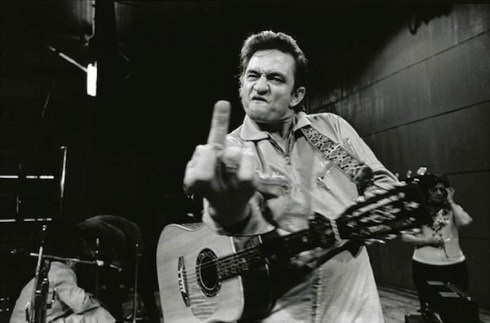
Collectors Weekly looks back at Johnny Cash’s famous performances in Folsom and San Quentin, as photographed by legendary music photographer Jim Marshall:

The most famous image from the day, though, is unquestionably the candid shot of Cash taken during a rehearsal before the show. […] Marshall recalls the origins of what he believed was “probably the most ripped off photograph in the history of the world. […] I said ‘John, let’s do a shot for the warden.’” Apparently, that’s all the prompting Cash needed to look straight into Marshall’s lens and flip him the bird.

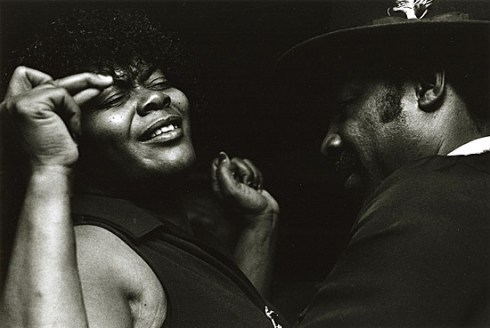
Dancing at Shalimar in Oakland in 1983. From the book, Oakland Blues. Photo by Michelle Vignes

While I was surfing through info about Michelle Vignes for a previous post, I came across a quaint little piece on SportsShooter.

When reporter Jim Merithew describes Vignes’ accent as French, she corrects him:

“I don’t have a French accent. I have a mixed accent. I got my accent when I worked at Magnum. Everybody had a different accent; part French, part Hungarian, part German, part whatever it is. So that’s my Magnum salad.”

Vignes also has a cut-to-the-chase view of documentary photographers today:

“They seem to work on the web. To me it is just like spitting in the wind.”

More on Vignes here and here and here and here.

The success of the changes in Egypt will largely be judged on the strength of the new democracy – more specifically, the viability and strength of its institutions and the way in which they unite the people’s needs. If Egypt’s justice system serves truth and enacts fair judicial process, especially regarding deaths during the protests, then it shall be a source of pride and calm for Egyptians in their quickly changing nation.

Ahmed Mohammed Mahmoud was one of the first journalists to die during the protests. Mahmoud’s family believe he himself captured the photo-evidence to prosecute his killer.

From the London Photographers’ Branch:

“Ahmed Mohammed Mahmoud’s last photograph was an image of his killer taken just before he was shot in the face. His wife hopes that this evidence will bring his murderer to justice, with the support of his trade union, the Egyptian Journalists Syndicate.”

Watch this case.

People carry a symbolic coffin of Egyptian journalist Ahmed Mohammed Mahmoud, in a symbolic funeral ceremony in Tahrir Square, Cairo, Egypt, Monday, Feb. 7. Photo Credit: Ben Curtis / AP

RIGO 23 recently accompanied Robert H. King (formerly one of the Angola 3, now released), Emory Douglas (printer and legend of revolutionary graphic art) and Billy X Jennings (you HAVE to click that link!), three veterans of the Black Panther Party, on their recent trip to Porto and Lisbon in Portugal.

RIGO emailed:

“Here’s a little clip from the mural I painted at a housing complex south of the River Tejo in Lisbon to commemorate the visit to their community by Robert, Emory and Billy. Robert is a survivor of 29 1/2 years of solitary confinement; Emory Douglas was the Minister of Culture for the Black Panther Party.”

I have mentioned RIGO’s art in support of US political prisoners before. His TRUTH mural in San Francisco marked Robert H. King’s 2001 quashed conviction. RIGO continues to advocate for Herman Wallace and Albert Woodfox, the remaining Angola 2.

He supports Mumia’s ongoing legal battles and RIGO also recently joined Michelle Vignes – a true matriarch of radical documentary photography – for an exhibition in solidarity with Leonard Peltier. (Details and review of the show at the Warehouse Gallery in Syracuse, NY. Closed Feb. 6th)

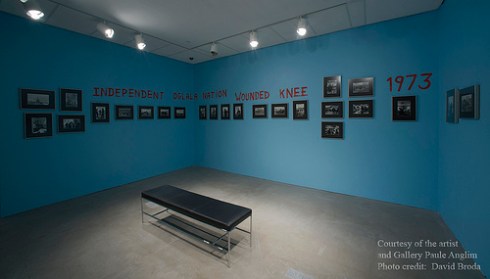
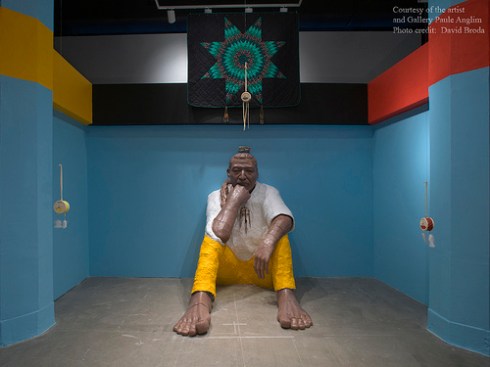
RIGO conceived of the space as an imaginary museum – The Tate Wikikuwa Museum: North America 2024. Tate Wikikuwa is Leonard Peltier’s Lakota name and 2024 is the year of his next parole hearing. It showcases arts & crafts by the Oglala Sioux and Peltier’s paintings, as well as documents, books, writings and educational material. Making use of Peltier’s colour choices, RIGO created a spiritually and politically charged space.

I would have loved to have seen Vignes’ prints of Peltier and the AIM Movement exhibited within the mood set by RIGO’s installation.

For such an important photographer of America’s West Coast counter cultures and radical movements, Vignes does not have a large web presence; there is a paucity of reviews and there are few images too. Next time I’m in the Bay Area, I will have to pay a visit to UC Berkeley’s Bancroft Library which acquired her archives in 2003.

Look out for more about Michelle Vignes on Prison Photography in the future.

Photo Credits: All images David Broda

(Found via Just Seeds and Bob Gumpert)

“I find it very interesting by the way that failure to learn your language is seen as a deficit but failure to learn my language is seen as so natural.”

Amanda Baggs

In My Language is one of the most logical and beautiful films I’ve ever seen.

(via)

PAUL RUCKER

In May of 2009, Paul Rucker partook of a two week residency at the Blue Mountain Center. The theme: Prison Issues.

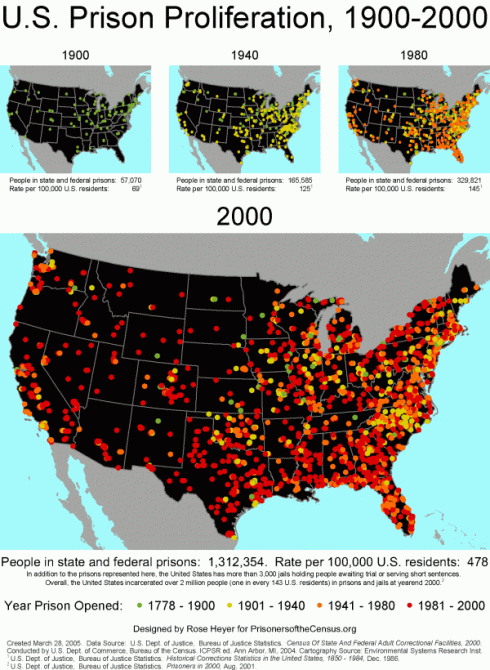
During his research he happened upon some pioneer GIS maps by Rose Heyer which modeled the growth of the US prison system. With the information he composed an original score. A note to accompany each carceral outpost to blink into existence in the “Land of the Free.”

232 years in 10 minutes and 45 seconds.

ROSE HEYER

Incidentally, Rose Heyer is a wonderful thinker. She developed the GIS methodology for the Prisoners of the Census project, enabling quick calculations of how Census Bureau’s prison miscount distorts representative democracy.

Heyer produced the map U.S. Prison Proliferation, 1900-2000 and she co-authored Too big to ignore: How counting people in prisons distorted Census 2000, Importing Constituents: Prisoners and Political Clout in Massachusetts Importing Constituents: Prisoners and Political Clout in Texas, Importing Constituents: Prisoners and Political Clout in Ohio, and Thirty-Two Years After Attica: Many More Blacks in Prison but not as Guards. Rose is now GIS and CAD consultant in California.

(Source)

I was recently interviewed by Zarina Holmes at Sojournposse about my project here at Prison Photography. Zarina’s questions were refreshing as I have a tendency to get stuck in my own thinking and politics sometimes.

The interview itself is a little long (my fault) but results from an effort to fairly explain the nuance of images from sites of incarceration.

One of the things I continually grapple with is who benefits from prison photography projects? Is it the prisoners, the audience or the prison authorities? There is no definitive answer. In the interview, however, I did make this statement:

“People are tempted to believe that creating an image from within a prison – a rare/privileged viewpoint – is in and of itself a subversive act. In fact, what I often discover is that photography in prisons and other sites of incarceration is not challenging the organisational structure of the institution but rather working within its protocols. Thus, many prisons neutralise “the power of photography” or the camera’s ability to operate as a tool for social change.”

I have not articulated this thought so bluntly before. I think it applies to a lot of photographers working in restricted institutions or milieus.

Think about it – the most famous prison images of the 21st century are those of Abu Ghraib. Those images had a global reach and brought about change yet they were amateur shots leaked against the interests of the US military (the prison authority). Photographers are never going to just walk in the front gate unannounced. Nor are they going to be welcomed by prison administrations to document the pain and abuses within.

What does that make prison photographs then?

EMAIL

prisonphotography [at] gmail [dot] com

Prison Photography Archives

Post Categories