Paraphrasing the introduction to Domestic Slavery: The cold and stark photographs of ordinary-looking buildings in and around Paris by Raphael Dallaporta are combined with Ondine Millot’s texts to become chilling portraits of hidden agony. The texts describe what went on in these photographed buildings, confronting the viewer with stories of abuse and cruelty, forcing us to consider the idea that behind the façade of the ordinary can lie a discomforting reality. […] Domestic Slavery bears witness to the banality of everyday inhumanity.

Some of the stories in Domestic Slavery are harrowing, and in some cases not least because the abusers are women, or a collection of individuals from the same extended family. These are tales of evil made normal.

From Domestic Slavery:

“For four years Violette slept without a mattress on the tiled kitchen floor of an apartment in the 13th arrondissement in Paris. Her work timetable was carefully planned. In the morning, she got up at 4am to prepare breakfast for Sahondra, her employer, and her son; afterwards, she travelled into central Paris where, at 6am, she began work for a cleaning company run by Sahondra’s brother-in- law; at 10am she returned to Sahondra’s apartment where she did the housework and prepared lunch and dinner; at 4pm, she travelled to Massy-Palaiseau – about 20kms from Paris – where she cleaned the apartment of Mamy, Sahondra’s brother. When she returned to the 13th arrondissement around 10pm each day, there was more work: a pile of washing-up or ironing kept her busy until midnight, either at Sahondra’s or in her sister’s next-door apartment. For four years, during which time she was hardly fed, Violette worked 18 to 20 hours a day. She had left Madagascar aged 22 in the hope of earning enough money to feed her child, who she left behind. During the whole ordeal her four employers paid her nothing.”

“With the aid of the CCEM, the Committee Against Modern Slavery, she took her employers to court. Her case was heard in 1999 in Paris and it became the first-ever case of modern slavery dealt with in France under penal law. Her employers were ordered to pay Violette €22,900 in damages and interest; they were also fined and given suspended prison sentences.”

PHOTOGRAPHING SCENES OF UNLAWFUL ACTS

The type of sorrowful external view (long after the matter) employed by Dallaporta brought to mind Angela Strassheim‘s stake-out street shots of former crime-scenes for her series Evidence, of which I have written about previously. The two leave me feeling so differently however, I’d like to explore the reasons.

Both Dallaporta and Strassheim found their building-subjects due to information on public record following judicial process/trial. Neither photographer makes effort to show the architectures as extraordinary – because they are not. Yet, Dallaporta’s photography leaves me morose and confused about the human condition. I think it has something to do with closure – or lack of – in each of the projects.

Strassheim’s work leads the viewer through the crime. In the titles, she lists the weapons used. Strassheim shows us the traces of metals, that are traces of DNA, that are traces of blood, not only by being their but by using specialist forensic techniques. She literally reveals the marks of homicides.

Strassheim’s effort is two-fold in showing us the evidence but more crucially the conclusion of violence. It was bloody murder, but it was brief and it is over. Dallaporta’s works on the other hand don’t offer me an out. I am not mollified by the idea that this was a collection of one-off final acts. Often the buildings are only one of multiple sites of abuse.

I have no idea about the prevalence of domestic slavery in France, but I presume it is no different to other Western nations. If I need homicide figures I can find them, but if I want figures on illegal imprisonment and servitude I’m at a dead-end. Dallaporta’s work is an attack on our complacency.

In describing the bare details of each abuse, Dallaporta and Millot succeed in positioning domestic slavery as anywhere and everywhere; they present it as a national issue and as everyone’s problem. Domestic Slavery might just be the harshest indictment of absent community in our societies. Dallaporta’s work certainly plays on the unknown.

Inside of me, Domestic Slavery induces fear of the unknown. I can understand murder – it has been explained to me since I was a young child – but I do not understand modern slavery. Dallaporta’s work brings that to bear and, for me, that it is what makes Domestic Slavery so successful.


I was recently asked to propose a blogging workshop for photography students. It pushed me to think why blogs should be written and why they should be read.

Blogging tools have developed concurrently with the social media platforms that have permitted our shared glut of imagery. Writers in general have provided context to images for a long time, but I reason bloggers are a new front line in the expanded process.

Here are my thoughts.

VISUAL OVERLOAD

The flow of images through our daily lives increases at exponential speeds. Social media, photo-sharing sites with essentially unlimited storage and mobile hardware have created this sprawling (and it could be said, suffocating) visual superstructure.

At 60 billion photos, Facebook has a larger photo collection than any other site on the web. By comparison, Photobucket hosts 8 billion, Picasa 7 billion and Flickr 5 billion. Facebook’s photo data as an infographic.

VIEWING PHOTOGRAPHY IN A POLITICALLY MINDFUL MANNER

What to make of this slew of imagery is something both Fred Ritchin and Joerg Colberg have addressed in the evergreen debate about ‘What’s Next? (for photography)’ now being pressed by FOAM Magazine.

Colberg asks us to think about the meaning of our own digital archives and impress upon them a meaning, perhaps even a strategy. Ritchin urges us to think about making sense of the world through all the images available to us. Both are concerned with us being actors in the real world, and knowing that the photograph plays a part in social/political action and decision.

Ritchin:

Will all this media help us understand what we have done to our planet and what we should do about it? Will we want to help? Or will we remain increasingly oblivious, as if we don’t live here but in some virtual spaces? (This is the new immortality – avoiding not only who but where we are.)

So photographs are less useful for evidence, and as a result we are less sure of what is going on in the world. This can be a welcome change – without the photograph’s certainties we are invited to interrogate issues and events, to understand for ourselves.

Photographs, which used to sometimes prod us into action, even revelation, are now the domain of spaces like Facebook for which we repetitively (obsessively?) photograph ourselves so that we look as ‘good’ as we can possibly make ourselves look. The world and we are one, refracted together in a self-portrait.

But the problem is that few are engaged in such reflection, so the world is allowed to evolve without much effective oversight (moral as well as practical). By killing the messenger – the photograph – we no longer have to worry very much about what it has to say to us. In the information age, we are allowed to – even encouraged to – know very little, because knowing without ever doing anything about what one knows is hardly worth the effort.

Instead of becoming a photographer, figure out what to do with the enormous numbers of images – how to find the relevant ones, present them, contextualize them, link them, meld them with other media, use them effectively. This too is ‘writing with light.’

Colberg:

Interestingly enough, these questions tie in with the way the photograph has come under intense pressure, especially in a news-related context, where news organisations, in particular newspapers, have managed to blame photographs and photographers for the loss of credibility brought on by shoddy and superficial reporting. Photographs are not to be manipulated, we are told. Meanwhile the images we see on a daily basis are becoming ever more artificial.

Beyond our status as subjects within – and/or impulsive producers and passive consumers of – imagery, we are also to a very modest extent curators and distributors. In these last two roles, we can add most meaning and most weight. And it can be done through thoughtful and engaged blogging.

I have gone on record as saying the best bloggers writing about photography are those who can be relied upon to filter content meaningfully.

A good blog has a clearly stated goal and delivers accordingly. That’s how I judge success. Some blogs may cast a wide net, others focus on a niche, but in either case a consistent voice will secure the interest of readers. One hundred committed readers are more valuable than hundreds of thousands of browsers and “stumble-upons.” People need to be told why they should look at a picture just as much as they should be told in a lede why they should read a story past the first paragraph.

THE IMPORTANCE OF TEXT

The iconic photograph – that is to say the stand alone image which communicates and resonates – is a rare and, for most photographers, an unattainable thing.

Understood within this context, writing about photography can be of paramount importance. And it can be an act of conscience.

Fine art photographers may argue explanatory text demeans a photograph; Robert Adams insisted that auxiliary captioning proved the image had failed in describing all it need to. But Adams’ is an out-dated philosophy. In current times, when photographs have diminished reliability, they require justification for looking.

During their role as World Press Photo jurors, Broomberg and Chanarin considered a photo of drawing of a battle plan from Darfur sketched into the sand on the floor of a hut, and noted:

Without a caption it is a meaningless squiggle. But together with the explanation the image is suddenly transformed into something truly menacing; a real insight into the low-tech horror of the genocide.

Blog posts can be considered extended captions, highlighting the meaning and purpose of photographs. As such, bloggers’ choices on their subject matter are significant. And political.

Peter Hoffman‘s representation of life at Bryan House is one of sanctuary and everyday tasks. It is the sort of normality and calm you expect many of the refugees depicted have sought for a long time. Bryan House is in Aurora, Illinois, where legally established refugees are allowed to reside for periods of a year or more at a time while saving up for a new home, college tuition or other life progressing steps.

Support the Bryan House organization by purchasing Hoffman’s self-published book. You can also buy a limited edition print at Collect.Give. All profits go directly to Bryan House.

(Found via La Pura Vida)

“I was have always paid attention to how artists worked in the world, especially with the form known as the Artist Talk where the artist is invited to present his/her works. This form remains intriguing to me.  It always seems to involve the following elements: A podium or table; A slide or video projector; Table with glass or bottle of water; A (most of time) inadequate introduction followed by a lecture which is inevitably interrupted by some technical problem that may or may not be resolved; End of lecture; Enthusiastic, polite, or no applause; Someone announces that the artist is willing to answer questions from the audience; Moment of silence; Artists fear and wishes that no questions are forthcoming; Audiences fears and wishes that no questions are forthcoming; Some daring soul inevitably raises his/her hand to ask a good or bad question; artists give good or bad answers; Someone mentions that time has run out; Audience leave while a few people approach the artist to ask him/her more questions; Everyone is escorted out; Artists is invited for a drink or dinner where a polite conversation takes place; Email coordinates are exchanged; Artist is dropped off at a mediocre hotel with an equally mediocre and expensive internet connection.” (Source)

Walid Ra’ad is the recipient of the 2011 Hasselblad Award and founder of the Atlas Group.

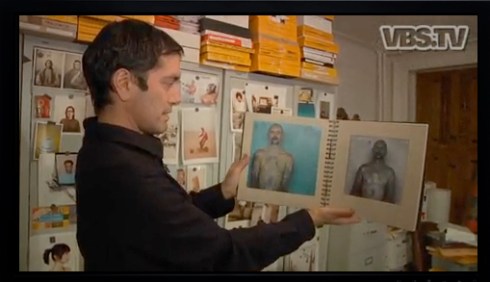
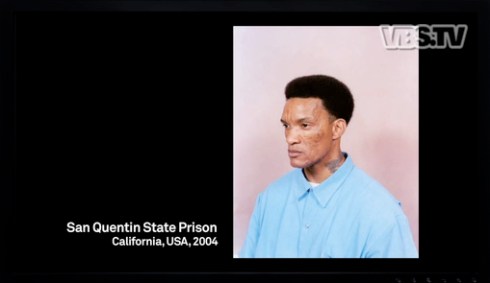
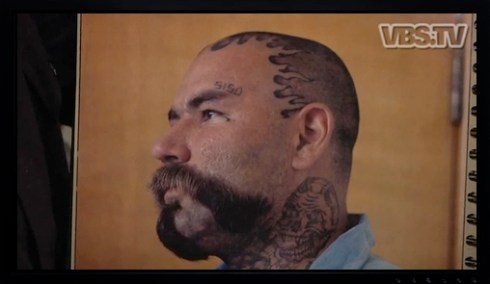
I was interested to discover that photographs of San Quentin inmates played a formative role in Stefan Ruiz‘s career. At 4:45mins, Ruiz talks about his position as an art teacher at San Quentin and his compulsion to make portraits.

From a battered Fujifilm box held together with gaffer tape, Ruiz pulls out a wire bound album of prison portraits:

“I really wanted to take pictures of them so I started taking all these photos. I put this whole little notebook together … and I would carry this box [everywhere]. This was before laptops. I used to bring this to Europe all the time and I’d show this. This was what got me jobs.

Ruiz goes on to explain that he was employed by Caterpillar to imitate the look of those San Quentin portraits. Ruiz’s contact at Caterpillar then moved to Camper and the relationship continued. After Camper Ruiz went to COLORS Magazine as Creative Director (Issues 55 – 60, April 2003 – April 2004). All the while, Ruiz was perfecting his “well-lit” and “polished” style.

Some observers are turned off by the fusion of art/documentary/fashion employed by Ruiz. Common criticism of this multi-genre work is that it can depict poverty as glamorous, violence as eye-candy, and people as consumable props in a visual world obsessed with surface.

The flaw to these dismissive crits is that cinema has been forging this type of imagery for decades; yet, we expect slick augmented reality in the moving image. Ruiz’s use of lights instead of B&W film and the blur of a Leica is hardly an attack on documentary and certainly not on realism (since when has photography ever plausibly claimed a monopoly on realism, anyway?).

Ruiz’s portraits have a solid footing in reality; they are devoid of photojournalist cliche and require participation from the subject. And as far as commercialism is concerned – at least in the case of COLORS – the relationship of money to Ruiz’s aesthetic experiments is acknowledged.

Ruiz likes to “work with the person.” From telenovela actors to hospital patients and clinicians and from rodeo queens to refugees, Ruiz has connected with his subjects through a transparent discussion about what they can achieve together with a device that records and stores their likeness.

The VBS profile of Stefan Ruiz* is a great introduction to his past, present and future trajectory. Highly recommended.

* I apologise for the crude use of screengrabs in this post.

“I hold this slow and daily tampering with the mysteries of the brain to be immeasurably worse than any torture of the body”

– Charles Dickens, American Notes, (Harper & Brothers, 1842) p. 39

If we are to understand how and why prisons function in modern America, it is helpful to know their history. As many of you will be aware there was a time in Western societies when prisons were not the primary form of punishment; instead jails were used for short sentences for disturbing the peace, debt, being poor and as a means to hold people before trial.

Likewise, prisons have not always used solitary confinement. Solitary today is used to punish (sometimes minor) infractions within a prison or to isolate inmates during an investigation/following an incident. Its use differs institution to institution.

Needless to say, on any given day in America 20,000 people are held in solitary despite scientific proof it damages the psyche and regresses basic functioning.

With that in mind, the origins of the practice are pause for thought. In the above video, Sean Kelley, Program Director at Eastern State Penitentiary outlines the history of the famed prison in Philadelphia, and its evolution of the practice of solitary confinement.

PRODUCTION

The Invention of Solitary‘ was produced by Muralla Media Works headed up by Chris Bravo and Lindsey Schneider.

Bravo and Schneider are involved in several projects and as such I’d describe them both as media activists. They’ve produced advocacy video for incarcerated women and for the mentally ill in prisons. They were also videographers at the ‘Fighting Prisons’ panels at the 2010 US Social Forum.

Their largest current project is CONTROL, a feature-length documentary that tells the story of youth whose lives have been caught in the web of the criminal justice system. View the trailer.

With audio-visuals as their material, it is interesting that they also muse – through the SILENCE OPENS DOORS webzine on the history and philosophy of silence & noise.

Which brings us full circle – read the SILENCE OPENS DOORS blog post about The Invention of Solitary.

Philadelphia County Prison, Debtors’ Wing, Reed St. & Passyunk Ave., PHILADELPHIA, Philadelphia County, PA.

This from Welcome to Debtors’ Prison, 2011 Edition, Wall Street Journal.

Some lawmakers, judges and regulators are trying to rein in the U.S. debt-collection industry’s use of arrest warrants to recoup money owed by borrowers who are behind on credit-card payments, auto loans and other bills.

More than a third of all U.S. states allow borrowers who can’t or won’t pay to be jailed. Judges have signed off on more than 5,000 such warrants since the start of 2010 in nine counties with a total population of 13.6 million people, according to a tally by The Wall Street Journal of filings in those counties. Nationwide figures aren’t known because many courts don’t keep track of warrants by alleged offense. In interviews, 20 judges across the nation said the number of borrowers threatened with arrest in their courtrooms has surged since the financial crisis began.

In September 2009, Jeffrey Stearns, a concrete-company owner from Indiana felt the full force of the present law. From On the Rise of Debtor’s Prison: ‘The Scariest Thing That Ever Happened to Me’ (WSJ)

[Stearns] answered a knock at the door from a Hancock County, Ind., deputy sheriff. The deputy was holding a warrant to arrest Stearns for not paying $4,024.88 owed to a unit of American International Group Inc. (AIG) on a loan for his pickup truck.

The irony here, as pointed out by a Demand Progress petition, is that AIG recieved a $122.8 billion bailout – about $4,000 for every American.

More from the WSJ:

After being handcuffed in front of his four children, Stearns, 29 years old, spent two nights in jail, where he said he was strip-searched and sprayed for lice. Court records show he was released after agreeing to pay $1,500 to the loan company. “I didn’t even know I was being sued,” he said, though he doesn’t dispute owing the money.

Sign a petition to your lawmakers against the greed and manipulation

Really?

“Here I can experience the most vivid and complete representation of my memories.”

The above is a quote from the promo video (on 29 seconds) for a new smart-phone App named Color. The claim is – how should I put this? – a load of bollocks.

Color automatically shares all the images you snap in the App with everybody else using the App within the immediate geographical area. I’m still waiting to find out how large that area is.

Color‘s promise that “There’s no attaching, uploading, or friending to do” would send me running a mile. Hello? Privacy?

Color is a product to feed the suffocating self-obsession of modern society.

If someone else makes an image, on their smart phone, of other people, or of an event, in another time, and in another space, and then, you own a tool onto which the image is stored as a digital file, it does not make that event, nor any representation of it, YOUR memory.

It doesn’t even make those people your friends.

EMAIL

prisonphotography [at] gmail [dot] com

Prison Photography Archives

Post Categories

RSS PETE BROOK’S TUMBLR ‘PHOTOGRAPHY PRISON’

  • An error has occurred; the feed is probably down. Try again later.