
You are currently browsing the monthly archive for November 2010.
Kirk Crippens contacted me a few months back to tell me about his work at San Quentin. He’s working on a documentary on the SQ Insight Garden Project.
He’s also working on Hidden Population, a personal project of unorthodox portraiture.

I suspect for Crippens, the ‘back of the head approach’ is a novel workaround of DoC legal restrictions on identifiable depictions of men in its custody. As applied to a US prison population, Crippens’ work is original and rather beguiling; how many of his subjects are aware of the camera’s glare? Does the notion of victimhood surface here? How often does the bowed head recur? It is very difficult to imply penitence in prison portraiture without relying on cliche. The doo-rags, beanie-hats, neck hair, peeping tattoos and ubiquitous blue cotton mean these images fluctuate between personal and abstract.
For such a simple idea, Crippens could go a long way with it. It is still a work in progress so I just want to bring your attention to it right now. Hopefully, I’ll get Kirk on PP soon to discuss it at length.
BACKS OF HEADS
To compose images of the back of the subjects’ heads is the same approach adopted by Eric de Vries for ‘Invisible Scars’ – portraits of the Khmer Rouge labour camps, Cambodia. In terms of political context, the two sets of subjects are constellations apart , but I thought the shared technique was worth noting.
CRIPPENS
In 2010, Kirk Crippens achieved significant success with Foreclosure, USA. He had three solo exhibitions of his and nine group shows throughout 2010. Crippens was named in Photolucida’s Critical Mass Top 50 for 2010. Foreclosure, USA also won the Blue Earth Prize For Best Project Photography at the PhotoAlliance 2010 Our World Portfolio Review. Crippens was recently nominated for the 2011 – 2013 Eureka Fellowship Program, a project of the Fleishhacker Foundation.
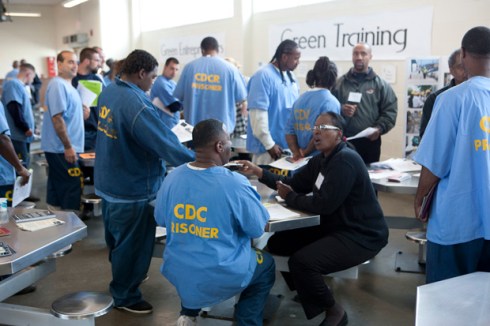
Green jobs fair at San Quentin State Prison. Courtesy of Kirk Crippens.
KALW Informant, a great quality news-site on criminal justice in the San Francisco Bay Area is asking the tough questions – The state could release 40,000 inmates soon. Where will they work? (Rina Palta, November 19, 2010) Palta has answers for readers too. The green economy.
I talked about the common sense behind green jobs for paroled and released prisoners in December 2008. Van Jones (yup, the guy hounded out of the Obama administration by the right-wing media crying Commie) posited before the nation’s economy tanked that social justice and environmental justice had common solutions. He was and remains right.
Palta highlights the mutual benefit for the tens of thousands of released prisoners and the State of California in a progressive, state-sponsored jobs programs and the expansion of the renewable energy industry. San Quentin Prison held a ‘Green Jobs Fair’ in August 2010.
Unfortunately, getting support for govt. stimulus is, these days, difficult politically; taxpayers may balk at the idea of putting taxpayer dollars toward work for felons.
However, unexpected or unpalatable for some CA residents, it would be wise to support former prisoners. It’ll save communities and save future DoC costs. California may be about to release 40,000 inmates based on a 2009 federal judicial ruling (the State of California has taken the case to the Supreme Court for appeal). That’s a lot of working age men with gaps in their skills and working histories. Train them.
Photographer and journalist, Ghaith Abdul-Ahad, reporting from an embedded position with the Taliban published a three part series of articles in the Guardian recently. They’re accompanied by a gallery of 11 images.
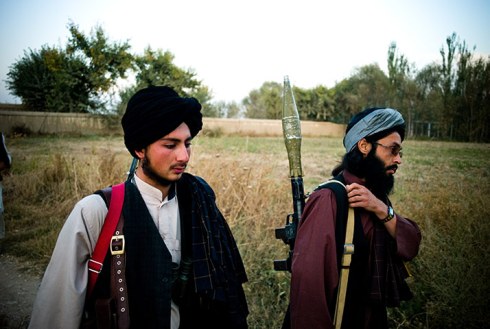
The fighters walk through a landscape of fields, criss-crossed with irrigation canals Photograph: Ghaith Abdul Ahad for the Guardian
David Campbell talks about how valuable (if visually ordinary) Abdul-Ahad’s images are. Valuable because of where they are, alongside the Taliban; it is rare to see Western journalism this close.
Abdul-Ahad’s first part, The Taliban troop with an east London cab driver in its ranks, reveals the seasonal fighting Afghan nationals take on, in some cases they come from Britain for a Summer of Jihad. One fighter will return to his job as a London Cab driver. As remarkable as it must be rare.
In the second part, Five days inside a Taliban jail, Abdul-Ahad tells of the suspicion that fell upon he and a colleague following a battle with American forces. Their belongings were confiscated and they were blindfolded & trucked to another area. They were then marched for 9 hours up a mountain.
Shortly before daybreak we reached a barn on top of a mountain. This was where we would be incarcerated for the following days.
The word prison usually implies a thick-walled building with gates, padlocks and guards. But in the Taliban concept of a jail, the gate doesn’t exist. The jailer was the gate, the prison cell, the executioner and sometimes, if you were lucky, your friend.
The prisoners and the guards lived in the same room, divided by an invisible line. Both groups slept on flimsy mattresses covered with an almost black layer of shining grime.
For the first night we were blindfolded with chequered Afghan scarves that reeked of grease and which served as our towels and prayer mats. After that night, we were only blindfolded when we were led into the adjacent barn to wash and relieve ourselves. The floor of this barn was covered with droppings of goats and humans.
Apart from the jailer, I counted seven guards in all, from frail teenagers to big, tough fighters. They lived in conditions that were not much better than the prisoners. They were not allowed to leave or carry mobile phones and had to spend the night in the cell with the prisoners, often with their feet tied to those of their prisoners. They were fed the same meagre food.
After their credentials had been verified by Taliban leadership in Quetta, they were released.
As we were about to leave, Lal Muhamad produced a thick bundle of dollar bills and tried to give us a hundred each. “This for your trouble,” he said. We refused, and began the long journey back to Kabul.
Finally, in part three, Talking to the Taliban about life after occupation, Abdul-Ahad speaks to a Taliban commander, an administrator and an ambassador.
According to the commander, the Taliban want to be less ideological, less oppressive.
The ambassador refers to the war’s origins and what the US can and should be protecting, “The Americans have one right only, and that is their right to be assured that Afghanistan will not be used against them and that is something the Taliban should give.”
EMBEDDING WITH THE TALIBAN
Journalists Najibullah Quraishi and Paul Refsdal have embedded with the Taliban before.
Onesided embedding with allied troops can be a problem.
 PRESS TV reports:
In response to a question by Press TV on Monday over the whistleblower website’s “leaks,” President Mahmoud Ahmadinejad said “let me first correct you. The material was not leaked, but rather released in an organized way.”
“The US administration released them and based on them they pass judgment …. [The documents] have no legal value and will not have the political effect they seek,” the Iranian chief executive added at the press briefing in Tehran.
Ahmadinejad stressed that the Wikileaks “game” is “not worth commenting upon and that no one would waste their time reviewing them.”
Here, Ahmadinejad proves how little reality interests him. As with every outside threat, he attributes it to a malevolent US. Why scream conspiracy? Especially when the leaked material is being corroborated by diplomats across multiple nations? It’s a ludicrous notion. I wonder what Assange thinks of Ahmadinejad’s accusation?!
[via Lede blog, NYT]
An artist’s use of photography to stick it to the man
Asim Rafiqui brings to our attention the response of Hasan Elahi, a Bangaldeshi-born American citizen, to government suspicion and the FBI’s unwillingness to remove him from the “watch-list”.
Since 2002, Elahi has monitored his own movements on his website Trackingtranscience.net
Rafiqui:
Elahi posts his day, every single mundane aspect of it. A globe-trotting Professor of media, he posts all his activities, complete with GPS coordinates and the date/time stamps at the site, effectively monitoring his daily life. His meals, toilet breaks, airport waits and almost all the mundane acts that define 99% of what constitutes modern life. His server logs reveal that the Pentagon, and even the Executive Office of The President have clicked in while the FBI continue to monitor his activities through this site itself. Our tax payer’s money at work.
Pictured below, Elahi’s toilet breaks.

Two years ago, Elahi appeared on the Colbert Report and explained that if 300 million Americans did this, the FBI would have to employ millions of agents just to keep up with the data flood. Subversive, funny and the best type of protest … except he’s left with no privacy.
HASAN ELAHI
Hasan M. Elahi is an interdisciplinary media artist with an emphasis on technology and media and their social implications. His research interests include issues of surveillance, sousveillance, simulated time, transport systems, and borders and frontiers. Elahi is currently an Associate Professor at the University of Maryland. He previously taught at San Jose State University; Rutgers; the University of South Florida in Tampa, Florida; West Virginia University; Wanganui School of Design, in Wanganui, New Zealand; and also in Houston, Texas.
Elahi’s own site – http://elahi.umd.edu/
The Visible Man: An FBI Target Puts His Whole Life Online, Wired.com, by Clive Thompson, 05.22.07.
– – – – – – –
Found via Andrew Jackson’s Writtenbylight blog

Source: http://www.time.com/time/world/article/0,8599,1903971,00.html
Last week, Ahmed Khalfan Ghailani, 36, the first suspect transferred from Guantanamo military prison to stand a civilian trial was found guilty of only 1 of the 285 charges brought against him – a charge relating to involvement in the 1998 bombing of the American Embassy in Nairobi, Kenya.
PBS reports:
Prosecutors branded Ghailani a cold-blooded terrorist, but the defense portrayed him as a clueless errand boy, exploited by senior al-Qaida operatives and framed by evidence from contaminated crime scenes. Ghailani was convicted of one count of conspiracy to destroy U.S. property. He faces a minimum of 20 years and a maximum of life in prison at sentencing on Jan. 25.
Only one charge was successfully prosecuted because civil courts don’t look kindly upon the involvement of torture in extracting testimony for evidence.
From the New York Times:
Many observers attributed any weakness in the prosecution’s case to the fact that the Judge Lewis A. Kaplan of United States District Court in Manhattan, who presided over the trial, refused to allow prosecutors to introduce testimony from an important witness, who was discovered after interrogators used coercive techniques on Mr. Ghailani.
If this trial is a precedent for other trials of Gitmo detainees to follow, prosecutions are going to have a tough time of it.
The extent of torture used by American powers across the globe is picked apart in the ACLU’s ‘Torture Report’.
Experts have dissected govt. documents (released under the Freedom of Information Act) to piece together the practice of enhanced interrogation techniques; practices that have ultimately derailed the prosecution cases against hundreds of GWOT detainees.
(Found via)
Damon Winter emailed me this week to let me know he’s been tinkering with his website. Since we spoke last [here and here] about his ‘Angola Prison Rodeo’ series, he’s revisited and re-edited.
http://www.damonwinter.com/ > STORIES2 > 5 > ANGOLA PRISON RODEO
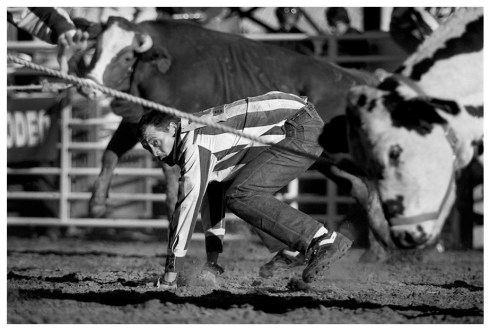
The image above is new and one of Damon’s preferred images.
Also since then, Winter covered Haiti. It was his first work in a disaster area. This week, Winter’s Afghanistan i-Phone images hit the front page of the New York Times – Between Firefights, Jokes, Sweat and Tedium (James Dao, November 21, 2010)
On those i-Phone Hipstamatic App shots … three things.
1) David Guttenfelder did the same thing earlier this year with a Polaroid App.
2) The simple i-Phone angle is not a story. Judging by the cursory Lens Blog entry, I think James Estrin and Winter might have known this.
3) I’ll pass on the i-Phone photos. Mainly because these have got a stupid amount of attention; attention that should be going to Winter’s videography and incredible number of stories in his short time in Afghanistan.
Damon, I still love your portraits and I still dig your work!
ELSEWHERES
I’d also like to recommend my interview with Winter (for Too Much Chocolate) about his career trajectory.
This week, the DVAFOTO boys pointed me in the direction of New York Times‘ Daphné Anglès video and “editor‘s choice” for the Canon Professional Network.
Anglès picked out ten photographs she thought worthy. One of them was this by William Price.
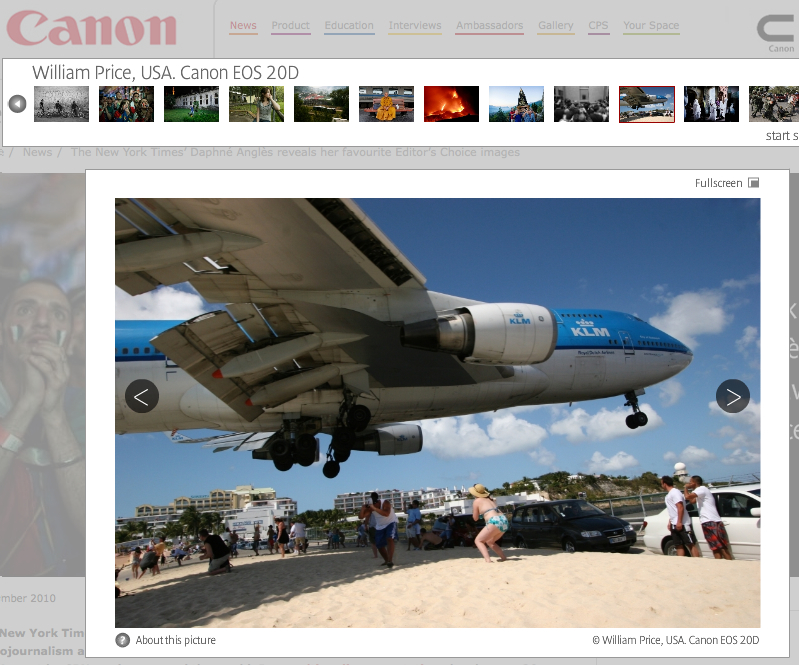
It’s not photoshopped. It’s at a beach on the Caribbean island of St Maarten.
Also this week, Stephen Bulger tells me Josef Hoflehner is showing his series Jetliner at the Galerie Nikolaus Ruzicska in Austria.
Hoflehner’s photos are also from St Maarten.
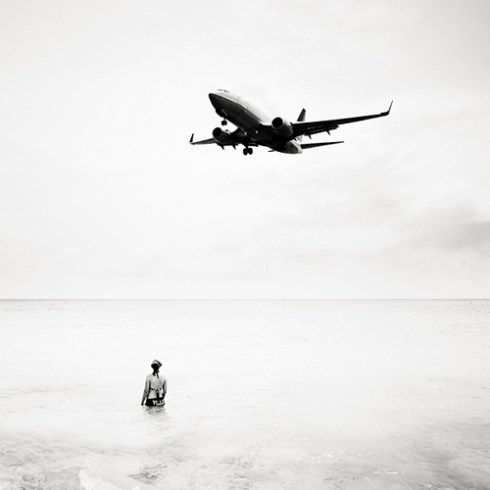
Jet Airliner #11, Continental Airlines Boeing 737-800, Arriving from Newark, NJ. © Josef Hoflehner
I recall in the past seeing other photographers take on this same subject. If pros are taking the time to be out there, I presume plenty of amateurs (and many tourists) must be too?
Ahem. Flickrrrr? Result.
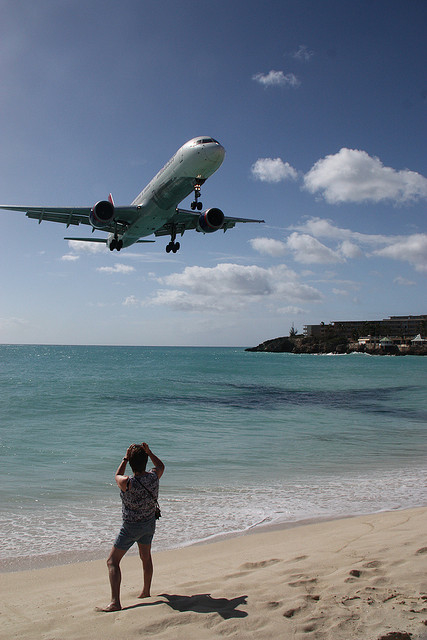
Image by Flickr user, Ike
A beach under an air-path is becoming iconic. It’s stunning, loud and easy to photograph. It encapsulates the compression of technology and leisure and it’s all about the madness and technological advancement in the age of speed. Now images of St Maarten are everywhere. Not a meme yet though (usually videos not images make it as memes).
So, I wonder what That TSA Poster from a few months back was all about?


 Prison Photography