
You are currently browsing the monthly archive for November 2010.
I was going to write a little something about That interview with Antoine d’Agata in Vice, but Darren’s got it covered:
“What is most troubling about D’Agata’s work is not specifically its content, but the rather trite assumption that life as a drug-addicted prostitute (in some conveniently distant place) contains more “truth” than that of, say, a suburban housewife or a plumber […] It remains a tiresome (if quite familiar) misapprehension that extremes of living can bring us closer to the most fundamental aspects of what it is to be human – as though there were no other kinds of truth.”
“The “reality” that he frames as an existential crisis is in fact an economic one, so his rhetoric is more like a transparent pretext for the way he has chosen to aestheticise what he photographs – a denial of his implied privilege. [d’Agata’s work] is beautiful and often daring, just not in the ways that he would have us believe.”
Well said Darren.
Put another way, and I heard this a few years back, “Oh d’Agata, he’s the Magnum photog who fucks and sucks his way around the world, yeah?”

© Kenneth Libbrecht. SnowCrystals.com
As heavy as the snow is falling here in Seattle, I dump these stories that I’ve noticed recently. All worth reading/seeing.
1) – The 2010 Lennart Nilsson Award (Recognizing Extraordinary Image Makers in Science) has gone to CalTach Physicist Kenneth Libbrecht. (Found via Jim)
2) – Rob Hornstra visited Abkhazia’s only prison.
3) – Moscow’s Butyrka remand prison is to install sunbeds for inmates.
4) – MIT has developed a camera that uses echos of light to see around corners. No doubt an attractive tool for SWAT teams, riot police and extraction teams in hostage situations and maybe prisons. I say this having written about ‘Through the Wall Surveillance’ before.
5) – French photographer, Olivier Laban-Mattei won the 2010 Grand Prix Paris Match for his coverage of Haiti. He was one of the many photographers who documented the death of Fabienne Cherisma. (Found via The Travel Photographer)
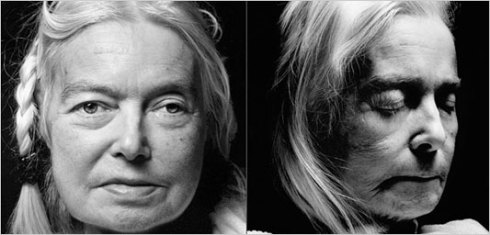
Edelgard Clavey, 67. First portrait: December 5 2003 / Second portrait: January 4 2004. © Walter Schels
6) – Walter Schels‘ photo project “Life Before Death”, includes 24 sets of before-and-after portraits ranging from a 17-month-old baby to a man of 83. Now on show at the Wellcome Collection, London. (More in this interview at LensCulture)
7) – More excellent opinion from John Edwin Mason, this time about the differences between the photo-op at Kenny Kunene’s lavish 40th birthday party and the responsible photography of Oupa Nkosi documenting the wealth and work of Black South Africans.
“No surprise, then, that Kunene has become the poster boy for shamelessly conspicuous consumption in county where, as the Guardian points out, 1.6% of the… population earns a quarter of all personal income. Only 41% have a job and just 58% have attended secondary school; 9% don’t have access to water, 23% don’t have toilets and 24% don’t have electricity. Average life expectancy is 52, the lowest since 1970. Zwelinzima Vavi, the South Africa’s most important labor leader, pointed to Kunene’s party when warning of elites who “scavenge on the carcass of our people” like hyenas.”
8 ) – Simon Sticker‘s 100 + 1 tips for the iconic Africa picture is the latest rant about stereotypes in conversation/photography on Africa.
National Photographers Association of Canada (NPAC) blog
9) – During the summer, I recommended the NPAC blog. Often working photographers will take over the posts for five posts in a week. Between the 8th and 12th November, Jen Osborne took the helm.

© Jen Osborne. Bounce is a very popular music movement originating in New Orleans, USA. It came from the streets and is a mix between Rap, Jazz, and Electronic music. It is popular amongst young adults due to its hard, fast and sexual nature, which inspires eccentric fashion trends. It also appeals to the gay community because Bounce music now contains various gay entertainers.
Jen’s five days of blogging:
Day 1 – The Importance of Learning – Working on the fly with ‘Bounce’ dancers in New Orleans.
Day 2 – Bad associations can sabotage good work! – On access to Talavera Bruce prison, Rio de Janiero. Sketchy fixers, smuggled prison cellphones and released female prisoners.
Day 3 – Thinking Locally – Drug addiction, mental illness and homelessness in her home city Vancouver.
Day 4 – Vicarious Trauma – Vicarious trauma, a newly defined term applies to “wide range of people working with clients or subjects suffering from traumatic experiences; doctors, journalists, social workers, lawyers …”
Day 5 – Doing It Because You Want To – “It is important to have your own projects to work on – projects that make you as the photographer gratified. I think it is important to do meaningful work because it will always be there for you, even when the jobs aren’t.”
Great stuff.
10) – Ed Ou, reflecting on the Joop Swart Masterclass makes all young photojournalists smile with his stirring optimism:
“It is exciting to spend time with photographers from around the world and never mention the “death” of our industry. While there may be smaller budgets and fewer outlets, there will always be room for good photography. The only way to brave the bad times is to just keep shooting.”

© Ed Ou. Nurse Larissa Soboleva holds two-year-old Adil Zhilyaer in an orphanage in Serney, Kazakhstan. Adil was born blind and afflicted Infantile Cerebral Paralysis (ICP) and hydrocephalia as a result of his mother’s exposure to radiation during years of Soviet weapons testing during the Cold War. He was abandoned by his parents and is now cared for in an orphanage.

Unexpectedly, my posts on prison tattoo photography have been very popular – [1], [2], [3], and [4]. Continuing the theme, I’d like to feature the work of Herbert Hoffman.
From an early age, Herbert Hoffmann (1919-2010, b. Pommern, Germany) was drawn to people with tattoos. He was educated in Berlin. During the Third Reich, tattooed people were seen as criminals and consequently, the tattoo culture diminished. In 1940, Hoffman signed up for basic military service with the German army. From 1945-49, Hoffmann was held prisoner of war by the Russians. When he returned to Germany he worked as a travelling salesman, and encountered many persons who were tattooed despite the old Nazi ban. While working Hoffmann always took along his camera and photographed the people he met. In 1961, Hoffmann opened his own tattoo studio in Hamburg, Germany.


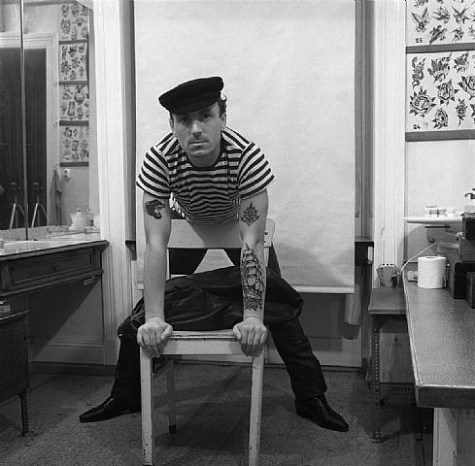
FIRST TATTOOS, THEN PHOTOGRAPHS
Hoffman distinguishes himself from photographers who look in at the tattoo culture from the outside. He defined the culture and then adopted the lion’s share of documenting it. Hoffman’s DIY method is like that of graffiti artists who return with a camera to make images of the surfaces which they have earlier decorated. (Notably, Hoffman’s tattooing preceded the rise of graffiti and its recognition as art/culture in the 1970s/80s.)
Aged 91, Hoffman passed away on June 30th of this year. Despite the indisputable novelty of his photographs, and his central position to German tattoo culture, Hoffman only received mainstream recognition very late in life. No surprise really; Hoffman was working with the maligned, ‘lowly vernacular’ medium of photography, to record the re-emerging tattoo subculture.


TEN HAAF EXHIBIT
Hoffman’s images are on show at Ten Haaf Projects in Amsterdam until December 18th. Ten Haaf Projects, Laurierstraat 248, 1016 PT Amsterdam, The Netherlands. Tel: 020-4285885 www.tenhaafprojects.com. And how good is this? At the Ten Haaf opening in October artist Henk Schiffmacher tattooed Hoffman’s designs on exhibition goers.
EXHIBITS / BOOKS
Hoffman’s books are here and a picture gallery of Hoffman’s life here.
Selected Solo Exhibitions: 2010 ‘Living Pictures’ Ten Haaf Projects Amsterdam; 2010 ‘St Pauli’s Souvenirs’ Galerie Lehmann Berlin. Publications: 2008 ‘Skinscapes, Die Kunst der Körperoberfläche’, text Herald Kimpel, Hrsg: H . Kimpel, Marburger Kunstverein Marburg; 2006 ‘Signs and Surfaces’ by Andreas Fux, Herbert Hoffmann, Ali Kepenek Hrsg Künstlerhaus Bethanien Berlin; ‘Mensch! Photographien aus Dresdner Sammlungen’, Hrsg: Wolfgang Hesse und Katja Schumann; ‘Kupferstichkabinett’, Staatliche Kunstsammlungen Dresden.
ALL IMAGES © HERBERT HOFFMAN

As part of the ongoing OPEN-i project, Edmund Clark and I discussed Ed’s latest project Guantanamo: If the Light Goes Out.
Ed’s nuanced work from on Guantanamo began with his documenting the domestic interiors of released British detainees. As Ed progressed he realised he needed to go to the US base on Cuba. The project deliberately jumps between these environments of “residence”, forcing the viewer to consider the personal as opposed media representations we otherwise rely on.
Ed’s work deliberately excludes portraits of detainees, partly because he feels those images are widespread but also due to a belief that audiences react to “images of bearded men” with unavoidable prejudice.
Ed also looks at the leisure spaces on Guantanamo that US military personnel inhabit during down time. The juxtapositions are poignant.

The photographs in the book Guantanamo: If the Light Goes Out wrap around letters received by detainee Omar Deghayes during his time in Gitmo. Except they are not letters, they are copies, processed, redacted, re-processed, copied again. If he received a colour copy it was a rare treat. Some of the correspondence is so bizarre, Deghayes wondered if the were genuine or if they were props to the mind games played by his captors.
My family has been urging me for years to talk more quickly, and having heard myself here I get their point. The only excuse I have is that it was early in the morning here on the Pacific Coast when we sat down for the webinar.
Ed, on the other hand, talks wonderfully about the images and their situation in our shared GWOT visual landscape.
PHOTOGRAPHS AS IMPLEMENTS OF TORTURE
The book, Guantanamo: If the Light Goes Out concludes with an essay by Dr. Julian Stallabrass. He describes a rather pernicious and Luddite use of photographs in psychological torture at Guantanamo:
Al-Qahtani was repeatedly shown photographs of scantily dressed women, along with images of 9/11, particularly pictures of children who had died that day, had the pictures taped to his body, and to ensure that he had paid them close attention, he was induced to answer questions about them.
This is a practice of interrogation of which I was not aware and is obviously troubling; a deliberate use of imagery to vex and agitate and an example of the power of photography as applied in an abusive context.
OPEN-i
Thanks to OPEN-i coordinator Paul Lowe for inviting me back once again. It’s an honour to speak with a photographer at the top of his game. OPEN-i is a global network hosting monthly live discussions on critical issues relevant to documentary photography and visual storytelling.
EDMUND CLARK
Edmund Clark is winner of the 2010 International Photography Awards (The Lucies), 2009 British Journal of Photography International Photography Award, and the 2008 Terry O’Neill/IPG Award for Contemporary British Photography for his book ‘Still Life Killing Time’. His work is in several collections including The National Portrait Gallery, London, and the Museum of Fine Arts, Houston.

GITMO – OTHER READINGS
Prison Photography archive of posts referring to Guantanamo.
The Prison Photography Guantanamo: Directory of Photographic and Visual Resources (May 2009)

© Sebastian Meyer. Source: http://sebmeyer.wordpress.com/2010/10/01/an-old-photo-i-found/
When reading the New York Times’ New York City Police Photograph Irises of Suspects a couple of days ago I was reminded of Sebastian Meyer‘s Guardian video dispatch from Afghanistan.
AFGHANISTAN
In the accompanying article, Jon Boone explains that in Afghanistan,
The US army now has [biometrics] information on 800,000 people, while another database developed by the country’s interior ministry has records on 250,000 people.
It is the sort of operation that would horrify civil liberties campaigners in the west, but there has been little public debate in Afghanistan. […] US soldiers have been collecting huge amounts of biometric data, with little oversight from the Afghan government.
It allows us to understand population shifts and movements, who wasn’t there before and who might be a potential threat just because they are new to that area,” said Craig Osborne, the colonel in charge of Task Force Biometrics.
The Afghanistan government has plans to introduce a biometric ID card by 2013; an attempt to thwart insurgency but it is also thought ID cards will reduce Afghanistan’s rampant voter fraud.
BIG APPLE
Back in New York, the NYPD is keeping track of prisoners and suspects for when they are transported or appear in court:
Authorities are using a hand-held scanning device that can check a prisoner’s identity in seconds when the suspect is presented in court, said Paul J. Browne, the department’s chief spokesman.
Officials began photographing the irises of suspects arrested for any reason on Monday [Nov. 15th] at Manhattan Central Booking and expect to expand the program to all five boroughs by early December, Mr. Browne said.
Mr. Browne said a legal review by the department had concluded that legislative authorization was not necessary. “Our legal review determined that these are photographs and should be treated the same as mug shots, which are destroyed when arrests are sealed,” he said.
[My bolding. Source]
WHERE IS THIS GOING?
It is clear that the US is gathering vast quantities of biometric data at transport hubs, immigration offices, police stations, conflict zones. Am I foolish to think that all this information might not one day be consolidated?
Not even considering Chomskyite accusations of US Imperialism based on military violence, could we not consider silos of biometric data (with global reach) as the foundation par excellence to empire in the networked 21st and 22nd centuries? As an invisible but intractable abundance of strategic knowledge and power?
I accept these questions probably mirror the fears of every era in which people first learn and then come to terms with new technologies that impinge upon the assumptions of the age regarding privacy and civil liberty. But still.
MORE
More from Federal Jack here.
Freelance photographer, Sebastian Meyer has a blog. The image above was sourced from this blog post. On his website, I recommend ‘How to buy a gun in London’

After looking at the TSA’s list of airports with Full Body Scanners, I’ve decided to drive to California for the Christmas Holidays. I’d already made the decision to stay in Seattle for Thanksgiving, so no immediate problems.
This post obviously spurred by the story of unlikely hero, John Tyner.
Some of you might be thinking that it’s not a big deal because those images are not saved, stored or transmitted, right. Wrong.
From the list below, if you’re flying anywhere meaningful in the US, some TSA agent is going to ogle your fancies.
Happy Holidays!
Airports who currently have imaging technology:
- Albuquerque International Sunport Airport
- Hartsfield-Jackson Atlanta International Airport
- Baltimore/Washington International Thurgood Marshall Airport
- Boston Logan International
- Bush Houston Interncontinental Airport
- Boise Airport
- Bradley International Airport
- Brownsville
- Buffalo Niagara International Airport
- Charlotte Douglas International
- Chicago O’Hare International
- Cincinnati/Northern Kentucky International
- Cleveland International Airport
- Corpus Christie Airport
- Dallas/Fort Worth International Airport
- Denver International Airport
- Detroit Metro Airport
- Dulles International Airport
- El Paso International Airport
- Fort Lauderdale-Hollywood International
- Fort Wayne International Airport
- Fresno Airport
- Gulfport International Airport
- Grand Rapids Airport
- Harrisburg International Airport
- Harlingen/Valley International Airport
- Honolulu International Airport
- Indianapolis International Airport
- Jacksonville International Airport
- John F. Kennedy International Airport
- Kansas City International
- LaGuardia International Airport
- Lambert/St. Louis International Airport
- Laredo International Airport
- Lihue Airport
- Los Angeles International
- Luis Munoz Marin International Airport
- McAllen Miller Airport
- McCarran International Airport
- Memphis International Airport
- Miami International Airport
- General Mitchell Milwaukee International Airport
- Mineta San José International
- Minneapolis/St.Paul International Airport
- Nashville International Airport
- Newark Liberty International Airport
- Louis Armstrong New Orleans International Airport
- Oakland International Airport
- Omaha Eppley Field Airport
- Orlando International Airport
- Palm Beach International Airport
- Philadelphia International Airport
- Phoenix International Airport
- Pittsburgh International Airport
- Port Columbus International
- Raleigh-Durham International Airport
- Richmond International Airport
- Rochester International Airport
- Ronald Reagan Washington National Airport
- Salt Lake City International Airport
- San Antonio International Airport
- San Diego International Airport
- San Francisco International Airport
- Seattle-Tacoma International Airport
- Spokane International Airport
- T.F. Green Airport
- Tampa International Airport
- Tulsa International Airport
Airports receiving imaging technology soon:
- Chicago Midway International Airport
- Houston William P. Hobby Airport
- Saipan International Airport

It was interesting to watch Marion Jones speak on Monday’s Daily Show. She was locked up for 6 months for lying to federal investigators during the Balco scandal. Jones’ imprisonment included a 45 day stint in solitary confinement.
Jones is now in the very early stages of prison reform advocacy:
“I’m in the process of looking for organizations that I can partner with, get their stories out there, share my experience, use my voice. When I was in prison, some of the women there talked to me and shared their stories with the hope that, because I have a voice on the outside, people will want to hear what I have to say.”
“Too many times, you’ll hear, ‘Aw, there’s just prostitutes or drug-heads or the bottom rung of our society in there.’ Before you jump to a conclusion and make any ignorant or rash comment, take a break – remember, that’s what I’m trying to get out there – find out what you can about the situation and make a smarter response. I’ll do whatever I can do to talk about awareness and change.”
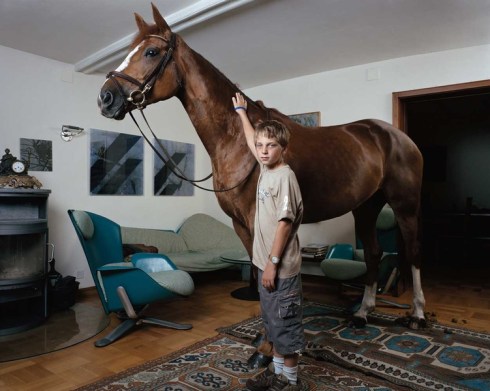
Jon Naiman. Familiar Territory, #21. Chromogenic Print. 32×40″ Image. Unmatted. 3/6. $3600
What is there not to love about Jon Naiman‘s series Familiar Territory? (More here)

 Prison Photography