
You are currently browsing the yearly archive for 2011.
Stephanie De Leng‘s Inside HMP Manchester is a very low-key but intriguing exhibition (by appointment only) currently on in Liverpool.
De Leng says:
“I have been allowed inside HM Prison Manchester, formerly known as Strangeways, to document its workings, staff, and prisoners who are willing. This is a delicate project built on trust, and follows in the wake of a TV documentary in the coming months. It is the first time that a photographer or camera crew have been allowed inside this prison since the 1990 riots. A lot has changed since then in a very positive way, and for my part I intend to document it honestly, and not in a grim trying to dish the dirt way. There is a lot of good to say, or show in my case.”
So far, de Leng – trying to avoid “bland corporate” style portraits – has focused on photographing the staff. She hopes to slowly bring more and more images of the prison to wider audiences over a period of time. Softly, softly. I’m intrigued.

Officer Alan Blocksidge, Butler Trust winner and MBE for his work rehabilitating drug addicts within HM Prison Manchester. Photo Credit: Stephanie de Leng
Inside HMP Manchester
De Leng’s photographs will be on show at Baltic Creative as part of LOOK2011, the inaugural Liverpool Photography Festival based around the theme “Is Seeing Believing?”
LOOK2011 says:
“It has been 21 years since the ‘Strangeways’ Prison riot, the 26 day roof top protest that changed the face of the prison system. The riot in April 1990 resulted in the partial destruction of the old Victorian wings and the injury of 147 prison officers and 47 prisoners. The disturbance inspired copycat riots at a number of other prisons, including HMP Bristol and HMP Dartmoor. A five-month public enquiry ensued, resulting in The Woolf Report which served as an ongoing blueprint for the reform of the prison system. ‘Inside HMP Manchester’ is intended to make the viewer set their normal prejudices and assumptions aside, and to look at justice from another angle.”
The exhibition is by appointment only. Except on May 13th, when Baltic Creative will be open between 6 – 9pm for the Light Night. Stephanie de Leng will be present to discuss her works. The Baltic Creative Center, 22 Jordan Street, Liverpool, Merseyside, L1 0BW, UK. 0151 703 2005
STRANGEWAYS ELSEWHERE ON PRISON PHOTOGRAPHY
Former Governor of Strangeways: “Give UK Prisoners the Vote.” And in the US?

Photo Credit: Nina Berman
Recently, Bryan Formhals pleaded for photographers to write more; Joerg repeated the call.
Nina Berman, a very intelligent photographer, is also a fierce writer with undeviating message. On the 6th May, Berman wrote this:
“The Taliban stone women, we act outraged, spend billions trying to destroy them. And here in the land of the free? We dress girls up, shove shit in their mouths, make them plead for more, smile while they’re being tortured, gang bang them with multiple partners in multiple entry points, infect them, drug them, then dress them up with fake tits and travel them on the convention (prostitution) circuit. Annual US sales $10 billion. Worldwide porn industry sales are more than Apple, Google, Amazon and Microsoft combined.”
If you are in Liverpool over the next couple of months, then you should drop in to any number of the exhibits put by LOOK2011 the inaugural Liverpool Photography Festival.
The theme for the festival is “Is Seeing Believing?” Of particular interest is Confined at the Bluecoat.
Confined is an exploration of the idea of confinement in contemporary life by photographers Juergen Chill, Edmund Clark, John Darwell, Dornith Doherty, Ben Graville, David Maisel and David Moore. Subjects range from imprisonment and detention, the ethical treatment of animals, ecological conservation and the history of psychiatric care.
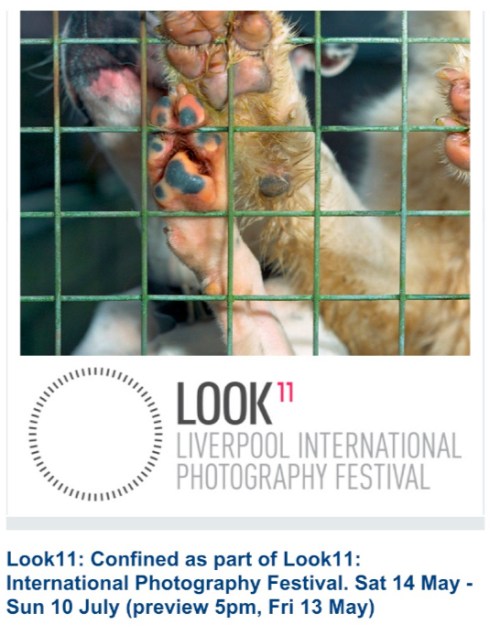
I have a personal involvement in the show. Exhibitions curator Sara-Jayne Parsons asked me to pen some words for the Confined catalogue. And, after interviewing David Moore about his Paddington Green Police Station series I encouraged him to contact Parsons and together they decided to exhibit the prints. It will be the first time Moore has publicly shown his Paddington Green Police Station photographs.
Unfortunately, I won’t be making it over to the UK soon, but I hope those of you who are in Blighty make it to the exhibition, not to mention all the other LOOK2011 exhibits, lectures and workshops.
Confined is on show at the Bluecoat, School Lane, Liverpool L1 3BX, from Fri, 13 May 2011 – Sun, 10 Jul 2011, 10.00 AM – 6.00 PM, Tickets: Free. (Visitor info)
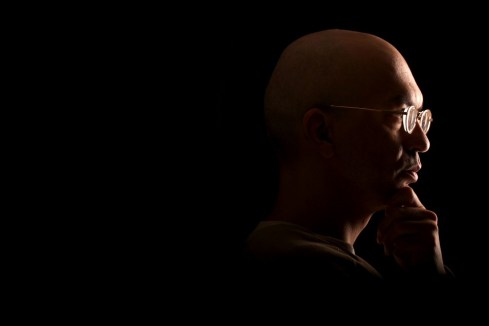
As I have mentioned here, NON-SUFFICIENT FUNDS, an exhibition of prison art by my students is ongoing in Seattle.
Prior to the show, the gallery asked that I try to make some portraits of the artists. I am not a photographer, so I was fortunate enough to secure the expertise of friend and Seattle Times photojournalist Erika Schultz.
The wall on which the portraits and their accompanying bios hung have been incredibly popular among the audience. Erika’s portraits are phenomenally unexpected. In this instance, text and image combine and challenge the damaging stereotypes of prisoners that usually hamper prison reform.
The non-existent genre of “prison photography” just expanded by one project.
PHOTOS AS EMOTIONAL CURRENCY
Not surprisingly, Erika’s portraiture has gripped the attention of the students too. For a US prisoner, sitting for a professional portrait is very, very, very rare. Photographs play a crucial part in the unorthodox family relationships that persist despite prison walls. The students are aware of this and incredibly eager for prints, which I will provide.
You should see more of this project on Erika’s blog.
Well, well, well. All sorts of commentary on the importance of photographs surrounding the assassination of Osama bin Laden and President Obama’s announcement in the East Room with reenactment of his speech for the still cameras.
From the White House Situation Room (now with added memes) and Reuters’ bloody gallery (WARNING: Graphic images of corpses) to whether we deserve or need to see bin Laden’s bullet-riddled head. Then there’s Senator Scott Brown’s faux-pas over a hoax photograph. Not to mention the reported different versions of the actual event.
For all the best articles click on the links over on Raw File Blog’s twitter feed, where I’ve been compiling them all day.
There’s still one photo – to be precise its caption – that is bothering me. And it’s this one:

White House photographer, Pete Souza, captioned the image thus: “President Barack Obama and Vice President Joe Biden, along with members of the national security team, receive an update on the mission against Osama bin Laden in the Situation Room of the White House, May 1, 2011.”
Except everywhere I’ve seen it used, the inference is that the White House team are watching a live feed of the raid on bin Laden’s compound.
They might be, but I want a SOURCE.
It seems to me this image may have been interpreted as one thing at an early stage and because it the narrative tied to the body language is so seductive, no-one has chosen to question it.
I think the reading of the image is massively altered depending on whether you think they’re watching murders in progress or whether they are, for example, waiting nervously for the screen to boot up.
Ryan Singel for Wired.com’s Epicenter blog went as far to say the White House “officials watching what one presumes is the livestream of the Navy Seal raid on Osama’s hideout in Pakistan.”
For all the hullabaloo about this image, no-one is actually sure about what is on THAT screen.
So, does anyone have a solid source saying that they are viewing a live feed of the operation?

Newark, New Jersey, December 2009: A Buthanese refugee is changing his shirt siting on the floor of his room. CREDIT: Gabriele Stabile/CesuraLab
Four years ago, Gabriele Stabile of CesuraLab went out to photograph in the airport hotels of New York, Newark, Chicago, Miami and Los Angeles – the five official US ports of entry for approved asylum seekers. The result The Refugee Hotel (originally The Refugee Motel) has been steadily added to since.
‘The “Refugee Hotels” are today’s Ellis Islands. Places of temporary lodging on refugees’ journeys from where ever “there” was to wherever in America they end up. My intention was to document the moments between two kinds of uncertainty. Refugees come fleeing hunger, they come from forced exile, they come escaping certain death. Some spend years in camps waiting for their ballot to be cast. I spoke to one person who’d waited seven years to talk to me in an anonymous hotel room in Newark, New Jersey. The resettlement process, even with all its difficulties and challenges, must be light years away from the harsh realities of life in a refugee camp. Still, I don´t know what to make of the establishing shot we start their American stories with: standardized hotel chains.’
The Refugee Hotel recently achieved it’s next phase by securing a pre-print agreement with McSweeney’s and raising $6,000 on Kickstarter to publish a book.
This is a fascinating project about immigration because while the lives of the subjects are swept up in global politics, there’s no possibility of them being caught up in the rhetoric of illegal immigration. Quite contrary, these are formerly persecuted people for whom the United States of America hold a real shot at stability.
Perhaps, Stabile’s photographs are of nascent American dreams, or maybe they’re simply the first images of American lives?
Stabile interviews with FADER and Miss Rosen.
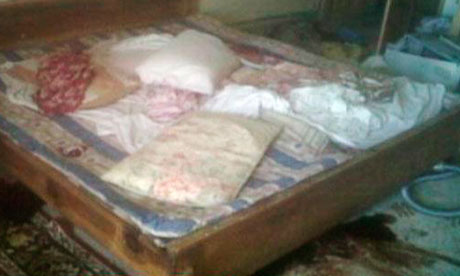
Screen-grab from ABC newsreel footage, as featured in the Guardian‘s front-page slide show.
Osama bin Laden wasn’t in mountain caves. He was in a mansion in Abbottabad, a major Pakistan city two hours north of the country’s capitol, Islamabad. Bin Laden had been there for more than six months.
Part evil-lair, part self-imposed prison, part luxury – the mansion is a major part of the story and questions about “who protected Osama bin Laden over the past decade” will no doubt follow.
There’s a few things going on here, so let’s start with the most simple. “You made you bed, now you must lie in it die in it.” Anyone? No? (To be clear, I don’t know if this was OBL’s bed, or even if he was killed in this room).
Nonetheless, the blood on the floor tells us this bedroom is a site of ambush; the bed is an object of a stormed house. Yet, this image is not distinguishable in any meaningful way from all the other images of house raids in America’s 21st century wars.
THE VISUAL CULTURE OF BEDS
Contemporary concerns have been about sex (the discarded condoms of Tracey Emin’s My Bed proved her as honest as she is crass) and violence (or maybe Rauschenberg was just about disorder?)
Historically, the image of the bed has been co-opted for highly political purposes. And interestingly, the bed played a central role in the dissemination of images of Arabic regions round Europe in the 17th and 18th centuries.
Artists under patronage painted aristocracies, noble beasts, mythologies, and Christian narratives. The boudoir was rarely mentioned; acts of the bedroom hidden. For titillation, commissioned artists were sent abroad. Orientalist Art has little to do with the distant lands it “depicts” but most to do with the obsessions of artists and patrons with harems and the sexual behaviours of people of colour.*
Without wanting to over-simplify, Orientalist Art is – at both conscious and subconscious levels – the projection of suppressed sexual desire upon an “Other” group. The subject has little or no means to correct the misrepresentations. Furthermore, any corrections by the subject would disrupt the self-serving narratives of the distant audience.
Centuries of visual manipulations and stubborn visual usury between the West and the rest, with the bed as the visual anchor to the lazy indifference, are wrapped up in the unorthodox war photograph above. If the image does indeed depict the bed of Osama bin Laden (the personification of cultural antagonism, violent opposition, the most distant of “Others”) then, I at least, identify some irony therein.
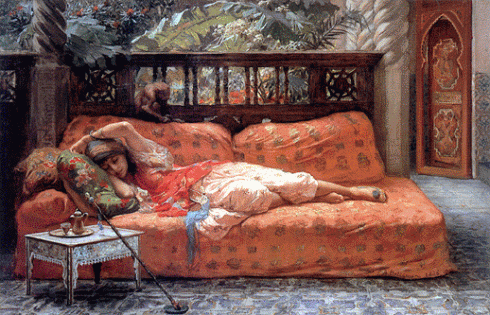
“The Siesta,” by Frederick Arthur Bridgman (1847-1928), oil on canvas, 11 ¼ by 17 inches, 1878, private collection, courtesy of the Spanierman Gallery, New York
One final thing. A bed is a place of rest, a grave is a final resting place. Western allies worried any grave would become an extremists’ pilgrimage site, so Osama bin Laden’s body was buried at sea. But have they avoided the problem? Might this Abbottabad mansion and this bedroom not become places of pilgrimage?

 Prison Photography