
You are currently browsing the yearly archive for 2011.
Blake has compiled a great little piece about the final images of some of the best known photobooks.
Here’s what Blake has to say about Eggleston:
The final image in Eggleston’s Guide is typical Eggleston. It’s so banal it almost seems meaningless. Yet I’ve always found this picture loaded and menacing. Peaked hoods in the south creep me out. I wouldn’t make this my last image before bedtime.
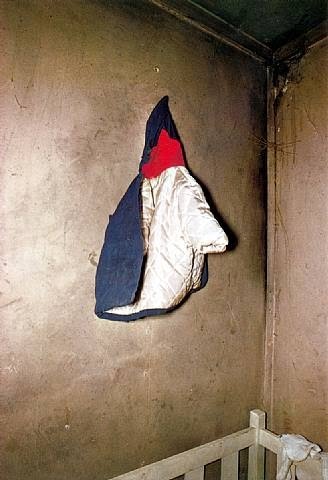
Near Jackson, Mississippi, 1970, William Eggleston
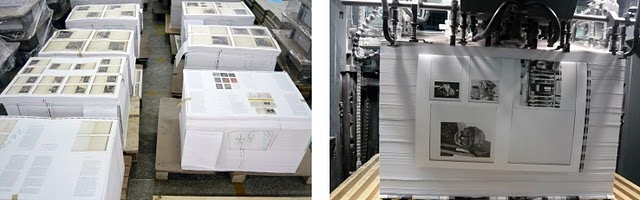
Jeff Ladd explains over at PhotoEye, why, what and how Errata Editions came to be:
“It was in 2004 after Martin Parr and Gerry Badger’s The Photobook: A History Volumes I and II were published that I realized not only the huge scope in the array of photobooks (two-thirds of their choices I hadn’t even heard of) but how elusive most were. Nearly 90% of what had been referenced as the “most important” photobooks are out of print and really only accessible to a few wealthy collectors or through research libraries. As a photography teacher, the idea that a young photographer just learning their craft couldn’t, without great effort or expense, experience what came before them was very disturbing to me. It begged the question of consequence; what if the greatest literature or poetry was not available for young writers to be informed by? That seemed to be the current state of the history of photobooks.”
[My bolding]
FOAM Magazine has launched WHAT”S NEXT, a platform for discussion of future trends in photography. Covering the questions about digital/chemical photography and the future of photobooks is no surprise.
It is pleasing to see questions about museum curatorship and preservation practices. After all, we can take care of our own archives, but who, how and where to take care of culture’s archives are much larger questions.


Ara Oshagan sat down for an interview with Boy With Grenade to talk about his project Juvies from the California Youth Detention system. Oshagan talks about “access, his process and the state of documentary photography today.” It’s long but parts make good reading.
“There is a certain pragmatism in my outlook. I knew I could not have access to these kids outside of the limited access that I had when I went in. So I did not worry about that. I made sure that I was totally ready—physically and mentally—when I did spend time with them, to make the absolute most of that time, to be fully in the “space” with them, to have a clear mind, to connect as much as possible, and hope that this connectivity will translate into good photographs.”
“To make good photographs, I feel, one must create a good process. Photographs can never be an end; they necessarily must be a byproduct of an experience, a process. That connectivity with your subject matter must be present. If you go into a situation with the sole purpose of making “good photographs” you will invariably fail. Or at least, I will.”
Read the full interview.
I’ve written about Oshagan’s Juvies on Prison Photography once previously.
For all sorts of reasons, my life is a whirlwind right now.
With regard Prison Photography and what it all means, might mean, things are tabled for renegotiation. Rejigging.
The renegotiation is in thinking of more creative ways to share new content, but also leverage old content to make it available to interested parties.
A complete redesign of Prison Photography is on the cards; old interviews and criticism would resurface again. But overhaul is not scheduled within the next year. In the meantime, there exist novel means to share the archive of information on Prison Photography.
This week, I made the trip to Coventry University to guest lecture for the Picturing the Body (#PICBOD) course. Course leader Jonathan Worth is a lesson in enthusiasm. With the backing by Jonathan Shaw and the assistance of Matt Johnston along with a host of others within and beyond the photo deptartment’s walls, Jonathan Worth is creating something wholesome, giving and pioneering.
Worth and his collaborators are building a model for free, online photography curricular in criticism and practice for both BA and MA students; students in Coventry and across the globe.
My presentation ‘Tattoos, scars and tears, Robert Gumpert’s work in San Francisco jails’ (which you can listen to here) focused on Robert Gumpert‘s ever developing project ‘Take A Picture, Tell A Story‘. As an introduction and to provide context to Robert’s work, I summarised the work of photography within sites of incarceration throughout the history of the medium.
Following the lecture, Jonathan Worth suggested the introduction alone could constitute a lecture. I would venture farther and say it could warrant a full course in itself.
I’m writing a few syllabi presently and – in the spirit of #PICBOD – I realised I should be sharing my notes.
So, here they are … on a cachable page for perpetuity.
A BRIEF HISTORY OF PRISON PHOTOGRAPHY (IN LOOSE CATEGORIES)
Before the golden age of photojournalism, the photographing of prisoners was used for purposes of identification, order and discipline. The two part mugshot (front view and profile view) was standardised by Alphonse Bertillion. Police departments adopting the system had in-house technicians and photographers but they are anonymous in history.
Remarkable archives by anonymous police photographers exist the world over, but two noteworthy collections are in New Orleans and Sydney.
American prisons fell on to the radar of professional and committed photojournalists in the sixties and seventies, more and more. Three Magnum photographers (Eve Arnold, Bruno Barbey, Danny Lyon) went to Texas. Arnold returned to the subject again and again. The Lone Star state had a punitive prison culture with reform commonly taking the form of hard labor on the chain gang; images echoed those of slavery in the South.
The “exotic” prison (Late 70s, 80s, USA):
Morrie Camhi’s photographs of California prisoners remain some of the most authentic portraits made within US prisons. Douglas Hall Kent, spent years and published at least two books on prison tattoos. Garry Winogrand stopped by Huntsville for the prison rodeo. The much lesser known Ethan Hoffman produced a book titled Concrete Mama about Walla Walla Penitentiary in Washington State. The brutality and tenderness of interactions between prisoners as depicted by Hoffman are surprisingly frank.
Pioneers in prison documentary photography/photojournalism (1980s and 90s in USA):
Cornell Capa (Attica, NY, USA); Taro Yamasaki (Michigan), Ken Light (Texas), James Nachtwey (Texas and other Southern states), Bruce Jackson (Arkansas), Alan Pogue (Texas).
Contemporary to the Americans (above) was the anomalous Jean Gaumy. In 1976, Gaumy was the first photographer allowed access to a French Prison.
Contemporary prison photography (1990s, 2000s):
Lori Waselchuk (Angola, Louisiana), Ara Oshagan (California juveniles), Victor Blue (California), Andrew Lichtenstein (multiple states).
Collaborative/rehabilitative projects (2000s):
Casey Orr (Leeds, England), Mohamed Bourouissa (Paris, France); Deborah Luster (Louisiana, USA), Klavdij Sluban (France and Eastern Europe), Mikhael Subotzky (South Africa), Steve Davis (Washington State, USA); Robert Gumpert (San Francisco, USA); Leah Tepper Byrne (USA)
Eastern European and Former USSR (Late 90s, 2000s):
Much of the photography from the former Soviet bloc is characterised by the grey abandonment of it all. Into the new millenium, younger photographers took less documentary approach with more nuanced fine art engagement with the inmates of Russia and its satellites. Examine the work of Christian Als (Latvia), Carl de Keyzer (Siberia), Yana Payusova (Russia), Sasha Maslov (Ukraine); Delmi Alvarez (Latvia) and Jane Evelyn Atwood.
Western Europe:
Generally, a more tactical use of technique and viewing from photographers such as Nico Bick (Netherlands), Juergen Chill (Germany), Matthieu Pernot (France and Spain), David Moore (London, UK) Danilo Murru (Sicily and Sardinia); Lizzie Sadin (Multiple countries); and Melania Comoretto (Italy).
Guantanamo (2002 – ):
Many photographers have addressed Guantanamo including Paolo Pellegrin, Brennan Linsley, Tim Dirven, Chris Maluszynski, Bruce Gilden, Louie Palu and Christopher Sims. Above all others, Edmund Clark has made the best contribution with emotive images from former detainees’ homes, letters of the detainees and an extremely engaging essay from Dr. Julian Stallabrass.
Political memory (20th and 21st centuries):
Donovan Wylie (Northern Ireland), Paula Luttringer (Argentina), Dana Mueller (US POW camps), Phillip Lohoefener (East Berlin Stasi prisons) and Anna Schteynschleyger (Former USSR).
Archives of Atrocities:
Willhelm Brasse, known as the Photographer of Auschwitz during WWII; the photographers of Tuol Sleng in Cambodia during the Kymer Rouge regime (1975-1979); Victor Basterra, Naval Mechanics School (ESMA), Buenos Aires, Argentina during the Dirty War (1976-1983)
Conceptual:
Chris Jordan‘s large digital composites that stack 2.3million prison uniforms upon six floor-to-ceiling cnavases approach the depressing scale of US incarceration. Featured in ‘Invisivle’ a summary of his first ten years or so probing military and state secrets, Trevor Paglen “stalked” previously clandestine extrajudicial prisons used in the global war on terror. Broomberg and Chanarin, on a tour of Afghanistan rolled-out sheets of photographic paper on days of historical importance, in one case a jail-break.
Africa (21st Century):
Without exception the photographs of African prisons focus n the deplorable conditions, the mistreatment of children and usually both. Julie Remy (Guinea), Fernando Moleres (Sierra Leone), Lynsey Addario (Uganda & Sierra Leone), Nathalie Mohadjer (Burundi), Joao Silva (Malawi).
INQUIRY NOT GENRE
Given the breadth of photogs’ motives and the different uses of these images it is foolhardy to think of prison photography as a genre. I have taken to calling it a ‘non-existent’ genre.
The website Prison Photography is an inquiry, primarily into the uses and abuses, creation, consumption and distriubtion of images within highly politicised institutions. The photograph is only the beginning.
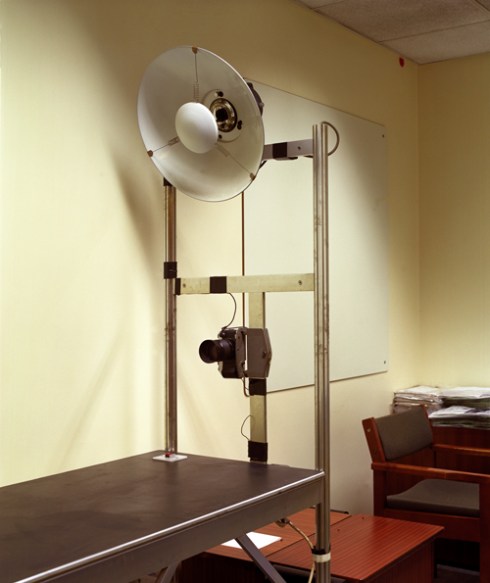
Photography and fingerprinting room.
David Moore has an uncanny knack of gaining access to sites most photographers might think are beyond reach.
In the Summer of 2009, Moore took advantage of a short-window of time during which the cells inside Paddington Green Police Station sat empty. The survey Moore completed – a series entitled 28 Days – was the first foray into this infamous jail. Prison Photography is proud to publish these images for the very first time.
[Keep reading below]

Chair.

Forensic pod.
Paddington Green Police Station is structurally banal. Constructed in the late sixties, its functionalism is belied somewhat by a concrete-lovers facade. For Britons, Paddington Green means one thing: Terrorism. Built into and underneath the station are sixteen cells and a purpose built custody suite; extraordinary hardware for a police station, but not for the interrogation of high-level terror suspects.
In the 1970’s many IRA suspects were incarcerated at Paddington Green prior to appearing in court. At that time, the period of initial detention was up to 48 hours, this could be extended by a maximum of five additional days by the Home Secretary. (Prevention of Terrorism Act, Northern Ireland, 1974). British terror legislation was not renewed until the Millennium.
The Terrorism Act of 2006 increased the limit of pre-charge detention for terrorist suspects to 28-days, hence Moore’s title for the work.
Originally, the Labour Government and Prime Minister Tony Blair, had pushed for a 90-day detention period, but following a rebellion by Labour MPs, it was reduced to 28-days after a vote in the House of Commons.
[Keep reading below]

Control room.

Chair, police interview room.

Holding cell.
In 2005, Lord Carlile (a hero of photographers, as a key person in reversing abused UK police stop-and-search procedures) was appointed independent reviewer for the government’s anti-terrorism legislation. His team visited Paddington Green in May, 2007 and issued a damning report on its inadequacy as a modern facility for the detention of humans for such extended periods.
The facilities […] were designed when the station was built in the late 1960s in order to deal with terrorism suspects from Northern Ireland – a far different threat from that faced from international terrorism today, in terms of scale and complexity. The main deficiencies of Paddington Green are as follows:
* there are only 16 cells. Over 20 people at a time were arrested during individual terrorism investigations in both 2005 and 2006 and some had to be sent to Belgravia police station, which is not set up to deal with terrorism suspects. In addition, the normal day-to-day work of Paddington Green police station, which serves the local neighbourhood, was severely disrupted.
* there are no dedicated facilities for forensic examination of suspects on arrival. Cells have to be to specially prepared for this purpose, which is time consuming and further exacerbates the lack of accommodation.
* there is no dedicated space for exercise. Part of the car park can be cleared to provide a small exercise yard but this takes time to arrange and the car park is overlooked. This is likely to reduce considerably opportunities for exercise.[48]
* only one room is provided for suspects to discuss their cases in confidence with a solicitor.
* there are no facilities on site for the forensic examination of equipment such as computer hard drives.
* the videoconferencing room is too small to accommodate judicial hearings on the extension of the period of detention. Such hearings are usually now held in the entrance lobby, which is itself cramped, is a thoroughfare into the custody suite, and opens into the staff toilets at the back. It is clearly an inappropriate location for such a crucial part of the detention process.
(Source)
And so it was, shortly after the completed £490,000 refurbishment of Paddington Green Police Station, Moore photographed to the smell of fresh paint.
[Keep reading below]

CCTV camera with courtesy screening over toilet, holding cell D

Holding cell D.
28 Days is a continuation of Moore’s preoccupation with sites of state apparatus, but this was not always his interest. During the nineties, Moore worked in New York as a commercial photographer, Upon his return to his Britain, he spent three years piecing together The Velvet Arena (1994), a look at the textures, couture and gestures of high society, openings and schmoozing … canapes and all.
From here Moore, still concerned with the dark weight of the familiar made photographs of the House of Commons. He describes The Commons (2004) as a forensic view. “British people know what the House of Commons looks like,” said Moore via Skype interview. His response was to get close and change the view; he focused on corners, carpets, perched flies, scratches in the wood and banisters.
The Commons was pivotal in Moore’s development. He argues that photography has always been entangled in politics, specifically the British Empire. Following the destruction by fire of the existing Houses of Parliament on 16 October 1834, Barry and Pugin designed the new houses for British law with Gothic-Revivalist importance. They were completed in 1847. Photography’s earliest manifestation came about in 1839 with the daguerreotype.
Law, reason, progress, conquest, taxonomy and technology drove the British Empire through the end of the 19th century. Photography, with its will to objectivity, played its part in stifling cultural relativism; it disciplined both colonialist and colonised. Against this history, The Commons, for Moore, was “born of political frustration.”
“It was important for me to break it down. I am probably most influenced by Malcolm McLaren than anyone else,” says Moore.
[Keep reading below]

Solicitors’ consultation room

Virtual courtroom.
“My volition as a photographer goes back to the want to use it as a democratic tool. Looking at state apparatus and panoptic sites, I see my work as an act of visual democracy. Any small chip I can make.”
In 2008, Moore made quite a large chip. For The Last Things, he negotiated access to the Ministry of Defence’s crisis command centre deep beneath the streets of Whitehall, London. Moore got the pictures no other photographer ever had, or ever will. Read my article for Wired.com about Moore’s experience working in the subterranean complex that – to this day – officially “does not exist.”
The Last Things more than any other portfolio, opened the door for Moore to work at Paddington Green. It was a body of work with which he could show he could be trusted. Besides the Police Station was vacant. “It was relatively low security,” explains Moore.
“Paddington Green was very different to the MoD crisis command center. Paddington Green is imbued with a history and a trajectory of history. I know about [IRA] terrorism and about interview techniques and who’d been held in there over the years.”
For Moore, 28 Days is a contrast of the old and the new. An old building with new fixtures. Old procedures replaced by new codes of conduct. “There were definitely some opinions from older police officers: ‘These are terrorists, what does it matter if a cell is painted or not?’ and there was a mix of young and old police officers. The architecture reflected the changing Metropolitan police,” says Moore.
Moore’s work at Paddington Green is a glimpse of an institution in transition; in a moment and not in use. It could be said the stakes were low for London’s Metropolitan Police; that the risk was minimal. It is likely Paddington Green Police Station will cease to operate as the first stop for terrorist suspects. Plans are afoot for a new purpose-built facility. For the authorities, Moore’s work is transparency, for us it is curiosity sated, and for the photographer it is a small victory for “visual democracy”.
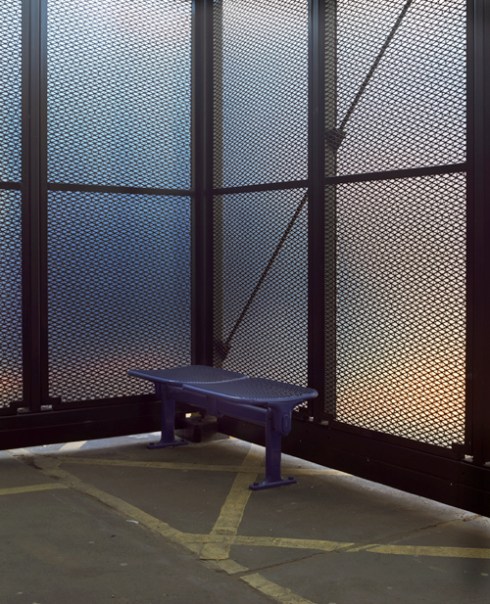
Exercise area.
All Images Courtesy of David Moore
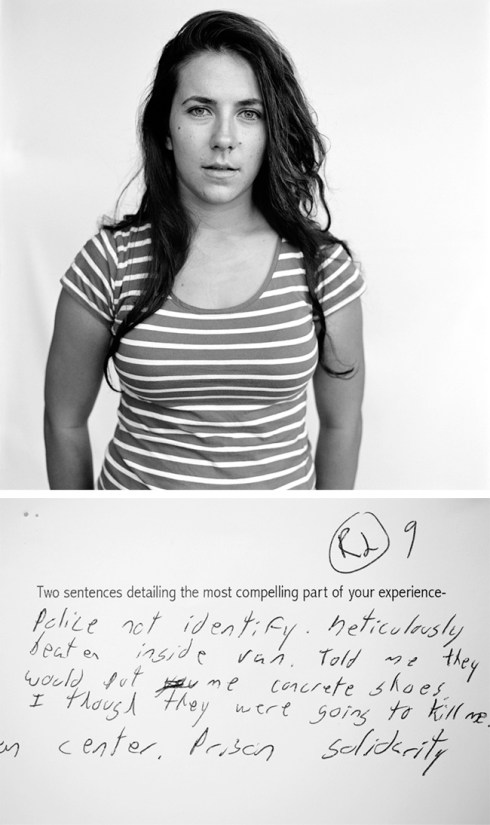
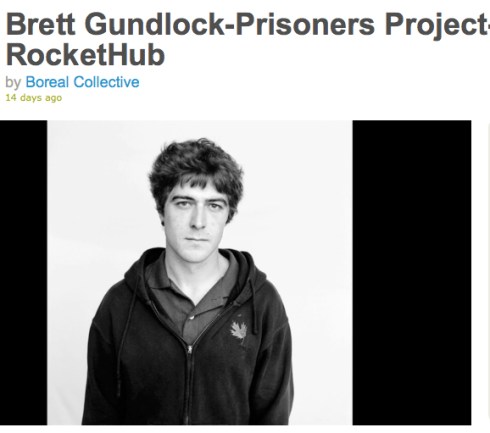
National Post photographer, Brett Gundlock was one of the 304 protestors arrested during the G20 protests in Toronto, last June.
Since last Summer, and dissatisfied generally with the representation of the protests, Gundlock has tracked down many of those also taken into custody. He has asked each of them to provide a (very) short statement on the experience of being processed through protest-policing and city jail.
In March, Gundlock will mount a show for the portraits and accompanying testimonies. For this he has already crowdfunded the $1,500 necessary via RocketHub. You can read more about the project here or you can watch Gundlock’s video intro.
Picturing Victimhood
Gundlock’s portraits are rather austere, which probably fairly reflects the seriousness with which many protestors take to their direct actions. In formal arrangement, they echo the look of two very famous photographers before him.
Marc Garanger, a young French soldier was pressed into a fortnight of taking 2000 identity pictures of Algierian women. Garanger considered himself – as military man and photographer – as an aggressor. His female subjects as victims. Although, as Fred Ritchin describes, when Garanger returned to Algeria decades later he was warmly received by the sitters and their families. And thus squashing the simplistic presumptions of the Western audience.
Richard Avedon’s In The American West was the work of a fascinated, brave yet perverse outsider. Perhaps the most amazing aspect of In The American West was that Avedon – under the guise of fine art – used his camera to adopt an outsider engagement with his subject akin to ethnographic research. In 20th century America, no less.
Whatever we might think of Avedon’s awe and reverence to his cowboys and oil-workers, they are set up as victims by means of their exclusion from the comfortable predictability of majority America.
Photographically, one end of the spectrum (Garanger, Avedon, Gundlock) depicts victims quiet and silent, while the other has them wailing in grief and duress. I’d suggest in this visual environment, Gundlock has made the right decision to ask for written recollections of the moment from his subjects.
Brett Gundlock is part of Boreal Collective.
Found via drool
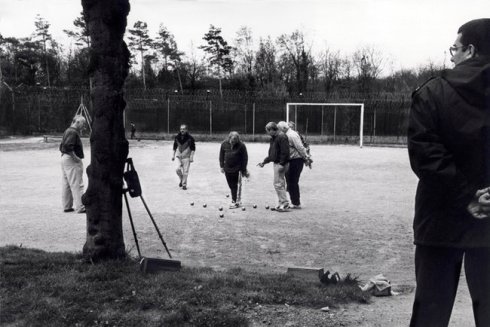
The daily game of pétanque, de Liancourt Detention Centre, France 2001. © Nicole Crémon
Nicole Crémon’s decade-old L’âge en Peine/The Age of Pain peers jejunely at a French prison used to lock-up old men. Even so, I just wanted to share this image. What the photograph lacks in composition it makes up for with its baffling scene.
The most secure game of bowls since yesterday’s game.

 Prison Photography