
You are currently browsing the monthly archive for May 2012.
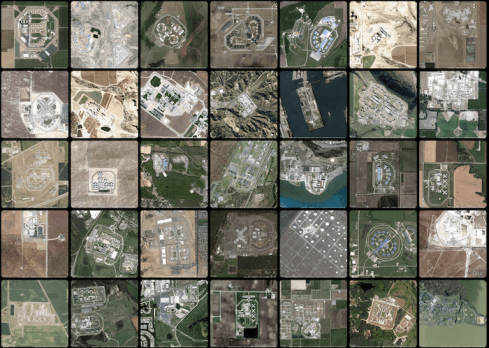
PRISON MAP
Prison Map is the most complete visualisation project of America’s prison system that I’ve come across. No surprise that it takes the form of satellite imagery and no surprise it was made with the aid of computer code.
Prison Map is the work of Josh Begley, an Interactive Telecommunications graduate student at NYU. He developed the project as part of Jer Thorp‘s Data Representation class.
The title is a little misleading. “It’s not a map,” says Begley, “It’s a snapshot of the earth’s surface, taken at various points throughout the United States. It begins from the premise that mapping the contours of the carceral state is important.”
A premise I can agree with. In my meagre attempts to comprehend the size and impact of contemporary prison construction, I’ve compared state-commissioned aerial photography with the fine art photography of David Maisel. I’ve also admired the Incarceration Nation project by non-profit Thousand Kites using roving Google Earth imagery to describe penal architectures (although the manual labour behind Incarceration Nation always seemed to big and ultimately wasteful; an irony not lost for a project commenting on the wasteful prison industrial complex.)
Begley had made cursory use of the CDCr’s own aerial photographs for his earlier Prison Count, but that project is shallow by comparison to Prison Map.
SIGNIFICANCE
Prison Map both orders and exposes the sprawl of prisons in our society; Begley was motivated by the frustration that words and figures often fall short. Again, it is a premise I’m very sympathetic to. What difference does it make if the figure you use to describe an invisible problem has an extra zero or not?
“When discussing the idea of mass incarceration, we often trot out numbers and dates and charts to explain the growth of imprisonment as both a historical phenomenon and a present-day reality,” says Begley. “But what does the geography of incarceration in the US actually look like? What does it mean to have 5,000 or 6,000 people locked up in the same place? What do these carceral spaces look like? How do they transform (or get transformed by) the landscape around them?”
TOOLS
Begley used the Correctional Facility Locator, a project of the Prison Policy Initiative (PPI)*, as his primary tool. The Correctional Facility Locator database includes the hard-to-locate latitude and longitude coordinates of every carceral facility counted in the 2010 US census.
Begley notes that the Correctional Facility Locator is the first and only database to include state and federal prisons alongside local jails, detention centers, and privately-run facilities. 4,916 facilities in total. It is the only such database of which I’m aware.
Using the Google Maps API and the Static Maps service, Begley and Thorp wrote a simple processing sketch that grabbed image tiles at specified latitudes and longitudes, saving each as a JPEG file. The processing sketch cycled through 4,916 facilities.
Some of the captured images were more confusing than instructive – and dealing with nearly five thousand images proved unwieldy – so Begley selected “only” 700 (14%) of the best photos. If you want to see Begley’s entire data set, you can do so here.
USES
The question that this project raises is what can be done with this visualised data to effect change and propel social justice? Artist Paul Rucker used maps created by Rose Heyer (also of PPI) to compose Proliferation. Begley has culled the images; what digital collaging, comparative analysis and collaborations can be constructed with the images?
Perhaps information is more important than images? Toward the end of his TEDxVancouver Talk, Jer Thorp (Begley’s NYU professor) talks about how data represents real life events and their associated emotions. Movements mapped to, fro and between prisons may begin to describe the mass movement within mass incarceration. Specifically dealing with New York State, the Spatial Information Design Lab at Columbia University investigated these types of visualisation with its Million Dollar Blocks project.
An App about the forced migrations within the prison industrial complex is waiting to be built. The first stumbling block is access to data. The prison system is not renowned for being open with its information.
– – – – – – – –
If you’d like to know more, Josh Begley can be contacted at josh.begley[at]nyu.edu
– – – – – – – –
Thanks to Sameer Padania for the tip.
– – – – – – – –
*PPI is one of the most imaginative research groups illuminating the dark recesses of our carceral landscape. PPI Director, Peter Wagner, was a PPOTR interviewee last year offering passion and intelligent analysis of the prison industrial complex. I’ve been aware – and made use – of many PPI resources in the past, but until now was unaware of the Correctional Facility Locator. Kudos to PPI.
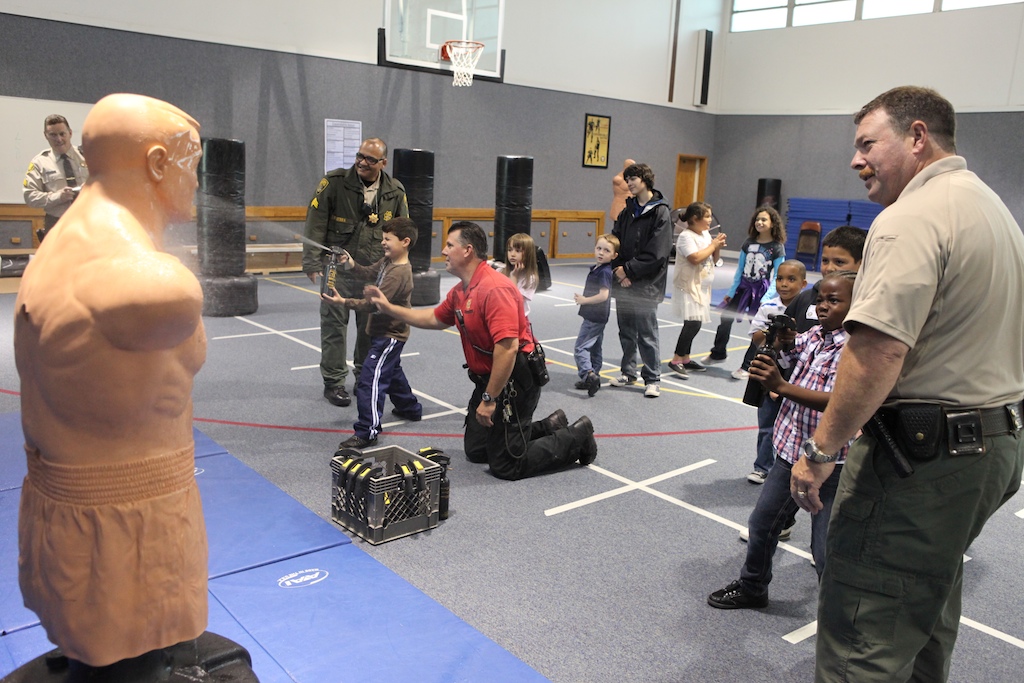
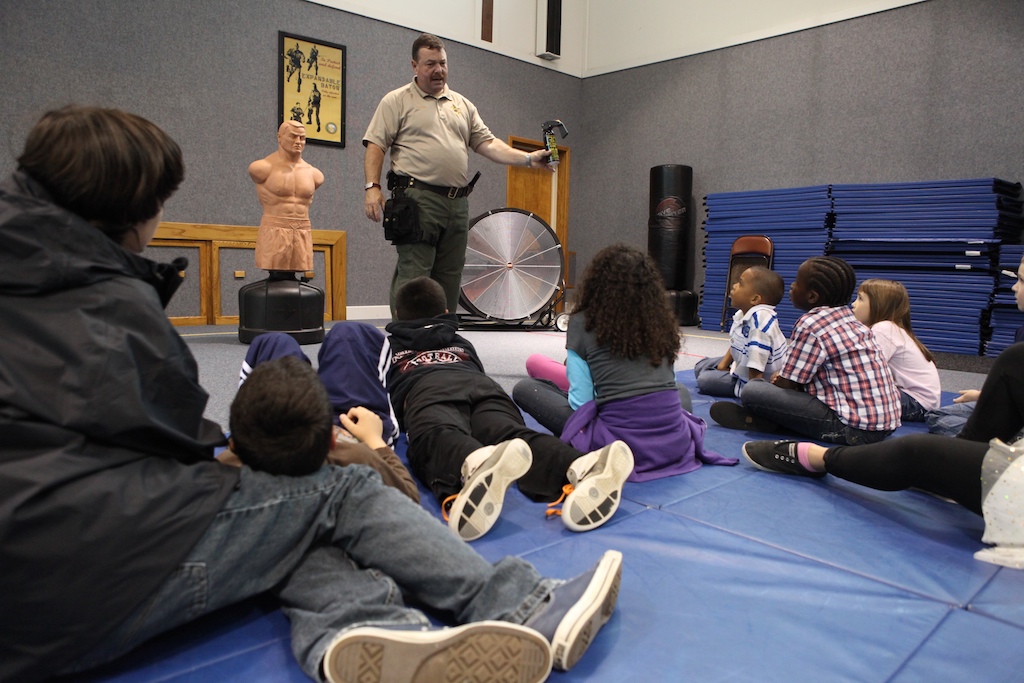
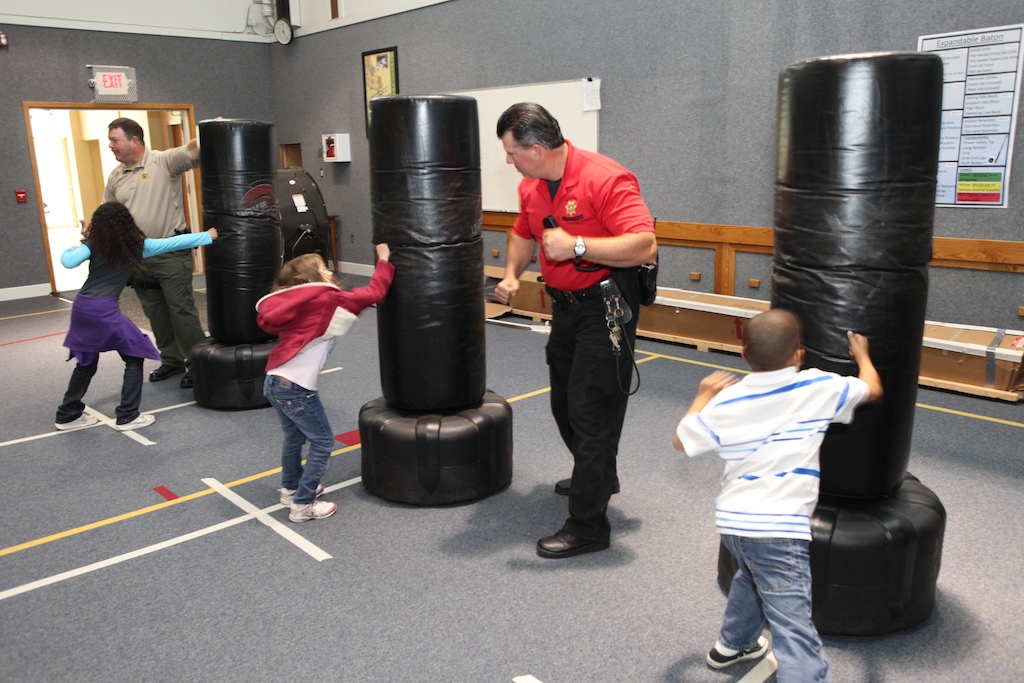
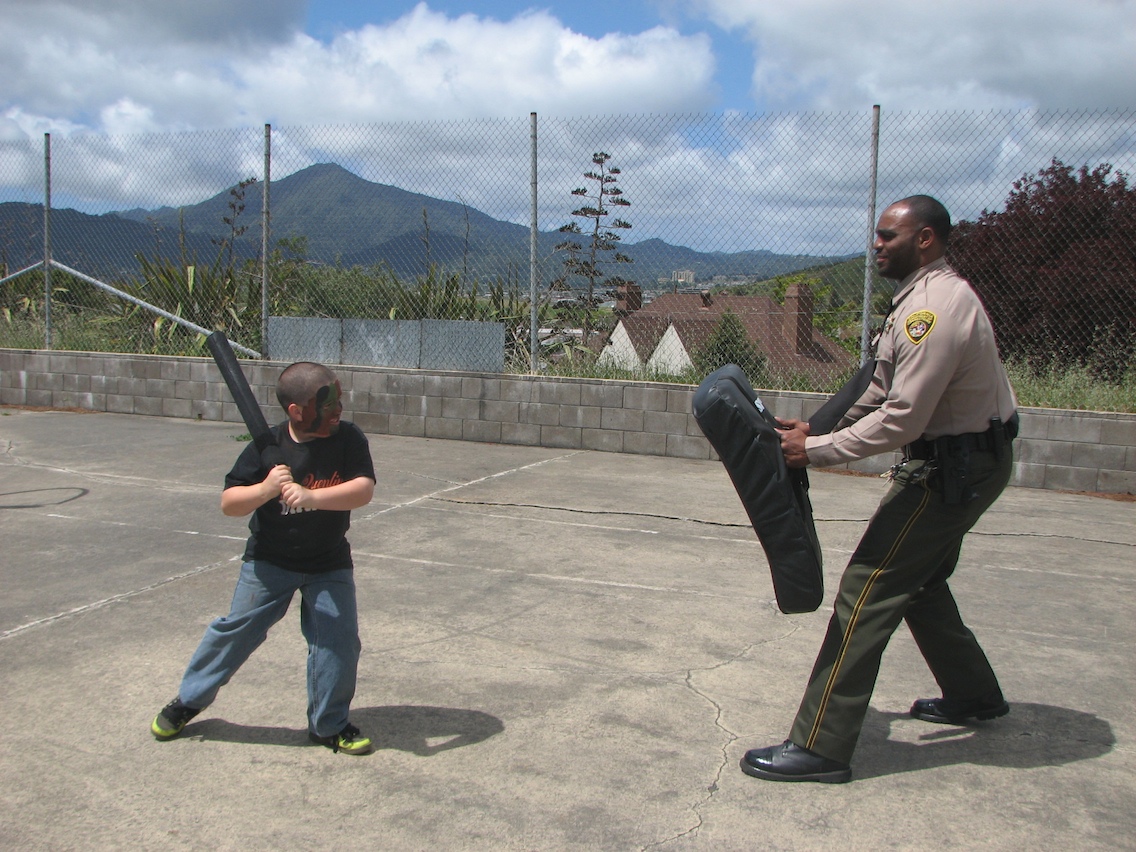
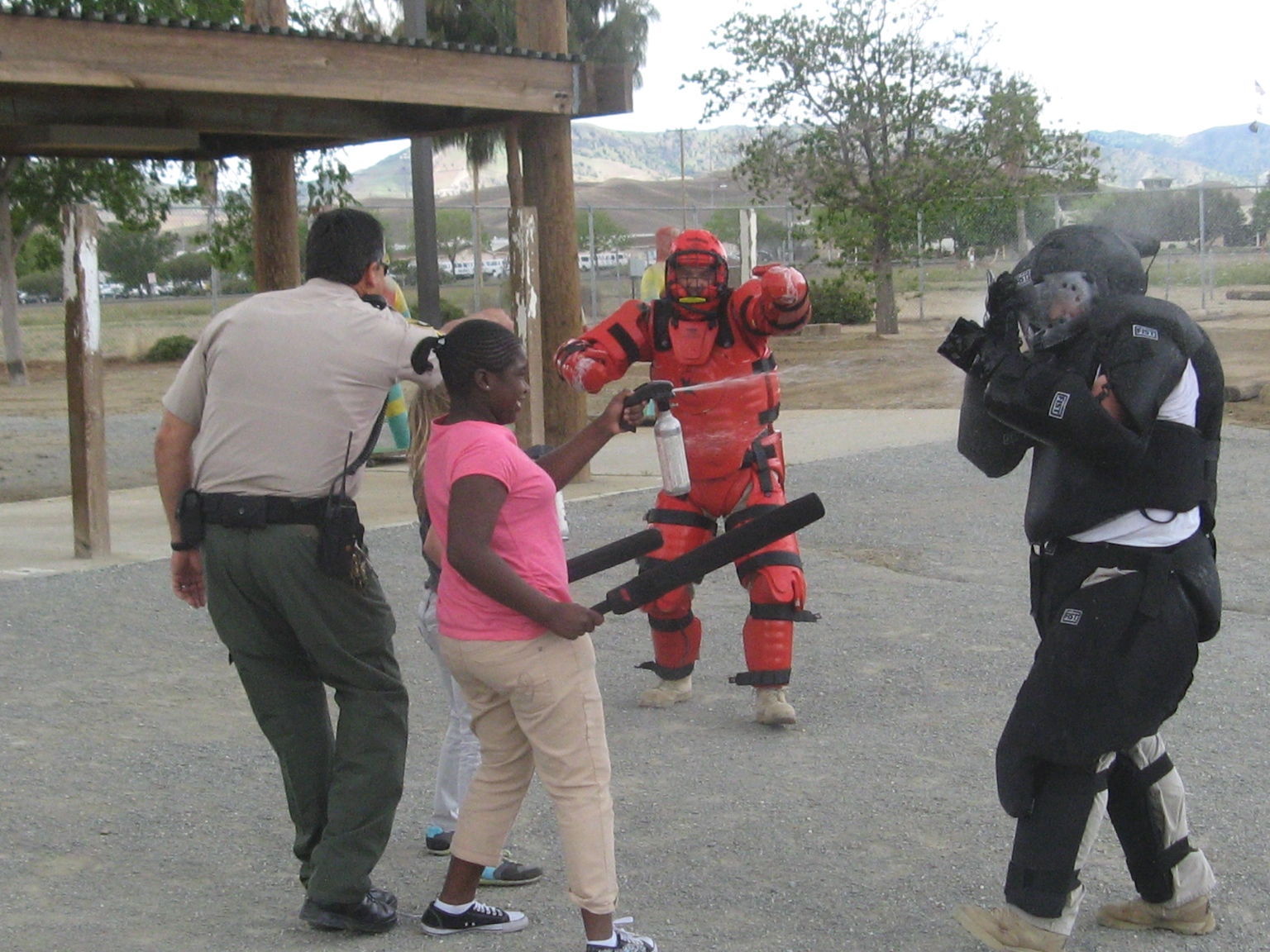
I stumbled across the California Department of Corrections‘ Flickr stream tonight. There are lots of sets to explore including some photo-galleries from various prisons of Bring Your Kids To Work Day.
Click on any image to see it larger.
I have always wondered if the prison system took part in Bring Your Kids To Work Day, and if so, how? Thanks to these clumsy attempts at community PR (clumsiness quite typical of large state agencies, I would say) we now know.
Children practicing fire abatement at California Correctional Centre; learning CPR at California Institute for Women; doing first aid at North Kern State Prison; riding the bus at Deuel Vocational Institute; and dressing up with the SERT team at Folsom.
Most of the photographs I have featured are from the Correctional Training Center, Galt, CA. Here’s head count – Hands Up Kids!
Third from bottom is a single image from San Quentin Prison’s Bring Your Kids To Work Day, and the final two images are from Avenal State Prison.
I’m a little speechless. You?






All images: Courtesy of the California Department of Corrections
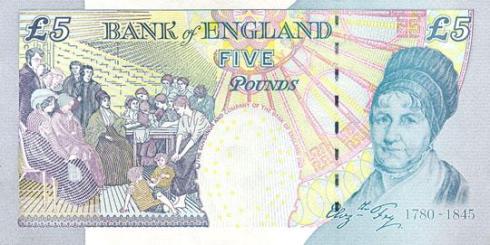
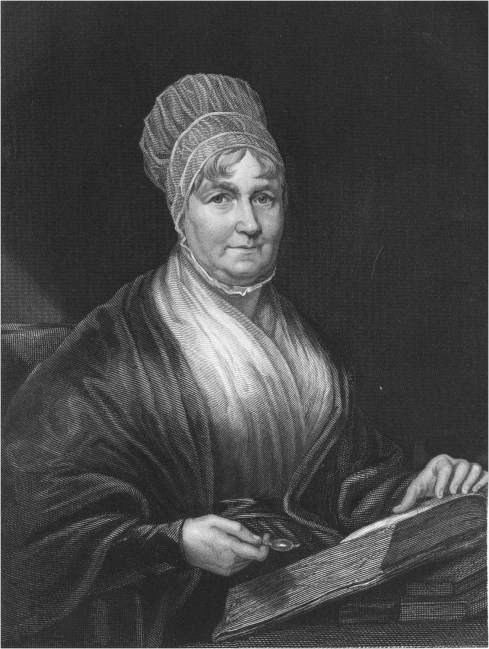
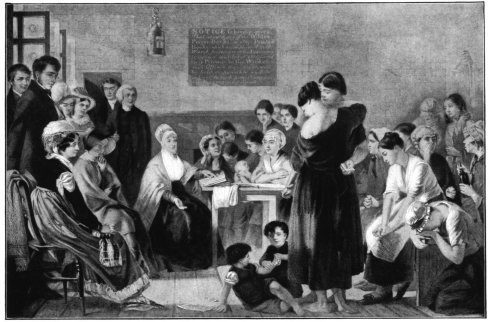
Elizabeth Fry was born this day 1780. If you live in the UK, she’s a familiar face. If not, you should make her soon a familiar face; she’s an example to all socially-engaged folk.
Fry is on the five pound note. She’s the Abe Lincoln of Britain (?!)
Fry knew about compassion before it was even in vogue. If she was kicking it today, she’d kick Jolie into touch. A one-woman hurricane of compassion; the “angel of prisons”; proper girl power; the matriarch, take a bow, Elizabeth Fry.



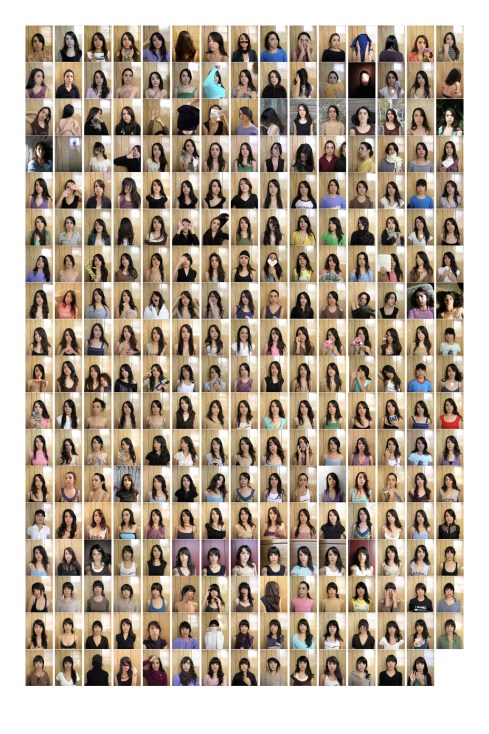
© Amy Elkins 269 self-portraits, part of Beyond This Place: 269 Intervals
Last week, I reviewed Photographs Not Taken (ed. Will Steacy, published by Daylight) for Wired.com. It is a book I have enjoyed thoroughly, which may seem a bit perverse as the majority of the tales seem to be about literal death and sullen loss. The other essays are all essentially about metaphorical death – death of an idea; the abandonment of an ideal; fractured and sudden awareness of mortality; or a shattering of photographer-bravado.
Bryan Formhals, many months ago, hollered for more writing by photographers. PNT would be the most recent, stand-out collection of essays to support that call.
PNT features two essays about prison.
Stefan Ruiz talks about his frustration with the limitations on camera during a seven-year stint teaching art at San Quentin State Prison.
“Most of the time […] I was a photographer in a visually amazing place with all these great subjects, and I couldn’t take a picture,” writes Ruiz.
Amy Elkins recounts a visit she and her brother made to see her dad in federal prison in 2005. She ends up describing a thousand or more photographs she didn’t take.
Call it compulsion, call it therapy, her response during the final 9 months of her dad’s imprisonment was to turn the camera on herself. Amy began making self-portraits began in 2006. Her self-portrait series, Beyond This Place: 269 Intervals became a mini internet sensation in 2007, by which time her dad was out but Amy was not out of the habit. Her self-portraits continue in Half Way There and Everybody Knows This is Nowhere.
“All three projects overlap with my father’s story,” says Amy “Half Way There continues as he lived in a re-entry house for 365 days under strict supervision. Everybody Knows This is Nowhere becomes more about re-entering the world and starting over. All in all I’ve shot over 6 years of these portraits.” Amy still photographs herself daily.
You can view the legacy blog posts here and Amy speaks about the relationship between her self-portraiture and family-life briefly toward the end of this conversation with Joerg.
AMY ELKINS’ PHOTOGRAPHS NOT TAKEN
We had been talking here and there. Once a week. Fourteen and a half minutes before hurried goodbyes were exchanged with uncertainty. It was our allotted time to share what we were experiencing. My new chapter in New York. His, in a federal prison, three thousand miles away. My father’s stories were endless. His seventy bunk-mates. Spanish ricocheting off of the concrete walls until it became static, white noise, a flock of birds. The mess hall. The books that had their covers torn off. The Hawaiian friend he made who sang like an angel. The night he woke to flashlights banging along the metal bunks, looking for inmates with blood on their clothes.
The teams that were formed. The chess matches and basketball games. Prison Break on the television in the rec room. The pauses in his voice. We had shared just under fifteen minutes a week for months from across the country. I mostly listened, the imagery leaping to mind, as his words came through the line. These were the things I wanted to make photographs of. By the time I actually had my one and only visit with him while he was in prison, my imagination had grown wild and I was so emotionally charged that I had to place my hands together in order to keep them from shaking, and to hide the amount of cold sweat pooling in them. There were metal detectors, x-ray machines, electronic drug tests, and questionnaires before my brother and I were led into locked waiting rooms, before we were led into a barbed wire walkway, before we were led to the visitors’ area. No cameras, cell phones, keys, wallets, jewelry, hats, purses, food, or gifts were allowed. Just myself, my brother, my father, and a small square yard of short brown grass containing picnic tables, a walkway, and vending machines, wrapped in barbed wire fences, two rows deep. My father, looking aged by stress, wore a tan uniform that seemed to fall all around him like robes. His hair had grown somewhat wild and was whiter than I remembered it. His eyes were youthful and tired.
The photograph was in my head. The moment of panic, of not knowing what to talk about or how to catch up in reality, while families reeled all around us with children and their mothers or grandparents. The vending machine coffees and board games. I longed for this moment to stay preserved, as if it would become more real if I could hold it captive on film.
Or that my story would be more intriguing if I could prove what it looked like. The photograph not taken, a portrait of what we had become, the fear that my family had failed me, the confrontation of unconditional love, a portrait of uncertainty. Instead, I sat with my hands tucked against the worn-out wood of the picnic tables, watching and listening to the sounds of what we were able to be for a moment.
THE SELF
The story runs deep. But how about the images? There’s a touch of naivety in Amy’s self portraits, but no more than any other young artists sussing his or her emotions. The portraits are paired with quotes by her father delivered in those weekly 15 minute calls, a text/image play that adds some depth.
Whatever life these photos have had or will have, I’d like to think they’re ultimately for future generations of her family; mementos of the quirky granny who grew up in the first quarter of the 21st century; the favourite aunt with certainty of narrative but evidence of younger faltering.
After all, we might be miffed if we missed that shot of those things over there, time and time again, but we have no excuse for not recording ourselves. We might hit old age and regret not having the photos to match our memories.
Short-sighted folk may criticise 269 Intervals for its seeming indulgence or vague manipulation; it is strange that images to represent a family temporarily smashed apart by the efficiency of the law are of a pretty las (occasionally in a state of undress) but take a long sighted view and admit you are intrigued by photo-a-day projects. Who hasn’t thought about doing one themselves? … If only you I had the discipline. Between Kessels, Karl Baden, Hugh Crawford, Noah Kalina and Homer Simpson, Amy is in good company.

Amy Elkins was born in Venice Beach, CA, and received her BFA in Photography from the School of Visual Arts in New York City. Her work has been exhibited nationally and internationally, including Kunsthalle Wien in Vienna, Austria; the Carnegie Art Museum in California; and the Minneapolis Institute of Arts in Minnesota. Elkins is represented by Yancey Richardson Gallery in New York, where she recently had her second solo exhibition.

The Global Post has just launched ENCARCELACION an investigative series about the correctional systems of Latin America that “have gone horribly wrong.”
We’ve seen the headlines of jailbreaks in Mexico, riots in Venezuelan prisons, and fires in Honduran jails, but often these stories seems a world away. The politics underpinning the strife in Latin American prisons is not my area of expertise but the importance of the stories is undeniable. It is interesting that the Global Post has used photography as an anchor to the front page.
After digging down into ENCARCELACION‘s trove of info, you may want to follow links to Prison Photography‘s irregular coverage of various aspects of life in Latin American prisons:
Gary Knight – Joao Pina – Jackie Dewe Matthews – Valerio Bispuri – Pedro Lobo – Vance Jacobs and Columbian prisoners – tourist photography in Bolivian prisons – prison tattoos (some from Central America) – Kate Orlinksky’s portraits of Mexican female prisoners – Fabio Cuttica at a Columbian prison beauty pageant – Patricia Aridjis in Mexico – even Cornell Capa was in Latin American prisons at one time.
– – – – –
Thanks to Theo Stroomer for the heads up.

This afternoon, I’ll be speaking to photography students at Evergreen State College, Olympia, WA. Instructor, Steve Davis has asked me to discuss PPOTR, regale some stories, recount my interviews.
Without doubt, Lloyd Degrane‘s story was one of the most remarkable. I have yet to edit the audio of Lloyd’s interview, but I did transcribe part of our conversation so it could be included in the Cruel & Unusual/PPOTR Newspaper. I’d like to share the text (below).
When Lloyd and I met in Chicago, he was preparing for Prison, the first ever exhibition of his prison photographs. It was at Gage Gallery (which coincidentally just showed Lori Waselchuk – another PPOTR interviewee). Gage put together an audio slideshow, which I also wanted to share (bottom).
THE BACKSTORY
Lloyd is a gentle, unassuming, older gent. He worked diligently for an entire decade (1990-2000) within three Illinois prisons – the Joliet Receiving Center, the Stateville Maximum Security Prison and Cook County Jail (the largest walled facility in the world with approximately 11,000 inmates). Degrane did this without any fuss or anything approximating self-promotion.
Before the authorities allowed him in with his camera, the Department of Corrections sent Degrane on a 600-mile round-trip to Menard Prison, a maximum-security prison in Southern Illinois. At Menard, Degrane was to just have a tour of the facilities. The warden instructed him not to take in his camera, and said that they he discuss with Degrane the proposed photography project after Degrane has taken the tour.
Due to an extraordinary experience during his prison visit, Degrane never met the warden. The extraordinary experience did, however, give Degrane a bargaining chip with which to win access to the Illinois prison system.
LLOYD’S FIRST DAY IN PRISON
I was led around Menard Prison by a guard that was just about to retire. You don’t get comfortable for some time. On the yard, you’re walking around brushing shoulders with murderers and rapists. I’d never been around people who had committed heinous crimes.
We walked into a big cell house holding several hundred inmates. As we got to the centre of the cell house a race riot broke out around us. I later found out is was African American inmates who wanted to retaliate against a white biker gang for killing one of their own several weeks before, and we were right in the middle of that retaliation. I remember yelling and threats being directed at the guard I was with. I was wearing a white shirt at the time and prisoners stopped and looked at me as if to ask, “What is this guy doing here?” I ran with the guard through a gauntlet of muscular black inmates. We made it to a cell and inside the cell was one of the oldest inmates I’d ever seen – over seventy years of age. And the guard just pushed me inside the cell. And the race riot went into high gear then. The first thing I saw was a white biker gang member being beaten by four or five black prisoners and the beating got closer and closer to the cell I was in. One of the black prisoners picked up the white biker and threw him against the bars. His head split open and he fell right at my feet. That was my initiation into maximum-security prison. I thought he was dead.
I heard over the loudspeaker system “CIVILIAN INSIDE” and I looked at the guard who was in the cell with me and he pointed at me and he said, “That’s you”. About five minutes later I heard the state police come into the cellblock with kind of this chant from the wizard of Oz. It was a chant to get everyone psyched up and strike fear into the heart of the rioting prisoners. They marched in with clubs and they were there to rescue me. They made a pathway through this insanity and extracted me from the cellblock along with the officer. They got me out of the cellblock back to the warden’s office where I picked up my camera and they just kind of pushed me out the back door.
I went to the nearest tavern and had a couple of shots of whisky. The adrenaline was just incredible, to the point where I couldn’t sit down. I’d nearly lost my life and I’d never had an experience like that before.
Later that day, I contacted the communications officer for the Illinois Department of Corrections. He knew what had happened. He said, “If you don’t talk to the media about what happened today then we’ll send you into Stateville Prison,” And so I didn’t say anything. Two weeks later I got notice from the warden at Stateville that it was okay to come in and start the project.

International Commission Tent, St. Paul’s Camp. © Ben Roberts
Ben Roberts‘ Occupied Spaces catalogues some of the communal and private spaces that were installed in the St. Paul’s and Finsbury Square camps. The traces of activity and inhabitance serve as a clear document of the utilisation of a limited space by a large number of permanent and temporary residents.
My colleague at Wired.com Jakob Schiller wrote about Occupied Spaces in November with his piece Pianos, Kitchens and Offices: Inside London’s Occupy Tents. It’s good to see this work progress into a book format.
Roberts says:
“On 15 October 2011, protestors representing the global Occupy movement set up a semi-permanent camp outside St. Paul’s Cathedral in central London. The aim of the protest was to encourage discourse and raise awareness of social and economic inequalities.”
“On 25 October, several UK newspapers and media outlets ran stories claiming that ‘thermal imaging’ proved that only 10% of the 250 tents in St. Paul’s Square were being inhabited overnight. I was immediately skeptical of these claims.”
Ben Roberts Occupied Spaces
210 x 288mm, 28pp 24 colour photographs Text by Naomi Colvin Digital indigo + riso print on uncoated recycled paper Elastic cord loose leaf document binding Bagged in clear self-seal polypropylene.
First edition.
You can buy the book HERE!
For further information contact: Harry Hardie harry@hereontheweb.co.uk +44 (0) 7813 431345
Last week, for her photos of representations of death row prisoners’ last meals, Helen Grace Ventura Thompson won a Sony Photography Award in the Still Life category.
Last year, I listed a swathe of projects that photographed similar representations.
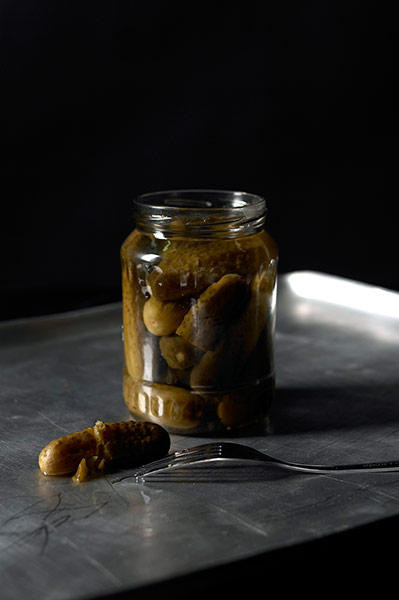
© Helen Grace Ventura Thompson
Despite these numerous projects, execution is still an invisible act. Perhaps rightly so – it is very gory. But it is gory paid for by tax dollars. The many projects focusing on last meals are reflex actions to this invisibility.
Sometimes the most interesting discussions can arise from the most left-field of questions. In that spirit: We can learn the last words of the executed, but what if we saw a last photo?
A Guardian gallery explains Thompson’s work, “The idea behind the project was to juxtapose the morbid context surrounding the meal with the relative mundanity of the food itself.”
The dissonance between morbid and mundane may jolt people. I hope that a jolt may kickstart conversations, because without a debate to follow then Thompson’s images and those like them are little more than studio experiments.
Food unites us all so we should be compelled by these images, one would think. What would you choose to eat before being fried or poisoned? Yet, for me, food photography is so ubiquitous it’s boring – I’m as uninterested by commercial gigs with painted food-props as I am by Instagram shots of my friend’s friend’s appetizer.
I also feel a little uncomfortable with the reverence laid over the photos of last meals, especially in light of the ultimate act of violence unleashed shortly after that last bite. Prisoners I have spoken to always talk about the inescapable noise of prisons. Photography is a quiet medium and these photographs are quieter than most.
I accept that Thompson’s job wasn’t to meet my unorthodox wandering thoughts, but I feel short-changed by her images. I wonder who makes the meals that Thompson references? And where do they get eaten? We’ve seen photographs of electrocution and gas chambers; bullet-ridden firing squad chairs; video tours of death houses; portraits of condemned men; and a photograph of a stainless steel table at which a last meal is eaten, but never see a photo of someone actually chowing down their last meal. Does anyone sit down with them?
Thompson’s style mimics fine art painted still lives and as such the reality, the noise, and the act of eating (or in some cases, a prisoner’s choice not to eat) are lost. Time is lost. Scott Langley has done the best job of reinserting time into a body of images documenting the most final of events.
Would a photographer following the acts (and meal) of a condemned man or woman be as distasteful as people witnessing his or her death from behind mirrored glass? If so, what’s the alternatives? Could we imagine allowing a condemned man or woman – with a disposable camera – to document his or her own murder, should they choose to? We see images of, and by, dead people all the time. The environment for executions is so controlled and sanitised they’d be quite boring pictures … until the subject turned the camera on him or herself. That’d be dripping with emotion; that shot would have a time stamp. That type of shot falls the other end of the scale to Thompson’s distantly crafted images.
Think about it. The media formula for executions is to report the last meal, the last words, the last breath and the last body spasms. Wouldn’t you be far more interested in seeing the last image? An image made by a person who knew they were about to die? Isn’t that the shot that no one else could ever get?

 Prison Photography