
You are currently browsing petebrook’s articles.

© David Shrigley
__________________________________________________________
AUTHOR’S NOTE: THIS POST FOLLOWS A COUPLE OF OTHERS ON (PHOTO)BLOGGING, HERE AND HERE.
__________________________________________________________
The 2011 Orwell Prize, the British awards for political writing, has just announced its longlists. The awards are into their 18th year, yet blogging was only recognised as a form of political writing in 2009. Here’s the blog longlist.
Upon the news, Charlie Beckett at POLIS chose to reflect on the health of blogging.
On one hand Beckett says that some good bloggers have bowed out (presumably not replaced instantly by new bloggers, quality-wise) but on the other acknowledges the slew of very good, very relevant and very free blogged opinion and commentary. He also applauds former mainstream media (MSM) journalists using the blog format as one tool in their kit. Overall, he thinks blogging is still in transition and “much of it below par.”
While I agree with most of Beckett’s points, I don’t agree with his conclusion. I think he is bored by the increased specialisation of blogs:
Everyone’s at it. The market’s gone way down the long tail with very specialist blogs … where people are addressing a very niche audience (though I wouldn’t be surprised if some of those narrow subject niches are rather capacious in terms of readers).
When Beckett refers to the market, I take it he is talking of activity and development of ideas, not solely about money exchange.
If Beckett is right about blog proliferation (I think he is) then we can conclude two things. Firstly, that readerships are getting cosier with their blogs of choice and selecting from an overall wider choice. Secondly, bloggers are splintering into niche next to niche to good effect; one’s subject matter does not dilute the others, but complements it.
The upshot? Bloggers and blog-readers have increased in relevance to one another.
Beckett sees this preponderance from the other side too. The mind-share (of readers) has been, and continues to be, a premium commodity for writers. For eyes-on-screens, bloggers are not only competing against MSM but against each other too.
Original content will secure those eyes.
TOO MUCH OPINION?
Beckett weighs the reporting of new facts against the “surplus supply” of opinion.
There is a so much professional and personal comment around on MSM (Comment Is Free) as well as independent forums like Mumsnet or Facebook that opinion is now so cheap (free) that it’s has lost its value in the market place of public debate. New ideas and new facts suddenly have more currency than views.
Readers don’t mind if content – containing new ideas and new facts – is written by a journalist or blogger, professional or amateur, as long as it is proven reliable and informed.
So now it seems the expectation of a blog is to be not only specialised (niche) but also to carry exclusive material (unique). That is a tall order, yet the long and engorged tail may suggest it is already being done.
Certainly, blogs need to do more than merely point.
Finally, Beckett says that here in America, we might still be hung up on a difference between bloggers and journalists. I wasn’t aware.
In the States I am amazed that there is a still a debate about bloggers v journalists. In the UK we appear to have moved on from that rather sterile argument, although our blogosphere does not have the power of the American versions.
Beckett calls the argument sterile because it is clear that if blog content is bogus, people won’t read. Conversely, if content is good and the copy is lyrical then readership follows, no matter who you are. (This logic may apply more to the act of reading more than, say, watching cable news where nonsense seems to dominate.)
“UNICHE”
You heard it here first folks. Uniche, meaning the required combination of niche subject matter and unique content, might be the tricky combination required by bloggers to survive remain relevant in the future. It’s not merely good enough to have your own area, you have to deal with its issues with fresh information and shower it over readers in timely, tasty morsels.
Whadd’ya reckon? Uniche? Does the wordplay work?
Uniche. Also the feminine plural of unico:
Adjective: unico m. (f. unica, m plural unici, f plural uniche)
1. only, sole, one, single
2. unique, unparalleled, unequalled
ONE MORE THING: BEN’S PRISON BLOG
Incidentally, one of the longlisted blogs for the 2011 Orwell Blog Prize is Ben’s Prison Blog. “The only blog by a serving British prisoner,” as claimed by author Ben Gunn, looks “stupidity and ignorance in the eye whilst attempting to inject some neurons into the criminological debate.”
I wrote about Gunn’s position as a pioneer incarcerated blogger a couple of years ago when one of his letters containing content deemed by the prison governor as “interesting enough to be published on the internet” was intercepted and not delivered. (More here)
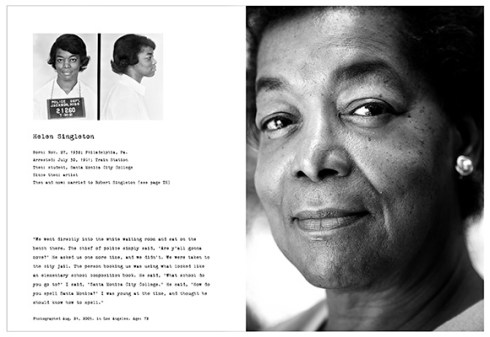
Born: November 27, 1932; Philadelphia; Arrested July 30, 1961; Train station, Jackson; Then: Student, Santa Monica City College; Since then: Arts administrator, now retired; Then and Now: Marrried to Robert Singleton; Photographed: August 24, 2005; Los Angeles. © Eric Etheridge
I’ve been meaning to write about Eric Etheridge’s project Breach of Peace for too long. This year marks the 50th anniversary of the Freedom Riders and their key 1961 victory for civil rights.
Today, the anniversary of Dr. Martin Luther Kings 1968 assassination, is an appropriate moment.
Firstly, a brief history of the Freedom Riders, as told by Etheridge:
In the spring and summer of 1961, several hundred Americans — blacks and whites, men and women — entered Southern bus and train stations to challenge the segregated waiting rooms, lunch counters and bathrooms. The Supreme Court had ruled that such segregation was illegal, and the Riders were trying to force the federal government to enforce that decision.
Though there were Freedom Rides across the South, Jackson soon became the campaign’s primary focus. More than 300 Riders were arrested there and quickly convicted of breach of peace — a law many Southern states and cities had put on the books for just such an occasion. The Riders then compounded their protest by refusing bail. “Flll the jails!” was their cry, and they soon did. Mississippi responded by transferring them to Parchman, the state’s infamous Delta prison farm, for the remainder of their time behind bars, usually about six weeks.
A few days after the last group of Riders were arrested in Jackson, on September 13, the Interstate Commerce Commission issued new regulations, mandating an end to segregation in all bus and train stations.
Etheridge’s book Breach of Peace: Portraits of the 1961 Mississippi Freedom Riders features his new portraits of 80 Riders and the mug shots of all 328 Riders arrested in Jackson that year, along with excerpts of interviews with the featured Riders. (See the Breach of Peace archives here)
The Mississippi Museum of Art is showing the mugshots of all 329 Riders arrested in Jackson as a giant, 54′ long mural, along with 20 of Etheridge’s portraits (March 19 – June 12). Free to the public.

Breach of Peace: Portraits of the 1961 Freedom Riders installation, Mississippi Museum of Art, March 2011
Etheridge’s work is a continuing multi-year effort. Through interviews and his camera, Etheridge gives his subject the opportunity to return to their political heroics. For those alive in the sixties, Etheridge’s work is an antidote to historical amnesia and for those who weren’t it’s an education.
KING’S GIFT TO HISTORY; A POLITICAL PHILOSOSPHY NOT TO BE FORGOTTEN, ALWAYS TO BE ACTED UPON
And so to King, whose politics are as relevant today as they were 43 years ago. As Jim Johnson reminds us, at the time of his assassination, King was in Memphis in solidarity with sanitation workers, who were striking the city not just for decent pay and working conditions but for recognition of their right to form a union. In light of the concerted, ongoing campaign by Republicans to subvert unions, it surely is plausible to wonder how far we remain from the promised land.
History is very important. Despite their self-label, progressives look back in time as readily as conservatives to pinpoint historical moments to justify their politics. Progressives look to the golden era of people power and the Peace Movement, conservatives hark back to the space-race and Reaganomics.
When history is at our backs, we must choose to leave it behind or let it propel us forward. In the case of the Civil Rights movement, its lessons should be forever in America’s conscience. The work toward social and economic equality is not yet complete, not by a long distance.
We have choices to make and a society to shape.
Which brings me to this potent image of the back of James Earl Ray, who was Dr. Martin Luther King’s assassin.
While hundreds of thousands were marching on the streets and millions across America swelled the turning political tides, James Earl Ray choose a different worldview.
Regardless of colour or creed, Martin Luther King’s promised land was for all … and for a better America. No doubt James Earl Ray was a troubled man but his rejection of America’s sea-change thrust him only in the direction of a dead-end.
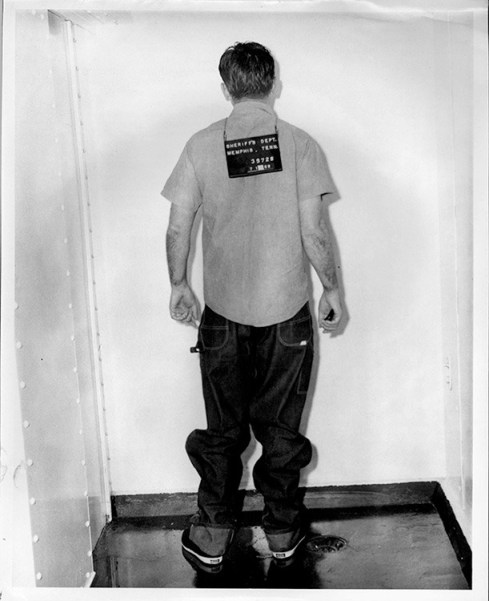
James Earl Ray facing the wall at Shelby County Jail. Photo by Gil Michael/Shelby County Sheriff’s Office
As Etheridge explains this is not an act of defiance. Shoved into a Shelby County Jail cell, Ray faces the reality upon him; the physical finality of confinement with nowhere to go. As he abandoned history, so history moved on without him.
TO END ON A GOOD NOTE
REMEMBER.
INSPIRATION, LOVE AND GOOD HEARTS ARE NOT FORGOTTEN BY HISTORY

Bob Gumpert‘s Locked and Found portraits are on show at HOST Gallery for the next month (April 7th – May 7th).
On the 13th April, there’s a panel discussion on three different projects made in, around and about jails and prisons, with Bob, Edmund Clark and Guardian writer Erwin James.
HOST’s blurb:
Robert Gumpert has been documenting the criminal justice system in San Francisco since 1994. We are delighted to bring his matchless archive of convicts, cops and courthouses to HOST gallery, where it will be exhibited for the first time in the UK.
Gumpert’s project began with an idea to photograph a homicide detective, but quickly expanded to cover numerous other aspects of the criminal justice system. After he exhibited the work in San Francisco in 2000, he thought that was the end of it, until he received a call from the sheriff’s office. California’s oldest jail was about to close, and for Gumpert, whose photographic roots were planted in the social activism of the 70s, this was a piece of history he felt compelled to document.
“‘Old Bruno’ was built in 1934 as an example of progressive incarceration, but it had become a toxic dump of a place where deputies and prisoners where expelled. Over the years the courts had ordered its closure and finally in August of 2006 everyone moved to the adjacent new Bruno. I documented the old jail, its closing and the opening of the new one,” says Gumpert, who then sought and received permission to continue his photographic quest across six county jails.
As his work progressed, so too did his attitude towards his subjects, the majority of whom were incarcerated men (he also photographed police officers and prison guards). From an ‘us and them’ relationship, his modus operandi evolved to one of participation, as Gumpert conducted audio interviews with everyone he photographed, in a kind of reciprocal exchange: a picture for a story.
Robert Gumpert has been working as a photographer since 1974, when he documented the coal miners’ strike in Harlan County, Kentucky. Since then he has worked on a series of long-term projects, including studies of the US criminal justice system and emergency health care in the United States.
For more information contact Anna Pfab on anna [at] foto8.com or 020 7253 2770.
HOST Gallery, 1-5 Honduras Street, EC1Y 0TH, London,UK
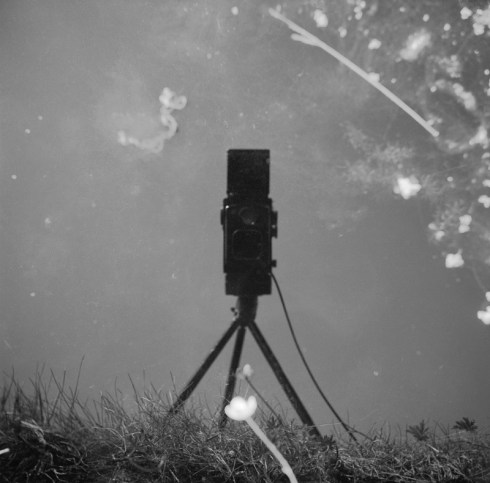
Self Portrait of the Artist as a Weeping Narcissus (free after Olaf Nicolai) © Norman Beierle, 2010.
A vicious ostrich, wedding mania in India, Nagatani’s Chromatherapy, scanner-hacked “pittance-cameras” and the scoop on the hottest new starlet of war photography; it’s fair to say that Norman and Hester are presently on top form.
Their generous sharing of finds along “the wondrous lanes and stray paths in the territory that comes with photography” often leave me gazumped and thinking afresh. Everyone knows I love Mrs. Deane, so it was great to read their take on what (photo) blogs do and where they might go if we choose to decide.
I hope you (and they) will tolerate such a large quote. It’s solid gold.
Blog posts are left as markers for the flock, to indicate where interesting fodder my be cached, where new projects can start, where questions can be engendered or where the ground becomes unstable. Each blog post can be viewed as a flag on the map, a point of interest for the visual tourist, for the data miner, for the visual entrepreneur, for the honey seeker. It can offer valuable information, or it can be a dead end, a tromp de l’oeil. At least it is an invitation to spend your time, however brief, with the text, the links, the visuals.
Aren’t we in a sense like hookers along the digital highway, pointing our fingers down in a come hither motion? I take it that in blog-land, regular visitors do their rounds, like we used to do our rounds on the flea markets, the used book fairs, the yard sales, the photographic equipment fairs in run down community centers. Now most of that now takes place on the eBays, Craigslists and Etsys of this world, and these companies profit from it, as do all parties, but the companies most of all by providing the commodity, the platform, the pipeline. Similar highways start to evolve for the photo world, does that mean we can soon expect the first blog equivalent of the chain stores?
More thoughts start to surface, do we want our blogosphere to become a market place? Do we commercialize or not, or maybe just a little bit? Or where will we find the means to support our idealistic and wilfully naive notion of a free exchange between equals? Of course, when given the choice, I prefer the vita contemplativa, but I am forced to survive in the vita activa, where there is no such thing as free love, and where everything either has a price or is considered worthless. If I would want to change that, I should be willing to fight for that, but am I, are we? (Photo) Blogging is seen by many as a fun thing that we do in our free time, not as a serious activity, or even as what it is also, a political act.
Not to promote arrogance, but maybe the hard core content blogger ought to be more self conscious about the role he/she could play. Sometimes — and curiously enough many of these sometimes occur when I visit places like Al Jazeera — , I feel as if we simply have been pussy footing for too long. What are we waiting for? Let’s go and make things happen!
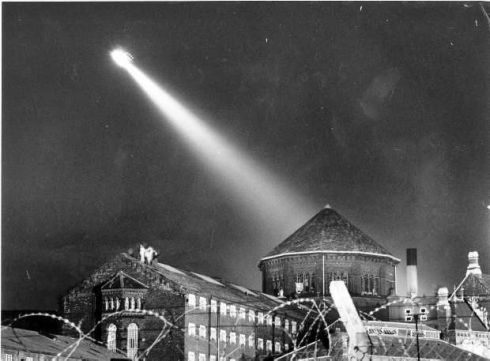
Strangeways, Manchester, UK. April 1990. Credit: Manchester Evening News
UK PRISONER VOTING RIGHTS
Brendan O’Friel, the governor in charge of Strangeways during 25 days of famous unrest beginning April 1st, 1990 has backed moves to give UK prisoners the vote.
O’Friel says the controversy is being deliberately stirred up for political reasons. He told the Manchester Evening News:
“I think it is a totally sensible thing to give prisoners the right to vote and then encourage them to vote. Whatever those people have done it is a question of trying to make sure that they are going to make a contribution to the community rather than being a drain on it. Anything we can do to encourage them to take responsibility and think positively is a very good thing.”
O’Friel’s view is not the concensus in the UK. In November 2010, The European Court of Human Rights ruled that denying the vote to prisoners was a violation of their human rights.
However, in early February the House of Commons voted overwhelmingly to reject any lifting of the ban, opposing the move by 234 to 22. By doing so they face a class-action lawsuit which could cost the British taxpayer millions in damages for as long as the government denies prisoners their vote.
The ridiculous thing about this is that the figures (approximately 90,000) would barely effect election results. This is expensive folly by Britain’s politicians.
The UK prisoner voting ban has been in place since 1870.
For comparison, The Telegraph reports:
“Many developed countries have some form of prisoner voting including 28 other European nations such as France, Germany and Italy. Russia and Japan exclude all convicted prisoners. Just two states in America allow it while others do not even give the vote back when inmates leave prison. Prisoners can vote in two of seven states in Australia.”
PRISONER VOTING IN AMERICA
In 2010, judges in Washington State found that felon disenfranchisement laws unfairly impacted minorities as they were more likely to be subject to racial inequalities in the application of policing procedure.
From the ever-excellent Prison Law Blog:
“On Sept. 21, the Ninth Circuit heard oral argument in Farrakhan v. Gregoire, an important case that could affect the voting rights of prisoners in Alaska, Oregon, Washington, Idaho, Montana, Nevada, California, Hawaii, and Arizona. Back in January, a split Ninth Circuit panel ruled that, in Washington State, “minorities are more likely than whites to be searched, arrested, detained, and ultimately prosecuted,” and that, because “some people becom[e] felons not just because they have committed a crime, but because of their race, then that felon status cannot, under section 2 of the [Voting Rights Act], disqualify felons from voting.”
Washington State appealed and the discussion is likely to go all the way to the U.S. Supreme Court.
It’s about time both Britain and the U.S. move into the 21st Century. From the Sentencing Law and Policy blog:
“According to a report co-published by Human Rights Watch and The Sentencing Project, a national organization working for a fair and effective criminal justice system, disenfranchisement laws are “a vestige of medieval times when offenders were banished from the community and suffered ‘civil death.’ Brought from Europe to the colonies, these laws gained new political salience at the end the nineteenth century when disgruntled whites in a number of Southern states adopted them and other ostensibly race-neutral voting restrictions in an effort to exclude blacks from the vote.”
For more on prisoner and ex-prisoner disenfranchisement, read Michelle Alexander. She condenses the arguments of her very successful book, The New Jim Crow, here.
STRANGEWAYS ON PRISON PHOTOGRAPHY
Strangeways Riot and Don McPhee
————————————————-
(M.E.N. story found via Jailhouse Lawyer)
John Holbrook‘s Death Row portraits (2008) were taken in the Polunsky and Gatesville units, Texas.
The portraits serve two functions – they are the products of Holbrook’s own therapeutic journey and they are didactic props for the families of victims of murder.
“I want to teach the victims this liberating truth that I have learned,” says Holbrook. “The only way we can truly stop suffering is to love and forgive those who have caused the suffering.”

Seemingly, Death Row was propelled by Holbrook’s interpretation of Christian forgiveness and his need to psychologically heal after seeing images of violence during his work.
For 17 years, Holbrook worked as a private investigator on capital murder cases in Texas. In 1995, he was assigned to a case involving the double homicide of a teenage couple for which he spent many hours examining crime-scene evidence and graphic photographs.
Years later, Holbrook began suffering anxious episodes.
“A psychologist determined that my photographs of that time of homeless and social outcasts shown in a spiritual light, were subconscious attempts to correct the ‘bad pictures’ I saw while working the capital murder case,” says Holbrook.
“Ultimately, I learned that I could overcome PTSD by forgiving those who had caused it.”
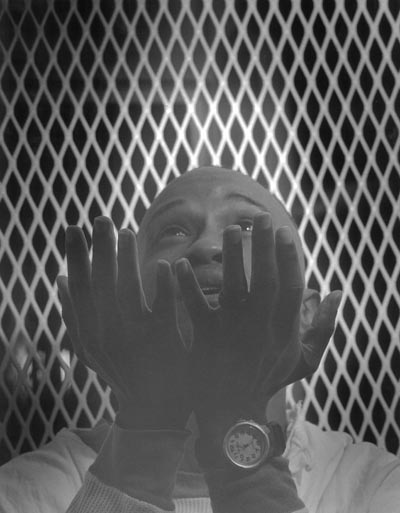
As he photographed through windows of prison visiting-room booths, Holbrook directed his subjects in spiritual gestures. The video (below) mirrors the artist’s rationale and is sympathetic to his needs. It bothers me a little that Holbrook feels he is the one to bestow forgiveness. He was a professional in his work. It was work that carried extreme emotional trauma after the fact, and I understand why Holbrook responded outwardly with conviction and a project as strong as his prior distress, but it could be argued Holbrook’s dragged prisoners into his healing process. If a university wanted to interview death-row prisoners they’d need ethics approval from a human subjects research board. I’d like to know about Holbrook’s preparations for the project.
That said, the prisoners he worked with (on the evidence of the video below) are engaged in the project and undoubtedly moved by the Holbrook’s portraits. I assume they were extremely grateful for the visits and discussion with Holbrook.
The stresses of criminal justice work lead to many responses by professionals and while Holbrook’s methods may be unorthodox, it seems he’s gone about them in good faith (pun intended). Better this outward healing than the slow degradation of family life and health that can impact police and prison personnel.
At its core, Holbrook’s work is a call to victims’ loved ones – who have significant sway in the death penalty debate – to oppose state murder.
“In order to get a death penalty, a Texas prosecutor will argue that the victim’s loved ones endorse the death of the accused. It is said that the surviving loved ones, “need closure”. Through my pictures, I argue that this disables the survivor’s ability to forgive the accused. To me, execution is a grave injustice done to the loved ones, ultimately denying survivors the ability to stop suffering.”
We mustn’t forget that Holbrook’s invocation of Christian teachings will help many Americans connect with his work. The work is anti-death penalty and Holbrook’s American audience vote.
I have not come across any project similar to this and I’d be very interested to get the views of the prisoners involved. I think only then can we begin to weigh the value of Holbrook’s works. Who knows, several of Holbrook’s subject may have already been executed?
The overt Christian imagery can be regarded as talking point, for some, maybe a noble purity, but for me it is suffocating. There are sociological causes to crime and there can be political responses. That is not to say I don’t believe in forgiveness; it is just to insist that forgiveness needn’t be monopolised by faith groups but instead incorporated into secular policy, restorative justice programs and sentencing laws that are not overly-retributive.
Forgiveness is an essential part of understanding the causes and cycles of crime. Unfortunately, too often “forgiveness” hinges upon a final apology of the condemned before we fry them anyway.
Paraphrasing the introduction to Domestic Slavery: The cold and stark photographs of ordinary-looking buildings in and around Paris by Raphael Dallaporta are combined with Ondine Millot’s texts to become chilling portraits of hidden agony. The texts describe what went on in these photographed buildings, confronting the viewer with stories of abuse and cruelty, forcing us to consider the idea that behind the façade of the ordinary can lie a discomforting reality. […] Domestic Slavery bears witness to the banality of everyday inhumanity.

Some of the stories in Domestic Slavery are harrowing, and in some cases not least because the abusers are women, or a collection of individuals from the same extended family. These are tales of evil made normal.
From Domestic Slavery:
“For four years Violette slept without a mattress on the tiled kitchen floor of an apartment in the 13th arrondissement in Paris. Her work timetable was carefully planned. In the morning, she got up at 4am to prepare breakfast for Sahondra, her employer, and her son; afterwards, she travelled into central Paris where, at 6am, she began work for a cleaning company run by Sahondra’s brother-in- law; at 10am she returned to Sahondra’s apartment where she did the housework and prepared lunch and dinner; at 4pm, she travelled to Massy-Palaiseau – about 20kms from Paris – where she cleaned the apartment of Mamy, Sahondra’s brother. When she returned to the 13th arrondissement around 10pm each day, there was more work: a pile of washing-up or ironing kept her busy until midnight, either at Sahondra’s or in her sister’s next-door apartment. For four years, during which time she was hardly fed, Violette worked 18 to 20 hours a day. She had left Madagascar aged 22 in the hope of earning enough money to feed her child, who she left behind. During the whole ordeal her four employers paid her nothing.”
“With the aid of the CCEM, the Committee Against Modern Slavery, she took her employers to court. Her case was heard in 1999 in Paris and it became the first-ever case of modern slavery dealt with in France under penal law. Her employers were ordered to pay Violette €22,900 in damages and interest; they were also fined and given suspended prison sentences.”
PHOTOGRAPHING SCENES OF UNLAWFUL ACTS
The type of sorrowful external view (long after the matter) employed by Dallaporta brought to mind Angela Strassheim‘s stake-out street shots of former crime-scenes for her series Evidence, of which I have written about previously. The two leave me feeling so differently however, I’d like to explore the reasons.
Both Dallaporta and Strassheim found their building-subjects due to information on public record following judicial process/trial. Neither photographer makes effort to show the architectures as extraordinary – because they are not. Yet, Dallaporta’s photography leaves me morose and confused about the human condition. I think it has something to do with closure – or lack of – in each of the projects.
Strassheim’s work leads the viewer through the crime. In the titles, she lists the weapons used. Strassheim shows us the traces of metals, that are traces of DNA, that are traces of blood, not only by being their but by using specialist forensic techniques. She literally reveals the marks of homicides.
Strassheim’s effort is two-fold in showing us the evidence but more crucially the conclusion of violence. It was bloody murder, but it was brief and it is over. Dallaporta’s works on the other hand don’t offer me an out. I am not mollified by the idea that this was a collection of one-off final acts. Often the buildings are only one of multiple sites of abuse.
I have no idea about the prevalence of domestic slavery in France, but I presume it is no different to other Western nations. If I need homicide figures I can find them, but if I want figures on illegal imprisonment and servitude I’m at a dead-end. Dallaporta’s work is an attack on our complacency.
In describing the bare details of each abuse, Dallaporta and Millot succeed in positioning domestic slavery as anywhere and everywhere; they present it as a national issue and as everyone’s problem. Domestic Slavery might just be the harshest indictment of absent community in our societies. Dallaporta’s work certainly plays on the unknown.
Inside of me, Domestic Slavery induces fear of the unknown. I can understand murder – it has been explained to me since I was a young child – but I do not understand modern slavery. Dallaporta’s work brings that to bear and, for me, that it is what makes Domestic Slavery so successful.
I was recently asked to propose a blogging workshop for photography students. It pushed me to think why blogs should be written and why they should be read.
Blogging tools have developed concurrently with the social media platforms that have permitted our shared glut of imagery. Writers in general have provided context to images for a long time, but I reason bloggers are a new front line in the expanded process.
Here are my thoughts.
VISUAL OVERLOAD
The flow of images through our daily lives increases at exponential speeds. Social media, photo-sharing sites with essentially unlimited storage and mobile hardware have created this sprawling (and it could be said, suffocating) visual superstructure.
At 60 billion photos, Facebook has a larger photo collection than any other site on the web. By comparison, Photobucket hosts 8 billion, Picasa 7 billion and Flickr 5 billion. Facebook’s photo data as an infographic.
VIEWING PHOTOGRAPHY IN A POLITICALLY MINDFUL MANNER
What to make of this slew of imagery is something both Fred Ritchin and Joerg Colberg have addressed in the evergreen debate about ‘What’s Next? (for photography)’ now being pressed by FOAM Magazine.
Colberg asks us to think about the meaning of our own digital archives and impress upon them a meaning, perhaps even a strategy. Ritchin urges us to think about making sense of the world through all the images available to us. Both are concerned with us being actors in the real world, and knowing that the photograph plays a part in social/political action and decision.
Ritchin:
Colberg:
Beyond our status as subjects within – and/or impulsive producers and passive consumers of – imagery, we are also to a very modest extent curators and distributors. In these last two roles, we can add most meaning and most weight. And it can be done through thoughtful and engaged blogging.
I have gone on record as saying the best bloggers writing about photography are those who can be relied upon to filter content meaningfully.
A good blog has a clearly stated goal and delivers accordingly. That’s how I judge success. Some blogs may cast a wide net, others focus on a niche, but in either case a consistent voice will secure the interest of readers. One hundred committed readers are more valuable than hundreds of thousands of browsers and “stumble-upons.” People need to be told why they should look at a picture just as much as they should be told in a lede why they should read a story past the first paragraph.
THE IMPORTANCE OF TEXT
The iconic photograph – that is to say the stand alone image which communicates and resonates – is a rare and, for most photographers, an unattainable thing.
Understood within this context, writing about photography can be of paramount importance. And it can be an act of conscience.
Fine art photographers may argue explanatory text demeans a photograph; Robert Adams insisted that auxiliary captioning proved the image had failed in describing all it need to. But Adams’ is an out-dated philosophy. In current times, when photographs have diminished reliability, they require justification for looking.
During their role as World Press Photo jurors, Broomberg and Chanarin considered a photo of drawing of a battle plan from Darfur sketched into the sand on the floor of a hut, and noted:
Blog posts can be considered extended captions, highlighting the meaning and purpose of photographs. As such, bloggers’ choices on their subject matter are significant. And political.

 Prison Photography