
You are currently browsing petebrook’s articles.

Peter Hoffman‘s representation of life at Bryan House is one of sanctuary and everyday tasks. It is the sort of normality and calm you expect many of the refugees depicted have sought for a long time. Bryan House is in Aurora, Illinois, where legally established refugees are allowed to reside for periods of a year or more at a time while saving up for a new home, college tuition or other life progressing steps.
Support the Bryan House organization by purchasing Hoffman’s self-published book. You can also buy a limited edition print at Collect.Give. All profits go directly to Bryan House.
(Found via La Pura Vida)

“I was have always paid attention to how artists worked in the world, especially with the form known as the Artist Talk where the artist is invited to present his/her works. This form remains intriguing to me. It always seems to involve the following elements: A podium or table; A slide or video projector; Table with glass or bottle of water; A (most of time) inadequate introduction followed by a lecture which is inevitably interrupted by some technical problem that may or may not be resolved; End of lecture; Enthusiastic, polite, or no applause; Someone announces that the artist is willing to answer questions from the audience; Moment of silence; Artists fear and wishes that no questions are forthcoming; Audiences fears and wishes that no questions are forthcoming; Some daring soul inevitably raises his/her hand to ask a good or bad question; artists give good or bad answers; Someone mentions that time has run out; Audience leave while a few people approach the artist to ask him/her more questions; Everyone is escorted out; Artists is invited for a drink or dinner where a polite conversation takes place; Email coordinates are exchanged; Artist is dropped off at a mediocre hotel with an equally mediocre and expensive internet connection.” (Source)
Walid Ra’ad is the recipient of the 2011 Hasselblad Award and founder of the Atlas Group.
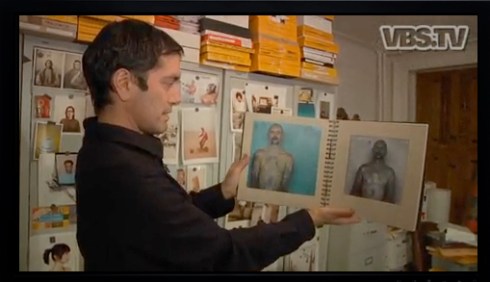
I was interested to discover that photographs of San Quentin inmates played a formative role in Stefan Ruiz‘s career. At 4:45mins, Ruiz talks about his position as an art teacher at San Quentin and his compulsion to make portraits.
From a battered Fujifilm box held together with gaffer tape, Ruiz pulls out a wire bound album of prison portraits:
“I really wanted to take pictures of them so I started taking all these photos. I put this whole little notebook together … and I would carry this box [everywhere]. This was before laptops. I used to bring this to Europe all the time and I’d show this. This was what got me jobs.“
Ruiz goes on to explain that he was employed by Caterpillar to imitate the look of those San Quentin portraits. Ruiz’s contact at Caterpillar then moved to Camper and the relationship continued. After Camper Ruiz went to COLORS Magazine as Creative Director (Issues 55 – 60, April 2003 – April 2004). All the while, Ruiz was perfecting his “well-lit” and “polished” style.
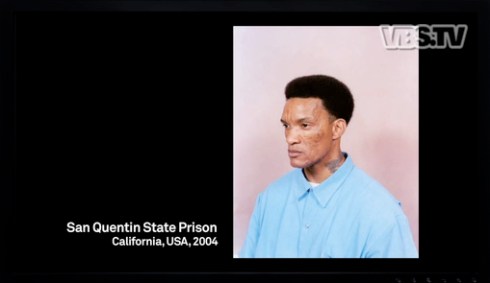

Some observers are turned off by the fusion of art/documentary/fashion employed by Ruiz. Common criticism of this multi-genre work is that it can depict poverty as glamorous, violence as eye-candy, and people as consumable props in a visual world obsessed with surface.
The flaw to these dismissive crits is that cinema has been forging this type of imagery for decades; yet, we expect slick augmented reality in the moving image. Ruiz’s use of lights instead of B&W film and the blur of a Leica is hardly an attack on documentary and certainly not on realism (since when has photography ever plausibly claimed a monopoly on realism, anyway?).
Ruiz’s portraits have a solid footing in reality; they are devoid of photojournalist cliche and require participation from the subject. And as far as commercialism is concerned – at least in the case of COLORS – the relationship of money to Ruiz’s aesthetic experiments is acknowledged.
Ruiz likes to “work with the person.” From telenovela actors to hospital patients and clinicians and from rodeo queens to refugees, Ruiz has connected with his subjects through a transparent discussion about what they can achieve together with a device that records and stores their likeness.

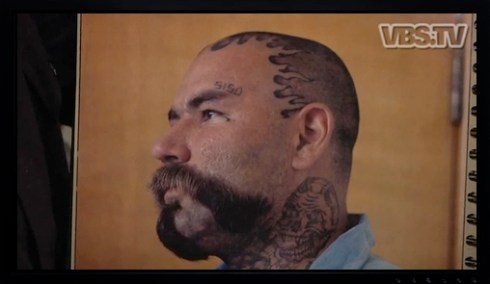
The VBS profile of Stefan Ruiz* is a great introduction to his past, present and future trajectory. Highly recommended.
* I apologise for the crude use of screengrabs in this post.
“I hold this slow and daily tampering with the mysteries of the brain to be immeasurably worse than any torture of the body”
– Charles Dickens, American Notes, (Harper & Brothers, 1842) p. 39
If we are to understand how and why prisons function in modern America, it is helpful to know their history. As many of you will be aware there was a time in Western societies when prisons were not the primary form of punishment; instead jails were used for short sentences for disturbing the peace, debt, being poor and as a means to hold people before trial.
Likewise, prisons have not always used solitary confinement. Solitary today is used to punish (sometimes minor) infractions within a prison or to isolate inmates during an investigation/following an incident. Its use differs institution to institution.
Needless to say, on any given day in America 20,000 people are held in solitary despite scientific proof it damages the psyche and regresses basic functioning.
With that in mind, the origins of the practice are pause for thought. In the above video, Sean Kelley, Program Director at Eastern State Penitentiary outlines the history of the famed prison in Philadelphia, and its evolution of the practice of solitary confinement.
PRODUCTION
‘The Invention of Solitary‘ was produced by Muralla Media Works headed up by Chris Bravo and Lindsey Schneider.
Bravo and Schneider are involved in several projects and as such I’d describe them both as media activists. They’ve produced advocacy video for incarcerated women and for the mentally ill in prisons. They were also videographers at the ‘Fighting Prisons’ panels at the 2010 US Social Forum.
Their largest current project is CONTROL, a feature-length documentary that tells the story of youth whose lives have been caught in the web of the criminal justice system. View the trailer.
With audio-visuals as their material, it is interesting that they also muse – through the SILENCE OPENS DOORS webzine on the history and philosophy of silence & noise.
Which brings us full circle – read the SILENCE OPENS DOORS blog post about The Invention of Solitary.

Philadelphia County Prison, Debtors’ Wing, Reed St. & Passyunk Ave., PHILADELPHIA, Philadelphia County, PA.
This from Welcome to Debtors’ Prison, 2011 Edition, Wall Street Journal.
Some lawmakers, judges and regulators are trying to rein in the U.S. debt-collection industry’s use of arrest warrants to recoup money owed by borrowers who are behind on credit-card payments, auto loans and other bills.
More than a third of all U.S. states allow borrowers who can’t or won’t pay to be jailed. Judges have signed off on more than 5,000 such warrants since the start of 2010 in nine counties with a total population of 13.6 million people, according to a tally by The Wall Street Journal of filings in those counties. Nationwide figures aren’t known because many courts don’t keep track of warrants by alleged offense. In interviews, 20 judges across the nation said the number of borrowers threatened with arrest in their courtrooms has surged since the financial crisis began.
In September 2009, Jeffrey Stearns, a concrete-company owner from Indiana felt the full force of the present law. From On the Rise of Debtor’s Prison: ‘The Scariest Thing That Ever Happened to Me’ (WSJ)
[Stearns] answered a knock at the door from a Hancock County, Ind., deputy sheriff. The deputy was holding a warrant to arrest Stearns for not paying $4,024.88 owed to a unit of American International Group Inc. (AIG) on a loan for his pickup truck.
The irony here, as pointed out by a Demand Progress petition, is that AIG recieved a $122.8 billion bailout – about $4,000 for every American.
More from the WSJ:
After being handcuffed in front of his four children, Stearns, 29 years old, spent two nights in jail, where he said he was strip-searched and sprayed for lice. Court records show he was released after agreeing to pay $1,500 to the loan company. “I didn’t even know I was being sued,” he said, though he doesn’t dispute owing the money.
Sign a petition to your lawmakers against the greed and manipulation
Really?
“Here I can experience the most vivid and complete representation of my memories.”
The above is a quote from the promo video (on 29 seconds) for a new smart-phone App named Color. The claim is – how should I put this? – a load of bollocks.
Color automatically shares all the images you snap in the App with everybody else using the App within the immediate geographical area. I’m still waiting to find out how large that area is.
Color‘s promise that “There’s no attaching, uploading, or friending to do” would send me running a mile. Hello? Privacy?
Color is a product to feed the suffocating self-obsession of modern society.
If someone else makes an image, on their smart phone, of other people, or of an event, in another time, and in another space, and then, you own a tool onto which the image is stored as a digital file, it does not make that event, nor any representation of it, YOUR memory.
It doesn’t even make those people your friends.

I knew something was going on when my blog stats spiked over the weekend. Prison Photography interviews with those who photographed Fabienne Cherisma’s body in Haiti were drawing readers … and they came from Sweden.
PAUL HANSEN’S SPoY WIN
At the Swedish Picture of the Year Awards, photojournalist Paul Hansen was recognised as International News Photographer and won the International News Image for his image of Fabienne (below).
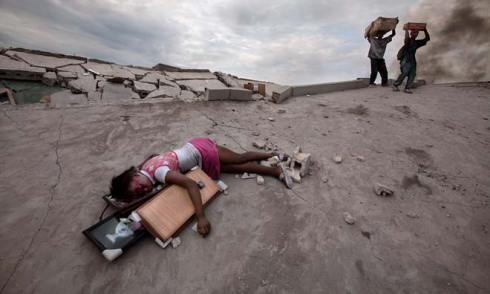
Fifteen year-old Fabienne Cherisma was shot dead by police at approximately 4pm, January 19th, 2010. Photo: Paul Hansen
In March 2010, Hansen answered some of my questions about the circumstances of Fabienne’s death, “For me, Fabienne’s death and her story is a poignant reminder of the need for a society to have basic security – with or without a disaster.”
Paul Hansen was one of eight journalists I quizzed about that fateful day in an inquiry that revealed that 14 photographers were present immediately after Fabienne’s death.
At the time, I noted how the Swedish media and public discussed the ethics of the image and that, by comparison, similar debates were absent elsewhere.
The debate has continued following Hansen’s award, focusing on Nathan Weber’s image (below) that was first published along with my interview with Weber.
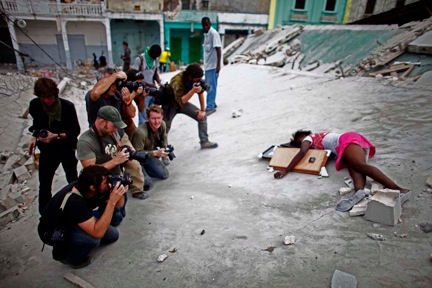
Photo: Nathan Weber
Weber’s image has unsettled many it seems. Judging by garbled Google translations here, here, and here it seems there are a few issues:
– General surprise that Weber’s image – and the revelations it brings – was not widely known before the SPoY award.
– Rhetorical questions about whether – given the scores of photographs made – Hansen’s image was “the best.”
– The expected accusations of exploitation and vulture behaviour by photographers.
– Fruitless thoughts on “truth” within this particular image.
Before they awarded Hansen, I wonder if SPoY were aware that so many photographers were present? Would it have altered the final decision? The image of Fabienne limp on the collapsed roof (whoever made a version) is the summary of innocent death, a society’s desperation and the man-made tragedies that compound natural disasters. It’s is a striking vision.
The circulation of Weber’s image has fueled skepticism toward photojournalism.
The problem with these types of brouhaha is that never are they able to measure if or what effect images – in this case Hansen’s – have. Did Hansen’s image secure a dollar amount of donations for the Haitian relief effort? Did it mobilise professionals and resources that would have otherwise not have moved?
If we are to talk about the “power of photography” then shouldn’t we expect and/or propose criteria for measuring and defining that “power”?
MICHAEL WINIARSKI, REPORTER AND HANSEN’S PARTNER
It should also be noted that Michael Winairski won the the award for News Storyteller from Dagens Nyheter, the national news outlet he and Hansen work for. When I contacted Winiarski last year about coverage of Fabienne’s death, I was particularly impressed with his transparency and commitment to the story. He and Hansen followed up two months after the killing and met with Fabienne’s family.
On receipt of the award, Winiarksi said, “”I’m glad we did not let go of Haiti. I and the photographer Paul Hansen have been back twice. And Paul is down there now with another reporter, Ole Roth Borg.”
ACCOLADES AFTER RECORDING DEATH
Paul Hansen is not the first photographer to be awarded for coverage of Fabienne’s death.
James Oatway won an Award of Excellence at POYi in the Impact 2010 – Multimedia category for Everything is Broken. Fabienne’s corpse open the piece and appears again in images 25 to 33. Olivier Laban-Mattei won the Grand Prix Paris Match 2010 for his coverage of Haiti, including the aftermath of Fabienne’s death. Fredric Sautereau was nominated for Visa d’Or News at Perpignan for his coverage of Haiti, which include seven images about Fabienne’s death.
There may be others.
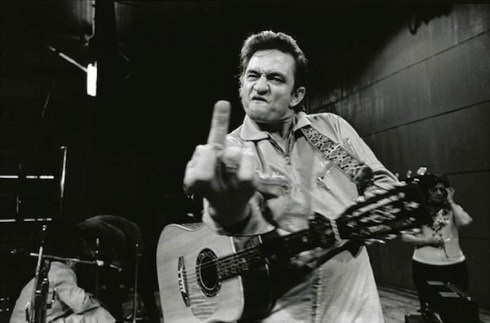
Collectors Weekly looks back at Johnny Cash’s famous performances in Folsom and San Quentin, as photographed by legendary music photographer Jim Marshall:
The most famous image from the day, though, is unquestionably the candid shot of Cash taken during a rehearsal before the show. […] Marshall recalls the origins of what he believed was “probably the most ripped off photograph in the history of the world. […] I said ‘John, let’s do a shot for the warden.’” Apparently, that’s all the prompting Cash needed to look straight into Marshall’s lens and flip him the bird.

 Prison Photography