
You are currently browsing petebrook’s articles.
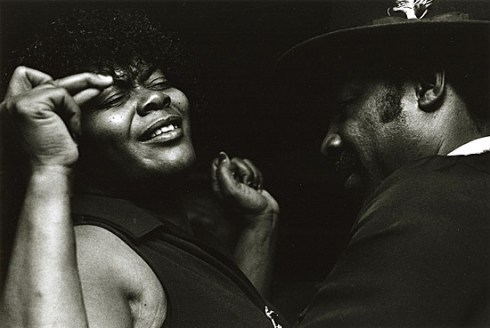
Dancing at Shalimar in Oakland in 1983. From the book, Oakland Blues. Photo by Michelle Vignes
While I was surfing through info about Michelle Vignes for a previous post, I came across a quaint little piece on SportsShooter.
When reporter Jim Merithew describes Vignes’ accent as French, she corrects him:
“I don’t have a French accent. I have a mixed accent. I got my accent when I worked at Magnum. Everybody had a different accent; part French, part Hungarian, part German, part whatever it is. So that’s my Magnum salad.”
Vignes also has a cut-to-the-chase view of documentary photographers today:
“They seem to work on the web. To me it is just like spitting in the wind.”
The success of the changes in Egypt will largely be judged on the strength of the new democracy – more specifically, the viability and strength of its institutions and the way in which they unite the people’s needs. If Egypt’s justice system serves truth and enacts fair judicial process, especially regarding deaths during the protests, then it shall be a source of pride and calm for Egyptians in their quickly changing nation.
Ahmed Mohammed Mahmoud was one of the first journalists to die during the protests. Mahmoud’s family believe he himself captured the photo-evidence to prosecute his killer.
From the London Photographers’ Branch:
“Ahmed Mohammed Mahmoud’s last photograph was an image of his killer taken just before he was shot in the face. His wife hopes that this evidence will bring his murderer to justice, with the support of his trade union, the Egyptian Journalists Syndicate.”
Watch this case.

People carry a symbolic coffin of Egyptian journalist Ahmed Mohammed Mahmoud, in a symbolic funeral ceremony in Tahrir Square, Cairo, Egypt, Monday, Feb. 7. Photo Credit: Ben Curtis / AP
RIGO 23 recently accompanied Robert H. King (formerly one of the Angola 3, now released), Emory Douglas (printer and legend of revolutionary graphic art) and Billy X Jennings (you HAVE to click that link!), three veterans of the Black Panther Party, on their recent trip to Porto and Lisbon in Portugal.
RIGO emailed:
“Here’s a little clip from the mural I painted at a housing complex south of the River Tejo in Lisbon to commemorate the visit to their community by Robert, Emory and Billy. Robert is a survivor of 29 1/2 years of solitary confinement; Emory Douglas was the Minister of Culture for the Black Panther Party.”
I have mentioned RIGO’s art in support of US political prisoners before. His TRUTH mural in San Francisco marked Robert H. King’s 2001 quashed conviction. RIGO continues to advocate for Herman Wallace and Albert Woodfox, the remaining Angola 2.
He supports Mumia’s ongoing legal battles and RIGO also recently joined Michelle Vignes – a true matriarch of radical documentary photography – for an exhibition in solidarity with Leonard Peltier. (Details and review of the show at the Warehouse Gallery in Syracuse, NY. Closed Feb. 6th)
RIGO conceived of the space as an imaginary museum – The Tate Wikikuwa Museum: North America 2024. Tate Wikikuwa is Leonard Peltier’s Lakota name and 2024 is the year of his next parole hearing. It showcases arts & crafts by the Oglala Sioux and Peltier’s paintings, as well as documents, books, writings and educational material. Making use of Peltier’s colour choices, RIGO created a spiritually and politically charged space.

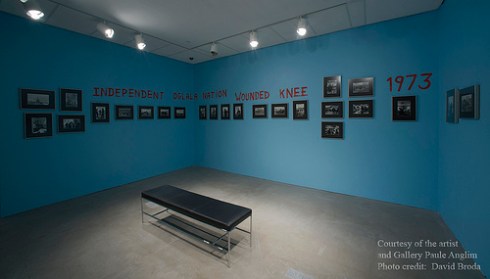
I would have loved to have seen Vignes’ prints of Peltier and the AIM Movement exhibited within the mood set by RIGO’s installation.
For such an important photographer of America’s West Coast counter cultures and radical movements, Vignes does not have a large web presence; there is a paucity of reviews and there are few images too. Next time I’m in the Bay Area, I will have to pay a visit to UC Berkeley’s Bancroft Library which acquired her archives in 2003.
Look out for more about Michelle Vignes on Prison Photography in the future.
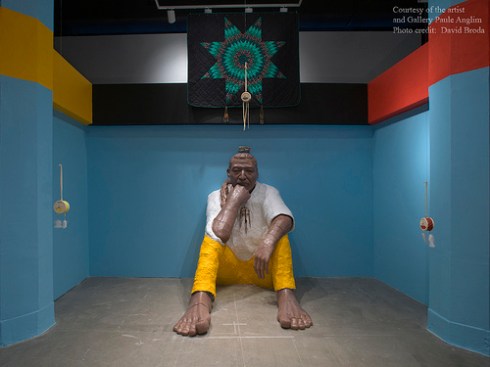
Photo Credits: All images David Broda
(Found via Just Seeds and Bob Gumpert)
“I find it very interesting by the way that failure to learn your language is seen as a deficit but failure to learn my language is seen as so natural.”
In My Language is one of the most logical and beautiful films I’ve ever seen.
(via)
PAUL RUCKER
In May of 2009, Paul Rucker partook of a two week residency at the Blue Mountain Center. The theme: Prison Issues.
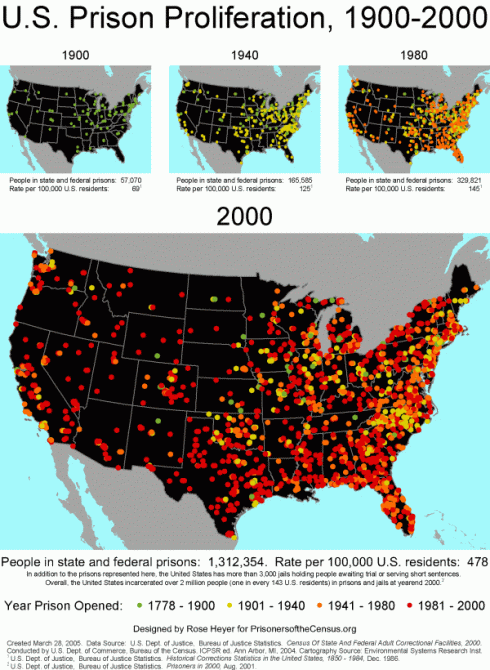
During his research he happened upon some pioneer GIS maps by Rose Heyer which modeled the growth of the US prison system. With the information he composed an original score. A note to accompany each carceral outpost to blink into existence in the “Land of the Free.”
232 years in 10 minutes and 45 seconds.
ROSE HEYER
Incidentally, Rose Heyer is a wonderful thinker. She developed the GIS methodology for the Prisoners of the Census project, enabling quick calculations of how Census Bureau’s prison miscount distorts representative democracy.
Heyer produced the map U.S. Prison Proliferation, 1900-2000 and she co-authored Too big to ignore: How counting people in prisons distorted Census 2000, Importing Constituents: Prisoners and Political Clout in Massachusetts Importing Constituents: Prisoners and Political Clout in Texas, Importing Constituents: Prisoners and Political Clout in Ohio, and Thirty-Two Years After Attica: Many More Blacks in Prison but not as Guards. Rose is now GIS and CAD consultant in California.
(Source)
I was recently interviewed by Zarina Holmes at Sojournposse about my project here at Prison Photography. Zarina’s questions were refreshing as I have a tendency to get stuck in my own thinking and politics sometimes.

The interview itself is a little long (my fault) but results from an effort to fairly explain the nuance of images from sites of incarceration.
One of the things I continually grapple with is who benefits from prison photography projects? Is it the prisoners, the audience or the prison authorities? There is no definitive answer. In the interview, however, I did make this statement:
“People are tempted to believe that creating an image from within a prison – a rare/privileged viewpoint – is in and of itself a subversive act. In fact, what I often discover is that photography in prisons and other sites of incarceration is not challenging the organisational structure of the institution but rather working within its protocols. Thus, many prisons neutralise “the power of photography” or the camera’s ability to operate as a tool for social change.”
I have not articulated this thought so bluntly before. I think it applies to a lot of photographers working in restricted institutions or milieus.
Think about it – the most famous prison images of the 21st century are those of Abu Ghraib. Those images had a global reach and brought about change yet they were amateur shots leaked against the interests of the US military (the prison authority). Photographers are never going to just walk in the front gate unannounced. Nor are they going to be welcomed by prison administrations to document the pain and abuses within.
What does that make prison photographs then?
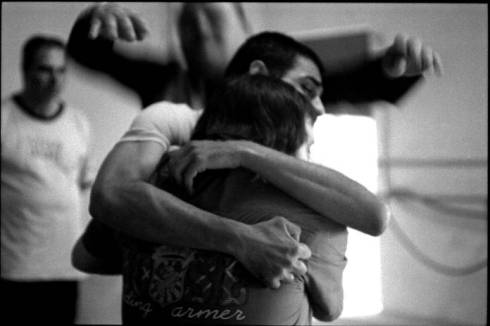
Between May 2007 and February 2008, Valentina Quintano documented O.P.G. Filippo Saporito (OPG), asylum for the criminally insane in Aversa, Italy. The series it titled ‘White Life Sentence‘ a term used by inmate-patients for indeterminate confinement.
O.P.G. Filippo Saporito (Google translation) serves the functions of both prison and mental health institution and as such has severe problems due to the often conflicting needs of two types of management. As recently as March 2011, sexual abuse crimes by staff have been reported in the Italian courts.
In the following interview with Valentina, she details her motives, the complex and unjust legal entrapment of many inmate-patients, their reactions to journalists and the ambient visual culture of OPG.
INTERVIEW
Why take on this subject?
A criminal mental asylum is an hybrid of two total institutions, it’s both a jail and a criminal asylum. It is a paradox to think that people in need of being cured are “helped” by being jailed. I wanted to bring light to the living conditions of the people whose recovery is made impossible in such institutions; they are just marginalized and hidden, as if the problem will disappear by pretending is not there. I aim to show something that most people don’t know about. In the 1980s, mental asylums in Italy closed but, oddly enough, criminal mental asylums continued to operate.
Who are the people in your photographs??
Most of the people jailed in such institutions are not considered dangerous anymore but there are no structures to host them and help them to be introduced back into society, so they are just left there. In many cases until they leave in a black bag. The legal situation is very complex.
Explain how it is complex.
Basically when prisoners enter OPG Filippo Saporito are assigned to a conviction time of 2, 5 or 10 years; a sentence considered a “security measure”. Those years are not exactly [defined as] a “conviction” and they can be added on top of a normal jail sentence too. Those sentences vary depending on the gravity of the crimes they committed. Once their scheduled sentence is over, they are judged by a psychiatrist and a judge to check if they are a social danger or not. If they are still considered dangerous their sentence gets a prorogue (usually six months) after which they will be judged again and so on.
The tricky bit is that in order to be released (and this procedure changes slightly from insitution to institution, but I will refer to what is the current practice at OPG Filippo Saporito) they need to find a structure, that can be a special house, or centre or families, which guarantee the surveillance on them for a one year freedom trial period, after which, if everything goes smooth, they will be definitely released.
What happens is that the number of inmates that would need this trial period outnumbers the number of places available in the above mentioned structures and very often the families can’t take under their charge the prisoners. Often, even if the person is not considered a danger anymore, if there’s no structure that can host them for the trial freedom period, their sentence are prolonged. The consequence is that 65% of the actual inmates are not considered dangerous anymore but are still held in OPG Filippo Saporito.


How many institutions such as this exist in Italy?
There are currently five criminal mental asylums In Italy. There’s a special section [for the mentally insane criminals] in another institution.
When I was working at OPG Filippo Saporito, it housed about 300 inmates. Of those, 65% were not considered a social danger anymore but they couldn’t be released for the lack of [social] structures in the community to take care of them.
What is the public attitude toward criminal mental asylums in Italy?
The Italian public knows very little about criminal mental asylums; most think that they have been closed together with the other mental asylums. They come on the news every now and than when the suicidal rate rises too high, a member of parliament goes and pay a visit inside, and denounces their inhuman conditions of life. It hits the papers for few days and then back to normal.
The prisoners have been amazing with me. They felt that for the amount of time I was spending there (I worked there for almost one year) I was not the normal journalist that comes, plays the voyeur for a few days and than disappears. At the end of the project almost everybody knew me and I knew most of their stories. Many times they have told me that with me they had the chance of talking about themselves, with someone really listening and not just handling them like paper files. [Listening] is a thing that the doctors should do, but the number of prisoners outnumbers the number of medical personal too much for it to be possible.

I gave them prints. The reactions I got were very different, some where happy, some others didn’t recognize themselves, not being used to see their image anymore, which was a very painful thing to witness.
Some prisoners do not recognise their faces?
They are mentally ill and the suicidal rate is very high so no sharp, flammable or explosive objects are allowed, nor things like shoestrings and so on. Generally, they are not allowed mirrors. The only image that some prisoners have of themselves is through old pictures; the perception of their own face and body is distorted.
“They lose track of what they used to be, because they have no guarantee that they will ever be allowed to become that person again.”
What’s more, in normal jails there is a photography service (I don’t know how it works exactly but I know that if you want to have a picture taken to send to your family you can somehow do it) but no-one considered that people in OPG Filippo Saporito might have the need for a photograph taken once in a while. For some people, the last time they saw their own face was years before.
The room interiors look very stark. Did any of the prisoners have other pictures or posters to use, hang and decorate spaces? Or, what is the visual culture of OPG Filippo Saporito?
Visual culture? Good luck with that! The average amount of space that each person has is so small that you don’t really have much wall to stick things on. In the most overcrowded sections, nothing was on the walls at all.
The sections which host people with more severe metal conditions are “decorated” with scribbles, and writing on the walls – which I consider screams more than decorations.
People that have bigger spaces usually have pictures from magazines (less porny that what I expected, to be honest) so landscapes, girls, some people a football team or a car, a postcard maybe, a couple of Christian crosses. The number of personal objects that inmates have is very small, which tells a lot about how this space works with the complete depersonalization of people.
The prisoners loose identity. They are trapped in a small space that, despite the amount of time they spend in it, they cannot identify it as belonging to them and so make no effort to decorate. They lose track of what they used to be, because they have no guarantee that they will ever be allowed to become that person again; they become faceless and with no identity and no ties with the outside world. Plus, most of them are severely sedated and/or depressed which doesn’t really stimulate any effort to make the place more welcoming.
Did the prisoners see your prints?
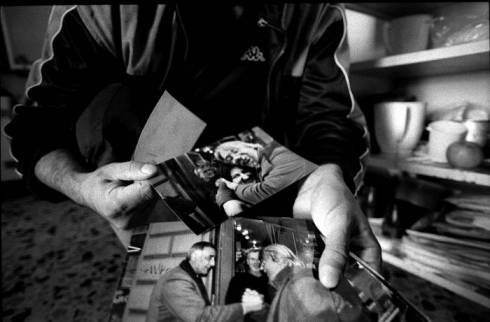
Quite a few asked me to have their picture taken in order to have something to send to their families and to see what they looked like. It was a tricky one for me, as I could not turn my reportage in working for them, so I had to be very careful to handle it and make no promises I couldn’t keep.
Prints were either sent to family or saved among their belongings. Someone chucked their portrait in the bin!
It’s very sad to see how is the inmates’ perception of possessions. They are not used to owning anything so the idea of possession almost disappears for them. Some people had a look at the picture and that was it, end of the use of the picture. They are deprived of the most basic elements that make a person an individual subjective human being.
Was it easy to share your prints?
It is not exactly that you bring a print with you and that’s it. Everything is extremely bureaucratic so I had to give pictures to the police attendants, who had to request the approval of the director and then they were given to another attendant that would have been in charge of delivery. Also, some staff considered giving people their pictures as inappropriate . More than once prisoners told me they never received the prints I had brought for them.


You said the prisoners appreciated and understood you presence. Do you know what they hoped your photography could do/might do?
For many reasons, most of them consider their condition of detention to be unfair. The biggest one is that their release is not time-based (not in a linear way, anyway, as I explained above) and that’s why they call their condition a life-sentence, even if not defined as such.
This condition of not knowing when they are going to be released (if ever) is source of great distress and, in my opinion, makes the recovery of a person impossible. What’s more, even if the law states that different crimes and different mental conditions are treated in different ways, the reality is that people with very serious conditions live close to people which are in better health, all under the same set of rules and in the same spaces. There are sections in which the surveillance is a little bit lower, for example when i was there they just had stated a section in which there were no police attendants but just nurses and medical personnel, but the difference between section to section vary very little.
Sometimes, for disciplinary reasons, people are moved to higher security sections and excluded from recreational activities, as a form of punishment, but this is of course off the records.
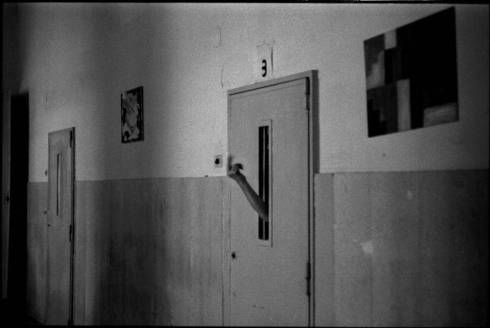
The jail is overcrowded, the number of inmates being almost twice as the one the jail was designed for. Food is very poor, and hygiene is too. [Available] medical and psychiatric assistance is ridiculous, and the police personnel are not specifically trained to cope with mental illness, which leads to a massive number of abuses and a complete lack of empathy towards the inmates.
The activities, which are considered to be treatment but in reality constitute just a form of entertainment, are restricted to a very small number of people (because there has to be one police attendant for every four inmates) and they are always the same inmates, the easier ones to cope with.
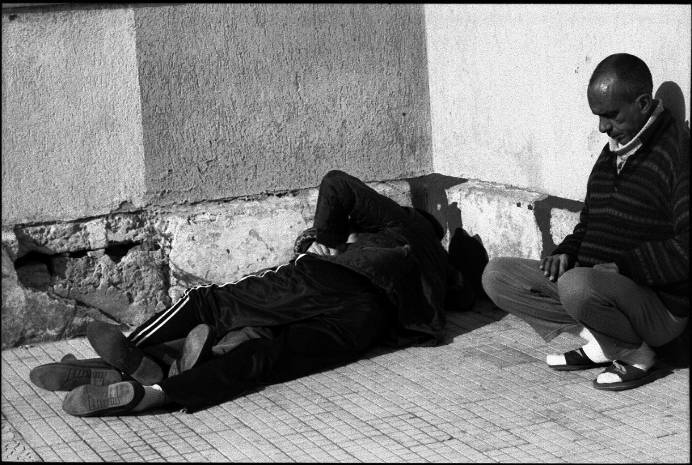
The prisoners are aware that the way in which they live is unknown to most of the population and only hits the news when a parliamentary inspection takes place. They hoped my presence was a way to get their voice out, and they hoped the approach I had compared to the other journalists (reporting from the “zoo” they live in without effecting change) would be different. So they were hoped at least I would be less biased that the average journalist.
I made clear to them all that I was no “big cat” and I could only do my best to bring their voice out, but also aware that having the reportage sold and diffused would have not been so easy, because the reality is that is sellable only when something in the news brings those places to attention again.
And then of course there is the personal element; there’s a girl hanging around, who knows your name and smiles at you, and she considers you a human being and not a case study or a patient, which for some people is something that they hadn’t had in long time.
Plus, a photographer is something that is “happening” that breaks the routine a little bit. I have to say, some of them were very hostile to journalists, and I can easily see why, for the way they handle the topic. It took time to gain their trust.
And something else too, one inmate saw me as a tie to the outside world; I was not a nurse, not a doctor, not a police officer, I was just a person talking to them for no other reason than talking to them, because I have spent days at times just talking about food or pets or places or my normal day or whatever. They thought I was out of my mind because I decided to go there on purpose instead of taking pictures of trees and beautiful landscapes!

Filippo Saporito strikes me as an eclectic complex. There is a training centre for clinical and psychiatric training?
If I am not wrong, yes, there is a training school that works together with the OPG but I don’t know much about it.
There is also a museum at the site, correct?
There is a very small museum in the [old] jail which hosts instruments that were previously used to deal with mental illness. But inmates are still there [in the asylum], still in the same medieval conditions. I wish the asylum was something in the past […] you can say it too is a museum, but a living horror museum.

BIOGRAPHY
Quintano is based in London, UK. She holds an MA (distinction) in Photojournalism and Documentary Photography from London College of Communication (December 2010) and received a Diploma in Photojournalism from The Danish School of Media and Journalism, Århus, Denmark (December 2009). Between July and November 2010, Quintano was Assignment Editor, Getty Images, London Office and is currently a Staff Photographer at the Italian monthly magazine, Progetto Campania. Quintano’s photography has appeared in the following books; Terre in Disordine, Minimum Fax (2009) and Enciclopedia della Canzone Napoletana, by Pietro Gargano, Magmata Edizioni (2006). Quintano’s work has appeared in many exhibitions, including Donne rEsistenti, Napoli, Italy (May 2008) and Rifiuto, at the Associazione La.Na., Napoli (July 2007)
Following up on my post about Julie Green’s The Last Supper, I think it is necessary to make an overview of the photography and painting projects that consider America’s death penalty by meals of depicting last meals and last meal requests.
Celia A. Shapiro
Shapiro’s recreations of last meals in lurid colour are possibly the best known within this subject matter. She made the series Last Supper in 2001. Of Shapiro’s work, critic Fred Ritchin said it proves the US only executes poor people. Ritchin’s position might be true, but as Julie Green reminded me most inmates, particularly in Southern states are limited to food from the prison kitchen and usually to a budget of $20. States that rarely employ the death penalty offer a generous $50 or no limit at all.
In all their garishness, Shapiro’s works are reminiscent of Martin Parr’s work. Parr too photographed the food of the poor; fish and chips, cupcakes, bangers and mash and trays of tea. Whatever Parr claims about objectivity there is a snide judgement in his work. Indeed it is his strength that his pictures show us the true absurdity of many of our dietary mores.
Shapiro’s work disgusts me. It disgust me in a good way. It angers me. Each of Shapiro’s images represent a life extinguished … gassed, cooked, fried. It’s hard to stomach. Good art evokes strong response.

John William Rook, age 27, executed by North Carolina, 9/19/86. © Celia A. Shapiro
James Reynolds
James Reynolds‘ Last Suppers was well received in 2009 but the interest in his birds-eye view still-lives seemed short-lived. I suspect they were appreciated more for their unorthodox view of a infrequently seen subject and for their role as conversation starter, than they were as lasting pieces of art.
The visual discipline of the institutional orange trays of containing in most cases a bizarre allocations of food, fairly reflects the irrationality of a state killing a citizen.
There is something maddening and suffocating about Reynolds’ ordered still-lifes. The demarcated space of the foodstuffs reminds me of aeroplane meals. For the executed it all comes down to a tightly presented meal, and this is meal is absurd.

© James Reynolds
Jonathon Kambouris
Jonathon Kambouris‘ efforts with The Last Meals Project is roughly contemporary with Reynolds (completed over 2009/2010). Judging by the shadows to the chicken legs, cups of coffee, Kambouris places food items ontop of a blown-up mugshot of a (infamous) inmate mugshot and makes the photograph from directly above, looking down.
Kambouris is tying his desire for a debate about the death penalty to the most renowned and media-coveted men and women. I am not convinced this is a good tactic as (whipped up) emotions about serial killers is not the place to begin a rational discussion on the symbolic foolishness of the death penalty. I think a better place to start a progressive debate – at least within the framework of art – would be Taryn Simon’s The Innocents or the painter Dan Bolick’s Resurrected. The existence of innocence on America’s death rows is a powerful argument working in favour of death penalty abolition.
One footnote to add is my astonishment at Kambouris’ statement at Feature Shoot: “In 2010 this photo essay traveled to Singapore to be shown in the Singapore Fringe Festival: Art and the Law. Ironically, Singapore has an extremely strict death penalty stance and I was informed that it is part of school curriculum to watch an execution take place.” Kids spectating murder? Can that be true?
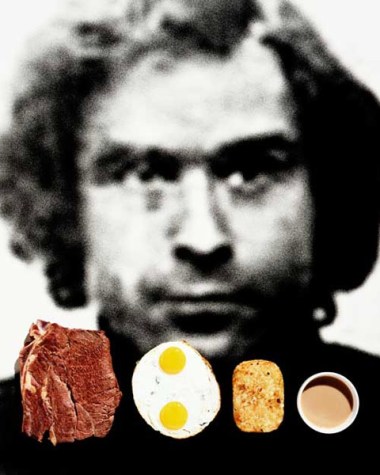
Name: Ted Bundy; Last meal: Steak, eggs, hash browns, coffee; Sentence: Death by electric chair; Executed: January 24, 1989, 7:16am; State: Florida. © Jonathon Kambouris
Mat Collishaw
Mat Collishaw goes all Flemish Master on his last meals. Except it isn’t the girl with the pearl earring chomping down on that lettuce it was Karla Faye Tucker a few hours before she was lethally injected by the State of Texas in 1988. Flemish still lives were part allegories of life, death and cycles of nature but frequently used items of trade as story telling devices. Knowledgable viewers would identify flowers or precious metals from across the globe brought by the Dutch merchants that dominated sea-trade in the 16th and 17th centuries.
In the age of supermarkets and year round strawberries, the global food trade and who runs is of little significance. The inference in Collisaw’s work is that America trades in sublime murder.
Found via Art Most Fierce.

Karla Faye Tucker (2010). C-Print, 73 x 60 com (29 x 24 inches) © Mat Collishaw
Jacquelyn C. Black
Black’s … last meal … (Courage Press, 2003) is a curious little publication. It is clearly an act of conscience. The studio photography is very literal without the interpretation we see in other artists’ works. I cannot be sure Black’s prints have ever gone on exhibition. Black pairs images of last meals with text of last statements.
When one is looking at photography in order to draw critical conclusion, it is often the absence if photography (or more precisely, the presence of something unexpected) that can provide the Eureka! moment. I am somewhat desensitised to the issue of state violence; I suspect the emotive response Black and her peers expect of the viewer, I do not deliver. It was therefore, an absent image and text in its place that caught my attention and really drove home the spiteful retribution of execution:
ASKED THAT HIS FINAL MEAL BE GIVEN TO A HOMELESS PERSON
(REQUEST DENIED)
… last meal … includes valuable auxiliary material – on the history of capital punishments; on statements made in landmark legislation; and on US death penalty statistics. Black also lists political resources for anti-death penalty activism.

Name: Anthony Ray Westley
Executed:May 13, 1997
Education: 8 years
Occupation: Laborer
© Jacquelyn C. Black
Barbara Caveng & Ralf Grömminger
Glowing like fast food menu boards but with the deliberateness of illustrations in a noodle bar, Grömminger’s photographs mounted in lightboxes for Caveng’s Final Meals installation are a bit pop. Any illusion of vitality is deflated by the procedural details of the eater’s execution.

Detail from ‘Final Meals’, installation by Barbara Caveng, 2000. Backlit boxes: Steelcases (40 x 40 x 18cm) with a pane on one side to pull, showing the execution protocol. Two audiostations with final statements. Meals photographed by Ralf Grömminger
Kate MacDonald
“The leftover table scraps relate the humanity of the condemned to our own ordinary experience,” says Kate MacDonald of her painted Last Meals series. That’s a bit poetic for me. More powerful is the fact these plates are empty. The remnants of sauce and chicken bone are primordial and bloody. Just as these items were devoured, so too will be the body that consumed them. Despite the polystyrene cup and plastic cutlery there is something very animalistic about MacDonald’s oil paintings.
Last Meals featured in the Texas Moratorium Network’s exhibit Justice For All? Artists Reflect on the Death Penalty, in which MacDonald and peers considered the injustices embedded within the death penalty; “Mental health and lack of advocacy, racial discrimination, poverty, and at the issue’s most basic argument, the possible innocence of the executed.”
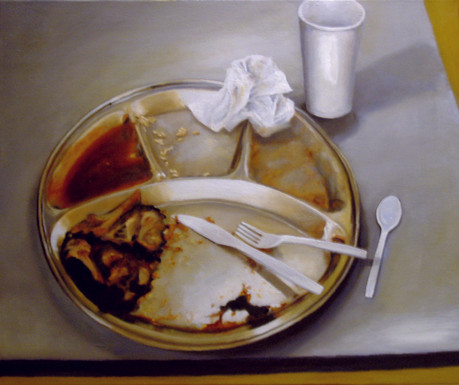
The last meal of Ruben Cantu, believed to be wrongfully convicted and executed in Texas. (24 x 20 inches), oil on canvas. © Kate MacDonald
As of May 2009, there had been 1165 U.S. state-sanctioned executions since 1976.
– – – – – – – – – – – – – – –
UPDATE: August 19th 2012
Two more projects.
Helen Grace Ventura Thompson
Ventura Thompson’s website. Her work in The Guardian. My thoughts.

© Helen Grace Ventura Thompson
and
Julia Ziegler-Haynes
Ziegler-Haynes’ website. Her work.

© Julia Ziegler-Haynes
– – – – – – – – – – – – – – –
UPDATE: December 14th, 2012
Henry Hargreaves
Hargreaves‘ No Seconds is a series of 10 stark photographs that re-create last meals alongside the name, age and conviction of the murdered individual. See more of his work on Raw File, Wired.com

© Henry Hargreaves
– – – – – – – – – – – – – – –
UPDATE: January 29th, 2013
Patrick Guns
For My Last Meals, 2007-2009, Guns asked 54 chefs to interpret 54 last meals.
“From this list of last meals, I asked renowned chefs to choose a meal according to their affinity for cooking and to recreate these last wills without any fear of asserting their own Humanism. As a tribute to a deceased man, their creations are more concerned about Man than about the Cook,” writes Guns.
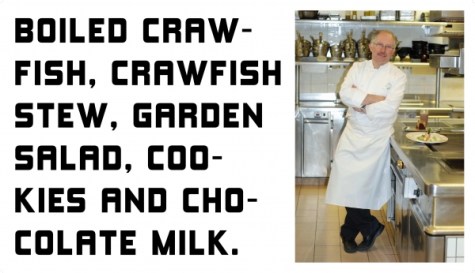
© Patrick Guns
– – – – – – – – – – – – – – –
If you have any other projects that need adding to the list, please get in touch.
– – – – – – – – – – – – – – –

 Prison Photography