
You are currently browsing petebrook’s articles.
When I can find the time, Lebbeus Woods‘ blog is always a treat to dip into.

© Ross Racine
On Ross Racine‘s digital drawings, Woods says:
Artists and poets have struggled over the centuries to make works that startle us with their originality and, in effect, wake us up to depth of human feelings in our own uniqueness and individuality. The artist’s and the poet’s originality connects with our own, invoking the feeling that to be human is to be unique. The artist is a mirror of ourselves, inspiring us not to be artists but individuals […] But the raw fact is, most of us are not so unique. Our lives, except for the smallest details, pretty much resemble the lives of others, particularly those in our social group, whatever it might be, defined by economic class, race, educational background and many others. The truth is that we are intensely social creatures and our social context often overwhelms our individual traits and aspirations. This would seem to be the message imbedded in Ross Racine’s drawings of suburbs.
View Ross Racine’s work here.
– – – –
Woods’ post on Libya is also rather rousing. It discusses (not in any related way) the push for another type of individual recognition.
I include the map below, because despite my web-surfing it was new to me and it may be to you also.

(Click to view large)
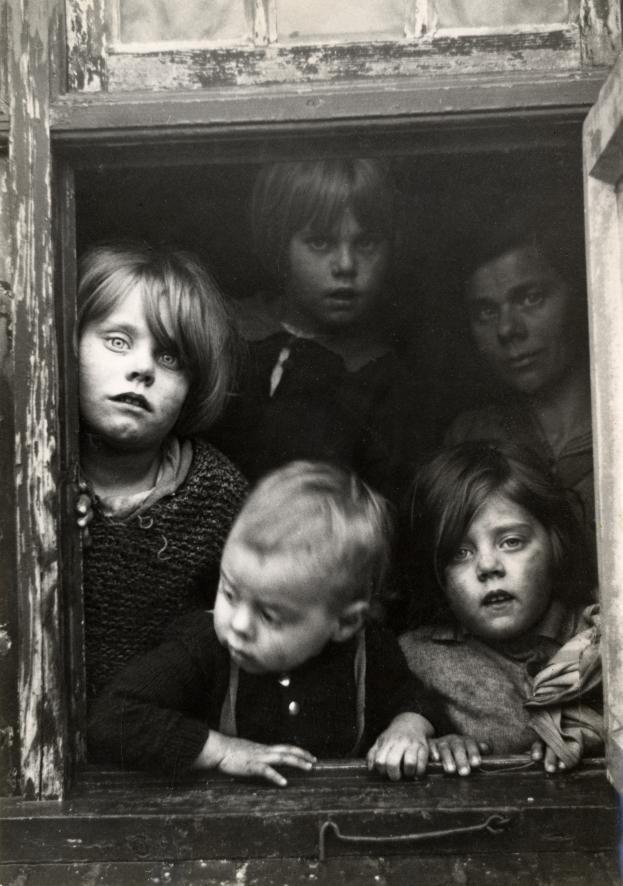
Children of the family Raaymakers, hit by the crisis, getting help thanks to an action of magazine Het Leven. Best, The Netherlands, 1936.
The National Archive in The Netherlands just published a 30 image set on the theme of poverty.
The strength of some of the images blew me away. (Click any image for a larger view) The set spans nationals and eras so this isn’t a photo essay, just a moment to reflect. Through history, photography has indulged the upper classes, but how has it treated the impoverished? I don’t have the answers, just a meandering of a visual train of thought.
Children with scars and with gazes that cut through time …

Irish tinkers: mother and child in front of improvised tent, 1946
… and children slowly erased by time.
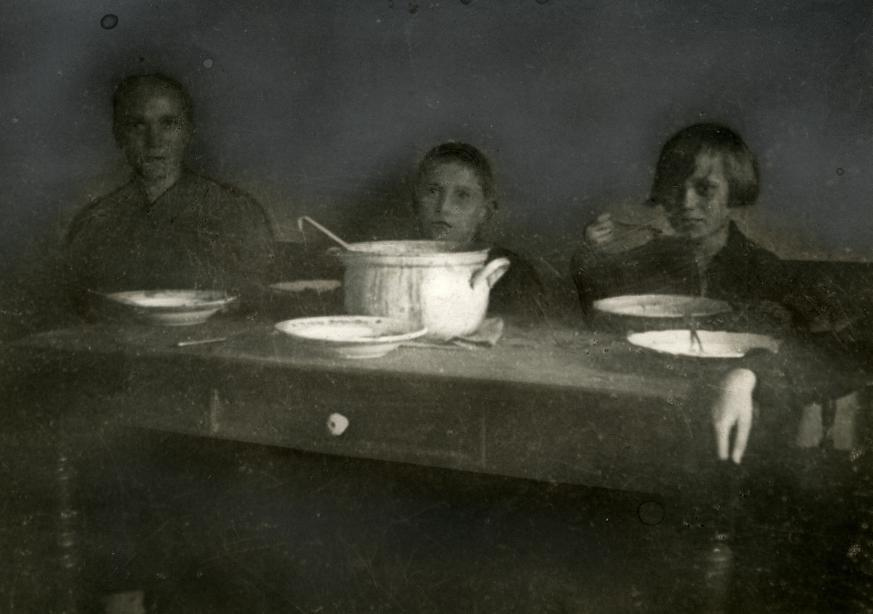
Poor German miners’ families eating at a soup kitchen, 1931
Jobs programs that have adults digging dirt like children digging beach sand …
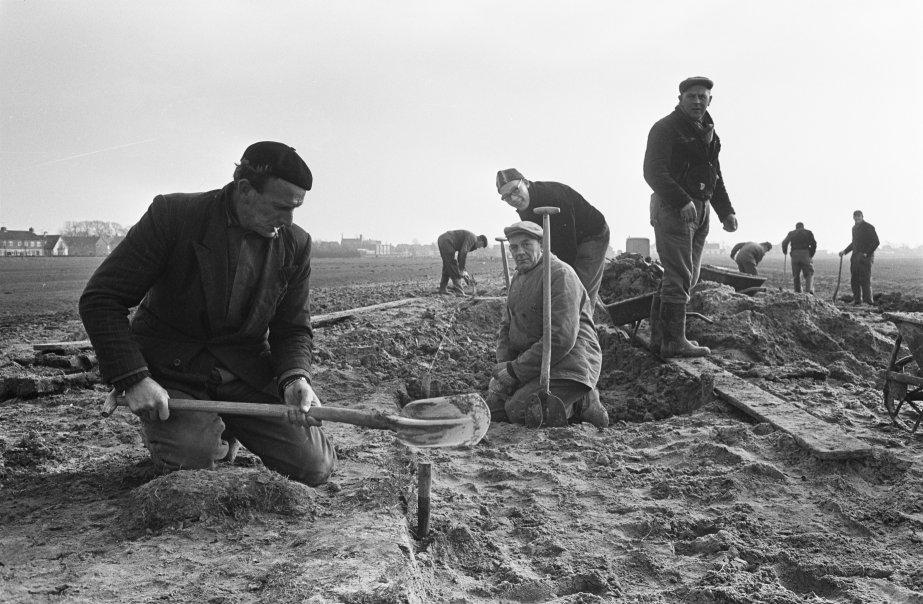
Unemployment relief program in Schagen, Netherlands, 1967
… then, poor people who have carted each other across cobbles …

Woman transported on a hand-cart, Amsterdam, 1934
… and those that sleep beneath them.
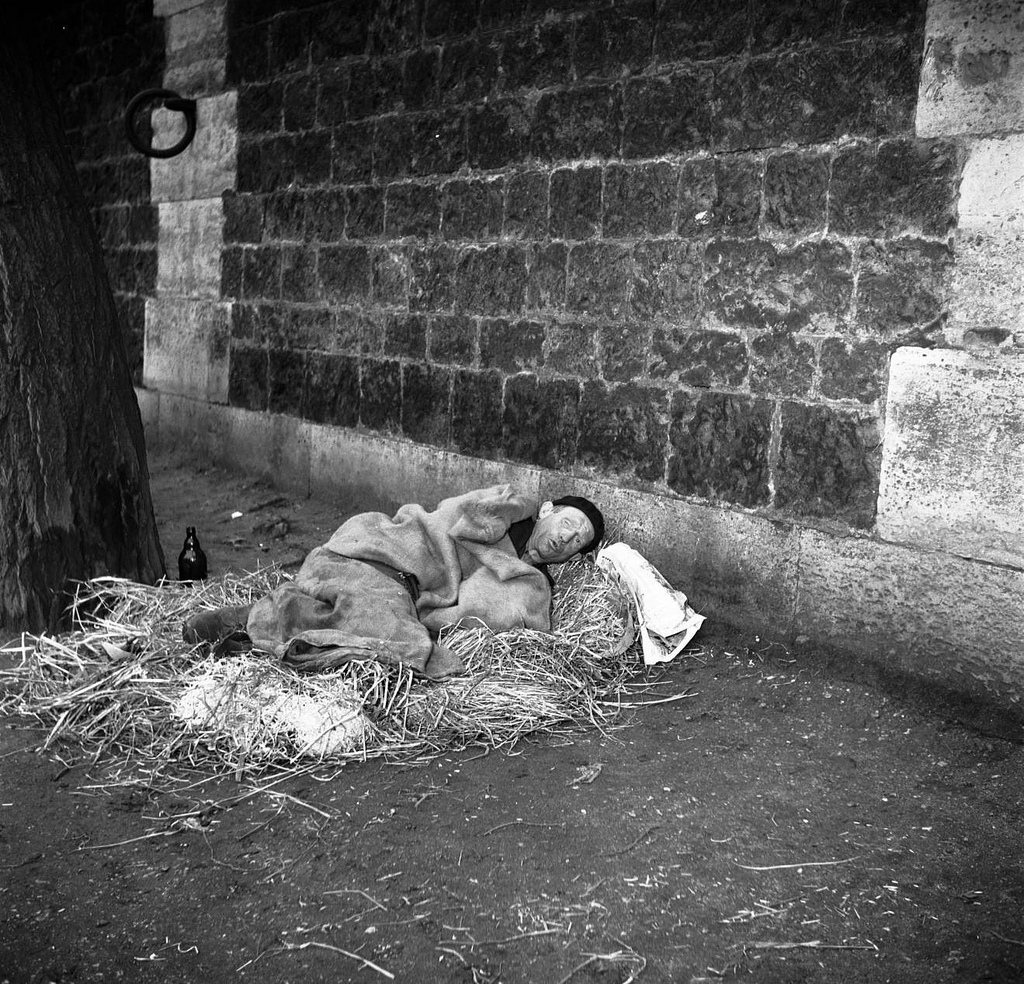
French man spending a night under a bridge, catches a glimpse of photographer Willem van de Poll, date unknown.
Men have begged for the charity of the richest …
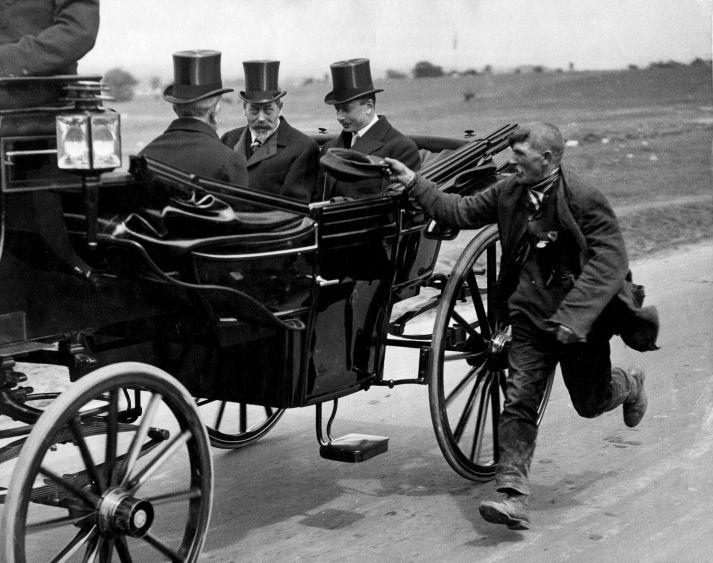
Man begs for money from George V (1865-1936), Epsom Downs, Derby Day, 1920.
…but usually received from the humblest.

Soup kitchen, Rotterdam, The Netherlands, 1917
Poor people have been asked to rent dentures …

Man bites down on available dentures for hire, United States, 1940.
… and they have been made into leaders …

Dutch tramp who became a politician, Amsterdam, 1921
… and in so much as the poor man is the worker, they’ve seen it all.
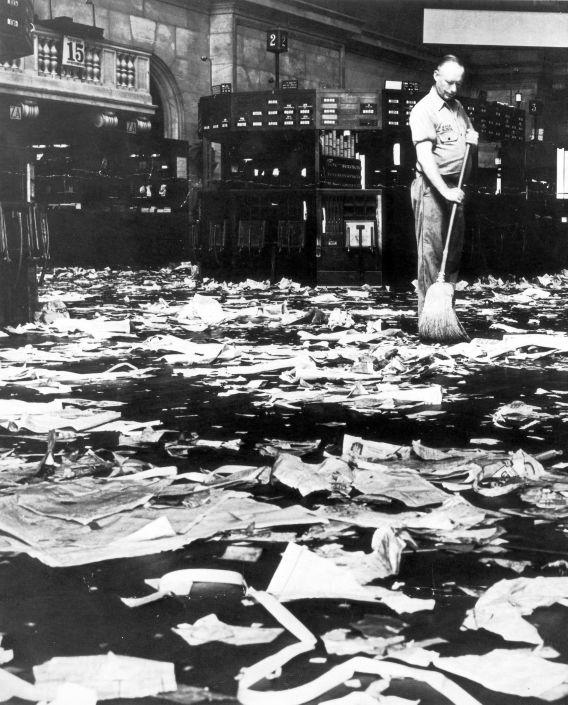
Worker sweeps the floor in the New York Stock Exchange following the Wall Street Crash, 1929.
More images can be seen within the Collectie Spaarnestad: www.spaarnestadphoto.nl

Bettina von Kameke‘s series Wormwood Scrubs is a reflective look at the communal life of prisoners inside one of Britain’s most notorious prisons.
Wormwood Scrubs (Her Majesty’s Prison) is well known in Britain through both popular culture and sporadic news stories about the latest infamous prisoner. It is a institution everyone has heard, some would claim to know about, but in fact only a few truly know. Those few would be the staff and prisoners.
Von Kameke says:
“I was surprised at how respectful the interaction between staff and prisoners was. Of course I was aware that there is drug-dealing inside and it is a hard prison. I could feel the intensity and harshness of the energy… I reflected it in the sadness, heaviness, anger and frustration through the expressions on their faces. But the objective is to show the humanity in the system.”
I am impressed by von Kameke’s awareness (and depiction) of communal living.
“I question and explore the interior and exterior conditions, means and forces, which make a communal life sustainable. My photographs disclose the aesthetics of an enclosed community, which I carefully observe through the viewfinder of the camera.” (Source)
Prison jobs and recreational time are what make incarceration sustainable, and by that I mean as free from waste and repetition as possible.
Prisoners never make direct eye contact with von Kameke’s lens; she shoots as if she is not there. This, I suspect, has a lot to do with the amount of time she spent in Wormwood Scrubs; she spent over six months on the prison wings.*
She and the prisoners probably did have relationships, but they are not the subject of von Kameke’s photography; attentions are elsewhere … apparently.
Between von Kameke and her subjects is acceptance and restraint, almost to the point of collaboration. It cannot be overstated how difficult this is to achieve in a prison environment when everyone potentially has something to pursue and gain through interactions.


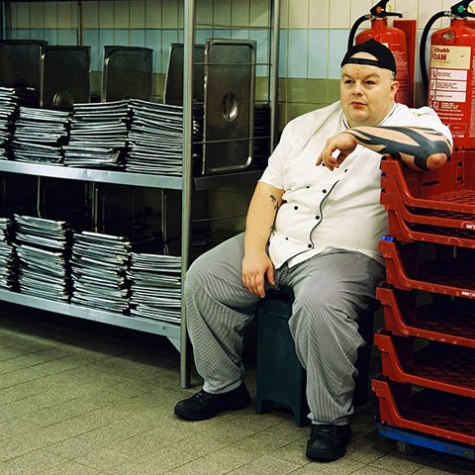
One final thing to note is the overlap in atmosphere between Wormwood Scrubs and von Kameke’s earlier series Tyburn Tree, which depicts the Benedictine Nuns of the Tyburn Tree Convent, London. Communal living within total institutions can be both enforced and voluntary.
Wormwood Scrubs is on show at Great Western Studios, 65 Alfred Road, London W2 5EU until March 11th.
More images at the Guardian.
* I always contend that the best prison photography projects result from a long term engagement with the subject. Von Kameke’s Wormwood Scrubs bears out this thesis oncemore.
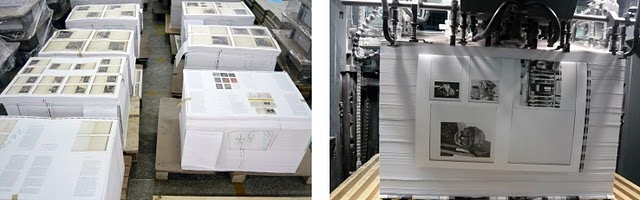
Blake has compiled a great little piece about the final images of some of the best known photobooks.
Here’s what Blake has to say about Eggleston:
The final image in Eggleston’s Guide is typical Eggleston. It’s so banal it almost seems meaningless. Yet I’ve always found this picture loaded and menacing. Peaked hoods in the south creep me out. I wouldn’t make this my last image before bedtime.
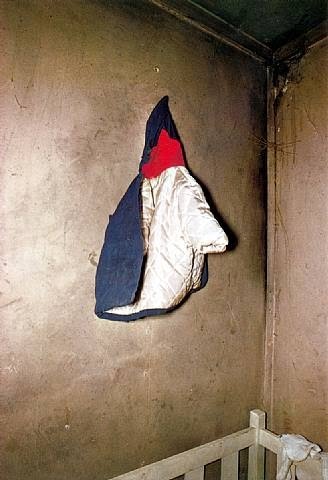
Near Jackson, Mississippi, 1970, William Eggleston
Jeff Ladd explains over at PhotoEye, why, what and how Errata Editions came to be:
“It was in 2004 after Martin Parr and Gerry Badger’s The Photobook: A History Volumes I and II were published that I realized not only the huge scope in the array of photobooks (two-thirds of their choices I hadn’t even heard of) but how elusive most were. Nearly 90% of what had been referenced as the “most important” photobooks are out of print and really only accessible to a few wealthy collectors or through research libraries. As a photography teacher, the idea that a young photographer just learning their craft couldn’t, without great effort or expense, experience what came before them was very disturbing to me. It begged the question of consequence; what if the greatest literature or poetry was not available for young writers to be informed by? That seemed to be the current state of the history of photobooks.”
[My bolding]
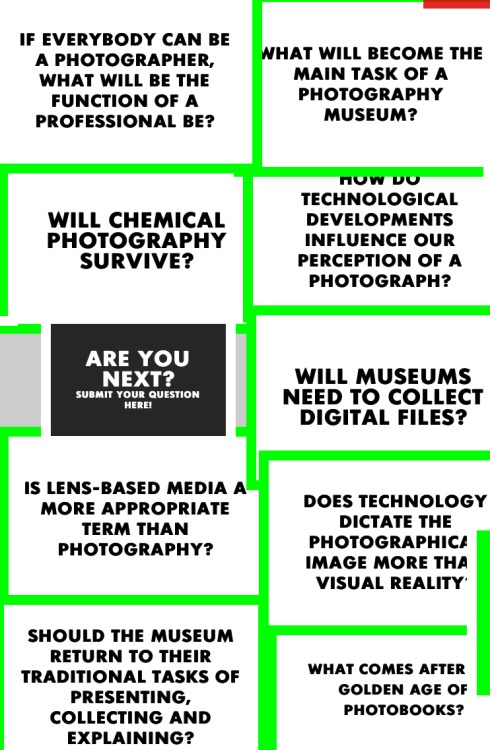
FOAM Magazine has launched WHAT”S NEXT, a platform for discussion of future trends in photography. Covering the questions about digital/chemical photography and the future of photobooks is no surprise.
It is pleasing to see questions about museum curatorship and preservation practices. After all, we can take care of our own archives, but who, how and where to take care of culture’s archives are much larger questions.

Ara Oshagan sat down for an interview with Boy With Grenade to talk about his project Juvies from the California Youth Detention system. Oshagan talks about “access, his process and the state of documentary photography today.” It’s long but parts make good reading.
“There is a certain pragmatism in my outlook. I knew I could not have access to these kids outside of the limited access that I had when I went in. So I did not worry about that. I made sure that I was totally ready—physically and mentally—when I did spend time with them, to make the absolute most of that time, to be fully in the “space” with them, to have a clear mind, to connect as much as possible, and hope that this connectivity will translate into good photographs.”
“To make good photographs, I feel, one must create a good process. Photographs can never be an end; they necessarily must be a byproduct of an experience, a process. That connectivity with your subject matter must be present. If you go into a situation with the sole purpose of making “good photographs” you will invariably fail. Or at least, I will.”
Read the full interview.
I’ve written about Oshagan’s Juvies on Prison Photography once previously.
For all sorts of reasons, my life is a whirlwind right now.
With regard Prison Photography and what it all means, might mean, things are tabled for renegotiation. Rejigging.
The renegotiation is in thinking of more creative ways to share new content, but also leverage old content to make it available to interested parties.
A complete redesign of Prison Photography is on the cards; old interviews and criticism would resurface again. But overhaul is not scheduled within the next year. In the meantime, there exist novel means to share the archive of information on Prison Photography.
This week, I made the trip to Coventry University to guest lecture for the Picturing the Body (#PICBOD) course. Course leader Jonathan Worth is a lesson in enthusiasm. With the backing by Jonathan Shaw and the assistance of Matt Johnston along with a host of others within and beyond the photo deptartment’s walls, Jonathan Worth is creating something wholesome, giving and pioneering.
Worth and his collaborators are building a model for free, online photography curricular in criticism and practice for both BA and MA students; students in Coventry and across the globe.
My presentation ‘Tattoos, scars and tears, Robert Gumpert’s work in San Francisco jails’ (which you can listen to here) focused on Robert Gumpert‘s ever developing project ‘Take A Picture, Tell A Story‘. As an introduction and to provide context to Robert’s work, I summarised the work of photography within sites of incarceration throughout the history of the medium.
Following the lecture, Jonathan Worth suggested the introduction alone could constitute a lecture. I would venture farther and say it could warrant a full course in itself.
I’m writing a few syllabi presently and – in the spirit of #PICBOD – I realised I should be sharing my notes.
So, here they are … on a cachable page for perpetuity.
A BRIEF HISTORY OF PRISON PHOTOGRAPHY (IN LOOSE CATEGORIES)
Before the golden age of photojournalism, the photographing of prisoners was used for purposes of identification, order and discipline. The two part mugshot (front view and profile view) was standardised by Alphonse Bertillion. Police departments adopting the system had in-house technicians and photographers but they are anonymous in history.
Remarkable archives by anonymous police photographers exist the world over, but two noteworthy collections are in New Orleans and Sydney.
American prisons fell on to the radar of professional and committed photojournalists in the sixties and seventies, more and more. Three Magnum photographers (Eve Arnold, Bruno Barbey, Danny Lyon) went to Texas. Arnold returned to the subject again and again. The Lone Star state had a punitive prison culture with reform commonly taking the form of hard labor on the chain gang; images echoed those of slavery in the South.
The “exotic” prison (Late 70s, 80s, USA):
Morrie Camhi’s photographs of California prisoners remain some of the most authentic portraits made within US prisons. Douglas Hall Kent, spent years and published at least two books on prison tattoos. Garry Winogrand stopped by Huntsville for the prison rodeo. The much lesser known Ethan Hoffman produced a book titled Concrete Mama about Walla Walla Penitentiary in Washington State. The brutality and tenderness of interactions between prisoners as depicted by Hoffman are surprisingly frank.
Pioneers in prison documentary photography/photojournalism (1980s and 90s in USA):
Cornell Capa (Attica, NY, USA); Taro Yamasaki (Michigan), Ken Light (Texas), James Nachtwey (Texas and other Southern states), Bruce Jackson (Arkansas), Alan Pogue (Texas).
Contemporary to the Americans (above) was the anomalous Jean Gaumy. In 1976, Gaumy was the first photographer allowed access to a French Prison.
Contemporary prison photography (1990s, 2000s):
Lori Waselchuk (Angola, Louisiana), Ara Oshagan (California juveniles), Victor Blue (California), Andrew Lichtenstein (multiple states).
Collaborative/rehabilitative projects (2000s):
Casey Orr (Leeds, England), Mohamed Bourouissa (Paris, France); Deborah Luster (Louisiana, USA), Klavdij Sluban (France and Eastern Europe), Mikhael Subotzky (South Africa), Steve Davis (Washington State, USA); Robert Gumpert (San Francisco, USA); Leah Tepper Byrne (USA)
Eastern European and Former USSR (Late 90s, 2000s):
Much of the photography from the former Soviet bloc is characterised by the grey abandonment of it all. Into the new millenium, younger photographers took less documentary approach with more nuanced fine art engagement with the inmates of Russia and its satellites. Examine the work of Christian Als (Latvia), Carl de Keyzer (Siberia), Yana Payusova (Russia), Sasha Maslov (Ukraine); Delmi Alvarez (Latvia) and Jane Evelyn Atwood.
Western Europe:
Generally, a more tactical use of technique and viewing from photographers such as Nico Bick (Netherlands), Juergen Chill (Germany), Matthieu Pernot (France and Spain), David Moore (London, UK) Danilo Murru (Sicily and Sardinia); Lizzie Sadin (Multiple countries); and Melania Comoretto (Italy).
Guantanamo (2002 – ):
Many photographers have addressed Guantanamo including Paolo Pellegrin, Brennan Linsley, Tim Dirven, Chris Maluszynski, Bruce Gilden, Louie Palu and Christopher Sims. Above all others, Edmund Clark has made the best contribution with emotive images from former detainees’ homes, letters of the detainees and an extremely engaging essay from Dr. Julian Stallabrass.
Political memory (20th and 21st centuries):
Donovan Wylie (Northern Ireland), Paula Luttringer (Argentina), Dana Mueller (US POW camps), Phillip Lohoefener (East Berlin Stasi prisons) and Anna Schteynschleyger (Former USSR).
Archives of Atrocities:
Willhelm Brasse, known as the Photographer of Auschwitz during WWII; the photographers of Tuol Sleng in Cambodia during the Kymer Rouge regime (1975-1979); Victor Basterra, Naval Mechanics School (ESMA), Buenos Aires, Argentina during the Dirty War (1976-1983)
Conceptual:
Chris Jordan‘s large digital composites that stack 2.3million prison uniforms upon six floor-to-ceiling cnavases approach the depressing scale of US incarceration. Featured in ‘Invisivle’ a summary of his first ten years or so probing military and state secrets, Trevor Paglen “stalked” previously clandestine extrajudicial prisons used in the global war on terror. Broomberg and Chanarin, on a tour of Afghanistan rolled-out sheets of photographic paper on days of historical importance, in one case a jail-break.
Africa (21st Century):
Without exception the photographs of African prisons focus n the deplorable conditions, the mistreatment of children and usually both. Julie Remy (Guinea), Fernando Moleres (Sierra Leone), Lynsey Addario (Uganda & Sierra Leone), Nathalie Mohadjer (Burundi), Joao Silva (Malawi).
INQUIRY NOT GENRE
Given the breadth of photogs’ motives and the different uses of these images it is foolhardy to think of prison photography as a genre. I have taken to calling it a ‘non-existent’ genre.
The website Prison Photography is an inquiry, primarily into the uses and abuses, creation, consumption and distriubtion of images within highly politicised institutions. The photograph is only the beginning.

 Prison Photography