
You are currently browsing petebrook’s articles.
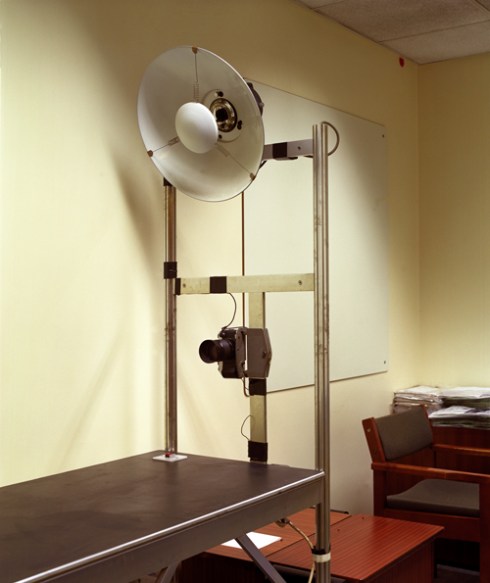
Photography and fingerprinting room.
David Moore has an uncanny knack of gaining access to sites most photographers might think are beyond reach.
In the Summer of 2009, Moore took advantage of a short-window of time during which the cells inside Paddington Green Police Station sat empty. The survey Moore completed – a series entitled 28 Days – was the first foray into this infamous jail. Prison Photography is proud to publish these images for the very first time.
[Keep reading below]

Chair.

Forensic pod.
Paddington Green Police Station is structurally banal. Constructed in the late sixties, its functionalism is belied somewhat by a concrete-lovers facade. For Britons, Paddington Green means one thing: Terrorism. Built into and underneath the station are sixteen cells and a purpose built custody suite; extraordinary hardware for a police station, but not for the interrogation of high-level terror suspects.
In the 1970’s many IRA suspects were incarcerated at Paddington Green prior to appearing in court. At that time, the period of initial detention was up to 48 hours, this could be extended by a maximum of five additional days by the Home Secretary. (Prevention of Terrorism Act, Northern Ireland, 1974). British terror legislation was not renewed until the Millennium.
The Terrorism Act of 2006 increased the limit of pre-charge detention for terrorist suspects to 28-days, hence Moore’s title for the work.
Originally, the Labour Government and Prime Minister Tony Blair, had pushed for a 90-day detention period, but following a rebellion by Labour MPs, it was reduced to 28-days after a vote in the House of Commons.
[Keep reading below]

Control room.

Chair, police interview room.

Holding cell.
In 2005, Lord Carlile (a hero of photographers, as a key person in reversing abused UK police stop-and-search procedures) was appointed independent reviewer for the government’s anti-terrorism legislation. His team visited Paddington Green in May, 2007 and issued a damning report on its inadequacy as a modern facility for the detention of humans for such extended periods.
The facilities […] were designed when the station was built in the late 1960s in order to deal with terrorism suspects from Northern Ireland – a far different threat from that faced from international terrorism today, in terms of scale and complexity. The main deficiencies of Paddington Green are as follows:
* there are only 16 cells. Over 20 people at a time were arrested during individual terrorism investigations in both 2005 and 2006 and some had to be sent to Belgravia police station, which is not set up to deal with terrorism suspects. In addition, the normal day-to-day work of Paddington Green police station, which serves the local neighbourhood, was severely disrupted.
* there are no dedicated facilities for forensic examination of suspects on arrival. Cells have to be to specially prepared for this purpose, which is time consuming and further exacerbates the lack of accommodation.
* there is no dedicated space for exercise. Part of the car park can be cleared to provide a small exercise yard but this takes time to arrange and the car park is overlooked. This is likely to reduce considerably opportunities for exercise.[48]
* only one room is provided for suspects to discuss their cases in confidence with a solicitor.
* there are no facilities on site for the forensic examination of equipment such as computer hard drives.
* the videoconferencing room is too small to accommodate judicial hearings on the extension of the period of detention. Such hearings are usually now held in the entrance lobby, which is itself cramped, is a thoroughfare into the custody suite, and opens into the staff toilets at the back. It is clearly an inappropriate location for such a crucial part of the detention process.
(Source)
And so it was, shortly after the completed £490,000 refurbishment of Paddington Green Police Station, Moore photographed to the smell of fresh paint.
[Keep reading below]

CCTV camera with courtesy screening over toilet, holding cell D

Holding cell D.
28 Days is a continuation of Moore’s preoccupation with sites of state apparatus, but this was not always his interest. During the nineties, Moore worked in New York as a commercial photographer, Upon his return to his Britain, he spent three years piecing together The Velvet Arena (1994), a look at the textures, couture and gestures of high society, openings and schmoozing … canapes and all.
From here Moore, still concerned with the dark weight of the familiar made photographs of the House of Commons. He describes The Commons (2004) as a forensic view. “British people know what the House of Commons looks like,” said Moore via Skype interview. His response was to get close and change the view; he focused on corners, carpets, perched flies, scratches in the wood and banisters.
The Commons was pivotal in Moore’s development. He argues that photography has always been entangled in politics, specifically the British Empire. Following the destruction by fire of the existing Houses of Parliament on 16 October 1834, Barry and Pugin designed the new houses for British law with Gothic-Revivalist importance. They were completed in 1847. Photography’s earliest manifestation came about in 1839 with the daguerreotype.
Law, reason, progress, conquest, taxonomy and technology drove the British Empire through the end of the 19th century. Photography, with its will to objectivity, played its part in stifling cultural relativism; it disciplined both colonialist and colonised. Against this history, The Commons, for Moore, was “born of political frustration.”
“It was important for me to break it down. I am probably most influenced by Malcolm McLaren than anyone else,” says Moore.
[Keep reading below]

Solicitors’ consultation room

Virtual courtroom.
“My volition as a photographer goes back to the want to use it as a democratic tool. Looking at state apparatus and panoptic sites, I see my work as an act of visual democracy. Any small chip I can make.”
In 2008, Moore made quite a large chip. For The Last Things, he negotiated access to the Ministry of Defence’s crisis command centre deep beneath the streets of Whitehall, London. Moore got the pictures no other photographer ever had, or ever will. Read my article for Wired.com about Moore’s experience working in the subterranean complex that – to this day – officially “does not exist.”
The Last Things more than any other portfolio, opened the door for Moore to work at Paddington Green. It was a body of work with which he could show he could be trusted. Besides the Police Station was vacant. “It was relatively low security,” explains Moore.
“Paddington Green was very different to the MoD crisis command center. Paddington Green is imbued with a history and a trajectory of history. I know about [IRA] terrorism and about interview techniques and who’d been held in there over the years.”
For Moore, 28 Days is a contrast of the old and the new. An old building with new fixtures. Old procedures replaced by new codes of conduct. “There were definitely some opinions from older police officers: ‘These are terrorists, what does it matter if a cell is painted or not?’ and there was a mix of young and old police officers. The architecture reflected the changing Metropolitan police,” says Moore.
Moore’s work at Paddington Green is a glimpse of an institution in transition; in a moment and not in use. It could be said the stakes were low for London’s Metropolitan Police; that the risk was minimal. It is likely Paddington Green Police Station will cease to operate as the first stop for terrorist suspects. Plans are afoot for a new purpose-built facility. For the authorities, Moore’s work is transparency, for us it is curiosity sated, and for the photographer it is a small victory for “visual democracy”.
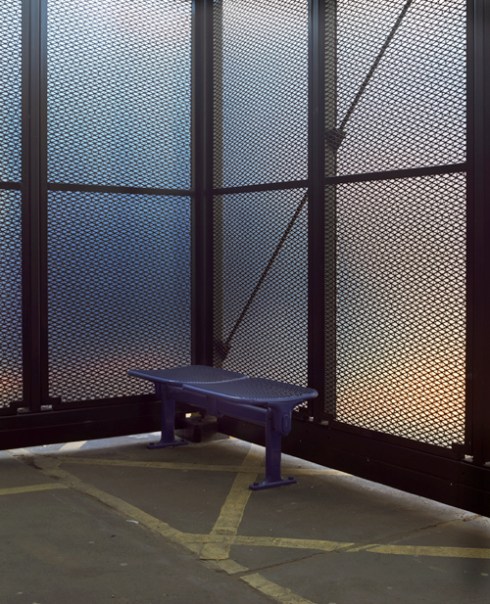
Exercise area.
All Images Courtesy of David Moore
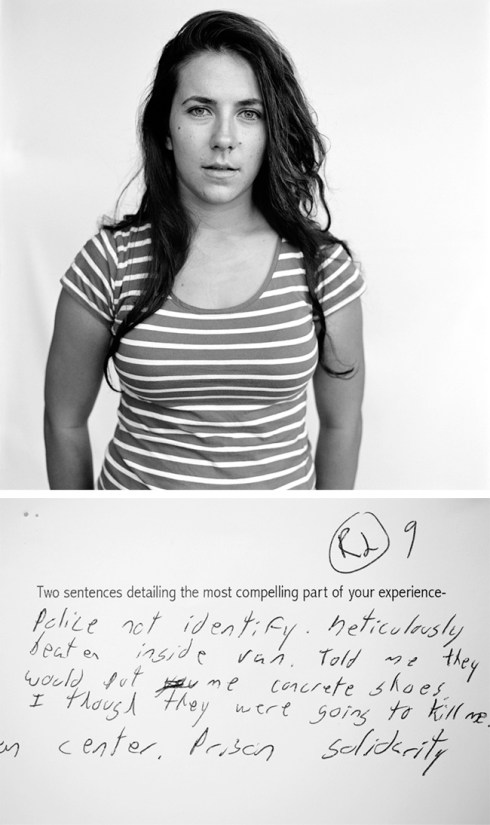
National Post photographer, Brett Gundlock was one of the 304 protestors arrested during the G20 protests in Toronto, last June.
Since last Summer, and dissatisfied generally with the representation of the protests, Gundlock has tracked down many of those also taken into custody. He has asked each of them to provide a (very) short statement on the experience of being processed through protest-policing and city jail.
In March, Gundlock will mount a show for the portraits and accompanying testimonies. For this he has already crowdfunded the $1,500 necessary via RocketHub. You can read more about the project here or you can watch Gundlock’s video intro.
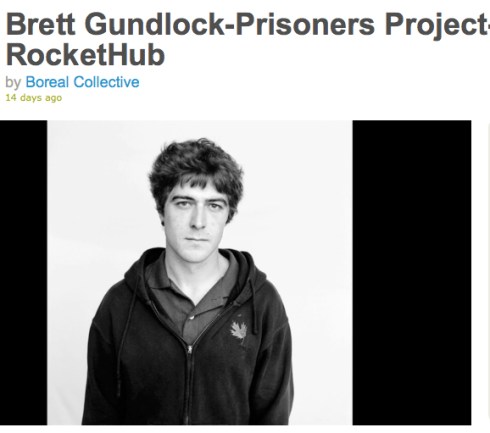
Picturing Victimhood
Gundlock’s portraits are rather austere, which probably fairly reflects the seriousness with which many protestors take to their direct actions. In formal arrangement, they echo the look of two very famous photographers before him.
Marc Garanger, a young French soldier was pressed into a fortnight of taking 2000 identity pictures of Algierian women. Garanger considered himself – as military man and photographer – as an aggressor. His female subjects as victims. Although, as Fred Ritchin describes, when Garanger returned to Algeria decades later he was warmly received by the sitters and their families. And thus squashing the simplistic presumptions of the Western audience.
Richard Avedon’s In The American West was the work of a fascinated, brave yet perverse outsider. Perhaps the most amazing aspect of In The American West was that Avedon – under the guise of fine art – used his camera to adopt an outsider engagement with his subject akin to ethnographic research. In 20th century America, no less.
Whatever we might think of Avedon’s awe and reverence to his cowboys and oil-workers, they are set up as victims by means of their exclusion from the comfortable predictability of majority America.
Photographically, one end of the spectrum (Garanger, Avedon, Gundlock) depicts victims quiet and silent, while the other has them wailing in grief and duress. I’d suggest in this visual environment, Gundlock has made the right decision to ask for written recollections of the moment from his subjects.
Brett Gundlock is part of Boreal Collective.
Found via drool
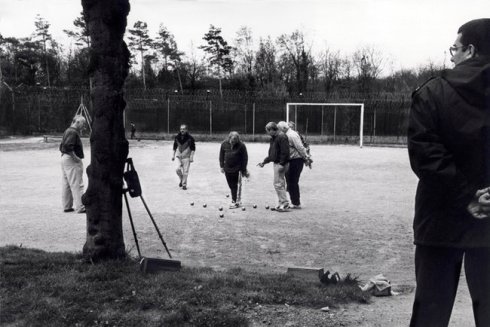
The daily game of pétanque, de Liancourt Detention Centre, France 2001. © Nicole Crémon
Nicole Crémon’s decade-old L’âge en Peine/The Age of Pain peers jejunely at a French prison used to lock-up old men. Even so, I just wanted to share this image. What the photograph lacks in composition it makes up for with its baffling scene.
The most secure game of bowls since yesterday’s game.
Geriatric Issues Previously on Prison Photography

Hillary Clinton at Uncle Nancy’s Coffeehouse, Newton, Iowa April 21, 2007 © Richard Colburn
Richard Colburn‘s Iowa Caucus is a poke in the eye to the super-production value of big media. His famous politician subjects are vulnerable and open, maybe confused or amused. I guess being exposed is a fair reflection of their experience meeting voters in the high-stakes early battle-state of Iowa. But I don’t get the impression Colburn is being cruel or ironic.
How does he isolate these public figures?
Colburn, like his images, might be very disarming. For me, this project has just become a barometer for other political portraiture.
I like these gentle versions of politicians. Instead of hawkish advisors, backroom deals and lobbyist “donations”, I’m thinking about grandparents and pie and mowing the lawn.
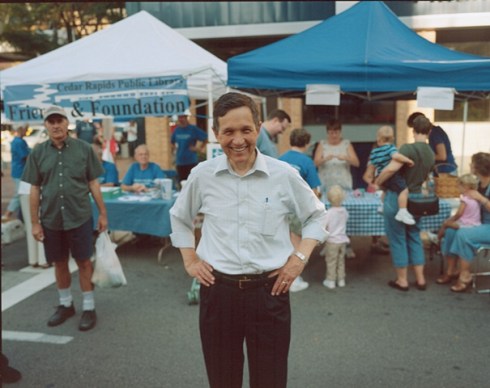
Congressman Dennis Kucinich at the Cedar Rapids Farmers Market. October 6, 2007. Withdrew January 25, 2008. © Richard Colburn

First off, some disclosure. M. Scott Brauer is a close friend, but I have a lot of friends who produce stuff and it’s never a prerequisite for promotion.
I enjoy this project.
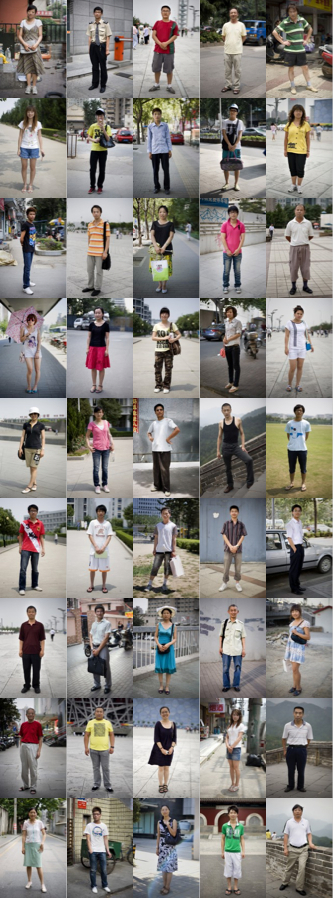
‘We Chinese‘ is several things. It is part break-up/part love-letter for Scott after relocating back to the States after years spent in China. It is a project to hum in the back of our minds whenever we think – or talk – about photography in China today. A nation of 1 billion can never be summed up by a single image or series, but good photography can provide firm foundations for thought.
Scott asked each subject two standard questions. The responses “range from prosaic to poetic, from rote to inspired, and from unemotional to patriotic.”
My favourite response is that of Wangbaoning, aged 20, who is unemployed but works for free as a building security officer. As compared to his assured fellow countrymen and women, his second answer is decidedly undecided.
What does China mean to you?: It stands for a unified China at this stage realizing hopes to be the master of its own affairs into the future.
What is your role in China’s future?: I haven’t really thought about it at this point, we’ll see, depends on motivation.
ALSO WORTH A LOOK
M. Scott Brauer’s Best Photographs of 2010

Nutraloaf, a product from the cafeteria of the Chittenden Regional Correctional Facility, sits atop an inmate’s bunk bed at the facility in South Burlington, Vt., March 21, 2008. (AP Photo/Andy Duback)
Last August, with Is Prison Food Unconstitutional? was the first time (on the blog) that I had considered the nutritional health of US prisoners.
Despite the catchy headline bait, the number of organic food programs within prisons serving their canteens is still limited. The reality is that prisoners eat poor quality food.
Earlier this month, CBS reported that “the USDA recalled more than 200,000 pounds of ground beef products sent to prisons in Oregon and California after inspectors found that some were discolored and smelled funky.” The packed-on dates were between July and November 2010. This beef went only to prisons, not to retailers.
Bryan Finoki, usually residing at Subtopia, has launched a call for Prison Food Critics.
“It seems as though the connections between the two [prisons and food] can be seen across a fascinating spectrum of cultural, moral, and economic landscapes, sharing fascinating intersections with histories of pop food magnates, innovative smuggler networks, Auschwitz-era recipe books, the politics of prison labor, and race-infused hunger strikes, just to start! […] Prisons don’t just deserve their own inmate food writers – they absolutely need them!”
Finoki meanders through prison food law, the cultural history of Nutraloaf and even theorises food as warfare, “Food is a very primal weapon, and its disguise under the cloak of non-lethality would surely not escape our astute prison food writer. In fact, no one has studied the long-term effects of prison food or the Nutraloaf.”
I am just left to wonder if writing is enough? Isn’t the juicy, dripping, all-colour image part-and-parcel of foodie blogs, recipe mags and eatery advertisements?
Shouldn’t the articles Finoki calls for be accompanied by dressed food photography?
WANTED! Prison Food Photographers!
SUSTAINABILITY PREVIOUSLY ON PRISON PHOTOGRAPHY
Science in Prison, Change Within Ourselves
Benjamin Drummond, Sara Joy Steele, Nature and Washington State Prisons
Last November, I delivered a lecture entitled Photography and Haiti’s Prisons in the Aftermath of the Earthquake. (Listen here, prep here.)
The lecture was more about how scant photographic evidence compounded the scare-mongering in written media following the escape of over 4,000 prisoners from Haiti’s National Penitentiary, Port-au-Prince.
I also paid tribute to The New York Times for their tenacious investigation of a prison massacre cover-up at Les Cayes Prison, 100 miles west of Port-au-Prince.
I encouraged students to have both critical stances on these contested and emotional narratives, but also keep a look out for media follow ups to the situation in Haiti regarding prison conditions, the reconstruction of the justice/prison system, and policing in the capitol.
Today Bite Magazine! published a 10 image essay by Boots Levinson of the ongoing “round-up” of prisoners.
Prior to the earthquake, Haiti’s prisons were renowned for corruption. Levinson’s images show us policing activities but they do not answer whether these prisoners were guilty of a serious crime in the first place.

#PICBOD
So successful was Jonathan Worth’s Photography & Narrative (#PHONAR) course, that Coventry University has decided to repeat the open and free, web-based format once-more. Classes are already underway for the Picturing the Body (#PICBOD) course. I am pleased to say I shall be involved again. More on that later.
Visit the site #PICBOD website.
Each year, UNICEF Germany grants the “UNICEF Photo of the Year Award” to photo series that best depict the personality and living conditions of children across the globe.
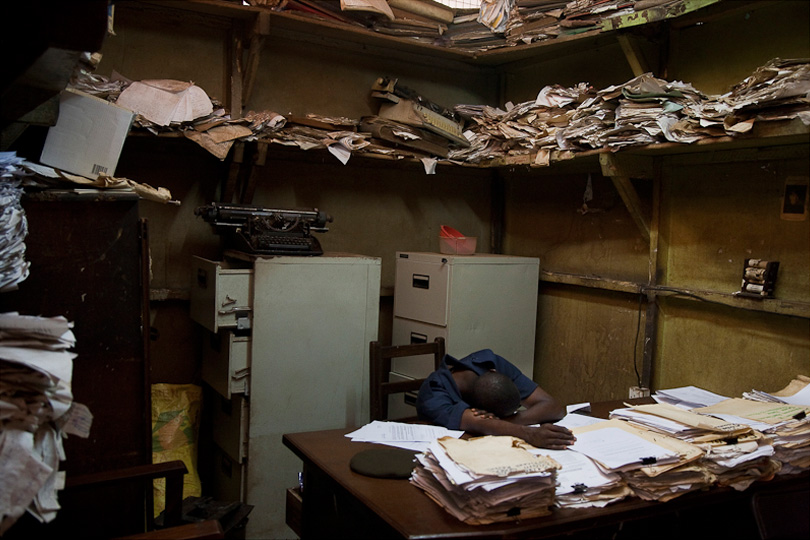
Among the 2010 Honorable Mentions was Spanish freelancer Fernando Moleres for his documents of children in Central Prison, usually known as Pademba Road Prison, in Sierra Leone’s capital Freetown.
Click here, scroll down and click on his name to see the full UNICEF portfolio. Click here for Moleres’ full portfolio.
It’s often difficult to engage an audience with “new” images of prisons, but Moleres succeeded with the image of the collapsed official at his desk (above). The disorganisation of paperwork in this image works as metaphor for a broken institution – much as Hogarth’s littered furniture and bodies are metaphors for broken society.
It also works as a foil (for those who are familiar with) to Jan Banning’s Bureaucratics portfolio; even those of Banning’s subjects amid seeming disarray, never appear defeated like Moleres’ prison administrator.
“Pademba Road Prison was built for 300 prisoners, but it has more than 1,100 prisoners at present, many of whom are children,” explains Moleres.
Conditions are appalling and hearing trials is based more on chance than process. “Countless cases of unspeakable misery – that’s the life of those who are imprisoned here,” says Moleres. “There are no beds, mattresses or sanitary facilities. No electricity and no water. Hardly any food. Their relatives often don’t know anything about the fate of the prisoners.”
A broken, hectic institution.
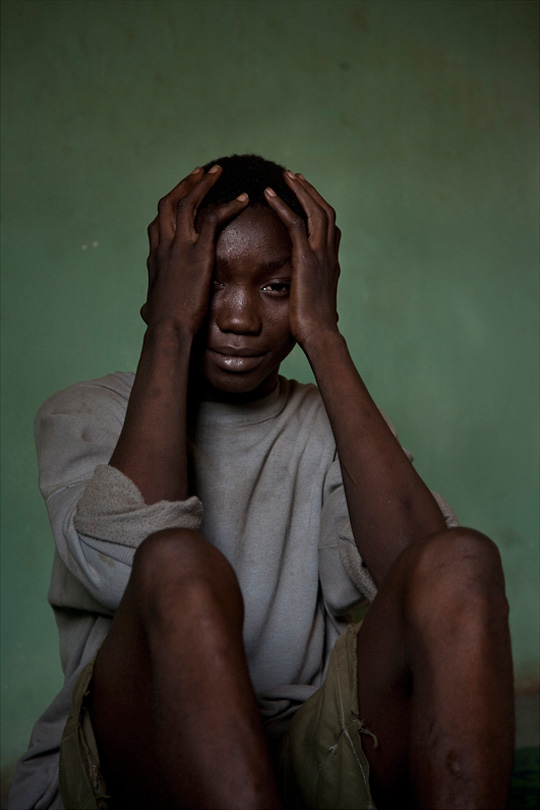
Moleres continues with three examples, “Teenagers like 16-year-old Lebbise*, sentenced without trial to three years in prison because he allegedly stole 100,000 Leones (25 Euros). 17-year-old Hilmani*, sentenced without trial because he allegedly stole his uncle’s scooter. 17-year-old Manyu*, sentenced without trial to three years in prison because he allegedly stole two sheep. He died in prison in spring 2010.”
*Names changed
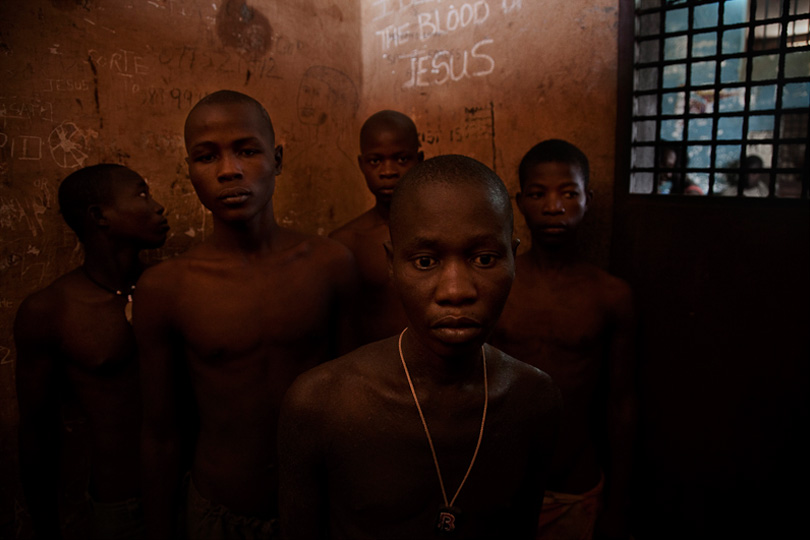
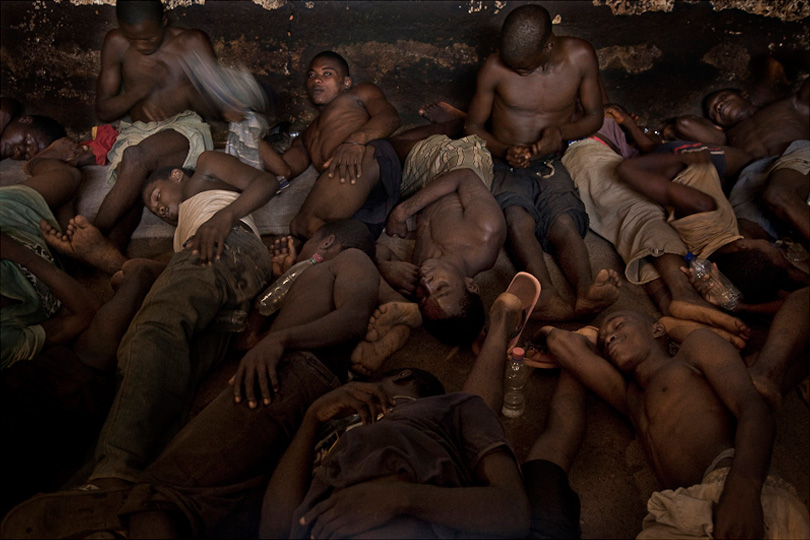

As an audience to this type of imagery, we should note that, in 2006, Lynsey Addario photographed in Pademba Road Prison as well as jails in Uganda. On the evidence of the photographs, conditions have not improved.
Moreles paints a picture of a wasteful, desperate and predatory environment in Pademba Road Prison. This is the common view of prisons in many African countries, and sadly the reality for children caught in these systems. Many of Moleres’ photographs repeat the scenes of prisons photographed by others working in Africa, eg, Nathalie Mohadjer (Burundi), Julie Remy (Guinea), Joao Silva (Malawi) and Tom Martin (Burundi).
The common threads of these portfolios is tension, filth, depleted light, malnutrition, overcrowding and the solitary gaze of a forlorn child.
Prisons are most destructive to young lives that are not prepared for induction to the unpredictable environment. I would say this of prisons in America and the UK just as readily.
UNICEF is right to shed light upon the most upsetting (and unseen) realities for the most disenfranchised children in our global society.
FERNANDO MOLERES
Moleres also won the Luis Valtuena International Humanitarian Photography Award for his story on the prison system in Sierra Leone.
Molores has photographed children and the issues that affect their since 1992. in over 30 countries. He has been recipient of a Mother Jones Grant, (1994), the “Juan Carlos King of Spain” International Prize (1995), an Erna and Victor Hasselblad Foundation Grant, Sweden (1996), a finalist for the Eugene Smith Prize (1997), World Press Photo award for “Children at work” daily life series (1998), W. Eugene Smith Prize, 2nd prize (1999), World Press Photo, Art category (2002), Revela International Award, Spain, (2009), Honorable Mention Philantropy Award (2010) and an Honorable mention for the Gijon international Prize.
http://www.fernandomoleres.com/
UNICEF PHOTO OF THE YEAR
The prizes for the UNICEF Photo of the Year, 2010 went to First: Ed Kashi; Second: Majid Saeedi; Third: GMB Akash.

 Prison Photography