
You are currently browsing petebrook’s articles.

Yesterday, I still didn’t know the blogger’s identity, now at least I know his or her initials are A.S.H.
If you’re aren’t reading Iconic Photos you should be. It is excellent. A.S.H. has just posted on his/her first 500 days of blogging.
Everything from love for commenters (Iconic Photos get a lot), to dubious search criteria, to accusations of very specific Americocentric partisanship despite the bloggers non-US citizenship.
A.S.H. sounds like he/she is having a blast, and despite A.S.H’s insistence he/she is not a good writer, I beg to differ.
This is worrying.
Los Angeles Jail guards at the Pitchess Detention Center, Castiac, CA have a new weapon in their armory. The 7 1/2-foot-tall ‘Assault Intervention Device’ emits an invisible 5-inch-square beam that causes an “unbearable sensation”.

The device is manufactured by Raytheon, an 80 year old multibillion dollar surveillance, radar and missile specialist with a catalogue of space-war technologies. Compared to Raytheon’s sprawling, global and stratospheric innovations, the ‘Assault Intervention Device’ is small, contained and personal.
Cmdr. Bob Osborne of the LA County Sheriff’s Technology Exploration Program, one of several deputies who tested (see video) the ‘Assault Intervention Device’, described the experience, “I equate it to opening an oven door and feeling that blast of hot air, except instead of being all over me, it’s more focused.”
The device – controlled by a joystick & computer monitor and with a 100 foot range – will be mounted near the ceiling in a unit at Pitchess housing about 65 inmates.
NBC Los Angeles reports, “The energy traveling at the speed of light penetrates the skin up to 1/64 of an inch deep. […] ‘Assault Intervention Device’ is being evaluated for a period of six months by the National Institute of Justice for use in jails nationwide.”
The statistics for violence at Pitchess are quite shocking – 257 inmate-on-inmate assaults occurred in the first half of the 2010.
Pitchess, a facility with 3,700 inmates, is a large facility with riots (some very recently) and obviously needs to counter the culture of violence. I just wonder whether shooting brawling inmates with lasers is the right way to go about it?
– – –
I have looked at highly sophisticated technologies before and how their imaging can affect our understanding of prison life, tension, engagement.
How would images of prisoners reeling from a ‘Assault Intervention Device’ laserbeam influence public opinion about this new fan-dangled correctional management tool? The deputies who’ve tested it say it’s unbearable and can only be endured for three seconds maximum, yet everyone knows that tasers are often repeatedly discharged upon stubborn, adrenaline-fuelled (sometimes drugged up) targets.
Again, very worrying.
“Women actively participated in every significant photographic movement and school of the twentieth century. […] As a young historian I discovered that a little digging in any period yielded important women who had been exhibited and published locally, nationally, and internationally. Women’s representation and the acknowledgment of their contributions declined or disappeared only when later historians evaluated a movement. The more general the compendium, the less likely women were to be well represented.”
Anne Tucker’s foreword for Reframings: New American Feminist Photographies
Kate Wilhelm of Peripheral Vision has put together a thoughtful post about the exposure, visibility and success of female photographers in the industry. Wilhelm’s main contention is the standards that exist in photography are male standards, a set-up particular to photography and not seen, as such, in other visual arts. I think she might be on to something.
I think photography (particularly fine art) is aggressively contested and often antiseptic, emotionally detached photos win over. I am not saying women have the market on emotion, but I do think female photographers might be attracted to subjects other than the cold observations that tend to dominate.
We seem to welcome softness, expression and emotive content in painting, but we either balk or yawn at the “sentimental” use of bokeh, lens flare, and golden hour dreamscapery in photography. I guess I worry that photography can be a cynical practice (?)
Photography has become synonymous with detachment and I think men are more comfortable celebrating detachment … Je suis désolé … I argue that solitary aesthetics, pursued by men in photography, have influenced the judging standards across the entire discipline.
Wilhelm provides these stats, which are her own observations, counts but a good start for discussion.
500 Photographers has only covered 17 women out of the 94 photographers it’s so far covered. That’s 18 percent.
Image Makers Image Takers has interviews with 20 photographers. Five of them are women. (Incidentally, it was edited by a woman.) That’s 25 percent.
The photograph as contemporary art, by Charlotte Cotton, discusses 219 photographers, give or take a few. 91 of them are women. That’s 42 percent.

I was sorry to hear that, after 6-and-a-half years, Big RED & Shiny has decided to close up shop. It’s 135th issue will be its last. It’s not ending operations due to money but because its just arrived at that time.
BR&S’s self-defined scope was the New England Arts scene, but in reality its reach and applied knowledge was national.
In my past writing I have leant on some of the great photography articles at BR&S – Larry Sultan, William Christenberry, Harold Feinstein and Stephen Tourlentes.
BR&S has had over 170 contributors down the years and the sites development stands out as a true community; the writing has been considered and committed – Matthew Gamber was editor-in-chief for 126 issues; writers turned editors, Micah Malone and Christian Holland, started with the first issue; James Nadeau first wrote an article in issue #19 and remained as editor.
Matthew Nash, publisher of BR&S said this:
If Big RED & Shiny were a human, our six-and-a-half years would put them in the first grade. Yet, online we are old. Very old. We have been online a full third of the life of the Internet. There was no Facebook when we started. No Blogger. No MySpace. The iPhone was over 3 years in the future.
If Nash is suggesting that BR&S has less of a place in the rapidly changing internet (which I’d currently characterise as an idea-economy, link-economy, micro-blogging, shuffling-content internet) then he is surely wrong. He observes that perhaps people have less need for editorial framing and more an appetite for primary content. Nash could be right, but I don’t know if that means editorial writing is pushed out. I hope that there’s room for both – I mean, a tweet (which is essential a quick-fire bulletin board) does not compete with a full length article (which is substantive content, ideas).
Whatever. The debate on the web is a distraction really from an announcement that means our arts coverage online just got a little thinner. Thankfully, the archive lives!
BR&S – Sad to see you go. Good luck with future endeavours!

Leventi, David - Stateville, Joliet, IL
Following my recent post of David Leventi‘s work, a reader contacted me to alert me of the potential (and presumably happenstance) development of Stateville Correctional Center, Joliet, Illinois as an art object.
Consistently through the representations of Stateville is the description of the roundhouse as one of the last remaining prisons in America adhering to the Panopticon model developed by Jeremy Bentham.
Let us be clear, the Panopticon is an outdated and abusive model for corrections; it relies on a small number controlling a large number through the threat of constant supervision. Modern correctional management must look beyond disciplinary techniques based upon spatial arrangement and look toward truly transformative (educational) engagement with prison populations.
Still one can only speculate that the roundhouse prison is of interest to artists primarily because of its “purity” of form as understood – and communicated – through the formal qualities of composition within the photographic print.
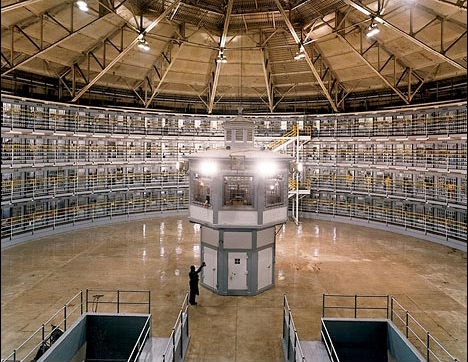
USA. Illinois. 2002. Stateville Prison. F house. There were originally four circular cell houses radiating around a central mess hall. The buildings were based on Jeremy Bentham's 1787 design for the panopticon prison house. The first round house was completed in 1919, the other three were finished in 1927. F house is the last remaining panopticon cell house. It's used for segregating inmates from the general prison population and for holding inmates who are awaiting trial or transfer. -Doug DuBois & Jim Goldberg.
In 2002, Doug Dubois, along with Jim Goldberg, went to Stateville Correctional Centre, and took a picture (above) of the prison’s interior. The New York Times later published the photograph.
A while later, Dubois found out that Andreas Gursky had too gone to Stateville, apparently inspired by Doug and Jim’s photograph and took a picture himself (below). Gursky has admitted in his career he finds ideas for images in newspapers and other popular media. Gursky’s image put in context here, at the Brooklyn Rail.
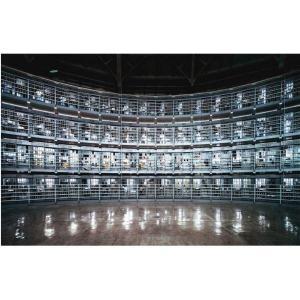
Andreas Gursky, “Stateville, Illinois” (2002), C-print mounted on Plexiglas in artist’s frame. Courtesy Matthew Marks Gallery, New York.
So, this raises questions. Has Stateville prison inadvertently become a tease, and a subject for curious photographic artists?
Do the individual activities of artists have a bearing on one another? Should these images exist within the same discourse? Do photographic attentions of the 21st century have any relation to the need and stresses of current correctional politics in Illinois?
Does the ascendancy of Stateville onto gallery walls effect any significant – or measurable – impression of Stateville prison within public consciousness?
Or are Dubois, Goldberg, Gursky and Leventi just continuing an intrigue which has continued throughout the decades?
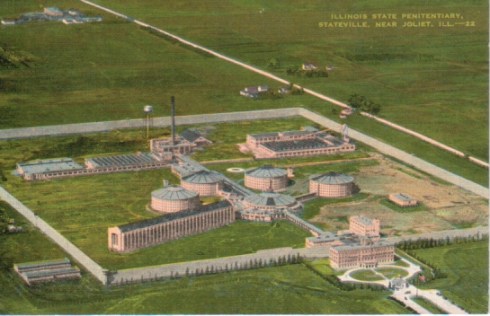
Postcard: Stateville Penitentiary, near Joliet, Illinois (ca. 1930s).
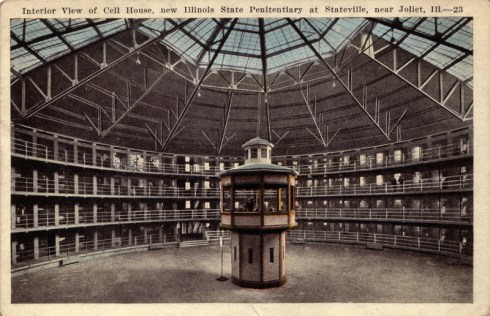
Postcard of an American panopticon: "Interior view of cell house, new Illinois State Penitentiary at Stateville, near Joliet, Ill." Source: Scanned from the postcard collection of Alex Wellerstein. (Copyright expired.)
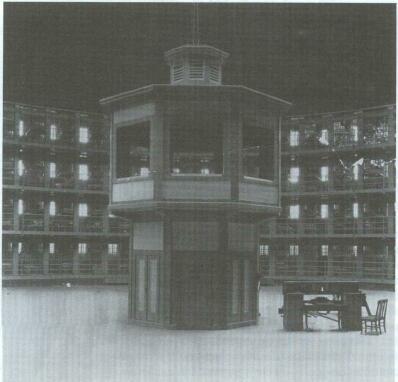
Photo of guard tower in round house at Stateville. Courtesy of Illinois State Historical Library. The second state prison was authorized at Joliet in 1857. It was built by convict laborers. That 135-year-old Joliet prison still houses more than 1,100 inmates. Meanwhile, Stateville. prison, also in the Joliet area, opened for business in 1917.

Inmates at Stateville Penitentiary in 1957. (Sun-Times News Group file photo)

Prison guard in a security tower, Stateville Penitentiary, Joliet, Illinois, USA. © Underwood Photo Archives / SuperStock
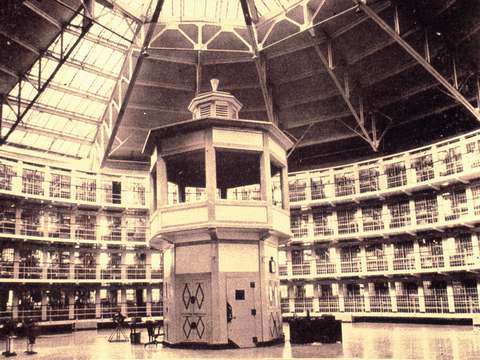
Panoptic guard tower at Stateville Prison, Stateville Prison (US Bureau of Prisons, 1949, p. 70), 1940s
At this years Les Rencontres d’Arles Photographie Festival the official photographs of the French prison inspectorate make up an exhibition entitled Behind the Walls of Cliche.
The independent French prison inspectorate (contrôleur général des lieux de privation de liberté) is nominated for six years and during that time he cannot receive any instruction from any authority; he can be neither removed nor renewed; and he cannot be prosecuted for his opinions he formulates or for the actions he carries out in his functions.
Currently, the director is Jean-Marie Delarue (here’s an interview with him about the state of French prisons).
Delarue’s team take photographs as documentation as they tour France’s prison system and it is these images that are currently on show at Rencontres d’Arles.
To my mind, this is a truly unique exhibit. I know not of any other arts festival that has put front-and-centre the administrative photography of a working independent or government agency overseeing prisons.
BLURB FROM LES RENCONTRES D’ARLES SITE
Sixty thousand detainees in French prisons: surely the problem can’t be all that hard to solve!
The Rencontres, in their own way, are part of the media, and this exhibition based on the report of France’s Inspector General of Prisons, Jean Marie Delarue, shows just how the world of French gaols, far from being an aid to social reintegration is, rather, an insult to the human condition. This is a call to look beyond the standard ideas about prison.
The exhibition also demonstrates the limitations of photography, which cannot convey the nuances of everyday unhappiness in prison. In a photo a TV set, a workshop and a library seem to offer possibilities which in fact are non-existent for most prisoners, and certainly not available on a regular basis. The rules of hygiene and safety are flouted every day, the psychological stresses are chronic, and the laws regarding the minimum wage and access are broken by the state itself. None of this is visible in a photo.
Pictures of a new prison seem to suggest a solution; but the image doesn’t tell you that new prisons have a higher suicide rate than old, dilapidated ones. Three people in a cell is something you can see; but what you don’t see is that one inmate standing means two lying down, because there’s nowhere to sit. And with prisoners spending 22–24 hours a day in their cells, it’s easy to imagine their physical and psychological state.
This is definitely not photojournalism, but rather an alarm signal regarding one of democracy’s least well known instruments.
François Hébel, exhibition curator
Excerpt from Law no. 2007-1545 of 30 October 2007:
’The Inspector General of Prisons is an independent authority whose duty it is, without prejudice to the prerogatives attributed by the law to the judiciary or jurisdictional authorities, to monitor the conditions of incarceration and transfer of persons legally deprived of their freedom, so as to ensure respect for their fundamental rights.
Within his field of responsibility, he takes no orders from any authority… He cannot be relieved of his duties before his term has expired… The authorities in charge of places of imprisonment cannot oppose a visit by the Inspector General except for grave, imperative reasons relating to national defence. The Inspector General may demand from those authorities all information and documentation required by the carrying-out of his mission. In the course of his visits he may speak, under circumstances guaranteeing the confidentiality of what is said, with any person whose participation he sees as necessary.
At the end of each visit the Inspector General makes known to the relevant ministers his observations regarding the state, organisation and functioning of the site visited, and the condition of those imprisoned there… Each year the Inspector General submits a report to the President of the Republic and to Parliament. This report is made public.’
The 2009 report is published by Dalloz.
PREVIOUSLY ON PRISON PHOTOGRAPHY
I’ve noted French prison photography before. From Jean Gaumy, the first photojournalist in the French prison system to contemporary artist Mathieu Pernot; from the archives of Henri Manuel to portraitist Phillipe Bazin; and to the recent exhibition Impossible Photography – artistic survey of French prisons.
– – –
Of course, if you want to get really involved check out Melinda Hawtin’s French Prison Photography graduate work.
France even has its own National Museum of Prisons!
– – –
Thanks to Yann Thompson for the tip!

Always lots of good stuff on MediaStorm and many of the projects from their workshops and training belie the relative “inexperience” of their creators.
Exodus tells the story of Diana Ortiz, 45, who spent over half her life in prison. She says it saved her.
Diana dropped out of high school at 18 to live with a man twice her age. To pay for their drug habit, her boyfriend devised a scheme to lure a man into a secluded Coney Island parking lot and rob him.
In the early hours of August 20, 1983, the robbery veered off-course and two men were shot. One was killed. Though Diana was not at the scene of the shooting, she was sentenced to 17 years to life for her role in the murder.
She served twenty-two and a half years.
While behind bars Diana earned her master’s degree, developed a strong identity and self confidence. She is now an inspiration for other inmates, helping them to rebuild their lives.
This workshop story was inspired by the New York Times story about Diana Ortiz titled Convicted of Murder as Teenager and Paroled at 41. (Which I mentioned here on PP before)
Credits
Photography, audio and video: Laurentiu Diaconu-Colintineanu, Natasha Elkington, Leah Thompson
Producer: Jennifer Redfearn
Executive Producer: Brian Storm
Graphics: Tim Klimowicz
Transcription: Avi Tharoor-Menon

 Prison Photography