
You are currently browsing petebrook’s articles.
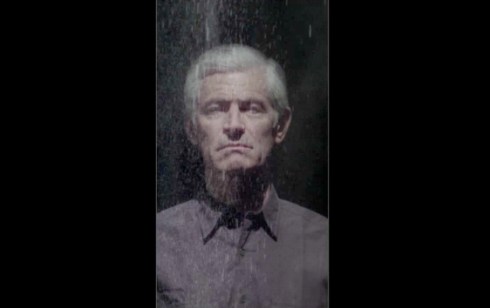
Screengrab. ‘James Nachtwey, a portrait of the artist’ (9 minutes). © Asa Mader
Get past the fact that Asa Mader is repeating Bill Viola’s tricks, my response to this installation video is that James Nachtwey is serious, and he is silent, and there’s some stuff falling to the ground around him.
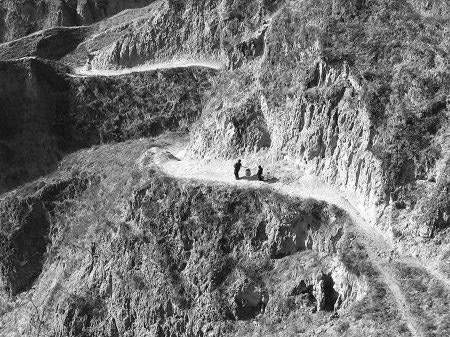
The original photo of Ren Shichen's work.

Zhang Ziping's revised photo of Ren Shichen's work.
Zhang Ziping, the winner of the 2010 “Human and Water” international photography competition was stripped of his title after he plagiarised the work of Ren Shichen.
“I never entered the competition, how could my work get the top award?” Ren was astonished to see the photo he took three years ago in Gansu’s Zhengning County listed among the winning photos on the Internet. “He (Zhang Ziping) downloaded my work from the Internet and changed it with image processing software.” (Story)
Crude, but it makes you wonder how often – across the globe – these types of antics occur!?
Afghanistan is a very poor country, placed 174th out of 178 in the Human Development Index. The literacy level is 50% for men and 20% for women and the average life expectancy is below 44 years. Only one in three people have clean drinking water and life expectancy is 43. It has suffered many years of war. This is a very challenging environment in which to introduce a formal, state-wide justice system based on written texts, record-keeping, databases (and a regular supply of electricity) and all the appropriate protections for the rights of suspects, defendants and prisoners that accompany such systems in the West.
Source: Alternatives to Imprisonment in Afghanistan. A Report by the International Centre for Prison Studies (February 2009)
Manca Juvan, the subject of a post on Sunday, also photographed in an Afghanistan women’s prison. Juvan is only one of several photographers to take on this subject matter – Anne Holmes, Andrea Camuto, Katherine Kiviat, and David Guttenfelder being others.

The entrance door to Walayat Women's Prison, Kabul. Currently 33 women and 16 children are kept imprisoned. © Manca Juvan, May, 2003
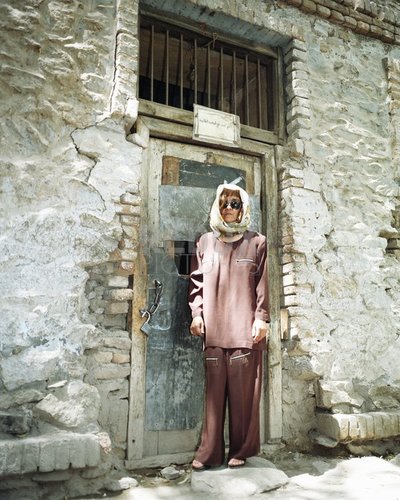
Suhila Fanoos, 25 years old, Walayat women's Prison guard standing in front of the Women's prison holding 32 female inmates for crimes such as skipping home and leaving their family responsibilities. Sign above her head reads "Prison of Women". Photographed in Kabul, Afghanistan July, 2003. © Katherine Kiviat/Redux Pictures
HOW TO APPROACH THESE PHOTOGRAPHS?
The portfolios of Juvan and her contemporaries had me thinking. Many photographs were from 2003 or later in 2007/08 (due to media coverage of allegations of abuse or the construction of a new prison).
I’d like to present a few images, but am I only comfortable doing so if I also provide an accurate summary as it is NOW for women imprisoned in Afghanistan.
Firstly, I just like to point out the two pairings above and below. Kiviat and Juvan (above) both show the same portal at Walayat women’s prison, Kabul. In 2004, one year later, Kiviat also photographed this door which is the same as that shot by Andrea Camuto (below). Camuto identifies the door as belonging also to Walayat women’s prison.
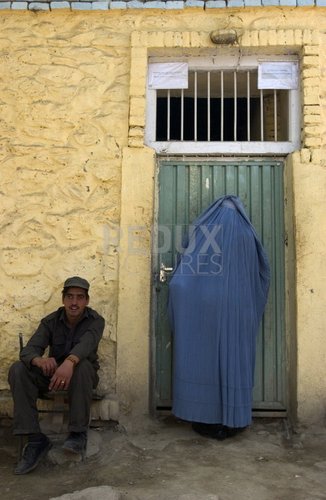
The women's prison in Kabul, A woman speaks to female prisoners through the peep hole of the prison door. © Katherine Kiviat/Redux. 2004
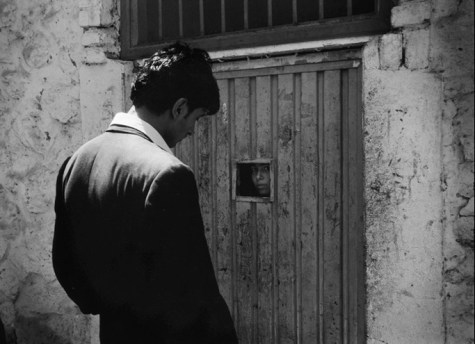
Visitation, Walayat woman's prison, Afghanistan © Andrea Camuto
WAYALAT WOMEN’S PRISON
Wayalat still operates as a prison, but it no longer houses female inmates. A 2003 IRIN report detailed the dire need for humane facilities at Wayalat:
‘According to Lt-Col Habibuallah, in charge of Wolayat prison, the present building with its 17 rooms and four toilets was built some 90 years ago to accommodate up to 200 people. “There are 511 men and 32 women imprisoned here,” he said. There were no categories for offenders and the accused and convicted were generally mixed together, including some inmates on death row. “There are no basic facilities, no ambulance, no proper medicine and health care, and the increasing problem of overcrowded rooms is a tragedy,” Habibuallah said. Even the 35 staff members lacked access to a toilet and were forced to sleep on the roof or in the courtyard at night. “We have worse conditions than the prisoners,” he claimed. Women inmates fare slightly better. Located in a separate building, the painted cells house between five and seven prisoners each, but the lack of adequate health care is felt more by the detained women.’
Manca Juvan‘s work focused on the women and their children in Wayalat. Katherine Kiviat‘s work is part of a larger body of work describing the new roles and careers (including that of prison guard) of women in Afghanistan. The collection is called Women of Courage.
Andrea Camuto‘s work, shot in 2005, 2007 & 2009 followed returning refugees and the “forgotten” women of Afghanistan to the cheaper countryside rents, to the hospitals … and to the prisons if necessary.
The common theme for these photographers is the injustice suffered for many women whose imprisonment is based upon judgement for “moral crimes” and “bad character” including sentences for adultery (which includes inappropriate acts both in and out of wedlock), being drunk, wanting a divorce or even just leaving a husband for a night to stay with family after suffering a beating.
PUL-E CHARKI
On the outskirts of Kabul, Pul-e Charkhi is Afghanistan’s most notorious prison. It has been used by every regime to house it’s enemies.The unearthing of mass graves in 2002 confirmed the Soviets’ use of the site for mass-killings and the Americans adopted and expanded the prison to house Taliban fighters. In 2006, there was a major rebellion and riot by the prisoners.
Anne Holme‘s work from Pul-e Charkhi was conducted in 2007. Holmes’ story is that of the struggle to raise children inside the walls, the quashing of legal rights and despite the “warden’s genuine concern” the inability of the justice system to provide fair hearing for the women.

Pul Charki's womens prison just on the outskirts of kabul is rough living. Inmates do not receive adequate medical attention, they cannot send or receive mail, and many of the women there have yet to learn the crime with which they have been charged. © Anne Holmes
In April 2008, David Guttenfelder visited Pul-e Charkhi. His work, Kids in Prison reveals disturbing figures – “There are 226 young children in Afghanistan’s prisons, including many who were born there. They have committed no crime, but they live among the country’s 304 incarcerated women.”
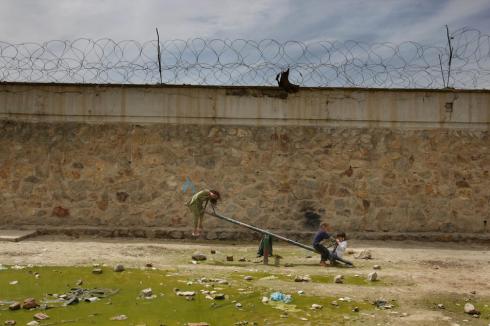
Jamila, left, plays on a seesaw with children of other female inmates on the prison yard of Pul-e Charkhi prison in Kabul, Afghanistan April 17, 2008. Jamila, age 7, and her mother, Najiba, who is serving a seven year sentence for adultery, have been in prison for 10 months. © David Guttenfelder/AP
Pul-e Charkhi was a brutal living environment. This report details inadequate sanitation, frigid winter temperatures, rape and humiliation.
In the same month that Guttenfelder photographed – April, 2008 – the women and children of Pul-e Charkhi were moved to a new purpose built facility. Recognising the special requirements of female prisoners, Badam Bagh was constructed by the United Nations Drugs and Crime Office (UNODC) with the financial support of the Italian Government.
The two videos below offer some comparison between the two facilities:
PUL-E CHARKHI
BADAM BAGH WOMEN’S PRISON
LYSE DOUCET AT BADAM BAGH
To bring us right up to date, the best reporting is not that in the photographic medium, but straight news reporting. Lyse Doucet‘s report for the BBC is a must see.

(I have applauded Doucet’s journalism in the mens’ wings at Pul-e Charkhi before).
At a moment when the White House is to open talks with the Taliban and the media is comfortably using the phrase “unwinnable war”, it is perhaps responsible to consider the lives of those caught up in the broken justice system of Afghanistan. The prisons of Afghanistan are one of the last priorities for a society that is war torn and divided. Afghanistan hasn’t got the resources to support the basic human rights of those it incarcerates when the rights of those outside prison walls cannot be guaranteed.
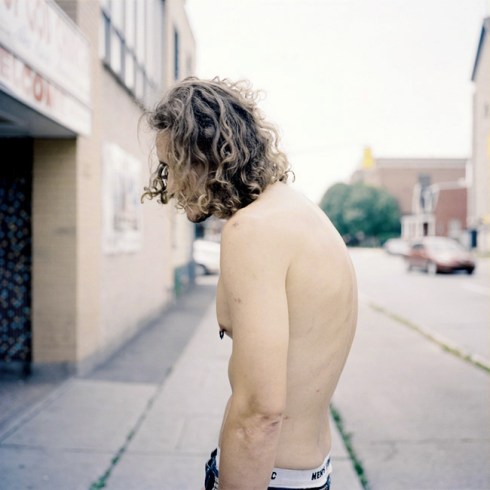
Joce, Ottawa, 2010 © Tony Fouhse.
Despite being four years deep in his project USER, Tony Fouhse is more confused than ever by what it all means.
I recommend you read his latest blog post. Fouhse talks about beginning his fourth and final year on the project, subjects who have died, and the gratitude of one of his subjects now she is clean.
The post is a reflection and it is as much for him as it is for us.
USER
I hope that you are all aware of his work photographing the crack addicts in Ottawa – not forgetting the interviews, the coverage, the love and the controversy that follows any project such as this that positions addicts as the subject of fine art.
So, I want to say a few things.
– Tony has been very open to discussion and criticism of his work. He will also defend his work with vigour, as often criticism leveled at his work is – in some guise – puritan criticism of photography in general.
– Tony’s subjects love his work; many go to the USER exhibition openings. Dawn was one of Tony’s subjects; her letter is included in Tony’s latest blog post: “I would like the picture so I can remind myself that I do not want to look that horrible or be that desperate again. I really do appreciate your work and all that you do. I have followed your work since I got clean. Please let me know if you have a copy of the picture.”
– Tony has shown real commitment to his process and the subjects. Yes, he is trying to construct a meaningful “complex sequence”, but that doesn’t mean he is manipulating his subjects, dropping in and out of their difficult lives. The best illustration of this is the map below. Every portrait over the past four years he has shot on this same corner. He knows all these men and women.

Portfolio at his website: http://tonyfoto.com
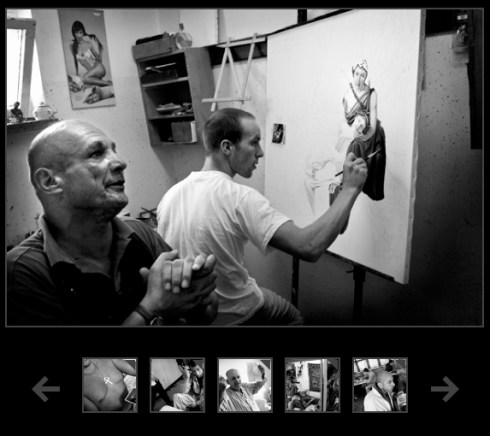
I failed in identifying a Slovenian photographer for the Photographers World Cup listing, until Yasmina Reggad suggested Manca Juvan. (I also failed with Paraguay, but more on that in time).
Juvan photographed Dob, the oldest and largest prison in Slovenia (built in 1963).
Dob has the unfortunate problems of many large prisons – overcrowding, inadequate sanitation, high-rates of infectious disease, violent & non-violent offenders jointly housed and the intractable hierarchies of prison culture.
Dob prison was built according to a new penology in Slovenia, which prioritised management of – as opposed to rehabilitation from – anti-social behaviour:
” The main goal of Dob prison was and still is the accommodation of a larger “aggregate” of dangerous offenders who have to serve long term sentences. The prison has met the particular security technical standards (high walls, wires, electric current, a buffer area, dogs, etc.). Treatment programs of inmates within the prison exist, and they are implemented, but the clear priorities in Dob prison are the control and security (Brinc and Petrovec, 2001).”
(Source: ‘Overview of Inmates’ Treatment in Slovenia’ by Danijela Frangež & Jerneja Šifrer. VARSTVOSLOVJE, Journal of Criminal, Justice and Security, Year 12, no. 2, pp. 217-234.)
A STORY NEEDING MORE THAN PHOTOGRAPHS
The portfolio is all too brief. Juvan works hard to focus attention on the individual inmates and the activities they choose to fill their time; it is respectful work but I feel the series just falls short. I suspect if Juvan had had longer in Dob prison she could’ve really teased out some more stories.
This is the type of photoessay that would benefit hugely from audio or multimedia components. If it is appropriate/needed, there’s no excuse now for a photographer to not include audio in his or her online portfolio (just ask duckrabbit).
In terms of “presenting photography on a computer”, I think user expectations and internet publishing tools limit the advanced reflexivity Joerg is championing. Between user-demands and web-tools, which will develop most rapidly to force development in the other? It’s time we start demanding more.
I am toying with the idea of listing my 100 favourite (online) digital photography archives, but museums, universities, historical societies and Flickr keep moving the goal posts. I see a new archive virtually every week.
If I stop to think what all this digitsation means, I suspect I’ll miss the boat on just enjoying the documents of times past.
The National Library of Scotland has just joined Flickr Commons, and this set of Edinburgh’s South Side probably pushes out one of the entries on a Flickr Commons top-ten article I penned last year.
It’s good that the drive toward digitisation and the “competition” (as I’ve defined it) is ongoing among these archives.

THE SKINNY
“The National Library of Scotland joined the Flickr Commons on July 13, 2010, with over 2,000 photographs, focusing on a collection of official British photography from the First World War. A smaller but equally rich set is chosen from a survey of the South Side of Edinburgh in 1929, photographed by Alfred Henry Rushbrook. And along with the letter ordering the massacre at Glencoe, is the last letter of Mary, Queen of Scots.”
(via)
Recently, I’ve been focused on photography a lot. The distraction from prisons is mostly due to the great writing and comment I read daily on the photography blogs I respect.
It occurred to me that the names of the blogs may stick longer in the memory than the names of the bloggers themselves (which might be the intent … and the branding, possibly?).
Nevertheless, I updated the hyperlinks down the left hand side to include the bloggers’ names and copy a list below.
>Re: PHOTO (Peter Marshall)
(Notes on) Politics, Theory & Photography (Jim Johnson)
[The Incoherent Light] (Darren Campion)
100 Eyes (Andy Levin)
1000Words (Tim Clark)
2point8 (Michael David Murphy)
40 Watt (Shawn Records)
5B4 Books (Jeff Ladd)
A Photography Blog (Rachel Hulin)
After Photography (Fred Rictchin)
American Suburb X (Doug Rickard)
Amy Stein
Asian Photography Blog (Yaohong)
BagNewsNotes (Michael Shaw)
Bill Eppridge
B (Blake Andrews)
Bite! Magazine (Margo de Beijer, Amanda Calluf, Sophia Greiff, Janique Helson)
British Photographic History
Buffet (Andrew Phelps)
Carlagirl photo (Carla Williams)
Colin Pantall
Conscientious (Joerg Colberg)
Consumptive (James Luckett)
Contact (Anna Stevens & Emily Graham)
Dektol (Danny Lyon)
Digressions (Daniel Shea)
Dodge and Burn (Qiana Mestrich)
Drool (Tony Fouhse)
Duckrabbit (Ben Chesterton, David White & Ciara Leeming)
Dvafoto (M. Scott Brauer & Matt Lutton)
En Foco (Miriam Romais)
Exposure Compensation (Miguel Garcia-Guzman)
Exposure Project
Eyecurious (Marc Feustel)
Fifty Crows
Food For Your Eyes (Nathalie Belayche)
Fugitive Visio (Evan Mirapaul)
Hamburger Eyes (Ray Potes & friends)
Harvey Benge
Humble Arts Blog (Grant Willing)
Ian Aleksander Adams
ILOVETHATPHOTO (Saskia Hoogerhuis)
John Edwin Mason
Lenscratch (Aline Smithson)
Lens Culture (Jim Casper)
L O Z (Laurence Vecten)
Manchester Photography (Mark Page)
Mrs. Deane (Norman Beierle & Hester Keijser)
Muse-ings (Tim Atherton)
New Photographics (Jonathan Worth)
No Caption Needed (Robert Hariman & John Louis Lucaites)
On Shadow (Nicholas Calcott)
One Way Street (Bernard Yenelouis)
Photogaphs Do Not Bend (Sherry Cuttler)
Photographers Speak (Dean Brierly)
Photographylot (Tom White)
PhotoPhilanthropy (Eliza Gregory)
Raw File: Wired
Raw Take (Mike Davis)
Reciprocity Failure (Stan Banos)
Shane Lavalette
Simon Sticker
Slightly Lucid (Aislinn Leggett)
The Photography Post (Rachel Hulin & Kate Steciw)
The Spinning Head (Asim Rafiqui)
The Visual Student (Kevin Martin)
The Year in Pictures(James Danziger)
Third Nature (Dalton Rooney)
ThisPhotoThat (This, Photo and That)
Too Much Chocolate (Jake Stangel & friends)
Truth in Photography (Robert Semeniuk)
Two Way Lens (Michael Werner)
Verve Photo (Geoffrey Hiller)
We Can Shoot Too (J. Wesley Brown)
We’re Just Sayin (Iris & David Burnett)
What’s Going On? (Dawoud Bey)
What’s The Jackanory? (Andrew Hetherington)
Zoe Strauss

Cartoon by David Walker ©
Remember these names, fame! And, I am sorry to do this, but let’s hear it for the blogs! Hope that tune stays in your head all day.
Even prisons that incarcerate children are violent.
In the UK, following a five year legal battle families have successfully (under Freedom of Information Act) had released a document titled ‘Physical Control in Care’. It is a manual for private prisons, authorising staff to:
– “Use an inverted knuckle into the trainee’s sternum and drive inward and upward.”
– “Continue to carry alternate elbow strikes to the young person’s ribs until a release is achieved.”
– “Drive straight fingers into the young person’s face, and then quickly drive the straightened fingers of the same hand downwards into the young person’s groin area.”
Or in other words, authorised child abuse. (Story)

 Prison Photography