
You are currently browsing petebrook’s articles.
As a follow up to yesterday’s post on Deborah Luster’s work One Big Self, I encourage you to listen to her speak about the project with The Kitchen Sisters. The interview, part of The Hidden World of Girls series focuses on Luster’s self rehabilitation through photography, the relationships she developed with female prisoners and the direct benefits the portraits brought to the incarcerated women.


This is macabre. I doubt many conservators have dealt with the technical issues of this “print” medium.
Foto8: “The tattoo collection at the Department of Forensic Medicine at Jagiellonian University in Krakow, Poland consists of 60 objects preserved in formaldehyde […] The tattoos were collected from the prisoners of the nearby state penitentiary on Montelupich Street as well as from the deceased on whom autopsies were performed.”
The tattooed skin was preserved in order to decipher the codes within the images:
In the 1970s, the CSI Department of Militia Headquarters in Warsaw published a special document only for prosecution agencies in which they analysed 2300 tattoos, including those from the collection at Jagiellonian University. For over four years, the researchers looked at prisoners, soldiers and criminals who served sentences in Czechoslovakia, Yugoslavia, Germany and the USSR. A catalogue that precisely described the meanings behind certain tattoos was created.
It should be said, figuring out what messages are involved in prison tattoos is common across all nations, systems and eras. Although, this is the first collection I know of that separated the tattoos from corpses.

ONE BIG SELF
I have told many people in person that Deborah Luster’s One Big Self is the most impressive prison photography endeavour to date. I have been slow to state as such on this forum because the scope, details and inspiration of the project are so overwhelming.
Every portrait deserves an essay, but that obviously is not possible. Rather than delay any further, my aim here is to present many of Luster’s portraits, describe the bare facts, and provide some further resources to understand the work.
THE FACTS
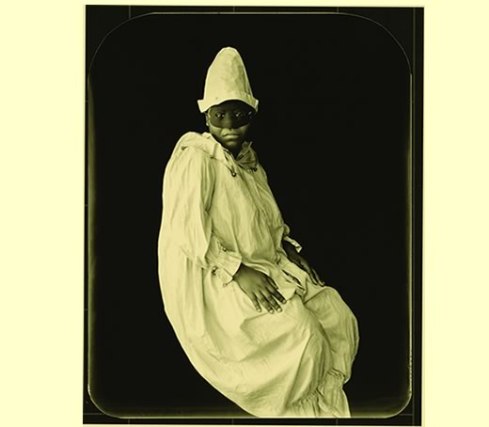
Completed between 1998 and 2003.
Portraits taken in many different prisons – mens and womens facilities; minimum to maximum security throughout Louisiana; and with different levels of supervision.
Tens of thousands of portraits taken.
Luster estimates she gave away 25,000 portraits to prisoners over the course of the project.
Luster worked fast – 10 to 15 portraits per hour. At a point working in sheer volume became the only reasonable way to respond to the size of the prison population with which she was engaged.


BACKSTORY
Luster got involved in this longitudinal study through a chance request. Luster’s emotional standing at the time of beginning was – is – atypical and unexpected.
Luster’s mother was murdered in 1988; “Although I was interested in photography prior to that time, I didn’t study or practice it. I began photographing in response to her murder.”
Luster did not deliberately go in search of the subject. In 1998, she was driving near Lake Providence, Louisiana when she came upon East Carroll State Prison Farm. She literally knocked on the front gate. There and then Warden Dixon gave her sanction to begin the endeavour.



VIDEO & AUDIO
SFMoMA has done us a great service in recording and publishing the following video shorts.
In four videos, Luster describes the ORIGINS of the project, elements of ACCIDENTAL PERFORMANCE, printing on ALUMINIUM PLATES, and comments on INDIVIDUAL WORKS.
Remarkable tales.


RESOURCES
Deborah Luster is represented by Catherine Edelman Gallery, who present the best online selection of her portraits.
Good background information is provided by Doug McCash of the New Orleans Times Picayune; David Winton Bell Gallery at Brown; and Grace Glueck of the New York Times.
In 2000, One Big Self was exhibited at the Center for Documentary Studies at Duke, providing an overview and gallery of the project.
INTERVIEW
The best in-print interview with Luster is included in recent publication, PRISON/CULTURE (City Lights), which I reviewed two months ago.
THE BOOK: ONE BIG SELF
The book is at a premium now and you’ll struggle to find it for under a $100. It is published by Twin Palm Press.

IMAGE/WORDS
Luster collaborated with writer/poet C.D. Wright. Luster’s images and Wright’s poetry are a great complement to one another. Listen to Wright read her poetry from the project.
A PROJECT ONGOING
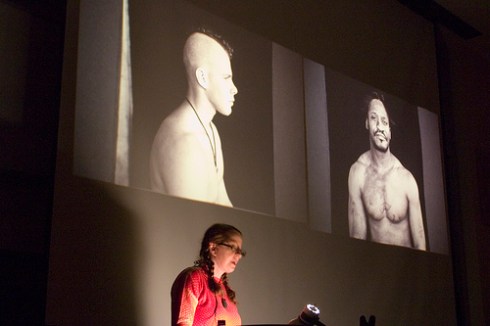
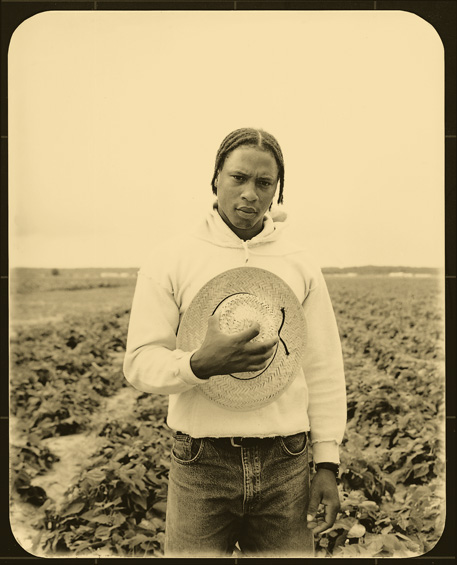
Despite the passage of seven years since the projects official closure, Luster’s career continues to be defined by her ground-breaking, genre-defining project. Her lectures are vital in that she describes the many facets of the project – from security arrangements, to gear (she generally worked with digital), to processing (she made use of tintype imitation technique printing onto small metal sheets), to the specifics of exhibition.
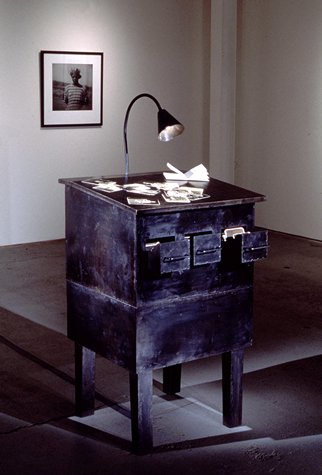
The image below shows a steel cabinet and lamp (containing 288 silver-emulsion aluminum plates) as it was displayed at the San Francisco Museum of Modern Art and other institutions. Luster wanted to create a tangible viewing experience in which the audience were required to handle the archive of human life in the same way the state of Louisiana organised and disciplined the bodies under its supervision.
In the video (below) Luster talks us through the senses and noises of the exhibit design.

Kenneth Clarke, the combative old school Tory, who is Justice Minister in Cameron/Clegg’s new UK coalition government has outlined his plans for major prison reform in his first major speech since taking office.
(Before preceding any further, I should say that beyond all the UK news outlets you should always consult John Hirst‘s opinion at Jail House Lawyer blog as regards the politics of prisons and the perceptions of prisoners & crime in the UK. He’s a bit irreverent but he’ll deliver the silenced opinion.)
RADICAL, EH?
From the BBC: Justice Secretary plans ‘radical’ prison policy change
Of course, anything is radical compared to then justice minister, Michael Howard taking a head-up-his-own-ass approach and declaring in 1993 that “Prison’s work”. Let’s see if Clarke and the Tories can undo 17 years of disastrous policy, which it is fair to say Labour made their own during their time in government (1997-2010)
PHOTOGRAPHY
I’ve looked at photographic projects in the UK before, particularly at the work of Edmund Clark, Casey Orr, the iconic photography of Ged Murray and Don McPhee at Strangeways and even young offenders using Facebook from behind bars.
WRITING
For the best account of prisons during the past disastrous 20 years, read Sir David Ramsbotham’s Prisongate. Ramsbotham was the independently-appointed Chief Inspectorate of UK prisons (1995-2000). His findings were shocking and surprised many who were deep in the British culture of corrections. (Ramsbotham offers his opinion in the BBC piece linked to here.)

Neger (Nuba), 1964, 145 cm X 200 cm, Oil on canvas, Catalogue Raisonné: 45, Gerhard Richter
The Richter image above is NOT A PHOTOGRAPH, nor a video still.
Matt Niebuhr, one of the best thinking bloggers on art & photography, has beautifully presented the back story to this OIL PAINTING. It’s a must read.
When Richter released his Overpainted Photographs (2009) last year, I scoffed. I still do. I think them lazy. At least now, I can appreciate part of the reason he got there.
In terms of the intersection of painting and photography, Richter’s earlier works, such as Neger (Nuba), are far more interesting and – it goes without saying – technically superior.
Clearly, Alec Soth does know what he is talking about … and he talks a lot of sense … and he talks often.
Last week, however, Magnum Photos attributed this quote to Soth and twatted it into the webiverse:
“It’s not about making good pictures anymore. Anybody can do that today – it’s about good edits…”
Thus a medium-sized discussion ensued on the Fraction Mag Facebook page covering the need for outside perspective, audience expectations, technologies beyond those of cameras but of distribution also, etc, etc …
I wanted to know why and when Soth said this and in what context he made the statement. I emailed him. Here’s his response:
Dear Pete,
I don’t when or in what context this comment was made or if it was made at all. Nor do I know who posted it. But this itself is quite telling, isn’t it? Are people interested having serious discussions about miscellaneous, fragmentary tweets? I would much rather talk about a fully realized interview or essay. In a similar way, I’m much more interested in edited projects than I am in isolated images.
Best,
Alec
I don’t know if we should now discuss this fragmentary correspondence or just leave it alone?
Alfie Brooks (not his real name) is the focus of Amelia Gentleman‘s recent Guardian article. Photographer Tom Wichelow spent 12 months with Alfie documenting his life:
During those 12 months, Alfie was sentenced to eleven days in prison (for stealing 400 balloons). It was his first stay in prison. Alfie intends it to be his only stay in prison. He was bored.

A coffee table at his flat, on which are instructions on how to use the curfew tag he has to wear. © Tom Wichelow
To the journalist, Alfie is simultaneously endearing and frustrating; he delivers pearls of wisdom and then childish logic. More startlingly, sometimes the two are the same – and we, the reader, need to rethink our perceptions and expectations of a younger generation without the same future-oriented behaviours we value and reward.
Alfie is affable and greeted warmly by folk about his hometown. He isn’t violent and has never stolen from an individual, only shops. It is a code he justifies. He has also smoked marijuana for as long as he can’t remember:
AMELIA GENTLEMAN
For me, Gentleman’s piece is not a ground-breaking piece of journalism, but it is unique. It takes the time to look at a young life that could be the norm for more young lives than we’d like to admit. It really spells out for us the drifting uncertainties of life for youth who’ve opted out of formal education, but are still bright, articulate, playful and “clear with ambition”. Gentleman has a fondness and hope for Alfie which is appropriate and understandable.
TOM WICHELOW
Gentleman’s piece is well supplemented by Tom Wichelow’s photo essay, A Year in the Life of Alfie Brooks. His year long study of Alfie is a nice counterpoint to other work in his portfolio, notably his work on CCTV in the Whitehawk housing estate, Brighton, You’ll Never be 16 Again and 2000 portraits.
In October of last year, when I posted on Jane Evelyn Atwood‘s documentary work from women’s prisons across the globe, the pictures and the message were well received.
Better still, is to listen to Atwood discuss the her photography and its lessons for us all. Her common observation across all women’s prisons is women are very often incarcerated because of the men in their life. They are abused, pimped into prostitution, inducted into crime, manipulated emotionally, and backed into corners – from which retaliatory violence is their only remaining option.
Persevere through the irritating, news-studio interview formula and you’ll be rewarded with Atwood’s insight.
Atwood is currently campaigning on behalf of Gaile Owens, the only woman on death row in Tennessee. During the original trial Owens did not testify to the full degree of the domestic abuse she suffered; she wanted to protect her children from the truth. The result was the absense of mitigating circumstances during consideration of the verdict.
Owens’ execution date has been set for September 18th, 2010. A movement is underway to see her death sentence commuted to life without parole. Visit http://www.friendsofgaile.com/ for all the information on the case and the opportunity to sign a petition.
Atwood is emotionally submerged in her work, close to her subjects. Any distinction between photographer and subject maybe unwanted; “Gaile is a battered woman on death row. And she needs our support.” This statement, as with Atwood’s work, goes to the heart of the most urgent advocacy – that which is motivated by empathy and kinship.
Watch Atwood’s France24 TV interview.

 Prison Photography